
MGK’s full-torso blackout is going viral – but the real story is ink load, laser regret, and what 44 needles actually do to a chest
Key Takeaways:
» Machine Gun Kelly’s blackout torso tattoo likely involved 100+ ml of ink and a huge trauma load, which radically changes removal and healing.
» “44 needles” means large magnum groupings, not 44 individual needles puncturing at once all over the torso.
» Full blackout panels complicate MRI, laser removal, and long-term inflammatory risk more than small conventional pieces.
» Pigment chemistry, especially carbon black and certain colored pigments under the blackout, matters more than celebrity aesthetics.
» Artists need hard boundaries and documentation when doing large blackout/cover projects on high-profile clients.
1. What Actually Happened With MGK’s Blackout Torso?
Machine Gun Kelly just unveiled a massive full torso blackout tattoo that covers most of his front, replacing or burying a big chunk of his previous work. Multiple outlets report the piece was done by blackwork specialist Roxx and that it “took 44 needles” to complete, with the entire chest and abdomen now essentially a black panel. A recent roundup from *The Hustle* calls it a “massive (like, ‘it takes up most of his torso’ massive) new tattoo… that apparently took 44 needles to complete, and covers much of the ink he already had,” and that tracks with what we can see in the photos from around the artist community.
Let’s decode that “44 needles” line, because that’s where the public always gets it wrong. No, they did not run a single 44-needle Franken-mag over raw skin for hours end-to-end. In actual studio terms, that quote almost certainly refers to magnum configurations (e.g., 9–23 magnum) used across the piece, not one 44-stacked bundle. Modern blackwork torso projects are typically done with a mix of curved magnums and tight liners, switching groupings as you move from broad fill to edge cleanup and scarred areas.
Why does this matter? Because the needle geometry defines the trauma profile. A big mag at the right voltage and hand speed can deliver a massive pigment load with less vertical tearing per square centimeter than a small liner repeatedly chewing the same area. If you’ve ever studied the relationship between needle geometry and dermal trauma, you know this is where most “brutal” looking sessions are actually being managed smartly: big tools, efficient passes, controlled depth.
From what’s visible, MGK’s piece looks like dense blackwork over existing color and linework. That means we’re not just talking about one ink layer – we’re talking about a sandwich of prior pigments plus fresh carbon black, compressed into the same dermal real estate. That has real consequences for removal, MRI, and long-term reaction risk, and that’s the part of this story nobody on TikTok is explaining.
2. The Real Numbers: Ink Load, Trauma, and Why Blackout Is Not “Just a Big Tattoo”
For a torso that size, fully saturated, you’re easily looking at 80–150 ml of black ink buried into the skin, depending on dilution and passes. That’s not a theoretical number; it lines up with consumption rates you see in large back-piece blackouts actually tracked in pro studios and with ink deposition studies summarized in reviews like this clinical overview of tattoo adverse effects and ink content. A normal mid-sized tattoo might involve a few milliliters; blackout panels are a different scale of exposure.
More ink means more of everything that matters clinically:
- More pigment particles in lymph nodes. Carbon black from tattoos routinely ends up in regional lymph nodes; with blackout, you’re multiplying that load. The review above documents pigment migration and systemic inflammation, including granulomas and pseudolymphomas associated with long-term pigment residence in tissue.
- More area of acute trauma. The same paper lists immediate complications like edema, pruritus, papules, and nodules after tattooing, along with infection risks when barrier control slips. You multiply the square centimeters, you multiply the opportunity for problems.
- More chance of allergic or photo-induced reactions from underlying pigments that are now trapped under black. Red, yellow, and some green pigments are disproportionately involved in allergic reactions and photo-induced flares; dermatology data on pigment-specific reactions are very clear that red and yellow are the worst offenders.
Here’s how blackout stacks up against a typical “large but normal” piece in practical terms:
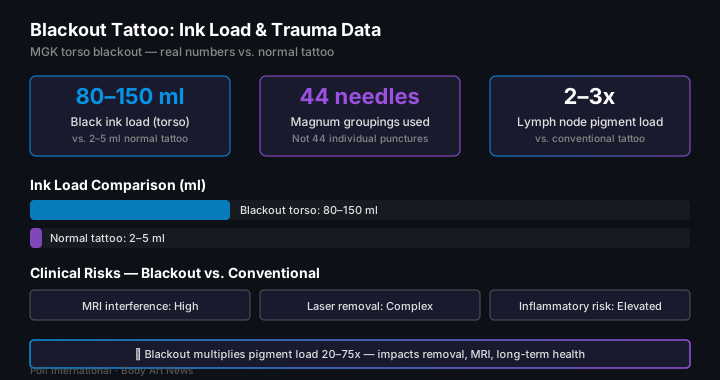
| Feature | Standard Large Tattoo (Backpiece/Chest) | Full Torso Blackout Panel |
|---|---|---|
| Typical ink volume | ~10–30 ml total pigment | ~80–150 ml dense black pigment |
| Pigment layering | Single or limited overlapping designs | Multiple older colors plus new carbon black layered in same dermis zone |
| Session structure | 3–6 sessions, varied areas | Often fewer but longer high-density fill sessions |
| Laser removal difficulty | Moderate; linework and color separable | High; dense carbon black absorbs energy and masks old pigment |
| MRI considerations | Local irritation possible in rare cases | Larger field of black pigment increases chance of heating sensation and artifact documented in MRI reaction reports |
| Long-term reaction risk | Localized to specific colors/areas | Systemic load is higher; any old “problem” pigment is now harder to access and diagnose |
| Visual reversibility | More pathways: partial laser, rework, negative space | Reversal usually means multi-stage laser plus possible scar camouflage |
The comment you hear from outsiders is, “He can always laser it off if he regrets it.” Technically yes – but it’s the single hardest scenario you can hand a removal specialist: multiple pigment types, dense carbon black over the top, large field size, and a client who works under hot stage lighting and travels. Melting multiple pigment systems with Q-switch or picosecond platforms in a chest-sized field is work measured in years.
Artists see this differently than fans. A blackout chest on a musician is not just an aesthetic; it’s a long-term engineering decision about that person’s skin surface. Once you commit to that much carbon black, every future laser choice, MRI scan, and skin reaction is altered.
3. Deep Dive: Pigment Chemistry, MRI, and Why Dense Black Is a Different Beast
Let’s talk chemistry, because that’s where this story really gets interesting.
Most modern black tattoo inks are based on carbon black, sometimes with small amounts of other agents for viscosity or flow. Carbon black as a material is not inherently evil – but it carries baggage:
- It can contain polycyclic aromatic hydrocarbons (PAHs), some of which are carcinogenic at sufficient doses. Regulatory reviews of tattoo inks have repeatedly flagged PAHs and primary aromatic amines (PAAs) as concern substances, especially in black and colored pigments that degrade under UV or laser into smaller toxic compounds, as highlighted in current toxicology research on tattoo inks.
- Azo pigments in older colored inks (especially reds and oranges) can break down into PAAs when exposed to UV or laser energy. When you bury them under blackout, you don’t remove that risk, you just make the system more opaque and harder to monitor visually.
On a torso like MGK’s, you likely have:
1. Legacy colored pigments with unknown brand and chemistry, some maybe 10–15 years old.
2. Modern professional carbon black, probably from a reputable blackwork-oriented brand.
3. Possibly some white or graywash used to modulate transitions.
From an engineering standpoint, that’s a mixed chemical system embedded into a large, critical area of skin. Long-term data already show granulomatous reactions, fibrosis, and systemic inflammation associated with tattoos, particularly where ink loads are heavy or colors like red are involved. The same review notes fibrosis and granulomatous changes as long-term effects, plus documented cases of uveitis, arthritis, and enteritis linked to immune reactions against pigment particles. When you go from “a few small pieces” to “full blackout chest,” your exposure profile changes dramatically.
Add MRI to the mix. The literature documents:
- Rare but real cases of burning, heat, or pain at tattoo sites during MRI. This can be due to ferromagnetic fragments in old pigments, but more commonly it’s local eddy current heating or RF interactions with conductive components in some inks. Large dense fields of pigment amplify this.
- Imaging artifacts that obscure underlying anatomy in heavily tattooed fields. On a chest, that can matter for heart, lungs, and mediastinal imaging.
In a full blackout like MGK’s, you’ve effectively built a giant RF-interactive patch on the torso. Most people will never feel a thing during MRI, but the risk envelope is wider than with a few small pieces. As more clients chase blackout trends, studios need to be blunt: this isn’t just a style; it’s a medical-design choice on your body’s surface.
There’s also the simple mechanical aspect of trauma. A blackout chest with magnums is still thousands of penetrations per square centimeter – and that’s where needle speed, taper, and hand discipline decide whether you get clean heal or orange-peel texture. If you’ve read up on how needle taper angle affects dermal cellular regeneration speed, you know shallow, polished tapers with controlled depth are the only way to do this sort of saturation without trashing the dermis. If you overwork a big zone like this, your client will wear that texture on every magazine cover.
Finally, there’s removal. Lasers see pigment, not regret. Dense carbon black absorbs the lion’s share of energy, leaving underlying pigments under-treated in each pass. That means:
- More sessions
- Higher cumulative fluence
- More chance of textural change and scarring
And remember, some pigments turn into more problematic molecules when hit with lasers. Carbon black itself can spall into smaller fragments that are more readily transported in the lymph, and azo pigments can crack into PAAs that have documented cancer and toxicity profiles in other exposure routes.
So when a client – celebrity or not – says “Black it all out, I want a reset,” the honest answer is: you’re not resetting; you’re compounding.
4. Patrick’s Note: What the Data Doesn’t Tell You About Regret and Overwrite
What I’ve seen in studios over the last twenty-plus years is this: regret rarely wants engineering; it wants erasure. That’s the emotional driver behind a lot of blackout projects. Clients don’t ask about laser cross-sections or lymph node pigment load; they just want the old story gone.
From a supply chain perspective, the weird part is that blackout is getting more technically sophisticated while the client conversations are getting dumber. Brands tune their blacks, we refine needle geometry, artists master buttery smooth panels – and the TikTok narrative is still “44 needles omg” like it’s some medieval torture device. The real risk isn’t the needle count; it’s the long-term pigment chemistry, the latent complications of heavy ink loads, and the fact that once you panel a torso in carbon black, future options shrink.
The other piece missing in this MGK discourse is documentation. Studios I trust on big blackout work keep ink lot records, pigment SDS sheets, and procedural notes on anything this large. Ten years from now, if there’s a reaction or a new regulatory restriction, that information is gold. If you’re an artist taking on a celebrity-scale blackout without a written record of ink brand, batch, and aftercare protocol, you’re building a high-visibility medical case study with your name on it and no paper trail.
5. FAQ: Technical Q&A
Q: Should artists treat full blackout projects with different consent and documentation than standard tattoos?
Yes. For any large blackout (chest, back, limbs), use an enhanced consent that explicitly addresses ink load, laser removal complexity, MRI considerations, and known pigment risks. Keep copies of ink SDS sheets, batch numbers, and session plans; this protects both client and studio if there are delayed reactions or future regulations.
Q: Is blackout safer if you remove or lighten old tattoos with laser first, then fill with black?
From a technical standpoint, staging removal first is usually the safer engineering choice. It reduces the total pigment stack, lowers the chance that problematic reds/yellows get trapped under fresh black, and gives the dermis recovery time before you re-traumatize with saturation. It’s more time and money, but biologically it’s a cleaner problem than trying to laser through a dense blackout over unknown older pigments.
Q: Does a full blackout chest meaningfully increase cancer risk compared to multiple smaller tattoos?
Current epidemiology does not show a clear, direct link between tattoos and systemic cancer, but toxicology data on PAHs, heavy metals, and PAAs in inks is strong enough that regulators are tightening limits. A blackout chest multiplies pigment mass and surface area, so if there is risk associated with cumulative load, you’re putting yourself closer to that line. At minimum, clients should understand they are choosing a higher-exposure scenario than a few scattered pieces.
Conclusion: Design the Skin Like It Has to Last 60 Years
MGK’s blackout chest is a perfect case study in how celebrity ink stories skip the part that matters: once the cameras go home, your skin still has to function. Full blackout panels aren’t inherently “bad,” but they are high-commitment engineering choices with long-term consequences for healing, lasers, MRI, and systemic pigment load.
If you’re an artist, treat blackout like a medical-grade procedure: documented inks, enhanced consent, staged planning, and a sober conversation about what this means for your client’s future body options. And if you’re the client, remember that covering regret in carbon doesn’t reset your skin; it just writes a denser chapter. For a deeper dive into how regulators are already reacting to these chemistry questions, read the breakdown of how evolving tattoo-ink regulation is reshaping studio risk and pigment choices.


