
Why TikTok’s neon UV ink tattoos are blowing up again, and what artists really need to know before they touch this trend
Key Takeaways:
» UV-reactive “blacklight” tattoos are trending again on TikTok and Instagram, but most viral designs are heavily filtered or shot under unrealistic lighting.
» Many “glow” inks are off-label repurposed industrial pigments, not purpose-designed biomedical materials, and often dodge proper testing or disclosure.
» The biggest real risks are delayed hypersensitivity reactions, photodegradation byproducts, and unreadable safety data sheets, not instant necrosis.
» Artists need a hard policy: no undocumented UV ink, full ingredient review, batch tracking, and clear consent that these pigments are experimental.
» If you wouldn’t inject that pigment into your own eye, don’t put it in someone’s skin, trend or no trend.
1. How we got here: TikTok neon fantasies vs. real skin biology
Over the last two weeks, “glow-in-the-dark tattoo” and “UV ink tattoo” clips have been all over TikTok and Instagram again, especially edits showing full sleeves that look like Tron armor under nightclub blacklight. Creators tag them as “glow tattoos” or “radioactive ink”, slice in some EDM, and suddenly you’ve got millions of views and clients walking into studios asking if you can “make it glow like that.”
The first problem: most of those pieces do not look like that in normal life. UV-reactive ink only “pops” under around 365–395 nm UVA from a blacklight, and the camera sensors plus editing apps aggressively boost saturation and contrast. Under regular daylight, many of these tattoos are faint, yellowish “ghost” lines at best. That gap between what the algorithm sells and what the skin can actually display is the same reality-check we hit when clients bring in hyper-edited white-ink tattoos that look like embossed Photoshop layers. I wrote about that optical scam in detail in the piece on why white ink tattoos almost never heal like the reference picture.
The second problem is chemical, not aesthetic. UV tattoos have been controversial since the early 2000s because a lot of early “glow” inks were literally repurposed fluorescent industrial or novelty pigments never designed to be injected in a living dermis. The FDA openly states that *no pigments are formally approved specifically for cosmetic tattoo injection*; pigments used in tattoo inks are borrowed from other industries like printing, automotive finishes, and plastics, and then suspended in carriers for skin use. The agency explicitly notes reports of inks using pigments found in *printer toner and car paint* as evidence of that gap between use and approval.
That doesn’t automatically mean every UV ink is toxic, but it does mean the regulatory “trust me bro” level is higher, because you’re combining two risk multipliers:
- A pigment class (fluorescent dyes, optical brighteners) that is photoreactive by design.
- A usage route (permanent intradermal exposure) that most of these molecules were never tested for.
When clients ask “is it safe?”, what they really mean is: “Does anyone have long-term human data on this exact pigment, in this exact carrier system, injected into the dermis for 40+ years, exposed to solar UV and then blasted with a Q-switched laser later if I remove it?” The honest answer right now is: No.
2. What the data actually says: reactions, regulations, and how UV stacks up
Let’s strip out fear-mongering and look at what we actually know about tattoo ink risks, then place UV-reactive pigments in that landscape.
Regulators and medical bodies already flag conventional inks as an unresolved safety problem. The FDA documents:
- Reports of bacterial and fungal infections traced to contaminated inks, including unopened sealed bottles, because “sterile” on the label doesn’t guarantee microbiological reality.
- Long-term issues like granulomas (immune nodules around pigment), keloidal scarring, and delayed allergic reactions, sometimes years after application.
- Pigments that include components like p-phenylenediamine (PPD), which can cross-sensitize people to hair dyes and other products later in life.
Now put UV inks next to standard pigments:
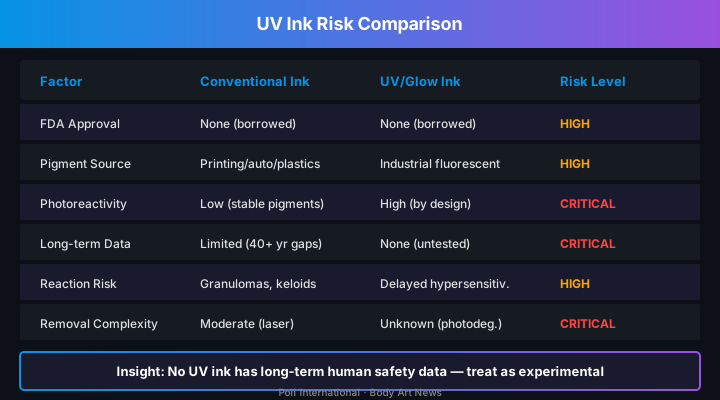
| Feature | Conventional Color Tattoo Ink | UV-Reactive / “Glow” Tattoo Ink |
|---|---|---|
| Pigment origin | Often industrial organics/inorganics, some cosmetic dyes; still not formally “approved” for injection | Frequently fluorescent dyes, brighteners, or proprietary blends with less dermatologic history |
| Regulatory clarity | Increasing scrutiny (EU REACH, upcoming US modernizations), widely used, more post-market data | Patchwork claims, often sold as “cosmetic” or “for artistic use only,” sparse long-term human data |
| Visibility in normal light | High; black, dark colors, and well-formulated brights read clearly | Often faint, yellowish or slightly off-white; many clients disappointed once healed |
| Photostability | Variable, but many modern pigments engineered for lightfastness | By design react to UV; risk of photodegradation into unknown byproducts is higher |
| Documented reactions | Allergic contact dermatitis, granulomas, photoallergy, infections across many colors | Fewer total reports (less market share), but case reports of pruritic, inflamed UV tattoos are out there; underreporting likely |
| Laser removal profile | Difficult but studied; multiple wavelengths and sessions, known risk of pigment fragmentation | Even less data: unknown breakdown products when fluorescent dyes are hit with high-energy pulses |
Notice what’s missing: there is no credible, large-scale dataset showing UV ink is a uniquely catastrophic category compared with everything else, but there is also no robust evidence that it’s “just as safe” as standard pigments. It’s under-studied, under-reported, and often under-disclosed.
From a materials perspective, fluorescent dyes are often larger polyaromatic systems or complex organometallic structures. Leave them in a living, oxygenated, UV-exposed environment for decades and you absolutely will get:
- Photobleaching, the ink loses brightness.
- Fragmentation, new smaller molecules, not present on the original SDS, forming over time.
If that sounds familiar, it’s because it’s the same chemistry behind why neon sign plastics and highlighter pen marks fade and yellow, except you’re not sanding those off, you’re asking macrophages and lymph nodes to deal with the debris.
3. Technical deep dive: what artists should demand before ever loading UV ink
This is where we get out of moral panic and into engineering controls. You can’t control TikTok, but you can control what you inject into a client.
If you’re going to touch UV ink at all, the minimum bar in a pro studio should look like this:
1. Ingredient transparency, or it doesn’t go in skin.
You need a full, legible SDS and INCI-style ingredient list, not just a brand name and vague words like “proprietary fluorescent pigment.” If the manufacturer cannot tell you the pigment class, you are flying blind. This is the same standard I apply to flexible jewelry polymers: if I can’t verify chemistry down to copolymer architecture, it doesn’t ship. It’s the reason genuine BioFlex® was certified to ISO 10993-6 and built on a USP Class VI biocompatible resin *before* regulators even demanded that for body jewelry, while knockoff “bioflex type” materials still copy the name and none of the data.
2. Carrier system and microbiology.
The FDA has documented infections from inks that arrived contaminated straight from the manufacturer, with organisms thriving in poorly preserved, glycerin-water mixes. A UV pigment in a dirty or under-preserved base is still a septic tank, no matter how cool it looks under a blacklight. You want:
- Single-use, sealed containers or cartridges.
- Preservatives appropriate for a high-water system.
- Sterility validated beyond “we wiped the filler neck with alcohol.”
3. Known problematic chemistries are a no-go.
If the fluorescent system is based on molecules historically associated with photoallergy or strong sensitization in cosmetics, you should assume that risk is amplified when permanently implanted. That means being extremely cautious with anything structurally similar to classic PPD-like moieties or azo systems with known breakdown to aromatic amines.
4. Patch testing and delayed observation.
For clients absolutely set on UV work, the responsible move is a small test patch in an inconspicuous area, then waiting a full 3–6 months before proceeding with larger designs. Immediate tolerance tells you very little; many tattoo allergic reactions are type IV delayed hypersensitivity that ramp up long after the needles are cleaned and put away.
5. Consent documents that tell the unsexy truth.
Your consent form needs to spell out that UV/fluorescent inks are:
- Less visible in normal light than social media suggests.
- Less studied long-term than conventional inks.
- Likely to fade or change under sunlight and may behave unpredictably under laser removal.
This is no different philosophically from explaining the real tissue outcomes of extreme needle tapers. When we talked about the relationship between needle taper angle and dermal cellular regeneration speed, the whole point was: if you choose the more traumatic option, you have to do it consciously, not by accident.
6. Laser and removal planning from day one.
Fluorescent pigments hit with Q-switched or picosecond lasers are a chemistry experiment you can’t fully predict. Some colors darken temporarily before fading; others fragment into products we don’t have toxicology on. Any client getting UV ink today is almost certainly going to live long enough to want something changed later. You plan for that future by keeping:
- Exact brand and color names.
- Lot number and date of application.
- Body map of where each batch went.
From a strictly engineering standpoint, the whole UV ink proposition looks like this: higher uncertainty, higher complexity, and no real functional benefit beyond a novelty effect that requires special lighting.
4. Patrick’s Note: Why “experimental ink” and social media are a bad combo
The thing practitioners miss here is how fast a “novelty” material turns into a de facto standard when it goes viral. I watched this happen with flexible jewelry polymers: one day BioFlex® is an over-engineered nerd project with full ISO 10993-6 biological evaluation, gamma sterilization validation, and phthalate levels below 1 ppm, three orders of magnitude under the REACH “substance of very high concern” threshold, and the next day the market is flooded with anonymous “bioflex-style” acrylic/TPU hybrids sourced by price per kilo. Then some regulator sees a cluster of reactions to the knockoffs and writes “temporary use only for flexible jewelry” into guidance, lumping the engineered material in with the garbage.
Now I’m watching UV ink run the same playbook in fast-forward. A couple of early suppliers experimented quietly; now, with TikTok in the mix, artists who’ve never read a single pigment safety dossier are being asked to inject mystery fluorescent systems because “it looks insane under the club lights.” That’s the exact opposite of the discipline I argue for when we talk about choosing tattoo ink carriers and additives that minimize foreign-body load, where every molecule has to earn its place by necessity, not vibe.
My honest take: if a pigment manufacturer cannot show you a clear toxicological profile, lightfastness data, and at least a good-faith attempt at biocompatibility testing, that ink is experimental, full stop. If you still decide to use it, own that with your client and with your paperwork. Don’t hide behind “everyone’s doing it” or “it’s probably fine” while the algorithm pushes another neon montage. Trends die. The molecules you inject do not.
5. FAQ: Technical Q&A
Q: Are UV or glow-in-the-dark tattoos actually radioactive or toxic by default?
No. The “radioactive” language is pure marketing, these inks are not nuclear material. The problem is not radiation; it’s that many fluorescent pigment systems have uncertain long-term biocompatibility when permanently implanted, especially under decades of UV exposure and potential laser removal. The risk profile is about chemical stability and immune response, not Geiger counters.
Q: If a UV ink is labeled “cosmetic grade,” is that enough to trust it for tattoos?
No. “Cosmetic grade” typically refers to topical use, on the surface, in rinse-off or leave-on products, not permanent intradermal injection. An eye-shadow dye that passes for occasional eyelid contact has not automatically proven itself safe as a 24/7 depot inside the dermis, constantly bathed in lymph and exposed to immune surveillance. You need tattoo-specific documentation, not just a cosmetic marketing phrase.
Q: Is there any way to make UV tattoos reasonably safe, or should studios ban them outright?
You can reduce risk with strict controls: verified ingredient lists, trustworthy suppliers, single-use sterile packaging, patch testing, and honest consent about the unknowns. But even with those controls, UV ink stays in the “elevated uncertainty” category compared with conventional pigments. If your studio culture is conservative and science-driven, a blanket “no undocumented UV inks” policy is defensible and easy to explain.
Q: How do I explain the social media difference to clients without sounding like a killjoy?
Show them healed photos in normal lighting, not just blacklight glamour shots, and explain the physics: these pigments only fluoresce when excited by UVA; cameras over-enhance that, and apps boost it further. It’s the same conversation you have about clients wanting ultra-fine white lines or single-needle micro-script that will blur with normal collagen remodeling, their skin is not Photoshop, and no ink can override biology.
Q: What’s the biggest red flag in a UV ink supplier’s documentation?
Any combination of vague “proprietary pigment,” missing CAS numbers, no clear SDS, and weasel wording like “for artistic use only, not intended for human application” while simultaneously marketing to tattooists. If a company is confident in the biocompatibility of its system, it does not need to hide the chemistry or disclaim the route of exposure it’s obviously targeting.
Conclusion: Glow responsibly or don’t glow at all
If you strip the hype away, UV and glow-in-the-dark tattoos are a textbook example of where virality outruns validation. You’re taking pigment systems designed to scream under UV, injecting them into tissue that has to manage them for decades, and then pointing a mobile camera at the first 48 hours like that’s the whole story. From an engineering and clinical standpoint, it’s an unjustified level of complexity for a cosmetic effect that only exists under special lighting and heavy post-processing.
The line for pros is simple: if a pigment can’t pass the same level of scrutiny you’d demand for something implanted in your own body, it doesn’t go into a client. That means choosing well-characterized inks, documenting everything, and being willing to walk away from a trend that doesn’t respect the biology you’re working with. If you want a deeper dive into how to weigh novelty against tissue reality, start with how needle geometry and trauma management dictate long-term tattoo readability, the logic is the same: respect the medium, or the medium will correct you later.


