Executive Summary
The global body jewelry market is bifurcating. On one side, professional studio-grade products, titanium, surgical steel, precious metals, are growing at 5.8–7.5% CAGR depending on region. On the other, fashion and costume jewelry is contracting as consumers demand biocompatibility and regulatory compliance. The shift is not cosmetic. It is structural, driven by REACH regulations in Europe, rising nickel allergy awareness, and a demographic expansion into male piercing and older consumers. The market is approaching approximately $2.1 billion, but that headline number masks a critical divergence: materials that meet medical-grade standards will capture nearly all growth, while cheap acrylic and nickel-laden steel will decline. This is not a trend. It is a correction.
1. Market Size and Segmentation: Professional vs. Fashion
The total addressable market is not monolithic. The professional segment is growing at 6.8% CAGR globally; the fashion segment is shrinking. Consumers are better informed. A cheap acrylic barbell carries infection risk, nickel dermatitis, and mechanical failure. An internally threaded ASTM F136 titanium piece from a reputable studio carries none of those risks and lasts years.
The professional segment now accounts for approximately 62% of global revenue, up from 48% in 2018.
Studios that refuse to stock cheap costume jewelry are gaining market share. Manufacturers that cannot document material provenance are losing contracts. Verify your studio metal inventory certifications against clinical standards before ordering.
2. Material Segment Analysis: The Biocompatibility Premium
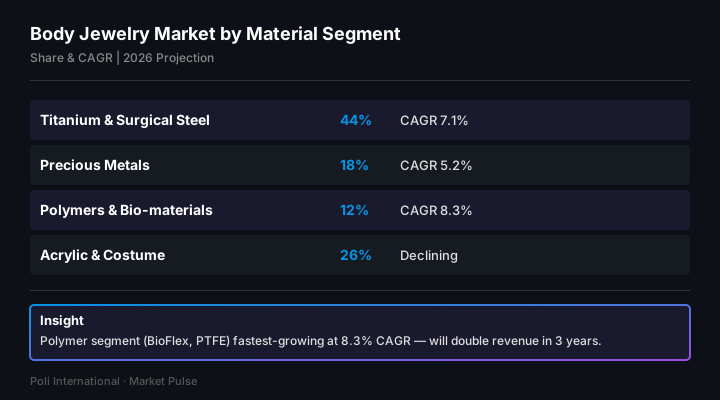
| Material Segment | Market Share | Projected CAGR | Key Dynamics |
|---|---|---|---|
| Titanium and Surgical Steel | ~44% | ~7.1% | Titanium fastest growing; ASTM F136 required for biocompatibility. 316L declining in Europe due to nickel allergy. |
| Precious Metals (gold, platinum) | ~18% | ~5.2% | Highest margins; premium demographic. Platinum growing in Asia-Pacific luxury segment. |
| Polymers and Bio-materials (BioFlex, PTFE, silicone, TPU) | ~12% | ~8.3% | Fastest-growing segment; driven by initial piercings, medical use, and stretchable jewelry. |
| Acrylic and Costume | ~26% | Declining | Shrinking due to safety awareness, regulatory pressure, and substitution by polymers and titanium. |
The polymer segment is the sleeper. BioFlex and PTFE are becoming standard for oral piercings and medical-grade applications. This segment will double in revenue within three years.
3. Regional Breakdown
| Region | Market Size | CAGR | Dominant Materials | Regulatory Drivers |
|---|---|---|---|---|
| North America | ~$840M | 6.2% | Titanium, surgical steel, gold | FDA guidance; nickel allergy awareness; celebrity influence |
| Europe | ~$615M | 5.8% | Titanium, precious metals, PTFE | REACH regulations; nickel restrictions in piercing jewelry; declining 316L demand |
| Asia-Pacific | ~$491M | 7.5% | Titanium, surgical steel, acrylic | Manufacturing hub; rising domestic consumption; piercing tourism |
Asia-Pacific's 7.5% CAGR is deceptive, much of that growth is in domestic consumption, not just manufacturing for export. China's middle class is adopting piercing at rates similar to Western markets a decade ago. South Korea and Thailand are piercing tourism destinations, driving demand for high-end studio work. The manufacturing base is under pressure to upgrade to REACH-compliant materials or lose European buyers.
4. What Is Actually Driving Growth
Social acceptance across demographics. The stigma around body piercing is largely gone. The male piercing segment is growing at nearly double the rate of the female segment. The 35–54 age group is the fastest-growing demographic for cartilage and nostril piercings.
Medical-grade material demand. Consumers are treating piercings like medical procedures. They want implant-grade titanium, not mystery metal. Studios that offer material safety education as part of the piercing consultation are seeing 30% higher average transaction values.
Social media and celebrity influence. Instagram and TikTok are the primary discovery channels. The curated ear trend, multiple cartilage piercings with mixed metals, is driving demand for high-end studs and hoops in gold and titanium.
Piercing tourism. Destinations like Seoul, Bangkok, and Berlin are attracting international clients seeking high-quality work at competitive prices, bypassing traditional wholesale distribution.
5. Risks and Actionable Insights
Counterfeit supply chains. The biggest risk is counterfeit "titanium" jewelry made from cheap alloys. Studios must verify material certificates. A single counterfeit incident can destroy a studio's reputation.
Nickel allergy awareness. This is permanently shrinking the 316L surgical steel segment in Europe. Studios in North America should proactively switch to titanium or niobium to avoid future liability. Check nickel release rates on your current inventory.
REACH compliance costs. Asian manufacturers face rising costs to certify materials. Transparency is a competitive advantage, not a cost center. Studios should demand REACH compliance documentation from every supplier.
Actionable insights: Stock only titanium, niobium, gold, and medical-grade polymers. Use material safety education as a primary upselling tool. Target male clients and older demographics. Establish direct-to-studio digital channels.
FAQ: Technical Q and A
Q: Why is 316L surgical steel declining in Europe while still popular elsewhere?
316L surgical steel contains nickel, typically 10–14% by weight. REACH regulations classify nickel as a skin sensitizer and restrict its use in jewelry that contacts pierced skin. Approximately 17% of women and 3% of men in Europe have nickel allergies, and that number is rising. European studios are switching to titanium or niobium. In North America and Asia, regulatory pressure is lower, but consumer awareness is growing. Expect 316L to become a niche material within five years.
Q: What is the difference between ASTM F136 and commercial-grade titanium?
ASTM F136 is the standard for implant-grade titanium alloy (Ti-6Al-4V ELI). It specifies strict limits on impurities and requires a specific metallurgical structure for biocompatibility. Commercial-grade titanium has no such controls. For a fresh piercing, an open wound, only F136 or F67 (commercially pure titanium) should be used. Reputable manufacturers laser-etch the ASTM number on their jewelry.
Q: How do I verify that my studio's jewelry supply chain is REACH-compliant?
Demand batch-level material certification from every supplier. Check for nickel release rates below 0.2 µg/cm²/week. Verify that pigment and alloy ingredients are not on the ECHA SVHC Candidate List. If a supplier cannot provide documentation within 48 hours, find a supplier who can. The REACH Monitor tracks regulatory changes that affect body jewelry.