Why Grade 23 Titanium Just Changed, And What That Does to Your Jewelry Choices
Key Takeaways:
» ASTM F136-26 confirms Ti‑6Al‑4V ELI (Grade 23) as the primary surgical implant alloy, but tightens how “implant‑grade” must be understood in practice.
» CoCr alloys remain viable for high‑load implants, yet their nickel and cobalt content makes them a second‑line choice for clients with metal sensitivity.
» Commercially pure niobium and titanium–zirconium systems offer low‑sensitisation alternatives, but require stricter control of impurities and mechanical limits.
» Studios should treat implant standards as minimums, then layer their own rules for surface finish, thread design, and mixed‑metal assemblies.
» “Implant‑grade” jewelry that does not track to ASTM / ISO chemistry, mechanical, and microstructural limits should be treated as uncertified and excluded from first‑pass piercing stock.
---
1. What ASTM F136-26 Really Says About “Implant-Grade” Titanium
ASTM F136 is the core specification behind what most of the industry casually calls Grade 23 titanium, the Ti‑6Al‑4V ELI alloy built for surgical implants, now updated as ASTM F136‑26, active from February 2026 for medical use. The standard defines the alloy’s chemical composition, mechanical strength and fatigue behavior, and basic metallurgical state (wrought, annealed) for bars, plates, wire, and other forms used in load‑bearing devices like screws and spinal cages. In practical terms, it is the line between “this titanium can live in bone for decades” and “this titanium belongs in a bike frame, not a human.” You can see this spelled out in detail in resources that break down ASTM F136 titanium properties, standards & applications for orthopedic and dental implants, where Ti‑6Al‑4V ELI is framed explicitly as a surgical material, not a fashion alloy.
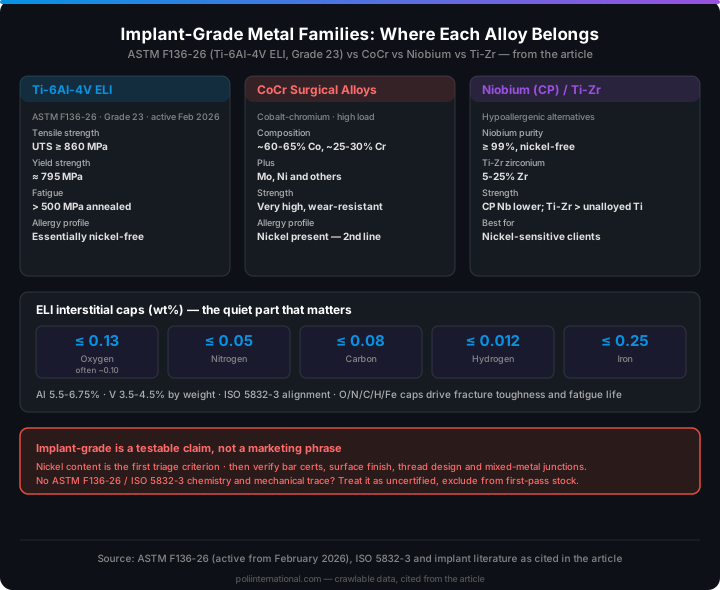
The ELI – Extra Low Interstitial tag is the quiet part that matters most to piercers: it refers to tighter caps on oxygen, nitrogen, carbon, hydrogen, and iron than standard Ti‑6Al‑4V, which directly improves fracture toughness and fatigue resistance. Typical published limits are on the order of O ≤ 0.13 wt% (often held around 0.10%), N ≤ 0.05%, C ≤ 0.08%, H ≤ 0.012%, Fe ≤ 0.25%, with aluminum held between roughly 5.5–6.75% and vanadium 3.5–4.5% by weight. Those numbers aren’t trivia: interstitial elements sit in between the grains in the titanium lattice and make the metal stronger but more brittle; pushing them down in ELI is what lets a screw survive millions of load cycles in a knee without cracking, and by extension, lets a 16 g labret post handle years of chewing and accidental knocks in the lip.
Mechanical requirements follow from that chemistry. Recent technical reviews of ASTM F136 bar material cite minimum ultimate tensile strength around 860 MPa (125 ksi), 0.2% yield strength around 795 MPa (115 ksi), and fatigue strengths comfortably above 500 MPa in the annealed condition, all validated against orthopedic applications. For jewelry, that means a straight post that resists bending in service but can still be cold‑worked for threads or press‑fits without unpredictable cracking. This is the same logic that underpins stricter manufacturing & quality control for implant‑grade jewelry, tolerances and bar stock that start from orthopedic logic, not costume‐jewelry margin.
---
2. Titanium ELI vs CoCr, Niobium, and Zirconium: Where Each Alloy Actually Belongs
When we zoom out from titanium, four families matter to piercers and collectors thinking in implant‑grade terms: Ti‑6Al‑4V ELI, cobalt‑chromium (CoCr) alloys, commercially pure niobium, and titanium–zirconium systems that borrow from dental implant metallurgy. They are not interchangeable, and each carries a specific pattern of strength, corrosion resistance, and sensitisation risk.
| Feature | Ti‑6Al‑4V ELI (ASTM F136 / Grade 23) | CoCr Surgical Alloys | Niobium (CP) / Ti–Zr Systems |
|---|---|---|---|
| Core composition | ~6% Al, ~4% V, balance Ti, extra‑low interstitial O/N/C/H/Fe | Typically ~60–65% Co, ~25–30% Cr, plus Mo, Ni, others depending on grade | Niobium ≥99% for jewelry; Ti–Zr implants often Ti with 5–25% Zr |
| Primary use case | Orthopedic screws, spinal cages, dental implants; high‑strength jewelry posts and rings | High‑load joint components, stems, modular connections; occasionally posts in heavy jewelry | Hypoallergenic posts/rings for nickel‑sensitive clients; experimental or niche dental/orthopedic implants |
| Nickel content / allergy profile | Essentially nickel‑free; vanadium and aluminum can rarely contribute to sensitisation in extreme outliers | Often contains nickel plus cobalt/chromium, all sensitising metals, though reactions are rarer than with nickel alone | Nickel‑free; niobium is routinely used as a hypoallergenic option, Ti–Zr keeps nickel out while tuning mechanics |
| Mechanical strength (typical) | UTS ≥ 860 MPa, high fatigue strength >500 MPa | Very high strength and wear resistance, tailored for joint replacement and modular heads | Lower strength for CP niobium, must be designed carefully for thin posts; Ti–Zr can exceed CP titanium strength while keeping biocompatibility |
| Regulatory / standard anchor | ASTM F136‑26, ISO 5832‑3, multiple recent implant 510(k)s cite Ti‑6Al‑4V ELI as predicate | ISO/ASTM CoCr implant standards; used for femoral components, stems, and modular devices | Ti–Zr research and some device filings show improved mechanical properties and biocompatibility over unalloyed Ti |
For CoCr, modern summaries from biomaterials and toxicology literature point out that chromium and cobalt are sensitising metals, and that nickel in that mix is still the most common allergy driver, even if implant reactions remain relatively rare compared to skin‑level jewelry exposure. That tracks with clinical reviews of allergic sensitisation to nickel and implanted metal devices in orthopedics and cardiology, where nickel allergy is acknowledged but serious implant reactions are described as uncommon and patch testing is not recommended routinely unless there is a strong history. For a jewelry studio, this translates to a simple rule: CoCr can be justified for very specific mechanical needs (extreme load, very thin cross‑sections), but is never the first choice for fresh piercings, and should be avoided entirely in clients with documented nickel or cobalt allergy.
Niobium lives at the opposite end of that spectrum: commercially pure niobium is nickel‑free and widely adopted in body jewelry for hypersensitive clients, precisely because it sidesteps the whole nickel/chromium/cobalt question. Its limitation is mechanical, not immunological, yield strength and hardness are lower than Ti‑6Al‑4V ELI, which means that thin posts and delicate rings can deform more easily and threaded junctions need careful design to avoid galling or distortion. The same “geometry versus material” tension shows up in more advanced titanium‑zirconium binary systems, where research compilations report compositions with 5–25% zirconium achieving higher mechanical strength than cold‑formed unalloyed titanium while preserving excellent soft‑tissue and hard‑tissue biocompatibility. That kind of data is starting to bleed from dental into piercing, in the same way titanium‑tantalum binary alloys have already been discussed as next‑generation implant metals that deliberately remove aluminum and vanadium from the equation.
---
3. The Numbers That Matter: Chemistry Limits, Osseointegration, and Sensitisation
To use implant metals well, studios need numbers, not adjectives. ASTM F136‑26 and related implant standards provide those numbers, and they directly drive how jewelry should be machined, polished, and selected.
On the chemistry side, the key distinction between Ti‑6Al‑4V and Ti‑6Al‑4V ELI lies in interstitial element limits. Comparative tables published for both grades show standard Ti‑6Al‑4V allowing up to roughly 0.13% oxygen, while ELI tightens practical limits down toward 0.10% or below, with nitrogen dropping from 0.05% to nearer 0.03% and hydrogen held around 0.012%. Carbon and iron are similarly constrained. Practically, this lower interstitial package improves fracture toughness, how the material behaves when a crack starts, and extends fatigue life for components cycled millions of times. In jewelry terms, that means a 14 g barbell shaft that flexes under stress instead of snapping at a thread root, and a micro‑labret disc that tolerates years of micro‑movements without propagating a machining flaw into a full‑scale crack.
On osseointegration, both orthopedic manufacturer guides and clinical reviews describe Ti‑6Al‑4V ELI as delivering “perfect osseointegration” in the sense that bone will reliably grow onto and anchor the implant surface when machining and surface treatments are correct. That doesn’t mean every piece of jewelry needs a bone‑bonding surface; it does mean that the alloy’s oxide layer stability, corrosion resistance, and microstructure have been proven in hostile biological environments for decades. Piercers using Grade 23 jewelry are “borrowing” that confidence: if the material stays stable at the bone–implant interface, it will cope with the much lower mechanical and chemical stresses of skin and mucosa, provided that machining and finishing do not introduce roughness, porosity, or contamination.
Sensitisation data is more nuanced. Reviews of nickel allergy and metal implants emphasise three points:
1. Nickel sensitisation can be acquired from implants, but it is not common compared with cutaneous exposure through cheap jewelry and occupational contact.
2. Nickel or metal allergy is very rarely the root cause of implant failure, where mechanical and infectious complications dominate.
3. Routine pre‑implant patch testing is not recommended except when there is a strong clinical history of nickel allergy.
For studios, this suggests that nickel content is still the first triage criterion for jewelry metals, but that obsessing over rare deep‑tissue reactions misses the bigger local picture: surface roughness, crevice design, and mixed‑metal junctions at the piercing site drive most real‑world complications. This is why serious manufacturers pair implant‑grade alloys with strict surface & coating technology standards, electropolishing, controlled Ra values, and thread geometries that minimise crevice corrosion, instead of relying on alloy choice alone.
---
4. Patrick’s Note: The Question He Asks and Answers
The question that decides most of my buying conversations now is stupidly simple: “If this bar were a bone screw, would you still be comfortable selling it?” When the answer is anything but an immediate yes, we do not machine it, and I will not ask a studio to put it through a healing piercing.
What the data doesn’t tell you is how often “implant‑grade” gets waved around in catalogs without a single reference to ASTM F136‑26 chemistry limits, ISO 5832‑3 alignment, or verified bar certifications. I’ve seen Grade 23 stamped on material that was clearly ordinary Ti‑6Al‑4V with interstitials drifted up for easier machining and cheaper bar pricing; it will still pierce, but it’s not the same alloy that lives inside a spinal cage or a dental fixture. That’s where I draw the line as a manufacturer: the difference between true implant‑grade titanium bar and commodity titanium sold as ‘surgical’ is not a branding nuance, it’s a question of whether a piercer can trust the metal to behave under long‑term biological load. The most useful conversations I’ve had with studios start there, with the chemistry table, not the catalog page, and move outward into thread design, surface finish, and whether we should be exploring next‑generation titanium–tantalum or titanium–zirconium systems for specialized clients instead of pretending one alloy fits everyone.
---
5. FAQ: Technical Q&A
Q: Does ASTM F136 automatically make any Grade 23 titanium jewelry “implant-safe” for fresh piercings?
No. ASTM F136 defines the alloy chemistry and mechanical properties for medical implants; jewelry must also meet studio‑level requirements for surface finish, cleanliness, and geometry. A bar can be true Ti‑6Al‑4V ELI and still be unsafe if threads are cut poorly, surfaces are rough, or mixed‑metal ends create galvanic pairs in the piercing channel.
Q: When would a piercer choose niobium or Ti–Zr alloys over Ti‑6Al‑4V ELI?
Niobium is the first choice when nickel hypersensitivity is documented and the client wants a non‑titanium option with a long history in body jewelry. Ti–Zr systems become interesting when you need improved mechanical strength over unalloyed titanium without introducing aluminum or vanadium, for example in very fine posts that still need higher fatigue resistance, but they should be treated as specialty materials with proper certification rather than casual substitutes.
Q: Is CoCr ever appropriate for body jewelry given its nickel and cobalt content?
CoCr has a clear place in high‑load orthopedic applications, where its wear resistance and strength justify carefully managed sensitisation risk. For jewelry, it should be reserved for rare cases where geometry and mechanical demands make titanium or niobium impractical, and must never be used in clients with known nickel or cobalt allergy; even then, the studio must balance the metal’s performance against the availability of safer nickel‑free alloys.
---
Conclusion: Tighten Your Implant-Grade Standard
If you take anything practical from the latest ASTM and implant literature, let it be this: “implant‑grade” is a testable claim, not a marketing phrase. Ti‑6Al‑4V ELI under ASTM F136‑26 remains the backbone alloy for posts and rings in serious studios, but it earns that role only when its chemistry, mechanical profile, and microstructure truly match the surgical spec and are paired with precise machining and finishing in the jewelry itself. Once you start asking for those tables, oxygen and nitrogen caps, tensile and fatigue strengths, verified bar certifications, documented standards alignment, the gap between true implant‑grade stock and generic “surgical titanium” becomes too obvious to ignore.
From there, choosing between Grade 23 titanium, niobium, CoCr, or emerging Ti–Zr systems becomes an engineering decision tied to the client’s allergy history, the piercing location’s mechanical load, and how the jewelry will be sterilised and handled over its lifetime. The more your studio treats metals the way orthopedic surgeons treat screws and cages, the fewer surprises you will see in healed piercings and long‑term wear, and the more sense it will make to explore advanced alloys like titanium–tantalum when the market finally catches up to what conscientious piercers have been asking for all along.
6. ASTM F136 vs F1295: Which Standard Actually Governs Your Jewelry?
Most people searching for "ASTM F136" or "ASTM F1295" want a straight answer: which specification applies to the metal in their piercing? ASTM F136 covers wrought Ti-6Al-4V ELI (Grade 23) for surgical implants. ASTM F1295 covers wrought Ti-6Al-7Nb, a niobium-stabilised alpha-beta alloy developed as a vanadium-free alternative. Both are implant-grade titanium standards. Neither is a "body jewelry standard" in the consumer sense, they are materials specifications written for implant manufacturers, and jewelry makers adopt them voluntarily.
The 2026 revision of ASTM F136 tightens chemistry tolerances, clarifies interstitial limits (O, N, H, Fe), and reinforces that "implant-grade" is a claim about a specific heat lot meeting a specific specification, not a marketing adjective. If a supplier cannot produce a mill certificate tied to the F136-26 designation, the claim is unverifiable.
ASTM F1295 (Ti-6Al-7Nb) is legitimate and well-documented in orthopaedic literature. It is not superior to F136 ELI for piercing applications; it is a parallel option. Where suppliers conflate F136, F1295, and generic "surgical titanium," the buyer loses the ability to audit what is actually in the jewelry.
I have spent 25 years watching this exact confusion play out at the counter. A piercer asks for "implant-grade titanium," gets handed a bag with no mill cert, and assumes the specification is being met because the word is printed on the label. That is not how materials compliance works. ASTM F136-26 exists precisely to make the claim auditable, you either have the documentation or you do not. The same discipline applies to every material I supply, which is why BioFlex® PP-R is backed by ISO 10993-6 and USP Class VI documentation rather than a slogan.
For buyers comparing F136, F1295, CoCr, niobium and zirconium, the practical rule is simple: ask for the standard number, the revision year, and the mill certificate. If any of the three is missing, treat the "implant-grade" claim as unverified. For a full breakdown of how each alloy performs in healed versus fresh piercings, read our material selection guide and use the alloy comparison tool before you specify your next order.