# Titanium vs Niobium for Piercings: Two Nickel-Free Implant-Grade Metals Compared
If you need a nickel-free piercing metal, you have two implant-grade choices: titanium (ASTM F136) and niobium (99.9% minimum purity). Both are zero-nickel, both form stable oxide passive layers, and both are safe for healing piercings. The question is not which one is safe. The question is which one fits the specific piercing, the client's colour preferences, and the studio's supply chain. The differences are real, and they matter to daily wear.
Why two nickel-free metals exist and why the choice matters
Nickel is the single most common contact allergen in body piercing, affecting an estimated 11.4% of the general population with higher rates among women and pierced individuals (Alinaghi et al., Contact Dermatitis 2019, PMID 30370565). A client who has never reacted to nickel can still develop sensitisation through cumulative exposure, and a fresh piercing creates the ideal electrochemical environment for nickel ion release: an open wound track bathed in body-fluid electrolyte for months.
For any studio that takes nickel risk seriously, the safest default is a zero-nickel metal. Titanium has been that default for decades. It is the most-prescribed initial-piercing material, supported by the ASTM F136 specification and a vast medical-device manufacturing infrastructure. Niobium is the alternative: clinically equivalent in biocompatibility, with a different set of practical trade-offs. A piercer who understands both can make finer recommendations than "titanium for everything."
Key differences at a glance
| --- | --- | --- |
|---|---|---|
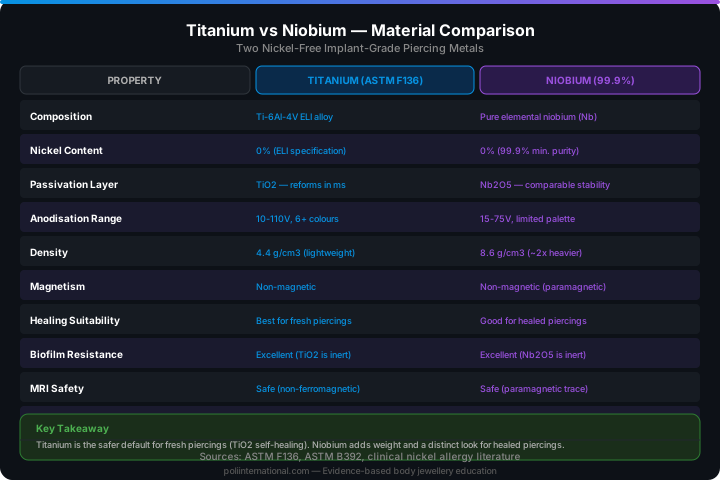
| Composition | Ti-6Al-4V ELI alloy | Pure elemental niobium (Nb) |
| Nickel content | 0% | 0% |
| Passivation layer | TiO₂: reforms in milliseconds | Nb₂O₅: comparable stability to TiO₂ |
| Anodisation voltage range | ~10–110V (narrower colour range) | ~10–130V (wider colour range, deeper blues/greens) |
| Anodisation colour stability | Excellent: TiO₂ is extremely durable | Excellent: Nb₂O₅ comparable to TiO₂ |
| Hardness | Harder: good scratch resistance | Softer: more susceptible to surface scratches |
| Weight | Lightweight (~4.4 g/cm³) | Heavier (~8.6 g/cm³, roughly 2× titanium) |
| Workability | Hard to machine: expensive tooling | Easier to machine: more affordable custom pieces |
| Colour without anodisation | Silver-grey | Steel-grey (slightly darker than titanium) |
| Cost (relative) | Moderate: standard implant-grade pricing | Slightly higher than titanium for basics; lower for custom work |
| Availability | Widely available from all quality suppliers | Less common: fewer suppliers carry it |
| Regulatory certification | ASTM F136 + ICP-MS | No direct ASTM implant spec: purity certification required |
| MRI compatibility | Fully compatible (non-ferromagnetic) | Fully compatible (non-ferromagnetic) |
Titanium (ASTM F136): the familiar workhorse
Titanium earned its position as the default piercing metal for good reasons. The ASTM F136 specification (Ti-6Al-4V ELI) defines exact elemental limits, and nickel is not an intentional alloying element: its presence is limited to trace impurity levels, maximum 0.05%. The metal forms a TiO₂ passive layer that is the body's preferred titanium interface: it is chemically stable, non-reactive with body fluids, and, critically, self-healing. If the oxide layer is scratched or abraded, it reforms in milliseconds in the presence of any oxygen source, including the oxygen dissolved in body fluid.
This self-healing property means a titanium post that has been micro-scratched by insertion, removal, or daily friction does not stay scratched. The exposed titanium substrate immediately oxidises, restoring the protective barrier before the immune system can mount a reaction. No coating is involved. No separate surface treatment can wear off. The protection is inherent to the metal.
Titanium's dominance also owes to infrastructure. Titanium has been the standard for orthopaedic implants, dental implants, and pacemaker housings for decades, creating a massive production chain that body jewelry inherits. Every quality studio stocks ASTM F136 titanium in common gauges and lengths. If a client needs a specific size in a specific colour, titanium is almost certainly available.
Niobium: the overlooked implant-grade option
Niobium is an elemental metal (Nb, atomic number 41), not an alloy. Body-jewelry-grade niobium is 99.9% minimum purity. It forms a Nb₂O₅ passive layer that is comparable in stability to TiO₂: chemically inert, non-reactive with body fluids, and fully protective in a healing wound track. Like titanium, niobium contains zero nickel. Unlike titanium, niobium has no single governing ASTM specification for body jewelry: certification relies on purity certificates (99.9% minimum) rather than a named implant specification.
The practical trade-offs are where niobium differentiates itself. Niobium is softer than titanium, which means it is more susceptible to surface scratches in daily wear; it is also easier to machine, which means custom, one-off pieces are more affordable. Niobium is approximately twice the weight of titanium (8.6 vs 4.4 g/cm³), a difference clients feel in larger-gauge jewellery. And niobium's anodisation voltage range extends to roughly 130V, opening colours (particularly deeper purples, blues, and greens) that titanium cannot reach.
Niobium is less common in studios for two reasons. First, titanium's medical-device history created supply-chain momentum that niobium never matched. Second, the absence of a named ASTM implant specification for body jewelry means piercers who insist on spec-backed materials may default to titanium simply because ASTM F136 is the document they know. This is an institutional gap, not a clinical one: niobium's biocompatibility is well-established in the materials-science literature, and its track record in body piercing is clean.
Anodisation comparison: colour range, voltage, and durability
Titanium anodises across roughly 10–110V, producing gold (≈15V), purple (≈50V), blue (≈70V), teal (≈85V), green (≈100V), and magenta tones. Above ≈110V, the oxide becomes thick enough that the interference effect degrades into muddy grey-brown tones. Titanium cannot produce true black through anodisation alone.
Niobium anodises across roughly 10–130V and produces a wider colour gamut in the blue-green-purple range, with deeper saturation at equivalent voltages. The extra 20V of headroom is meaningful: it pushes niobium's colour palette into territory titanium cannot match, particularly for clients who want rich, saturated cool tones.
Both oxide layers are comparably durable. TiO₂ and Nb₂O₅ are chemically integral to their respective metal surfaces: neither is a coating, and neither can chip, peel, or flake. Surface scratches remove the oxide locally on both metals, but the oxide reforms on titanium (self-healing); niobium's softer surface accumulates scratches more readily, which can create visible bright spots over time. This is a scratch-resistance difference, not a colour-fading difference. Well-cared-for anodised niobium holds its colour indefinitely.
Weight, feel, and practical differences in daily wear
Niobium's roughly 2× weight difference (8.6 vs 4.4 g/cm³) is the practical difference clients notice most. In small-gauge jewellery (18g, 16g), the weight difference is negligible. In larger gauges (10g, 8g, 6g), particularly in ear projects where multiple large rings or plugs accumulate weight on the lobe, the difference becomes perceptible and may affect long-term comfort.
Titanium's greater hardness means it resists surface scratches better in daily wear. This is most relevant for jewellery in high-contact areas: lip labrets that contact teeth, earrings compressed against a pillow, rings worn during activity. Niobium in these placements will accumulate surface scratches faster. The scratches are cosmetic only: the underlying metal is still biocompatible and the oxide still protective, but clients who want their jewellery to look pristine for years should factor this in.
Conversely, niobium's easier machinability means custom work (unusual lengths, custom decorative ends, one-off designs) is more affordable in niobium than in titanium. A client who wants a single custom piece may find niobium a better value proposition than commissioning the same design in titanium.
Recommendation logic: choosing between two nickel-free options
Is the piercing fresh (healing)?
├─ YES → Titanium. The TiO₂ self-healing property and wider
│ availability of certified ASTM F136 jewellery make it the
│ safer default. Niobium is also safe but less widely stocked.
└─ NO (fully healed)
├─ Want a wider colour range (deeper purples, blues, greens)?
│ └─ Niobium. The 130V anodisation ceiling opens colours
│ titanium cannot reach.
├─ Prefer lighter weight?
│ └─ Titanium (~60% lighter).
├─ Want a custom, one-off piece?
│ └─ Niobium. Easier to machine = more affordable custom work.
└─ Concerned about immediate availability?
└─ Titanium. Any quality studio stocks it.
Key takeaways
- Both titanium (ASTM F136) and niobium (99.9% min) contain zero nickel. Both form stable oxide passive layers. Both are safe for healing piercings.
- Titanium's TiO₂ layer is self-healing: scratches re-oxidise in milliseconds. Niobium's Nb₂O₅ is comparably stable but the softer metal accumulates scratches faster.
- Niobium anodises to a wider colour range (~130V ceiling vs ~110V for titanium), particularly deeper purples, blues, and greens. Neither metal can produce true black through anodisation alone.
- Niobium weighs roughly twice as much as titanium (8.6 vs 4.4 g/cm³). The difference is negligible in small gauges; noticeable in large-gauge ear projects.
- For healing piercings, titanium is the safer default purely because it is more widely available in certified ASTM F136 form. Niobium is clinically equivalent but less commonly stocked.
- For custom jewellery, niobium's easier machinability makes one-off pieces more affordable than titanium equivalents.
Also compare:
- Titanium vs Surgical Steel: if you are deciding on a metal for a healing piercing
- Gold vs Titanium: if you want precious metal instead (draft pending)
- Anodised vs PVD Coating: if colour durability is the priority (draft pending)
- Internally Threaded vs Threadless: if assembly type matters alongside metal choice (draft pending)
Frequently asked questions
Q: If niobium is so good, why is it less common than titanium?
A: Two reasons. First, titanium has been the medical-device standard for decades (orthopaedic implants, dental implants, and pacemaker housings), creating massive production infrastructure that body jewelry inherits. Niobium has no equivalent medical-device history. Second, titanium's ASTM F136 specification is universally recognised; niobium lacks an equivalent body-jewelry-specific ASTM standard, so certification relies on purity certificates (99.9% minimum) rather than a named implant specification. Niobium is clinically excellent but institutionally less established.
Q: Can I mix titanium and niobium in the same piercing?
A: Yes, and this is one of the safest mixed-metal combinations available. Both form stable oxide passive layers (TiO₂ on titanium, Nb₂O₅ on niobium) with similar nobility, so the galvanic potential between them is minimal. Unlike titanium plus steel (where the steel corrodes), titanium plus niobium is a low-risk combination for healed piercings. For fresh piercings, single-metal assemblies remain the safest choice.
Q: Does anodised niobium fade faster than anodised titanium?
A: No. Nb₂O₅ is comparably durable to TiO₂. Both oxide layers are integral to the metal surface (not a coating), so they do not peel, chip, or flake. Surface scratches can remove the oxide layer locally, and because niobium is softer, it scratches more easily. This is a scratch-resistance difference, not a colour-fading difference. Well-cared-for anodised niobium holds its colour indefinitely.