
Key Finding: A new peer-reviewed study from Contact Dermatitis (March 2026) confirms that women with a history of jewelry allergy face 6-fold higher risk of metal sensitization after implantation—and that nearly 25% of European earrings still violate nickel release limits. The research reinforces what regulatory bodies have known for two decades: ASTM F136 implant-grade titanium eliminates nickel-related reactions, while surgical-grade steel doesn't. For piercers in 2026, this study isn't breaking news—it's validation that the material standards clients trust are backed by epidemiological evidence. And with FDA MoCRA and EU REACH compliance now mandatory, knowing the science behind your jewelry choices has moved from best practice to legal necessity.
---
The Science Behind the Standards: Why That March 2026 Study Matters More Than You Think
I've spent 25 years manufacturing implant-grade metals, and I've watched the body jewelry industry oscillate between hype and denial about material safety. This week, a new peer-reviewed study in Contact Dermatitis examined 882 patients who underwent patch testing for metal allergies—either before or after implant insertion—between 1998 and 2022. The data is clean, the methodology is solid, and the implications are direct: your material choice matters more than ever before.
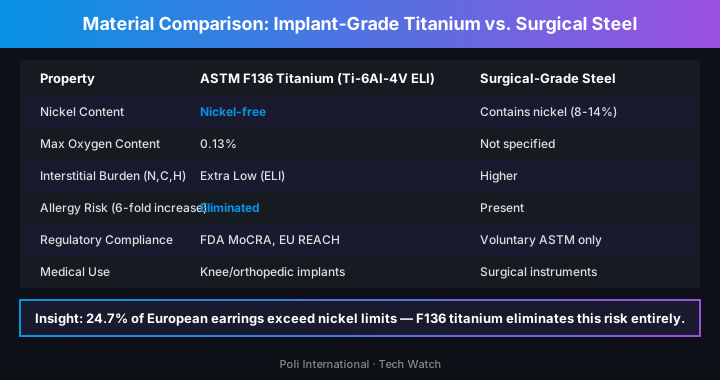
Here's what researchers found: women with a documented history of jewelry allergy faced a 6.11-fold increased risk of developing metal sensitization compared to women without that history. That's not a marginal difference. That's a signal. And when you cross-reference this with parallel research from 2025 showing that 24.7% of European earrings exceed regulatory nickel limits, you're looking at a supply chain problem wearing a dermatological mask.
The contact dermatitis community has understood nickel's danger for decades. The European Union didn't restrict nickel release (to <0.2μg/cm²/week for body piercings and <0.5μg/cm²/week for other skin-contact jewelry) by accident. That Nickel Directive, first established in 1994 and incorporated into REACH (Annex XVII, Entry 27), has measurably reduced the prevalence of nickel allergy across the European population—proof that regulation *works* when it's enforced. But here's the gap: North America has no comparable federal restriction on nickel release. We rely on ASTM standards, which are voluntary unless you're working with a professional piercer who knows to ask for them.
The March 2026 Contact Dermatitis paper doesn't invent new chemistry.
What it does is take patch-test data from a 25-year window and confirm what the regulatory science community has been saying: metal sensitization risk is nearly identical whether the exposure happens before or after an implant is placed. Translation: choosing the wrong jewelry upfront is as risky as wearing compromised material long-term. Pre-implant testing in patients with documented jewelry allergy could prevent bad reactions—but only if they're first pierced with material that won't trigger sensitivity in the first place.
This is where ASTM F136 implant-grade titanium (specifically Ti-6Al-4V ELI, meaning "Extra Low Interstitial") enters the equation. F136 titanium is nickel-free, has a maximum oxygen content of 0.13%, and a maximum interstitial burden (nitrogen, carbon, hydrogen) that keeps the material from degrading under physiological stress. It's the same material used in knee replacements and orthopedic implants. When I specify F136 for body jewelry, I'm not choosing an expensive option—I'm choosing *the* option that the literature supports.
What 2026 Regulatory Changes Mean for Your Jewelry Sourcing
The meta-story this week isn't just the science—it's the timing. We're now in 2026, which means FDA MoCRA (Modernization of Cosmetics Regulation Act) compliance is no longer theoretical—it's being enforced. And the EU has simultaneously tightened REACH restrictions on PFAS and added two new SVHCs (Substances of Very High Concern) to its candidate list, bringing the total to 253.
For piercing studios, this translates into a single uncomfortable truth: you need to know your supplier's compliance posture, and you need documentation to prove it. The March 2026 updates make clear that generic "implant grade" claims aren't enough. You need:
Mill test reports (MTRs) that certify the chemical composition of the raw titanium before it's manufactured into jewelry. An MTR details the precise percentages of elements like titanium, aluminum, vanadium, and critically, impurities—oxygen, nitrogen, carbon, hydrogen. It's not decorative documentation. It's proof that the material meets ASTM F136 or ISO 5832-3 standards.
Certificate of Compliance (CoC) for the finished jewelry, confirming that the post, barbell, or segment meets APP (Association of Professional Piercers) standards for surface finish (mirror polish, no stamps or scratches), thread integrity (internal tapping only), and biocompatibility. This is the document professional piercers now ask for during studio audits, and if your supplier can't provide it, that's a red flag.
Batch traceability. If a client reacts to a piece of jewelry, you need to know which batch it came from. Many compliant brands now use QR codes linking to specific batch analysis, similar to the labeling requirements now mandatory for EU REACH-compliant tattoo inks. The same principle applies to body jewelry: one batch per client record, one record per potential adverse event.
The regulatory landscape didn't change because the science changed—it changed because the industry's tolerance for undocumented materials finally wore thin. The FDA's 15-day adverse event reporting requirement for serious reactions—borrowed from cosmetics regulation and now expanding into jewelry—means that if a client develops a severe allergic reaction or infection traceable to your jewelry choice, your liability isn't just clinical, it's federal.
The Practitioner Reality: Supply Chain Pressure Meets Standards
None of this happens in a vacuum. While the Contact Dermatitis paper validates implant-grade standards and regulatory bodies tighten compliance, the piercing industry is simultaneously grappling with tariff-driven cost increases (10–24% overhead growth from 2025 to 2026), gold prices that have tripled in three years, and manufacturing consolidation. Studios report late orders, incorrect pieces, and inventory gaps because several major jewelry manufacturers have been acquired or shuttered.
This creates a perverse incentive: pressure to source cheaper materials to offset overhead costs. And cheaper often means "not F136," or "plated instead of solid," or "missing batch documentation." I understand the financial strain. But here's the hard truth: the Contact Dermatitis study proves that nickel-contaminated jewelry doesn't just cause itching—it causes persistent sensitization that can affect clients for life. And regulatory compliance now means that if you place non-compliant material, your liability chain runs directly back to you and your supplier.
The solution isn't to abandon cost-consciousness—it's to shift from supplier loyalty to supplier verification. Ask your jewelry vendor directly: "Can you provide a mill test report for the titanium you're using? Does your jewelry carry batch codes? Do you track adverse events?" If they hedge, equivocate, or say "we've never had an issue," they're telling you something important. Trust documentation, not anecdotes.
The Bottom Line: Material Standards Are Your Insurance Policy
The March 2026 metal sensitization research doesn't change what we knew about nickel allergy—but it does update the calculus. We now have 25 years of epidemiological data showing that regulatory compliance *actually reduces* the prevalence of allergic reactions in the general population. We have specific ASTM standards (F136, F138, F67, F1295) backed by decades of orthopedic and dental implant evidence. And we have 2026 regulatory requirements that make material traceability non-negotiable.
For a piercer in 2026, choosing implant-grade titanium isn't premium positioning—it's baseline professional practice. It's the documentation you hand to a client to explain why the cost is what it is. It's the line item in your insurance file if someone develops a reaction. And it's the validation you offer when a client with a documented jewelry allergy comes in and asks, "Is this really safe for me?"
Because now the answer can be backed by peer-reviewed epidemiology, not just vendor claims.
1. FAQ: Metal Sensitization and Implant-Grade Standards
Q: What does the March 2026 Contact Dermatitis study actually prove about nickel allergy risk?
The study followed 882 patch-tested patients over a 25-year window and found that women with a documented history of jewelry allergy face a 6.11-fold increased risk of metal sensitization after implantation. The key implication for piercers is that pre-existing jewelry allergies are not a contraindication to piercing, they are a signal that the choice of jewelry material becomes critically important. A client who reacts to cheap earrings is not someone to turn away; they are someone who needs ASTM F136 titanium rather than 316L stainless steel. The study also correlates with parallel data showing 24.7% of European earrings still exceed regulatory nickel release limits, confirming this is an active supply chain failure, not a historic one.
Q: What is a Mill Test Report (MTR) and why do piercers need to ask for one?
An MTR is a third-party laboratory certificate issued for a specific batch of raw metal material. It documents the chemical composition of the alloy, the exact percentages of every element, including interstitial impurities like oxygen, nitrogen, carbon, and hydrogen that directly affect biocompatibility. For ASTM F136 titanium specifically, the MTR confirms that oxygen is ≤0.13%, nitrogen ≤0.05%, and nickel essentially absent. Without an MTR, a supplier's claim of "implant grade" is an assertion, not a verification. Any professional jewellery supplier targeting the body piercing market should be able to provide batch-specific MTRs on request; those who cannot or hedge with "we've never had a complaint" are signalling a documentation gap that creates downstream liability for the studio.
Q: How does ASTM F136 differ from other titanium grades sold for body jewellery?
ASTM F136 specifies Ti-6Al-4V ELI (Extra Low Interstitials), the same alloy used in hip replacements and spinal fusion hardware. The ELI designation places tight upper limits on oxygen, nitrogen, and iron to maximise ductility and prevent embrittlement under physiological stress. Commercial-grade Ti-6Al-4V (ASTM F1472) shares the same primary composition but has looser interstitial limits, it meets aerospace strength requirements but is not classified for long-term body contact. Generic "titanium" or "aerospace titanium" jewellery sold without ASTM designation may be any grade, including variants containing aluminium and rare earth additions used in high-temperature aerospace applications that are definitively not biocompatible. ASTM F136 is not the premium tier, it is the minimum safe tier.
Q: What does FDA MoCRA compliance mean for body piercing studios in 2026?
The Modernization of Cosmetics Regulation Act (MoCRA) expanded FDA oversight of products applied to the body, bringing certain body art materials, particularly tattoo inks and some jewellery coatings, under reporting obligations that previously applied only to cosmetics. The directly relevant requirement for piercing studios is the 15-day adverse event reporting window: if a client experiences a serious reaction (hospitalisation, significant skin damage, systemic allergic response) traceable to materials used in your studio, you are now required to report this to the FDA within 15 business days. This obligation runs through the supply chain, your supplier needs to support your reporting with batch data and product composition records. Studios that cannot identify which specific batch of material was used in a procedure that caused a reaction face significantly elevated legal exposure under the MoCRA framework.
Q: Is batch traceability legally required in the EU for body jewellery, and how should studios implement it?
EU REACH and the General Product Safety Regulation (GPSR) require economic operators, which includes studios that source directly from non-EU manufacturers, to maintain traceability records for products supplied to consumers. For body jewellery, this means recording the batch or lot number of every piece implanted into a client, along with the supplier's compliance documentation. In practice, the simplest implementation is a per-client record noting the item description, batch code (usually on the supplier label or bag), and the date of the procedure. If a client returns with an adverse reaction, this record allows you to pull the batch and check whether it was associated with other reactions, contact the supplier for composition data, and demonstrate to an insurer or regulator that you operated with due diligence. QR-code labelling from compliant suppliers now links directly to batch-specific analysis documents, making record-keeping significantly easier than manual logging.


