ASTM F136 Titanium and Friends: New Data Piercers Need To Know
Key Takeaways:
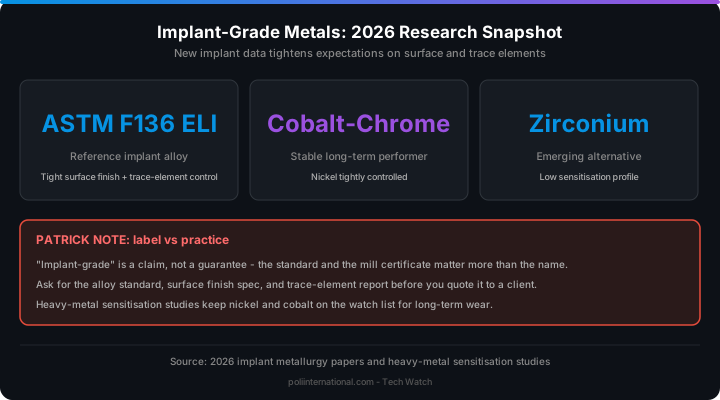
» ASTM F136 ELI titanium remains the reference implant-grade alloy, but new implant data is tightening expectations on surface finish and trace elements.
» Recent implant metallurgy papers highlight cobalt-chrome and zirconium as stable long-term performers when nickel is tightly controlled.
» Heavy metal sensitisation studies in implants reinforce that alloy certification alone is not enough - machining, polishing, and contamination control matter.
» Regulators and standards bodies are quietly nudging manufacturers toward stricter documentation of alloy provenance and process control.
» Studios should treat “implant-grade” as a full chain-of-custody concept, not a label on a bag - ask explicitly for grade, standard, and surface finish disclosure.
1. What “Implant-Grade” Means Today
Across recent orthopaedic and dental implant literature, ASTM F136 extra-low interstitial (ELI) titanium is still treated as the baseline material for long-term contact with bone and soft tissue, because of its combination of high fatigue strength, stable oxide layer, and low allergenic profile compared with nickel-containing steels and alloys.Advancements in Wearable and Implantable BioMEMS Devices At the same time, cobalt-chrome (CoCr), niobium, and zirconium alloys appear in comparative studies as alternatives where higher stiffness, wear resistance, or radiopacity are needed, and the biocompatibility picture for these alloys has sharpened over the past few months in the implant field.Advancements in Wearable and Implantable BioMEMS Devices
The key pattern in new work from orthopaedic and dental journals is that corrosion behaviour and ion release, not just nominal alloy composition, are driving risk assessments.Are Some Metals in Tattoo Inks Harmful to Health? An Analytical ... Even when the alloy meets ASTM or ISO grade chemistry, microstructural defects, residual stresses from machining, and suboptimal polishing can dramatically change how much metal is freed into adjacent tissue over years of wear and micromotion. For body jewelry, that translates directly: a barbell cut from F136 but machined with worn tooling, contaminated with shop oil, or finished with inconsistent electropolishing does not behave like the test coupons in implant trials.
Recent medical device reviews also make a sharp distinction between “implant-grade” as a regulated concept - where trace elements, mechanical properties, and surface conditions are characterised and documented - and “medical-looking” metals used in consumer products that mimic the colour and marketing language but lack supporting data.Tattoos, Body Piercing, and Healthcare Concerns For piercers, the practical takeaway is that ASTM F136 or ISO 5832-3 should appear on certificates and invoices, not just in catalogue copy; without that chain, you are relying on appearance and trust, not on metallurgy.
2. Alloy Comparisons: What The New Data Emphasises
Recent implant and biomaterials papers don’t overturn the hierarchy of common alloys, but they do sharpen where each one is strong - and what failure modes matter most in long-term tissue contact.Advancements in Wearable and Implantable BioMEMS Devices
| Feature | ASTM F136 Ti (ELI) | CoCr Implant Alloys |
|---|---|---|
| Nickel content & allergy risk | Essentially nickel-free; very low risk in sensitised patients | Often contains nickel and cobalt; higher allergy risk if ions are released |
| Fatigue & flexibility | High fatigue strength, relatively low modulus; good for dynamic load and soft tissue comfort | Very high stiffness and strength; excellent for load-bearing, but feels “harder” in soft tissue |
| Corrosion & ion release | Stable TiO₂ surface; low ion release when polished and passivated | Very low wear in well-designed joints, but Co and Cr ions are concern if corrosion/wear occur |
| Osseointegration and tissue response | Excellent bone integration; widely documented in orthopaedics and dental implants | Good performance in joint replacements; less used for direct osseointegration studs |
| Finish sensitivity | Surface roughness and contamination heavily influence oxide stability and tissue reaction | Wear and corrosion strongly depend on microstructure and counterfaces; more critical in moving joints |
The recent literature on implantable BioMEMS and sensor devices also brings niobium and zirconium into focus as corrosion-resistant conductors and housings, valued for their stable oxides and low ion release in electrolyte-rich environments.Advancements in Wearable and Implantable BioMEMS Devices This reinforces what many piercers already suspect: when nickel allergy is a concern, niobium and zirconium are rational alternatives to titanium, provided the alloy source and machining quality are properly controlled.
For studios, the actionable point is simple: if you are stocking multiple “implant-grade” metals, match them to the client profile and piercing site. High-motion, load-sensitive sites (like large-gauge cartilage or industrials) benefit from alloys with strong fatigue performance and stable oxide layers, while clients with complex allergy histories merit metals that avoid nickel and cobalt outright. That risk mapping is as important as the initial choice of taper and diameter, because the mechanical stress distribution in jewelry under physiological load interacts directly with corrosion and ion release over time.
3. Technical and Regulatory Details Piercers Should Care About
From the regulatory angle, the most recent filings and technical reviews are converging on a theme: trace element control and surface characterisation are no longer optional extras for metals that claim to be implant-grade.Advancements in Wearable and Implantable BioMEMS Devices ASTM F136 for titanium and comparable ISO standards for CoCr and other alloys define maximum levels of interstitials like oxygen, nitrogen, and carbon as well as specific mechanical properties such as yield strength and elongation. New commentary emphasises that these limits exist to control microstructural stability and crack growth, not just to meet a paperwork requirement.
In parallel, concerns about heavy metal exposure that dominate tattoo ink research - particularly around chromium, nickel, and copper - are being echoed in implant materials discussions.Are Some Metals in Tattoo Inks Harmful to Health? An Analytical ... While implant alloys and tattoo inks are not directly comparable, both domains now treat low-level, long-term ion release into tissue as a serious parameter. That thinking transfers cleanly to body jewelry: an ASTM grade label is a starting point, but studios need suppliers who can explain how their machining, passivation, and polishing routines minimise ion release by stabilising the oxide layer and removing embedded contaminants.
In practical terms, that means asking for details like:
- The specific alloy designation (e.g., ASTM F136 Ti-6Al-4V ELI vs. generic “surgical titanium”).
- Whether machining is followed by controlled passivation or electropolishing, not just tumbling.
- How the manufacturer keeps nickel and cobalt contamination out of titanium or niobium machining lines (mixed-metal machining increases cross-contamination risk).
Regulators are also tightening on documentation of manufacturing controls via ISO 13485 and similar systems in medical device factories.Advancements in Wearable and Implantable BioMEMS Devices Even though jewelry is largely outside that formal regime, piercers and studio owners can borrow the mindset: treat every jewelry supplier as if you were auditing a device manufacturer. Ask about incoming alloy verification, batch traceability, and how nonconforming parts are handled. In a world where sensitisation and infection risks from body art are under scrutiny in nursing and public health literature, having a defensible material story is part of professional practice.Tattoos, Body Piercing, and Healthcare Concerns
4. Patrick's Note: The Counter-Intuitive Label
The thing practitioners miss here is that the words “implant-grade” on a jewellery bag feel like a safety guarantee, but on their own they are closer to a colour description than a material specification. In orthopaedic device manufacturing, I’ve watched entire production lots of ASTM F136 titanium get held back or scrapped because surface testing showed a slightly unstable oxide or trace contamination - that same lot, sold into the body jewelry market without those tests, would happily be labelled “implant-grade” and worn by thousands of clients. The contradiction isn’t malicious; it’s a gap between how tightly implants are controlled and how loosely the term is used in our trade.
My honest take: what makes jewelry genuinely safe is not only the alloy name but the boring process detail almost nobody puts in catalogues - how sharp tooling is kept, whether mixed-metal machining lines are segregated, how passivation baths are monitored, and whether anyone is measuring surface roughness and oxide stability instead of assuming they are fine. In the Poli Journal, I’m going to keep pushing toward a standard where “implant-grade body jewelry metallurgy” means the same thing on your shelves as it does in an orthopaedic theatre, not just a marketing phrase that survived a graphic design meeting.Advancements in Wearable and Implantable BioMEMS Devices
5. FAQ: Technical Q&A
Q: Is ASTM F136 titanium always the best choice for initial piercings?
For most clients and most sites, ASTM F136 ELI titanium is the safest default because of its low allergenic profile, strong fatigue performance, and stable oxide layer when properly finished.Tattoos, Body Piercing, and Healthcare Concerns However, in clients with complex histories or specific needs (e.g., MRI-heavy lifestyles or documented metal sensitivities), niobium or zirconium from a verified medical-grade source can be equally rational choices.
Q: Does “implant-grade CoCr” make sense for body jewelry, or is cobalt-chrome too risky?
Implant-grade CoCr alloys perform extremely well in joint replacements, but their use in body jewelry should be cautious because cobalt and nickel ions are more problematic if corrosion or wear occurs.Are Some Metals in Tattoo Inks Harmful to Health? An Analytical ... If you stock CoCr, reserve it for clients without metal allergy history, use it in geometries that minimise fretting and wear, and insist on documented alloy grade and high-quality polishing.
Q: What should I ask suppliers to prove their jewelry is truly implant-grade?
Ask for the specific ASTM or ISO alloy designation, a certificate of conformity showing chemical composition and mechanical properties, and a description of finishing steps such as passivation or electropolishing.Advancements in Wearable and Implantable BioMEMS Devices If they cannot explain how they control contamination and surface condition, treat “implant-grade” on their packaging as unverified marketing rather than a material guarantee.
Conclusion: Turn “Implant-Grade” From Label Into Practice
The most recent implant metallurgy and biomaterials research quietly raises the bar for what implant-grade alloys must deliver: tight control of trace elements, stable oxides, and surfaces that genuinely minimise ion release over years of physiological load.Advancements in Wearable and Implantable BioMEMS Devices For body jewelry, that means studios need to move beyond alloy names and start demanding process transparency that mirrors medical device manufacturing, especially for ASTM F136 titanium, CoCr, niobium, and zirconium pieces that will live in clients’ bodies for years.
If piercers and studio owners treat “implant-grade” as a full chain-of-custody standard - from melt chemistry through machining and finishing to documentation - the industry can align everyday jewelry with the safety expectations already shaping orthopaedic and dental implants, instead of relying on marketing language that only looks medical from a distance.Tattoos, Body Piercing, and Healthcare Concerns