Shop
Tech Watch

Implant-Grade Alloys for Body Jewelry: What the Latest Implant Science Really Changes for Studios

PP

Chief Engineer

Patrick Poli

Journal Date

2026-07-31

Last Reviewed

2026-10-13

Why ASTM F136 Titanium, CoCr, Niobium, and Zirconium Are Not Interchangeable in Healing Tissue

Key Takeaways:
» ASTM F136 titanium (ELI grade) still shows the most predictable long‑term tissue response for body jewelry, driven by its passive TiO₂ surface and low ion release under load.
» Recent implant papers reinforce that cobalt‑chromium alloys belong in high‑load orthopaedic hardware, not in fresh piercings, due to higher cobalt and chromium ion leaching in vivo.
» Niobium and zirconium remain chemically stable with strong passive oxide films, but their lack of formal implant‑grade standards means studios must treat them as “low‑risk, not fully characterized” rather than equal to F136.
» EU MDR and evolving ISO/ASTM implant standards keep tightening documentation and performance expectations; studios should mirror this by demanding full alloy disclosure and test data from jewelry suppliers.
» For initial piercings, the practical guidance from current implant science is simple: default to certified ASTM F136 ELI titanium from audited factories and reserve other alloys for well‑healed tissue with informed consent.

---
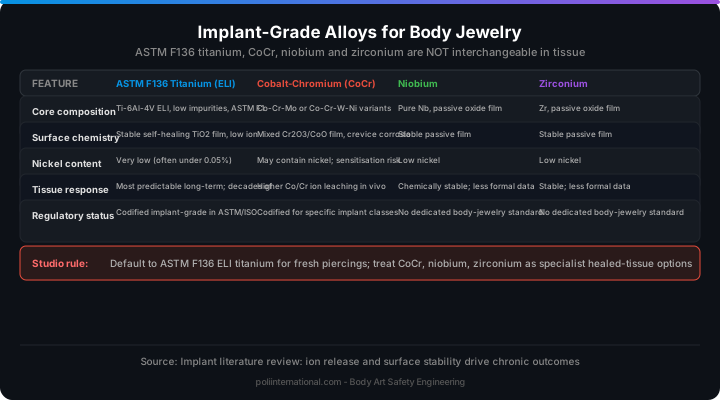
Comparison of ASTM F136 titanium, CoCr, niobium and zirconium for body jewelry
Infographic: Comparison of ASTM F136 titanium, CoCr, niobium and zirconium for body jewelry

1. Why Implant-Grade Alloys Matter More Than Ever in Body Jewelry

Across orthopaedic and dental implants, the last few years of biomaterials research have converged on one reality: metal ion release and long‑term surface stability drive most chronic complications more than bulk composition alone. Recent reviews of biomedical implant materials emphasize that even classically “biocompatible” metals can trigger inflammation, itching, and swelling when their corrosion products accumulate in surrounding tissue over years of service.Advancement in biomedical implant materials—a mini review This is the same tissue environment we work in with long‑term body jewelry—just with less formal regulation.

Modern implant literature now treats ASTM F136 titanium (ELI grade) as the baseline alloy for permanent load‑bearing implants because of its low modulus, excellent fatigue strength, and highly stable titanium dioxide passive film that sharply limits ion leaching.Implant biomaterials: A comprehensive review While most papers discuss hip stems and spinal hardware, the underlying physics—oxide stability in chloride‑rich fluid, protein adsorption, and mechanochemical wear—translate directly to barbells and labrets sitting in a piercing channel for decades. When long‑term implant failures are analyzed, journals like the Journal of Long‑Term Effects of Medical Implants consistently identify corrosion, fretting, and wear debris as root causes, not “wrong metal” in a simplistic sense.Journal of Long-Term Effects of Medical Implants

New critical reviews of biomedical implant materials hammer home a second point that should be front‑of‑mind for piercers: “stainless steel vs titanium” is not the real conversation anymore.Implant biomaterials: A comprehensive review The real differentiators are:

- How stable the passive surface film is in saliva, sweat, lymph, and blood.
- How much cobalt, chromium, nickel, vanadium, and aluminum are released under cyclic load.
- How consistently the alloy meets ASTM/ISO implant standards rather than generic industrial specifications.

Orthopaedic and dental implant studies under EU MDR show regulators moving toward tighter expectations for pre‑clinical and clinical testing of these properties, especially for high‑risk devices.Clinical investigations to evaluate high-risk orthopaedic devices Studios that care about healed outcomes should mirror this mindset: treat jewelry as a long‑term implant and demand the same level of alloy discipline orthopaedic surgeons expect.

---

2. How ASTM F136 Titanium Compares with CoCr, Niobium, and Zirconium in Tissue

Most of the recent work in implant journals still focuses on titanium and cobalt‑chromium alloys, with niobium and zirconium appearing more as specialty or experimental systems.Advancement in biomedical implant materials—a mini review For body jewelry, the key material features can be summarized as:

FeatureASTM F136 Titanium (ELI)Cobalt‑Chromium (CoCr)
Core compositionTi‑6Al‑4V ELI, low impurities; defined by ASTM F136 for surgical implantsTypically Co‑Cr‑Mo or Co‑Cr‑W‑Ni; multiple variants with different minor elements
Primary use in medicineHip stems, spinal implants, dental roots; standard load‑bearing, long‑term implantsFemoral heads, joint bearings, stents; high‑wear, high‑strength components
Surface chemistryStable TiO₂ passive film, self‑healing in vivo; low ion releaseMixed Cr₂O₃/CoO passive film; more sensitive to wear, crevice corrosion, and protein‑mediated breakdown
Nickel contentVery low (often <0.05%), below most sensitisation thresholdsMay contain nickel; sensitisation risk depends on grade and surface finish
Mechanical profileModerate modulus closer to bone; high fatigue resistanceHigh modulus and hardness; excellent wear resistance but higher stiffness mismatch with tissue
Regulatory statusExplicitly codified as implant‑grade in ASTM and ISO standardsCodified for specific implant classes; higher scrutiny for wear and ion release in articulating joints

Implant reviews consistently position ASTM F136 titanium as the “workhorse” alloy because it balances mechanical performance with minimal biological reactivity.Biomaterials as implants in the orthopedic field The extra‑low interstitial (ELI) specification caps oxygen, nitrogen, and iron to improve fatigue life and reduce microstructural defects—a benefit for jewelry stems and threads that face millions of micro‑movements in a piercing over years.

By contrast, cobalt‑chromium alloys are chosen in orthopaedics specifically for extreme wear situations—metal‑on‑polymer or metal‑on‑metal articulations—where hardness and abrasion resistance matter more than ion release.Advancement in biomedical implant materials—a mini review Multiple long‑term failure analyses have associated Co and Cr ion accumulation with inflammatory reactions and soft‑tissue changes near implants, especially when surface coatings or lubrication fail.Journal of Long-Term Effects of Medical Implants That doesn’t make CoCr “unsafe” in a general sense, but it underscores that this family of alloys is better suited to engineered, controlled bearing environments than to a new nostril piercing exposed to cosmetics and sebum.

Niobium and zirconium occupy an interesting middle ground. Both form stable passive oxide films (Nb₂O₅ and ZrO₂) and have decades of niche usage in pacemaker casings, dental implants, and experimental devices.Implant biomaterials: A comprehensive review They are attractive for jewelry because of:

- Very low nickel content.
- Excellent corrosion resistance.
- Visually distinctive anodized or heat‑treated surfaces.

However, unlike ASTM F136 titanium, neither has a widely adopted, body‑jewelry‑specific implant‑grade alloy standard comparable to F136. Where titanium has a clear regulatory and test framework, niobium and zirconium are supported more by scattered studies and industrial data. In practice, that means they are low‑risk but less fully characterized for every piercing scenario, especially in the context of emerging sensitisation and exposure limits.

For studios, the translation is straightforward:

- Treat ASTM F136 ELI titanium as your default first‑piercing alloy for any client with known or suspected metal sensitivity.
- Use CoCr with caution and only when you can trace the alloy back to medical‑device standards; prioritize healed piercings over fresh tissue.
- Position niobium and zirconium as advanced options for well‑healed piercings or clients who specifically request them, with clear conversation about the difference between “strong lab biocompatibility signal” and the robust long‑term dataset that exists for F136.

---

3. Technical and Regulatory Details Studios Should Track

Recent mini‑reviews and critical overviews of biomedical implant materials highlight a technical landscape that now matters for jewelry buyers: mechanistic corrosion science, ion release rates, and regulatory tightening under EU MDR and similar frameworks.Advancement in biomedical implant materials—a mini review

A few numbers and trends are directly relevant:

- Ion leaching and inflammation: Papers surveying metal implant complications report that long‑term implantation of alloys like stainless steel and CoCr can lead to inflammation, swelling, and pruritus due to gradual ion release into surrounding tissue.Advancement in biomedical implant materials—a mini review
- Passive film stability: Titanium’s TiO₂ layer is known to self‑repair rapidly when scratched in chloride‑rich solutions, limiting further dissolution; CoCr’s mixed oxide layers show more complex breakdown behavior when exposed to proteins and fluctuating pH.Implant biomaterials: A comprehensive review
- Osseointegration and soft‑tissue integration: Orthopaedic and dental studies show that micro‑roughened titanium surfaces, produced by blasting and etching, can accelerate bone ongrowth and soft‑tissue sealing—an indication that surface topography and chemistry can be tuned to improve piercing channel stability.Biomaterials as implants in the orthopedic field

On the regulatory side, the EU Medical Device Regulation (MDR) has pushed manufacturers toward more rigorous pre‑clinical and clinical data, especially for high‑risk orthopaedic devices.Clinical investigations to evaluate high-risk orthopaedic devices That tightening indirectly affects studios in two ways:

1. Alloy traceability: Medical‑grade titanium producers are increasingly documenting batch chemistry, mechanical properties, and surface treatments to satisfy MDR and ISO expectations. Jewelry houses that buy from these mills can, in turn, supply piercers with detailed certificates of conformity (CoC) instead of vague “medical titanium” claims.
2. Standard alignment: While there is not yet a dedicated ASTM or ISO standard for “body jewelry alloys,” the smart move is to align with the implant‑grade standards already codified—ASTM F136 for titanium, corresponding ISO titanium implant grades, and well‑defined CoCr specifications—and avoid industrial alloys with unknown impurity profiles.Implant biomaterials: A comprehensive review

For studios, that translates into concrete purchasing and documentation practices:

- Require ASTM F136 ELI or equivalent ISO designations on titanium jewelry invoices for initial piercings.
- Ask for full alloy designations (e.g., Co‑Cr‑Mo grade with standard reference) rather than generic “cobalt chrome steel” descriptions when stocking specialty pieces.
- Treat supplier documentation—material certificates, batch test reports, and surface‑finish notes—as part of your infection‑control and consent framework, not just back‑office paperwork.

This mindset matches how implant journals now link pre‑clinical materials testing with clinical outcomes: failures are often traced back to undocumented material variation, uncontrolled surface roughness, or uncharacterized coatings rather than headline alloy names.Journal of Long-Term Effects of Medical Implants

---

4. Patrick's Note: Where Studios Quietly Outperform Implants—and Where They Don’t

What I’ve seen in studios that take metallurgy seriously is surprisingly encouraging: the best piercing rooms are already ahead of some legacy medical device practices in how they standardize on ASTM F136 titanium for fresh tissue and keep stainless and CoCr in the background for very specific uses. That instinct lines up neatly with the implant literature’s long‑term findings on ion release and chronic tissue reactions, even if no one in the studio is actively reading orthopaedic journals.

From a supply chain perspective, the weak link isn’t the alloy itself—it’s the documentation. Orthopaedic implant makers live and die by batch chemistry reports and fatigue data; many jewelry suppliers still operate on “trust us, it’s medical.” Over the next few years, I expect studios to start demanding and filing alloy certificates with the same seriousness they bring to sterilization logs. When that happens, the gap between formal implant‑grade alloys and generic industrial metals sold as body jewelry will get very bright, very fast, and both piercers and clients will benefit.

---

5. FAQ: Technical Q&A

Q: For initial piercings, is there any reason to choose CoCr over ASTM F136 titanium?
No. For fresh tissue, ASTM F136 ELI titanium offers a more stable passive surface and lower documented ion release than CoCr, with decades of implant data backing its long‑term biocompatibility. CoCr’s strengths are in high‑wear, articulating implants, not in static jewelry sitting in a new piercing channel. In practice, CoCr should be reserved for very specific, healed‑tissue jewelry applications where its hardness is uniquely valuable.

Q: How should studios think about niobium and zirconium compared to F136 titanium?
Niobium and zirconium are chemically stable, passive‑film‑forming metals with low nickel content and good corrosion resistance, making them attractive for sensitive clients. However, they lack the extensive, standardized implant‑grade frameworks and decades of clinical data that exist for F136 titanium. Studios should treat them as promising low‑risk options for well‑healed piercings, not as replacements for F136 in high‑risk or initial piercings.

Q: Does ASTM F136 ELI titanium make a practical difference compared to generic “grade 5” titanium in jewelry?
Yes. ASTM F136 ELI places strict limits on interstitial elements like oxygen and nitrogen and requires specific mechanical properties and microstructural quality for implants. Generic “grade 5” titanium may meet similar bulk chemistry but not the tighter impurity and fatigue requirements, which matter for long‑term stability of threads, hinge points, and thin stems in body jewelry. For initial piercings and long‑term wear, studios should specify ASTM F136 ELI rather than relying on generic grade labels.

---

Conclusion: Standardize on Implant-Grade Titanium, Treat Other Alloys as Specialist Tools

The emerging consensus from orthopaedic, dental, and regulatory literature is clear: stable passive oxide films, controlled ion release, and documented alloy quality drive long‑term implant success far more than brand labels or marketing claims.Implant biomaterials: A comprehensive review For body jewelry, that means the safest default is still ASTM F136 ELI titanium for fresh piercings and high‑risk clients, with CoCr, niobium, and zirconium positioned as specialist materials used deliberately, with full knowledge of their strengths and gaps.

Studios that align their material choices with implant‑grade standards, demand real alloy documentation, and train staff on the practical differences between F136 titanium and other metals will be better equipped to minimize sensitisation, chronic irritation, and unexplained healing issues over the long term.Advancement in biomedical implant materials—a mini review

Mind map · Implant-Grade Alloys for Body Jewelry: What the Latest Implant Science Really Changes for Studios

  • Implant-Grade Body Jewelry Alloys
    • Alloy Biocompatibility Drivers

      Metal ion release and long-term surface stability drive most chronic complications from body jewelry more than bulk composition alone

      • Surface Oxide Stability
      • Metal Ion Release
        • Chronic Tissue Inflammation
    • ASTM F136 Titanium Baseline

      ASTM F136 titanium ELI grade remains the safest default material for fresh piercings due to its stable protective passive oxide layer

      • ELI Specification Purity
        • Low Interstitial Impurities
      • Protective Oxide Shield
        • Rapid Self-Healing Passivation
    • Cobalt Chromium Leaching Risks

      Cobalt-chromium alloys exhibit higher cobalt and chromium ion leaching in tissue, making them unsuitable for fresh piercings

      • Stiffness and Modulus Mismatch
      • In Vivo Ion Leaching
        • Inflammatory Soft-Tissue Damage
    • Niobium and Zirconium Standards

      Niobium and zirconium lack formal implant-grade alloy standards for body jewelry, so studios must treat them as not fully characterized

      • Chemically Stable Oxides
      • Low-Risk Specialist Options
    • Studio Quality Assurance Protocols

      Evolving medical implant regulations require piercing studios to demand batch-specific material test reports and mill certificates from jewelry suppliers

      • Alloy Traceability Records
        • Batch Mill Certificates
      • Rigorous Supplier Audits
StructureProcessMaterialHazard

5 branches, 0 sources. Each branch cites the article it came from; the labels beneath it are names, not claims.

Alloy Biocompatibility Quiz

  1. 1. What factor is primary in driving chronic complications like inflammation, itching, and swelling near long-term implanted metals?

    • ✓ Metal ion release and surface film instability over long periods in surrounding tissue. — Chronic tissue reactions are primarily driven by the accumulation of corrosion products and ion leaching over time rather than initial bulk chemistry alone.
    • • The total bulk volume of the metal hardware regardless of corrosion rates. — Complications stem from chemical breakdown and surface interaction at the interface rather than the physical volume of the implanted metal.
    • • High magnetic susceptibility causing localized micro-currents in fluid. — Magnetic properties do not drive the long-term inflammatory response associated with biological tissue exposure to metals.
    • • The total absence of trace alloying elements like aluminum or vanadium. — Minor alloying additions do not inherently prevent complications; surface stability and controlled release dictate biological response.
  2. 2. What key mechanical and structural advantage does the Extra Low Interstitial (ELI) designation provide in ASTM F136 titanium?

    • ✓ It caps oxygen, nitrogen, and iron impurities to enhance fatigue resistance and reduce microstructural defects. — Controlling interstitial elements improves structural integrity and durability against cyclic micro-movements in long-term wear.
    • • It completely removes aluminum and vanadium from the core titanium matrix. — ASTM F136 is a Ti-6Al-4V ELI alloy, meaning aluminum and vanadium remain essential components of its bulk chemistry.
    • • It significantly increases hardness so the metal matches the stiffness of cobalt-chromium. — The ELI standard is designed to optimize defect limits and fatigue strength rather than dramatically increase material stiffness.
    • • It enables the alloy to bypass forming a passive titanium dioxide layer during healing. — The passive titanium dioxide layer is the primary protective mechanism that makes the alloy biocompatible in tissue.
  3. 3. How does the passive surface film of ASTM F136 titanium differ from that of Cobalt-Chromium (CoCr) alloys in physiological fluid?

    • ✓ Titanium forms a self-healing titanium dioxide layer, whereas CoCr forms a mixed oxide film more prone to wear and protein-mediated breakdown. — The titanium dioxide passive layer rapidly repairs itself in chloride-rich fluids, providing superior long-term stability against biological breakdown.
    • • CoCr forms a self-healing titanium dioxide layer, while titanium relies on an unstable chromium oxide coating. — Cobalt-chromium alloys form chromium and cobalt oxides rather than titanium dioxide.
    • • Titanium generates a highly soluble iron oxide surface that dissolves continuously in saliva and lymph. — Titanium oxide is extremely insoluble and forms a protective barrier that limits metal dissolution.
    • • Both alloys form identical oxide films, but CoCr reacts faster with dissolved oxygen to increase bulk thickness. — The chemical compositions of the oxide films are distinct, leading to different corrosion and wear behaviors in vivo.
  4. 4. Why are Cobalt-Chromium (CoCr) alloys considered suitable for high-wear orthopedic joints but unsuitable for fresh body piercings?

    • ✓ CoCr releases higher levels of cobalt and chromium ions under load, increasing the risk of localized tissue inflammation in unhealed wounds. — High ion leaching in unhealed, reactive tissue environments can trigger acute sensitization and chronic irritation.
    • • CoCr lacks sufficient structural hardness to maintain thread integrity on body jewelry stems. — CoCr is exceptionally hard and wear-resistant, which is precisely why it is selected for high-friction joint bearings.
    • • CoCr dissolves immediately when exposed to normal human body temperature and sebum. — CoCr is chemically resistant, but its corrosion products under cyclic load can accumulate and irritate sensitive healing channels.
    • • CoCr has an elastic modulus much lower than biological soft tissue, causing mechanical sagging. — CoCr exhibits a very high modulus and stiffness compared to biological soft tissue, not a low one.
  5. 5. Why should studios classify Niobium and Zirconium as 'low-risk, not fully characterized' options rather than direct equals to ASTM F136 titanium?

    • ✓ They lack dedicated, widely adopted implant-grade alloy standards and extensive long-term clinical datasets specific to body jewelry. — While chemically stable and corrosion-resistant, these metals do not possess the standardized manufacturing and testing framework established for F136 titanium.
    • • They contain high levels of nickel that consistently exceed safety thresholds for sensitive clients. — Niobium and zirconium are known for having very low nickel content and high intrinsic chemical stability.
    • • They break down rapidly when exposed to standard saline solutions and human lymph. — Both metals develop strong passive oxide films (niobium oxide and zirconium oxide) that grant high corrosion resistance.
    • • They cannot be safely sterilized using standard studio autoclave equipment without structural failure. — Autoclave sterilization does not compromise the bulk chemical integrity or oxide stability of niobium or zirconium.
  6. 6. How does regulatory tightening under the European Medical Device Regulation (EU MDR) practically benefit body jewelry studios?

    • ✓ It encourages mills to supply detailed certificates of conformity tracking batch chemistry, mechanical properties, and surface finish. — Increased medical regulatory scrutiny drives upstream producers to document material origin and quality, providing verifiable data for jewelry buyers.
    • • It requires body jewelry studios to submit individual clients' healing logs directly to medical regulatory bodies. — Medical device regulations apply to device manufacturers and material supply chains, not individual piercer consent or studio records.
    • • It mandates the complete replacement of titanium alloys with medical-grade stainless steel across all studio inventory. — EU MDR tightens documentation and testing for all high-risk devices rather than favoring legacy stainless steel over titanium.
    • • It eliminates the requirement for studio sterilization logs by certifying pre-packaged jewelry at the mill. — Material batch documentation complements studio infection control practices rather than replacing sterilization procedures.
  7. 7. What mechanical characteristic gives ASTM F136 titanium an advantage over Cobalt-Chromium alloys when placed in soft tissue piercing channels?

    • ✓ A lower elastic modulus that provides a closer mechanical match to biological tissue. — A modulus closer to natural tissue reduces mechanical stress concentration and stiffness mismatch during body movement.
    • • An extremely high hardness that completely prevents micro-movements under stress. — Excessive hardness increases stiffness mismatch, whereas moderate elasticity is more compatible with surrounding tissue.
    • • High magnetic permeability that stabilizes cell membranes near the piercing site. — Biocompatibility in titanium is governed by oxide stability and mechanical properties rather than magnetic properties.
    • • An elevated thermal expansion rate that causes the metal to expand tightly in the piercing channel. — Thermal expansion inside the body is negligible and does not drive tissue compatibility or mechanical fit.
  8. 8. Why is generic 'Grade 5' titanium inadequate as a guaranteed substitute for ASTM F136 ELI titanium in initial piercings?

    • ✓ Generic Grade 5 titanium may share bulk chemistry but lacks the strict impurity caps and fatigue performance required by surgical implant standards. — The ELI designation imposes tight limits on interstitials like oxygen and iron, which directly impact defect rates and fatigue strength in long-term wear.
    • • Generic Grade 5 titanium contains up to 10% nickel to improve its workability and threading ease. — Titanium Grade 5 (Ti-6Al-4V) is a titanium-aluminum-vanadium alloy and does not contain nickel as an intentional alloying addition.
    • • Generic Grade 5 titanium cannot form a protective passive oxide film on its outer surface. — All titanium alloys form protective oxide layers, but defect density and structural purity differ based on standard specifications.
    • • Generic Grade 5 titanium dissolves completely when exposed to mild acidic cleansers or oral saliva. — Titanium Grade 5 is highly corrosion-resistant, but its higher impurity thresholds make it less controlled for implant applications.
  9. 9. What tissue response can be promoted by applying micro-roughened surface topographies (such as blasting and etching) to titanium implants?

    • ✓ Accelerated soft-tissue integration and enhanced cellular attachment along the implant surface. — Tailoring surface topography can encourage favorable biological responses, aiding tissue sealing and stabilization around the metal channel.
    • • Increased release of free metal ions directly into the bloodstream due to surface destruction. — Controlled roughening alters topography to support cell adhesion without destabilizing the underlying passive film.
    • • Immediate systemic allergic sensitization to titanium dioxide particles. — Micro-roughening is used specifically to enhance biological integration rather than trigger immune rejection.
    • • Complete breakdown of the metal's fatigue strength resulting in immediate stem fracturing. — Proper surface processing techniques are engineered to preserve bulk mechanical properties while optimizing the tissue interface.
  10. 10. What practical purchasing and application strategy is recommended for studios handling non-titanium alloys like CoCr, Niobium, or Zirconium?

    • ✓ Default to ASTM F136 ELI titanium for initial piercings, reserving other alloys for well-healed tissue with informed consent. — Standardizing on F136 titanium minimizes risk during healing, while allowing specialized materials to be used safely once tissue channels mature.
    • • Use Cobalt-Chromium exclusively for fresh nostril and oral piercings to maximize scratch resistance. — CoCr's potential for ion leaching under load makes it less suitable for fresh, unhealed tissue exposed to body fluids.
    • • Treat Niobium and Zirconium as full replacements for ASTM F136 titanium in high-risk initial piercings. — The lack of formal implant-grade standards for these materials means they should be used deliberately rather than as direct initial substitutes.
    • • Mix industrial grade alloys with medical titanium to balance material cost across studio stock. — Uncharacterized industrial metals with unknown impurity profiles pose unpredictable risks to tissue health.

Extended Reference Table

8 of 8 rows

Extended reference table generated from the article and its verified research sources. Bracketed numbers jump to the matching entry in the Technical References below.

SafetyItem, Material, Practice or Standard Primary Application or Function Core Composition Mechanical Properties Standards, Compliance or Specification Biocompatibility and Clinical Performance Source
✅ASTM F136 (Ti-6Al-4V ELI)Surgical implants, dental roots, hip stems, and gold standard for fresh piercings.Titanium alloy: 5.5–6.5% Al, 3.5–4.5% V, O ≤ 0.13%, Fe ≤ 0.25%, Ni < 0.05%.Young's modulus: 110–114 GPa; Tensile strength: 860 MPa min; Ductility: 8–12% elongation.ASTM F136-13(2021); ISO 5832-3:2021; UNS R56401; EU MDR.Excellent biocompatibility; forms stable TiO2 layer; measurable Al (0.3–0.8 ppb) and V (0.1–0.4 ppb) release.[6], [7], [8]
✅Commercially Pure (CP) TitaniumMedical implants (Grades 1-4), dental bodies, and initial body piercings.Unalloyed titanium (Grades 1-4) with varying oxygen/iron content; nickel-free.Yield Strength: 170–480 MPa; softer and more ductile than F136; more difficult to polish.ASTM F67; ISO 5832 series.Most corrosion resistant; 92.5-97% success rate in dental use; supports expulsion of secretions.[7], [8]
✅316L / 316LVM Stainless SteelVacuum arc remelted wrought steel for surgical implants and body jewelry.Iron-based alloy; Ni 10.0–15.0 wt%, Cr 16.0–18.0 wt%, C max 0.03 wt%.Elastic Modulus: ~200 GPa; Fatigue endurance: ~260 MPa; stable Cr2O3 passive layer.ASTM F138-19; ISO 5832-1:2016; ISO 10993.Risk of pitting/crevice corrosion; nickel leaching can trigger allergic contact dermatitis in 10-17% of users.[7], [8]
✅Cobalt-Chromium (CoCrMo) AlloysHigh-load articulating surfaces, hip bearings, and high-fatigue piercing jewelry.Cobalt base with Cr 26.0–30.0 wt% and Mo 5.0–7.0 wt%; may contain nickel.Elastic Modulus: ~230 GPa; Fatigue endurance: ~600 MPa; high hardness.ASTM F1537-20.Metallosis risk; higher ion leaching (Co/Cr) associated with inflammatory reactions.
✅Pure Niobium (Nb)Implant-grade jewelry material and pacemaker casings.99.9% Niobium minimum; very low nickel content.Pliable; forms Nb2O5 passive layer; naturally anodisable into various colors.ASTM B392.Chemically stable and well-accepted; excellent biocompatibility often overlooked.[7], [8]
✅Tantalum (Ta) and Ti-Ta AlloysPorous scaffolds for bone ingrowth and load-bearing orthopedic implants.Pure Ta or Ti with 10–65 wt.% Tantalum.Young's modulus: 65–96 GPa; Tensile strength: 575–1076 MPa; Fatigue limit: 440 MPa.ISO 13485; ISO 10993; FDA 510(k).50–67% lower metal ion elution than F136; promotes 40–60% bone ingrowth.[6]
✅Solid Gold (14K - 18K)Initial piercing jewelry and decorative medical components.58.3% (14K) to 75% (18K) Gold; alloyed with Ag or Cu; Ni/Cd-free.Softness increases with purity; 18ct is more chemically inert than 14ct.ISO 8654.Biocompatible if alloyed correctly; 14K carries higher sensitisation risk than 18K.[7]
✅Glass (Borosilicate / Soda-lime)Initial jewelry for healing piercings and medical applications.Lead-free borosilicate, soda-lime, or fused quartz glass.Inert; withstands autoclave sterilization; Ra approaches < 0.5 µin.ASTM F1538.Non-porous and non-reactive; exceeds standard smoothness goals for initial healing.[7], [8]

Free Body Art Wall Posters

Print-ready reference posters for your studio or your own wall. Free to download and display, embed on your own site with attribution. Click any poster to preview it full size before downloading.

Choose and download all 40 posters

Technical_References_Archive

About the Author

PP

Patrick Poli

Chief Engineer, Poli International · Creator of BioFlex® body jewelry

Patrick has spent 25+ years manufacturing body jewellery and studio equipment, and is the creator of BioFlex® body jewelry. He made custom titanium body jewellery in metric sizes the market still does not offer, because manufacturers stop at 2 mm steps and a piercing rarely fits a round number. He also was commissioned for titanium parts for the Wallace & Gromit films, and titanium fittings used as duffel-coat fastenings by a Savile Row house.

More about Patrick →

Last reviewed: 2026-10-13 · Published: 2026-07-31

Related Tools & Reading

Continue Reading

Implant-Grade Metals: What This Month’s Research Means For Body Jewelry▶
Tech Watch
🎧 Audio

Implant-Grade Metals: What This Month’s Research Means For Body Jewelry

This article explains how recent implant metallurgy research on ASTM F136 titanium, cobalt-chrome, niobium, and zirconium is tightening expectations around alloy chemistry, oxide stability, and surface finish for long-term biocompatibility. It translates those findings into practical guidance for piercers and studio owners on choosing genuine implant-grade body jewelry and demanding process-level transparency from suppliers.

2026-08-07

Read Journal →
ASTM F136 Titanium Explained: What It Really Guarantees▶
Tech Watch
🎧 Audio

ASTM F136 Titanium Explained: What It Really Guarantees

This article explains why ASTM F136 Ti‑6Al‑4V ELI titanium is the only widely available alloy with a fully validated implant‑grade specification for piercing jewelry, focusing on its controlled interstitial chemistry, nickel‑free composition, and decades of orthopedic biocompatibility data. It translates recent findings on titanium–tantalum alloys, nickel release thresholds, and dermatology research into concrete guidance for piercers and studio owners choosing metals for sensitised clients and long‑term wear.

2026-09-07

Read Journal →
ASTM F136 Implant-Grade Titanium▶
Tech Watch
🎧 Audio

ASTM F136 Implant-Grade Titanium

This article explains how the 2026 revision of ASTM F136 defines true implant-grade Ti‑6Al‑4V ELI (Grade 23) titanium, and compares it with CoCr, niobium, and titanium–zirconium alloys in terms of chemistry, mechanical performance, and sensitisation risk for body jewelry. It translates orthopedic implant standards into concrete studio rules for choosing bar stock, managing nickel allergy, and deciding when alternative alloys are justified.

2026-08-17

Read Journal →