Shop
Polymer Science

Metal-on-Metal Implants: What the Hip Replacement Lesson Teaches Body Jewellery

PP

Chief Engineer

Patrick Poli

Journal Date

2026-08-01

Last Reviewed

2026-09-22

Metal-on-Metal Implants and the Body Jewellery Lesson

Key Takeaways:

» Metal-on-metal (MoM) hip implants used a cobalt-chromium ball riding in a cobalt-chromium socket, and wear plus corrosion at that bearing released metal ions and particles into surrounding tissue
» The clinical consequence, adverse reaction to metal debris (ARMD), includes soft-tissue damage, pain, implant loosening, pseudotumours, and the need for revision surgery
» Tribocorrosion, the combined action of mechanical wear and electrochemical corrosion, is the mechanism that generated the debris; it applies to any metal rubbing against metal in a biological environment
» In body jewellery, metal-on-metal contact occurs in threaded jewellery connections, hinged pieces, and layered rings, and the same ion-release physics applies at a smaller scale
» Cobalt and chromium are the ions regulators and clinicians monitor; for sensitised individuals, even low-level release from jewellery can drive allergic contact dermatitis
» The implant lesson is why material selection matters: a single-metal or polymer-on-metal interface, and implant-grade alloys, reduce the debris load compared with mismatched metals in motion
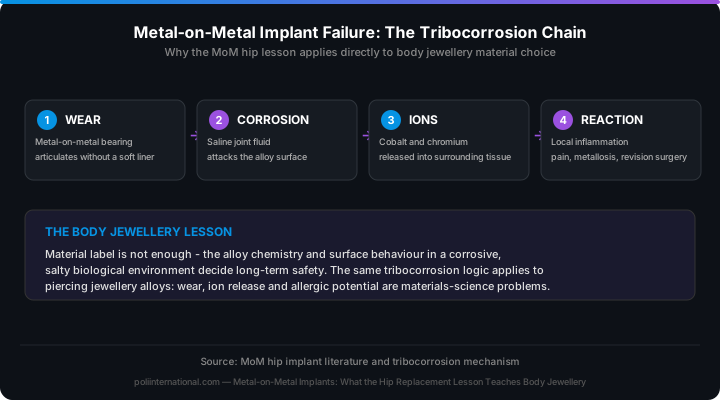
Metal-on-metal implant failure chain: wear, corrosion, ion release, and tissue reaction
Infographic: Metal-on-metal implant failure chain: wear, corrosion, ion release, and tissue reaction

1. What Metal-on-Metal Implants Were Supposed to Do

Earlier metal-on-polyethylene designs wore over time, shedding plastic debris that triggered osteolysis, the progressive destruction of bone around the implant.

A MoM hip implant uses a cobalt-chromium-molybdenum alloy ball that articulates directly inside a cobalt-chromium-molybdenum socket, with no polymer liner in between. The bearing surfaces are engineered to be extremely hard and smooth, and the design relies on a thin film of joint fluid to separate the two metal surfaces during normal motion.

Hundreds of thousands of patients received MoM hips worldwide before the failure pattern became undeniable. By the early 2010s, regulators including the FDA, the UK MHRA, and Health Canada had issued alerts, and many MoM systems were withdrawn from the market.

2. The Failure Mechanism: Wear, Corrosion, and Ions

The failures were driven by tribocorrosion: the combined action of mechanical wear and electrochemical corrosion on the same surface. In the body, the cobalt-chromium bearing is immersed in saline joint fluid, a corrosive electrolyte. Every step applies cyclic load that rubs the two metal surfaces together. The rubbing strips the protective oxide film from the metal surface, and the exposed metal corrodes, releasing ions and generating particles. The corrosion products repassivate the surface, only to be stripped again at the next cycle.

This wear-corrosion cycle produced two distinct hazards. The first was metal particles and ions entering the bloodstream: cobalt and chromium were measured at elevated levels in the blood of many MoM patients. The second was a local soft-tissue reaction now called adverse reaction to metal debris, or ARMD. In some patients the body mounted an immune response to the metal debris that produced pain, swelling, fluid collections, and pseudotumours, non-cancerous but destructive masses of inflamed tissue around the joint. The FDA describes the cascade plainly: soft tissue damage may lead to pain, implant loosening, device failure, and the need for revision surgery, in which the old device is removed and replaced.

Regulators responded with monitoring protocols. The UK MHRA issued medical device alerts recommending blood tests for cobalt and chromium and imaging for patients with painful MoM implants. Patients with progressing adverse local tissue reactions were advised to consider earlier revision to prevent extensive damage to bone, muscle, and nerves.

3. What This Means for Body Jewellery

Body jewellery operates at a much smaller scale than a hip implant, but it is the same physics. The earring back rubbing against the post, a hinged ring closing and opening, two stacked rings sliding against each other, a threaded ball seating against the barbell end: every one of those is a metal-on-metal interface in a saline biological environment. Tribocorrosion does not switch off at smaller dimensions; it just generates proportionally smaller debris loads.

For most people, the debris from jewellery-scale contact is negligible and clinically silent. But the implant record matters for two groups. The second is anyone with a healing piercing, where the tissue is already inflamed and more permeable to anything the jewellery releases.

Contact typeMaterial pairingDebris riskClinical relevance
Threaded barbell endTitanium on titaniumLowMinimal for non-sensitised wearers
Hinged ringSteel on steelModerateCan irritate a healing piercing
Stacked ringsSteel on goldHigherGalvanic plus wear effects; risk for sensitised skin
Implant ball jointCo-Cr on Co-CrHigh (orthopaedic)The MoM lesson: avoid metal-on-metal in load-bearing sites

This is why the professional standard for initial piercings is a single-material implant-grade piece, and why polymer jewellery exists. A polymer or single-metal interface removes the metal-on-metal contact entirely. Our metallurgy guide on 316L versus titanium walks through which alloys leach least, and the titanium versus surgical steel comparison explains the practical differences for daily wear.

4. Why Material Science Matters More Than the Label

The MoM implant episode is a useful corrective because it shows what happens when a material is chosen for hardness and marketed on promises while the electrochemical reality of the body is ignored. The cobalt-chromium alloy in those hips is an excellent metal: hard, corrosion-resistant in isolation, and perfectly fine as a single material. It failed as a bearing because articulation destroyed the surface and corrosion followed.

Body jewellery manufacturers who understand tribocorrosion design around it: they use implant-grade titanium for initial piercings, single-metal construction, and polymer options where flexibility or non-conductive properties matter. They avoid unnecessary metal-on-metal contact in high-friction locations. The materials story is not about avoiding metal; it is about understanding which metal, in which configuration, against which counterface, and for which wearer.

From the Chief Engineer's Workbench

Patrick Poli · 25+ years in body-jewellery manufacturing

Patrick's Deep Archive

I have spent my career working with instrument-grade materials and skin contacts, and I watched the metal-on-metal implant story unfold with a sense of deja vu. In manufacturing, we learned decades ago that you never run two bare metal surfaces against each other in a corrosive environment without a plan for the wear debris. That is why industrial bearings use lubricants, coatings, or dissimilar material pairs, and it is why the hip implant failure was, in hindsight, predictable. The body is the most corrosive environment we ever shipped into, and there is no maintenance schedule.

What the implant episode taught me for body jewellery is that the counterface matters as much as the material. A perfectly good titanium post against a steel ring is no longer a titanium product; it is a galvanic couple with a wear interface. I have seen clients with chronic irritation from stacking metals who assumed the problem was the cheaper piece, when the real problem was the interface between the two. Choose a single metal per piercing, prefer implant-grade alloys, and let polymer jewellery carry the load where metal-on-metal is unavoidable. The hip implant lesson cost orthopaedics billions; in body jewellery it costs you nothing to apply.

PPPatrick PoliChief Engineer · Creator of BioFlex® body jewelry

6. FAQ

Does my body jewellery release cobalt and chromium like a hip implant?

At a far smaller scale, yes: any metal in contact with skin releases some ions, and steel alloys contain nickel, chromium, and sometimes trace cobalt. For a normal wearer with a single metal piece, the load is negligible. For someone with metal allergy or a healing piercing, implant-grade titanium or polymer eliminates the concern.

Is metal-on-metal jewellery always bad?

No. Threaded titanium-on-titanium connections are standard and safe, and most jewellery-scale metal contact produces no measurable effect. The caution applies to mismatched metals, hinged or stacked pieces in high-friction locations, and healing piercings where tissue is inflamed.

What metals should I choose if I have a metal allergy?

Implant-grade titanium is the most reliable choice, followed by niobium and 14k or 18k gold that is nickel-free. Surgical steel is often called hypoallergenic but can still release nickel in sensitised individuals. Polymer jewellery removes the metal variable entirely. See our nickel allergy and piercing data guide for the regulatory detail.

Does polymer jewellery prevent metal-on-metal contact?

Yes, and that is one of its core design advantages. A polymer post and ball have no metal-on-metal interface and no galvanic couple, which makes it the safest choice for healing piercings, sports, and people with metal sensitivities. Our BioFlex sports piercings article covers why athletes switched.

Should I worry about my existing steel jewellery after reading this?

For most people, no. Decades of body jewellery use have not produced an ARMD-style epidemic because the scale and load are completely different from a hip bearing. The practical takeaways: prefer implant-grade single-metal pieces for new piercings, avoid stacking mismatched metals in healing tissue, and switch to titanium or polymer if you develop irritation or know you are sensitised.

Conclusion

Metal-on-metal hip implants were a well-intentioned engineering answer that failed in the body because tribocorrosion, wear plus corrosion, released cobalt and chromium into tissue and blood, driving soft-tissue damage and revision surgery in a significant minority of patients. The physics behind that failure is the same physics at work in every metal-on-metal jewellery contact, scaled down. The lesson is not to fear metal; it is to choose it intelligently: implant-grade single-metal construction for healing piercings, polymer where metal-on-metal is avoidable, and awareness of what your jewellery is made of and how it contacts your skin. The body does not read marketing labels; it reads electrochemistry.

Mind map · Metal-on-Metal Implants: What the Hip Replacement Lesson Teaches Body Jewellery

  • Hip Implant Lessons for Jewelry
    • MoM Hip Implant Complications

      Metal-on-metal hip implants generate wear debris that releases cobalt and chromium ions, causing tissue damage and device failure.

      • Adverse Local Tissue Reactions
        • Pseudotumors and Muscle Necrosis
        • Severe Local Bone Osteolysis
      • Systemic Metal Toxicity Risks
        • Elevated Blood Cobalt Levels
    • Tribocorrosion Degradation Mechanism

      Tribocorrosion combines mechanical wear and chemical corrosion to strip protective oxide films from metal surfaces in biological environments.

      • Cyclic Mechanical Wear
        • Oxide Film Stripping Cycles
      • Electrochemical Aqueous Corrosion
        • Saline Joint Fluid Electrolyte
    • Jewelry Scale Tribocorrosion

      Mechanical contact between moving body jewelry components under biological conditions triggers proportional metal wear and ion release.

      • Mismatched Metal Galvanic Couples
        • Titanium Post Steel Ring
      • Body Jewelry Wear Interfaces
        • Threaded Barbell Connections
        • Stacked Sliding Rings
    • Implant-Grade Single Materials

      Initial piercings require biocompatible single-metal titanium or polymer jewelry to prevent localized inflammation and galvanic corrosion.

      • Implant-Grade Titanium Jewelry
      • Certified Biocompatible Polymers
        • BioFlex Polypropylene Random Copolymer
StructureProcessMaterialHazard

4 branches, 0 sources. Each branch cites the article it came from; the labels beneath it are names, not claims.

Tribocorrosion Quiz

  1. 1. What specific combination of processes defines tribocorrosion in a metal-on-metal biological interface?

    • ✓ Mechanical wear stripping protective oxide films combined with electrochemical corrosion in saline fluid. — Tribocorrosion occurs when mechanical rubbing strips protective oxide films, allowing electrochemical corrosion in saline body fluid to continuously generate ions and particles.
    • • Microbial degradation of metal alloys occurring alongside physical thermal expansion. — Tribocorrosion relies on mechanical friction and electrochemical wear in fluids, rather than thermal expansion or microbial action.
    • • Chemical leaching of heavy metals caused solely by high biological acidity without friction. — Tribocorrosion requires the combined action of mechanical wear and corrosion, not purely static chemical leaching without friction.
    • • Galvanic destruction triggered exclusively by direct radiation exposure in joint fluid. — Tribocorrosion is driven by mechanical rubbing and electrochemical corrosion in saline, not by radiation exposure.
  2. 2. What was the primary driver for transitioning from early metal-on-polyethylene hip implants to metal-on-metal (MoM) designs?

    • ✓ Plastic debris from polyethylene wore down over time and triggered osteolysis, the destruction of bone. — Metal-on-polyethylene designs shed plastic wear debris over time, triggering osteolysis and progressive bone destruction around the implant.
    • • Polyethylene liners frequently dissolved when exposed to natural saline joint fluid. — Polyethylene liners wore down mechanically into shedding debris rather than chemically dissolving in fluid.
    • • Metal-on-polyethylene designs produced high levels of systemic cobalt and chromium toxicity. — Systemic metal ion toxicity was the outcome of the later metal-on-metal implants, not the earlier metal-on-polyethylene implants.
    • • Polymer liners caused severe allergic contact dermatitis in the majority of patients. — Bone destruction from plastic debris was the key failure driver of metal-on-polyethylene implants, not skin contact dermatitis.
  3. 3. According to the source, which two metal ions are primarily monitored by regulators and clinicians following metal-on-metal wear?

    • ✓ Cobalt and chromium — Regulators monitor cobalt and chromium ions because these are released during the tribocorrosion of cobalt-chromium-molybdenum alloy joint components.
    • • Titanium and niobium — Titanium and niobium are biocompatible materials used in jewellery, not the primary metals monitored in metal-on-metal hip implant wear.
    • • Nickel and gold — While nickel is a common allergen in steel jewellery, cobalt and chromium are the primary ions measured and monitored in hip implant patients.
    • • Copper and zinc — Copper and zinc are not the structural alloy components monitored in orthopaedic metal-on-metal joint implants.
  4. 4. In body jewellery, which material contact pair presents the highest risk of debris release and skin irritation due to combining wear with galvanic effects?

    • ✓ Steel on gold (stacked rings) — Stacking steel on gold combines mechanical sliding wear with a galvanic couple between dissimilar metals, producing the highest debris and irritation risk.
    • • Titanium on titanium (threaded barbell end) — Titanium-on-titanium threaded connections involve identical implant-grade metals and carry a low debris risk for non-sensitised wearers.
    • • Polymer on titanium (flexible labret) — Polymer interfaces remove metal-on-metal friction and galvanic couples entirely, resulting in minimal risk.
    • • Niobium on niobium (single metal ring) — Single-metal constructions avoid galvanic coupling, keeping debris risk lower than mismatched metal pairings.
  5. 5. What is an Adverse Reaction to Metal Debris (ARMD) in the context of metal-on-metal joint implants?

    • ✓ A local soft-tissue response causing pain, swelling, fluid collections, and non-cancerous pseudotumours. — Adverse reaction to metal debris (ARMD) involves immune-driven tissue inflammation, pain, fluid collections, and non-cancerous pseudotumours surrounding the joint.
    • • A systemic neurological shutdown triggered by acute metal poisoning in the bloodstream. — ARMD is a localized soft-tissue immune reaction to metal particles, rather than a systemic neurological shutdown.
    • • An autoimmune bone-growth surge that permanently fuses the joint socket to the bearing ball. — Metal debris causes destructive inflammation and bone loss leading to implant loosening, rather than promoting abnormal bone growth or joint fusion.
    • • A rapid bacterial infection that corrodes metal surfaces into toxic liquid compounds. — ARMD is driven by tribocorrosion and the host immune response to metal debris, not by bacterial infection.
  6. 6. Why does a titanium post paired with a steel ring create an unintended corrosion hazard in a piercing?

    • ✓ The pairing forms a galvanic couple with a wear interface, accelerating potential ion leaching. — Combining dissimilar metals like titanium and steel at a wear interface creates a galvanic couple that accelerates corrosion and ion release.
    • • Titanium causes surgical steel to melt at normal body temperatures through exothermic reactions. — Galvanic interaction increases corrosion potential in biological fluid, but does not generate extreme thermal reactions or melting.
    • • Steel instantly neutralizes the passive titanium oxide coating, making titanium brittle. — Titanium retains its physical structure, but pairing it with steel establishes an electrochemical galvanic couple under wear conditions.
    • • The combination creates a strong magnetic field that disrupts local biological cell repair. — Mismatched metals lead to electrochemical corrosion hazards, not magnetic field disruption of cell repair.
  7. 7. Why are healing piercings particularly vulnerable to low-level metal ion release from body jewellery?

    • ✓ Inflamed tissue in a healing piercing is more permeable to released ions and debris. — Healing piercings feature inflamed tissue that is significantly more permeable to released metal ions and wear debris.
    • • Healing tissue produces specialized acids that melt titanium and gold upon contact. — Tissue inflammation increases biological permeability to leaching ions, but does not generate acids that dissolve stable metals.
    • • Unhealed skin lacks nerve endings, preventing the body from signalling early metal allergic reactions. — Unhealed tissue contains active nerve endings and immune cells, making it heightened in sensitivity rather than numb to irritants.
    • • New wound tissue absorbs solid metal particles and converts them into toxic bone mass. — Released metal ions drive inflammatory contact dermatitis or localized irritation rather than converting into solid bone material.
  8. 8. How does polymer jewellery eliminate the risk of tribocorrosion in body piercings?

    • ✓ It removes both the metal-on-metal contact interface and the formation of galvanic couples. — Replacing metal counterfaces with polymer eliminates the metal-on-metal contact point and prevents galvanic electrical coupling.
    • • It releases protective chemical coatings that permanently coat and shield adjacent metal parts. — Polymers function as non-metallic structural components rather than releasing chemical sealants onto nearby metals.
    • • It actively absorbs ambient body saline to prevent any liquid electrolyte contact. — Polymer jewellery operates safely in saline biological environments by eliminating bare metal friction, not by absorbing joint or body fluids.
    • • It converts exposed metal surfaces into non-reactive ceramic compounds over time. — Polymers do not alter the chemical state of surrounding metals, but rather provide a non-conducting, non-metal interface.
  9. 9. What monitoring protocol did the UK MHRA issue for patients with painful metal-on-metal hip implants?

    • ✓ Blood tests for cobalt and chromium, along with diagnostic imaging of the implant site. — The UK MHRA recommended checking blood cobalt and chromium levels alongside diagnostic imaging to assess tissue health in symptomatic patients.
    • • Daily microscopic skin scrapings combined with full-body joint radiation scans. — Regulatory alerts focused on blood ion measurements and localized tissue imaging rather than skin scrapings or radiation scans.
    • • Immediate compulsory surgery for all patients regardless of symptom severity or blood levels. — Revision surgery was advised specifically for patients with progressing adverse local tissue reactions, not as an immediate mandatory mandate for all recipients.
    • • Urine filtration tests to monitor plastic particle shedding from the implant liner. — Monitoring protocols targeted metal ions in blood and tissue changes around metal-on-metal bearings, not plastic particle filtration.
  10. 10. Why can surgical steel (316L) still cause allergic contact dermatitis in sensitised individuals despite being commonly labeled hypoallergenic?

    • ✓ Steel alloys contain nickel and chromium, which can leach ions in biological environments. — Surgical steel is an alloy containing nickel and chromium, both of which can leach low-level ions and trigger allergic reactions in sensitised individuals.
    • • Surgical steel rapidly degrades into pure lead particles when exposed to human sweat. — Surgical steel does not contain lead; its allergic potential stems from nickel release in sensitised individuals.
    • • Hypoallergenic steel is coated in copper compounds that peel off during initial insertion. — Irritation from steel is caused by its internal nickel content leaching into biological fluid, not from a peeling copper surface layer.
    • • The manufacturing process infuses steel with plant resins that provoke severe immune responses. — Allergic contact dermatitis from steel jewellery is driven by metal ion release, particularly nickel, rather than organic resins.

Extended Reference Table

8 of 8 rows

Extended reference table generated from the article and its verified research sources. Bracketed numbers jump to the matching entry in the Technical References below.

SafetyItem or Material Applicable Standard or Specification Primary Medical or Studio Application Key Biocompatibility or Mechanical Property Ion Release or Sensitization Risk
✅Titanium Ti-6Al-4V ELI (Grade 23)ASTM F136 / ISO 5832-3Initial piercings and orthopedic implants (spinal rods, hip stems)Modulus (~110 GPa) matches cortical bone; stable self-healing TiO₂ passive filmNickel-free (<0.05%); extremely rare allergy risk; significantly lower elution than 316L
✅Surgical Steel (316L / 316LVM)ASTM F138 / ISO 5832-1Healed piercings and temporary orthopedic fixationVacuum arc remelted (VAR) for lower inclusions; Cr₂O₃ protective layerContains 13.0–15.0% nickel; Cr₂O₃ layer vulnerable to chloride attack in fresh wounds
✅NiobiumASTM B392 (99.9% purity)Initial piercings and pacemaker casingsStable Nb₂O₅ passive layer; highly pliable and naturally anodizable to blackZero-nickel; hypoallergenic alternative to surgical steel
✅Cobalt-Chrome (CoCrMo)ASTM F75 / ASTM F1537 / ASTM F799Joint replacements and heavy-duty structural jewelryHigh hardness and fatigue life ~4x greater than Titanium; stiffness (210-230 GPa)Effectively nickel-free (max 0.2-1.0%); potential Cobalt/Chromium ion release; high MRI artifacts
✅BioFlex® (PP-R)ISO 10993 / USP Class VIFlexible jewelry for athletes, pregnancy, and MRI/surgical retainersPolypropylene random copolymer; non-ferromagnetic and radiolucentNickel-free and plasticizer-free; eliminates dental enamel erosion
✅14k or 18k GoldISO 8654Initial piercing jewelryMust be 75% pure (18k) minimum; chemically inert baseMust be nickel- and cadmium-free; alloy metals (silver, copper) have lower release than nickel
✅Medical-Grade SiliconeISO 10993Flexible jewelry and ear stretching plugsPlatinum-cured or peroxide-cured PDMS; autoclave-stableNickel-free; plasticizer-free; risk of irritation if not medical-grade
✅Polytetrafluoroethylene (PTFE)USP Class VIFlexible piercing retainers and medical tubingLow friction coefficient and non-stick surface; chemically inertNo ion release

Free Body Art Wall Posters

Print-ready reference posters for your studio or your own wall. Free to download and display, embed on your own site with attribution. Click any poster to preview it full size before downloading.

Choose and download all 40 posters

Technical_References_Archive

  • [1]US Food and Drug Administration. Concerns about Metal-on-Metal Hip Implants. fda.gov/medical-devices/metal-metal-hip-implants. fda.gov/medical-devices/metal-metal-hip-implants/...
  • [2]Posada OM, Gilmour D, Tate RJ, Grant MH. CoCr wear particles generated from CoCr alloy metal-on-metal hip replacements, and cobalt ions stimulate apoptosis and expression of inflammatory genes in human monocyte/macrophage U937 cells. Toxicology and Applied Pharmacology. 2014;281(1):125-135. [PMID 25281833](https://pubmed.ncbi.nlm.nih.gov/25281833/)
  • [3]Acta Orthopaedica. Metal-on-metal hip arthroplasty: registry and clinical outcomes. 2015;86(Suppl). doi:10.3109/17453674.2015.1006981.
  • [4]Posada OM, Tate RJ, Meek RMD, Grant MH. In Vitro Analyses of the Toxicity, Immunological, and Gene Expression Effects of Cobalt-Chromium Alloy Wear Debris and Co Ions Derived from Metal-on-Metal Hip Implants. Lubricants. 2015;3(3):539-568. [doi:10.3390/lubricants3030539](https://doi.org/10.3390/lubricants3030539)
  • [5]PMID 28161662, Wang Y et al. Release of metal ions from nano CoCrMo wear debris generated from tribo-corrosion processes in artificial hip implants.. J Mech Behav Biomed Mater. 2017;68():124-133. [PMID 28161662](https://pubmed.ncbi.nlm.nih.gov/28161662/)
  • [6]PMID 23196425, Liao Y et al. CoCrMo metal-on-metal hip replacements.. Phys Chem Chem Phys. 2013;15(3):746-56. [PMID 23196425](https://pubmed.ncbi.nlm.nih.gov/23196425/)
  • [7]PMID 20832379, Delaunay C et al. Metal-on-metal bearings total hip arthroplasty: the cobalt and chromium ions release concern.. Orthop Traumatol Surg Res. 2010;96(8):894-904. [PMID 20832379](https://pubmed.ncbi.nlm.nih.gov/20832379/)
  • [8]PMID 20044676, Langton DJ et al. Early failure of metal-on-metal bearings in hip resurfacing and large-diameter total hip replacement: A consequence of excess wear.. J Bone Joint Surg Br. 2010;92(1):38-46. [PMID 20044676](https://pubmed.ncbi.nlm.nih.gov/20044676/)
  • [9]PMID 26132653, Drummond J et al. Metal-on-Metal Hip Arthroplasty: A Review of Adverse Reactions and Patient Management.. J Funct Biomater. 2015;6(3):486-99. [PMID 26132653](https://pubmed.ncbi.nlm.nih.gov/26132653/)

About the Author

PP

Patrick Poli

Chief Engineer, Poli International · Creator of BioFlex® body jewelry

Patrick has spent 25+ years manufacturing body jewellery and studio equipment, and is the creator of BioFlex® body jewelry. He developed antimicrobial silver-ion body jewellery with Clariant’s polymer laboratory, years before a pandemic made the idea obvious. He also spent two years developing it as a PP-R random copolymer, tested to ISO 10993 and built on a USP Class VI resin.

More about Patrick →

Last reviewed: 2026-09-22 · Published: 2026-08-01

Related Tools & Reading

Continue Reading