Why Metal Piercing Jewelry Fails Athletes, And Why BioFlex Doesn't
Key Takeaways:
» Metal piercing jewellery in contact sports creates a fixed rigid lever at the piercing site, in a tackle, fall, or equipment snag, that lever transfers force directly to the piercing channel.
» BioFlex PP-R flexes under impact and does not create a rigid fulcrum point. The same mechanical property that makes it suitable for healing piercings makes it safer during sport.
» Navel, nipple, and ear piercings specifically face elevated risk from sports equipment, nipple rings caught in rugby jerseys, navel bars snagged in grappling clothing, helix piercings compressed by helmets.
» BioFlex is classified as long-term wear, not temporary post-operative material, athletes do not need to cycle it in and out seasonally.
» PTFE (a common flexible alternative) cannot be injection-moulded, meaning jewelled ends rotate to face the wrong direction. BioFlex maintains orientation across all activities.
1. The Mechanical Reality of Metal in Motion
Most discussions about piercing jewellery and sport focus on infection risk, shared equipment, sweat, surface bacteria. This is a real consideration, but it is secondary to the structural problem.
A titanium barbell or surgical steel ring is a rigid object with fixed geometry. It does not flex. It does not absorb impact. When a physical force is applied at an angle to the piercing site, a rugby tackle, a judo throw, a football collision, the edge of a cycling helmet, the jewellery does not yield. The tissue does.
In low-energy scenarios, this results in irritation, tenderness, and localised inflammation at the piercing channel. In higher-energy impacts, it can cause tearing at the entry point, migration (the piercing shifts to relieve pressure), or blowout, where the channel tears through to the surface.
The problem is not metal toxicity.
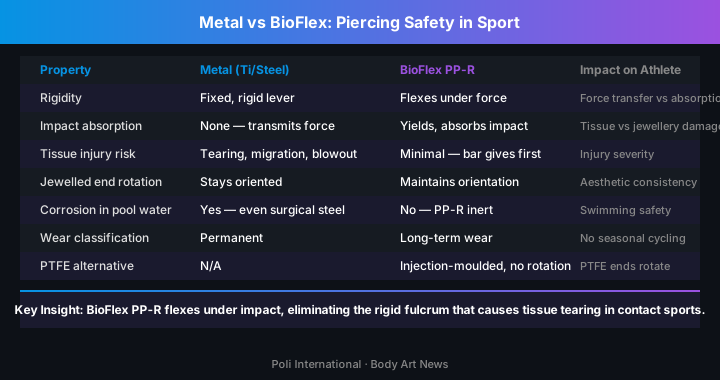
The problem is rigidity under force. A rigid object transmits impact to soft tissue rather than absorbing it.
2. Where Sport and Piercing Collide
Nipple piercings in contact sports
Of all the sports-related piercing injuries documented, nipple piercings in contact sports are the most consistently reported. Rugby is the clearest example: a metal nipple ring caught in an opponent's jersey during a tackle can exert significant traction on the tissue. The forces involved, a 100kg player falling, are not trivial. Even if the ring does not tear out completely, the tissue response can set healing back months.
Many professional and semi-professional clubs now require nipple piercings to be removed or replaced with retainers for training sessions. BioFlex nipple bars are the correct tool for this: the bar yields under lateral force rather than acting as a rigid fulcrum.
Navel piercings and grappling sports
Judo, Brazilian jiu-jitsu, wrestling, and similar grappling sports involve clothing that wraps tightly around the torso. A navel piercing caught in a gi or wrestling singlet can be snagged by the opponent's grip, particularly in standing throws where the clothing is gripped at the waist. Metal navel bars have been the cause of genuine injury in these contexts.
BioFlex navel bars flex under incidental loading rather than transmitting force to the piercing channel. The bar gives before the tissue does.
Ear piercings and helmets
Helmet edges sit exactly at the ear crease for many sports, cycling, horse riding, climbing, contact sports. A helix or conch piercing under a tight helmet brow creates localised pressure over the metal stud or ring. Over a two-hour training session, this is a cumulative compression injury. With BioFlex, the retainer distributes that sustained compressive load rather than concentrating it at a rigid point.
Swimming
Chlorinated pool water is directly hostile to the skin around healing piercings. Metal jewellery in pool water corrodes over time, even surgical steel, which is not rated for continuous aqueous exposure. The oxidation products can irritate healing tissue.
BioFlex is chemically inert in water, it is a polyolefin with no susceptibility to chlorine or saline. There are no corrosion products. Many swimmers wear BioFlex full-time rather than managing a rotation between metal for daily wear and removal for training.
3. The Long-Term Wearability Argument
A common misconception about flexible body jewellery is that it is a "temporary" or "healing phase" material, something to be worn for a few months and then replaced with "proper" metal jewellery. This misconception is partly driven by PTFE and acrylic products marketed as "flexible" that are not rated for indefinite wear.
BioFlex PP-R is a different matter entirely. Certified to ISO 10993-6 and built on a USP Class VI biocompatible resin, there is no certification or biological constraint that limits its wear duration. Athletes who prefer BioFlex for training do not need to switch back to metal for their "real" jewellery, BioFlex can be worn indefinitely, to the same standard.
This matters practically: an athlete who trains five days a week does not want to be changing jewellery twice daily. BioFlex goes from training to office to evening without any change required.
4. Patrick's Deep Archive: The Calls from the Training Ground
*First-person from Patrick Poli, inventor of BioFlex® and founder of Poli International Co., Ltd.*
I started hearing from sports people almost as soon as BioFlex reached the market. The typical message was not "I've had an injury", it was "is there something I can wear that doesn't need to come out?"
Rugby players were the most consistent group. Nipple piercings, specifically. The sport involves close-quarters physical contact and clothing that can snag. Several players had been told by their clubs to remove the piercing entirely, and they would contact me because they wanted to know if there was an alternative. BioFlex solved the problem completely: the bar is soft enough under lateral load that it gives before the tissue does.
I also received queries from MMA and grappling athletes, and from road cyclists. The cycling queries were about helmets, specifically helix piercings being compressed under helmet padding over multi-hour rides. Again, BioFlex retainers solved this immediately. The flexibility of the material distributes sustained compressive load rather than concentrating it.
What I found consistently surprising was how rarely the sports medicine community had thought about this. The standard advice from sports physiotherapists was always "remove the jewellery before training", and nobody had told them there was a material that eliminated the reason for that advice.
5. FAQ: BioFlex and Athletic Use
Q: Is BioFlex safe in chlorinated pools?
Yes. BioFlex PP-R is chemically inert and does not react with chlorinated or saline water. It is suitable for swimming, diving, and water sports. There is no corrosion, no release of compounds into pool water, and no effect on the material's biocompatibility certification.
Q: Can I wear BioFlex during full-contact sport, including tackling?
BioFlex is softer and more flexible than metal under impact loading. For nipple, navel, and ear piercings in contact sport, BioFlex is the material of choice. However, any active piercing involves a compromise of skin integrity, consult with a sports physiotherapist if you have concerns about specific injury scenarios.
Q: Does BioFlex degrade in sweat?
No. Polypropylene random copolymer is chemically inert to perspiration at any pH. Long-term sweat exposure does not degrade the material, alter its surface properties, or cause any release of additives. This is structurally different from TPU (polyurethane), which can degrade in aqueous environments over time.
Q: Can I train with a fresh piercing in BioFlex?
A fresh piercing requires a healing period regardless of jewellery material, typically two to four months for standard placements, longer for cartilage. Training with a fresh piercing of any kind increases infection and mechanical disruption risk. Wait until your piercer confirms the piercing is healed before returning to high-impact sport.
Q: Is BioFlex available in sports-specific lengths?
BioFlex bars can be trimmed to custom lengths without specialist tools. This allows athletes to trim a navel or surface bar to a lower profile for training without ordering custom jewellery.
*The full BioFlex® range for sport and active wear is available at poliinternational.com/bioflex/.*