BioFlex vs PTFE: Why PP-R Random Copolymer Wins Every Time
Key Takeaways:
» PTFE (polytetrafluoroethylene) and BioFlex PP-R are both radiolucent, non-metallic, and used in body piercing, but they are fundamentally different polymers with different processing limitations.
» PTFE cannot be injection-moulded, it must be extruded as rod stock. This means PTFE body jewellery is limited to straight rods with separately threaded ends that rotate freely.
» Freely rotating ends on PTFE bars mean jewels and decorative elements face unpredictable directions, a crystal that was facing forward migrates to the side or backward during normal wear.
» BioFlex PP-R is injection-moulded, complex three-dimensional geometry is achievable in a single piece. Orientation of decorative elements is fixed in the mould.
» The practical consequence: BioFlex is used for navel bars, curved barbells, labrets, and industrial bars with specific geometries. PTFE is used almost exclusively for straight bars where orientation is irrelevant.
1. Two Polymers, Two Different Processing Realities
Body piercing materials have to satisfy a specific combination of requirements: biocompatibility, sterilisability, dimensional stability, and some degree of flexibility. For much of the 1990s and 2000s, metal materials, surgical steel, titanium, niobium, dominated. PTFE (Teflon) was the first widely used non-metal alternative. BioFlex PP-R followed.
Both materials share some important properties.
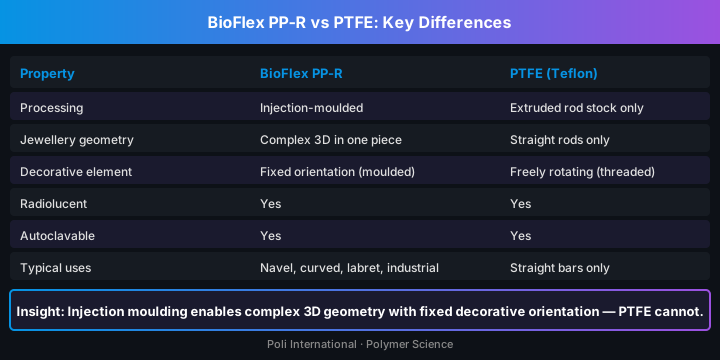
Both are radiolucent, they do not show up on X-ray or create MRI artefacts. Both are chemically inert. Both are non-metallic, eliminating the nickel sensitisation issue that affects a significant percentage of the population. Both are soft enough to be autoclave-sterilised without degradation at standard steam sterilisation temperatures.
But the manufacturing processes available to each material are fundamentally different, and those differences determine what is actually possible in terms of jewellery design.
2. Why PTFE Can Only Be Extruded
PTFE has an extremely high melt viscosity, in its molten state, it does not flow in the way most thermoplastics do. This property prevents injection moulding. You cannot push liquid PTFE into a mould under pressure and have it fill a complex cavity.
The practical consequence is that PTFE body jewellery is manufactured almost exclusively from extruded rod stock. Extruded PTFE rod is cut to length, then machined or post-processed to add thread features. The threaded ends, balls, flat discs, jewel tops, are separately manufactured from other materials and threaded onto the PTFE rod.
This is the root of the orientation problem. A threaded ball or jewel on a PTFE rod has only its thread engagement to maintain its position. Thread engagement alone does not prevent rotation, the ball can spin freely on the rod. In normal wear, body movement, clothing contact, and sleep will rotate the threaded end. A crystal positioned facing forward when the jewellery was installed will face sideways, then backward, within days.
For a plain ball top, rotation is irrelevant, a ball looks the same from every direction. But for asymmetric decorative elements, crystals, shaped flatbacks, specific designs, PTFE rod construction makes orientation maintenance impossible.
3. What Injection Moulding Changes
BioFlex PP-R, as a random copolymer with conventional thermoplastic melt behaviour, can be injection-moulded. This is the pivotal manufacturing difference.
Injection moulding allows the entire jewellery piece, bar, curve, and decorative element, to be produced as a single monolithic part from the same shot of material. There is no threaded interface between the bar and the decorative end, because the decorative end is not a separate component. It was formed in the mould at the same time as the bar.
A monolithic moulded piece has no rotation axis. The crystal face is in the same plane as the flat of the mould surface it was pressed against during manufacture. It cannot rotate because there is no joint around which rotation could occur.
This is why BioFlex can produce navel bars with specific upper and lower decorative elements reliably oriented to face the correct direction. A BioFlex banana bar with a crystal cup at the lower end will still have that crystal facing forward after six months of wear, because the position of that cup is locked into the geometry of the moulded part. There is no mechanism by which it can move.
4. Patrick's Deep Archive: Why PP-R and Not PTFE
*First-person from Patrick Poli, inventor of BioFlex® and founder of Poli International Co., Ltd.*
When I was developing BioFlex in the late 1990s, PTFE was already in use in the industry. It was the obvious comparison point. My starting question was straightforward: is there something better?
PTFE has a specific set of properties that make it genuinely useful for simple straight bars. It is extremely chemically inert, more inert than PP-R, in fact. It has very low surface friction. And it was already being used without significant incident in professional piercing environments. If I had been building only straight plain bars for industrial piercings or tongue bars, PTFE might have been a defensible choice.
But I wanted to make proper navel jewellery. Curved bars. Banana bars with crystal cups. Pieces where the decorative element is part of the design and needs to stay in a specific orientation.
PTFE makes that impossible. The extrusion constraint means you are always working with rod stock and threaded ends, and threaded ends rotate. I watched pieces come back from customers where the jewel was facing the wrong way, and the only answer was "screw it back into place until it rotates again." That is not acceptable as a product.
PP-R solves the rotation problem at the manufacturing stage because you can design the entire piece in three dimensions and mould it as one component. The crystal face is locked. The curve geometry is exact. There is no post-assembly rotation risk.
The trade-off is that PP-R is more complex to process, you need proper injection moulding tooling, which requires investment in moulds. That barrier to entry is partly why the market remains full of PTFE rod jewellery with rotating ends, rather than properly engineered PP-R pieces. The tooling cost means counterfeit producers and small-volume manufacturers never invest in real mould geometry. They extrude rod, cut it, and call it "bioflex."
5. FAQ: BioFlex PP-R Versus PTFE
Q: Is PTFE biocompatible for body jewellery?
PTFE is biocompatible and has a long history of use in medical implants, including vascular grafts. It is not inherently unsuitable for body piercing. The issue is design limitation, not toxicity. For straight bars without directional decorative elements, PTFE performs acceptably.
Q: Why do some piercers still prefer PTFE?
For industrial bars, straight tongue bars, and surface bars without directional elements, PTFE's extreme chemical inertness and very low surface friction are genuine advantages. Some piercers also find PTFE easier to cut and fit to length chairside. The material itself is fine; the design limitation only matters when directional decoration is required.
Q: Can BioFlex degrade over time?
BioFlex PP-R is certified to ISO 10993-6 for implant-grade use. It is a semi-crystalline polyolefin with high oxidative stability and no plasticiser component. Unlike TPU (polyurethane), it does not absorb moisture or degrade in aqueous environments. Its long-term stability is significantly better than TPU under cyclic mechanical loading.
Q: If PTFE is so limited, why is it still sold as body jewellery?
Cost and availability. PTFE rod stock is inexpensive and widely available. Converting it to a jewellery blank requires only cutting and threading equipment, not injection moulding tooling. The result is cheap to produce. The market segment that cares about decorative orientation moved to BioFlex when it became available; the segment that wants a plain retainer at minimum cost still uses PTFE rod.
Q: Is PTFE radiolucent in the same way as BioFlex?
Both PTFE and PP-R are radiolucent and non-ferromagnetic. For surgical retainer purposes on radiolucency grounds alone, either material is acceptable. The key distinction for surgical use is the ISO 10993-6 implant-grade biocompatibility certification, which BioFlex holds.
*For full technical data on BioFlex® PP-R chemistry and certification, see poliinternational.com/bioflex/.*