Can You Be Allergic to Titanium Body Jewelry?
Key Takeaways:
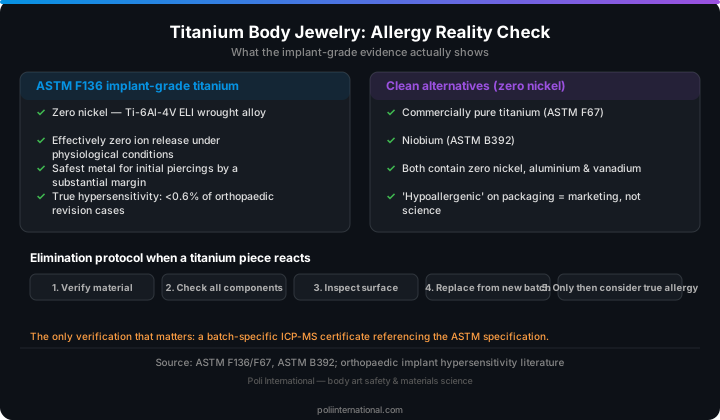
» ASTM F136 titanium contains no nickel and has effectively zero ion release under physiological conditions, making it the safest metal for initial piercings by a substantial margin.
» When a titanium piece causes a reaction, the most common cause by far is that the piece is not actually implant-grade titanium, the surface is contaminated, or dissimilar metals are in contact.
» True titanium-associated hypersensitivity is a case-report phenomenon, with orthopaedic implant data reporting rates below 0.6% of revision cases and attributing them to alloying elements rather than the titanium metal.
» The elimination protocol is verify the material, check all components, inspect the surface, replace from a different batch, and only then consider genuine alloy hypersensitivity.
» For confirmed titanium-alloy reactions the cleanest alternatives are commercially pure titanium (ASTM F67) or niobium (ASTM B392), both of which contain zero nickel, aluminium and vanadium.
» The word "hypoallergenic" on packaging means nothing; the only verification that matters is a batch-specific ICP-MS certificate from an accredited laboratory referencing the ASTM specification.
1. What "hypoallergenic" actually means, and what it does not
"Hypoallergenic" is a marketing term, not a clinical or regulatory category. It has no standardised definition in body jewellery, and no agency enforces it. A manufacturer can apply it to any material regardless of composition. What matters is the specification. Implant-grade titanium is defined by ASTM F136: a wrought Ti-6Al-4V ELI alloy with 5.5 to 6.5% aluminium, 3.5 to 4.5% vanadium, and tightly controlled oxygen and iron maxima. It contains no nickel.
The clinical reason titanium is the default for initial piercings is the surface chemistry. Titanium forms a self-healing TiO2 passivation layer that reforms within milliseconds of mechanical damage, and in physiological conditions ion release from ASTM F136 titanium is effectively zero. When a piercer says "titanium is hypoallergenic," they mean clinically that this material does not contain the known sensitisers that cause the vast majority of piercing reactions. That is true of ASTM F136, but it is not the same as claiming nobody can react to any component of the alloy.
2. The four actual causes of a reaction to a titanium piece
When a client reacts to what is believed to be titanium jewellery, the reaction is real. The cause, however, is usually one of four things, and true titanium allergy is the least likely.
The piece is not actually ASTM F136 titanium. This is the most common cause. The piece is labelled "titanium" but is a lower-grade commercially pure titanium with iron impurities, a titanium alloy with a non-implant composition, or a different metal entirely with a titanium-coloured anodised or PVD finish. Anodised titanium, anodised niobium and gold-toned PVD are visually indistinguishable; colour does not identify the metal. The only reliable verification is a batch-specific ICP-MS certificate from an ISO/IEC 17025 accredited laboratory stating the full elemental composition. Price is a useful screening tool: implant-grade titanium machined and polished to Ra 0.4 µm or better has a real production cost.
Surface contamination, not the metal. The most common true cause of a reaction to a real titanium piece is something on the surface: residual machining lubricant, polishing compound, ultrasonic cleaning solution not fully rinsed, or contamination from handling and storage. Even autoclave-sterilised jewellery that was not dried completely before pouching can harbour contaminants. Surface finish also matters: titanium rougher than Ra 0.8 µm provides anchoring sites for biofilm and mechanically irritates healing tissue.
Galvanic corrosion from mixed metals. A titanium post paired with a steel or gold closure forms a bimetallic couple whose electrochemical potential difference drives ion release from the less noble metal. In a healing piercing this looks exactly like an allergic reaction: localised redness, swelling and prolonged irritation at the contact point. Every component touching the wound must be the same metal, preferably the same alloy batch.
Reaction to alloying elements, vanadium and aluminium. ASTM F136 contains approximately 6% aluminium and 4% vanadium as part of the alloy structure, and in rare cases a genuine Type IV delayed hypersensitivity can develop to one of these elements rather than to the titanium itself. Orthopaedic implant registries report titanium-associated hypersensitivity at rates below 0.6% of revision cases, predominantly attributed to alloying elements, and case reports document reactions that resolved on a vanadium-free alloy or commercially pure titanium.
3. How to tell if it is really a titanium reaction
The clinical presentation matters. A true allergic reaction develops over days to weeks, not hours, and does not respond to aftercare adjustments. An infection presents with heat, purulent discharge and systemic symptoms that allergy does not produce.
| Symptom pattern | Likely cause |
|---|---|
| Redness and swelling within 24 hours, tender to touch | Mechanical irritation, poor aftercare or infection |
| Redness and itching over 1-2 weeks, no heat, no discharge | Possible allergic or hypersensitivity response |
| Redness strictly at the post-closure contact point | Galvanic couple from mixed metals |
| Irritation with visible roughness on the jewellery surface | Surface finish defect or contamination |
| Reaction persists across different batches | Consider alloying-element hypersensitivity |
| Reaction resolves after switching to certified ASTM F136 | Original piece was not implant-grade |
The practical elimination protocol runs in order. Verify the material by asking for the batch-specific ICP-MS certificate. Check that the post, closure and any decorative element are the same metal from the same alloy specification. Inspect the surface under magnification for roughness, pitting or contamination. Replace with a certified piece from a different batch and observe. If the reaction recurs with verified ASTM F136, consider niobium, which contains no nickel, aluminium or vanadium and has a passive layer comparable in stability to TiO2. Only then does the clinical picture shift toward genuine alloy hypersensitivity, and the correct next step is referral to a dermatologist for patch testing, which is a medical procedure, not a studio one.