
Executive Summary
Polymer body jewelry is the fastest-growing material segment in the global body jewelry market at 8.3% CAGR, and BioFlex (medical-grade PP-R random copolymer) leads this growth. The segment currently commands approximately 12% market share and is projected to double in revenue within three years. The growth is not driven by fashion or price, BioFlex is not cheaper than steel. It is driven by clinical evidence: flexible polymer jewelry reduces mechanical stress on healing tissue, eliminates nickel sensitisation risk entirely, and offers specific advantages for oral piercings, initial piercings, and medical imaging scenarios where metal is contraindicated. With over 25 years of clinical data, ISO 10993-6 certification, and a USP Class VI biocompatible resin, BioFlex is not a 'plastic alternative', it is a medically validated implant material.
1. What BioFlex Actually Is
BioFlex is PP-R random copolymer, a medical-grade polypropylene variant that is flexible, autoclavable, and biocompatible. It is definitively NOT TPU, urethane, acrylic, PMMA, nylon, PVC, or any of the materials sometimes misleadingly labeled as 'flexible body jewelry' in online marketplaces.
The material distinction matters because acrylic (PMMA) and PVC are not biocompatible for long-term tissue contact. They can leach plasticisers, degrade under autoclave sterilisation, and cause chemical irritation in healing piercings. BioFlex was specifically developed for medical applications and has been in clean clinical use since the late 1990s. That is over 25 years of real-world data with zero nickel content, the sensitisation risk that drives consumers away from steel simply does not exist.
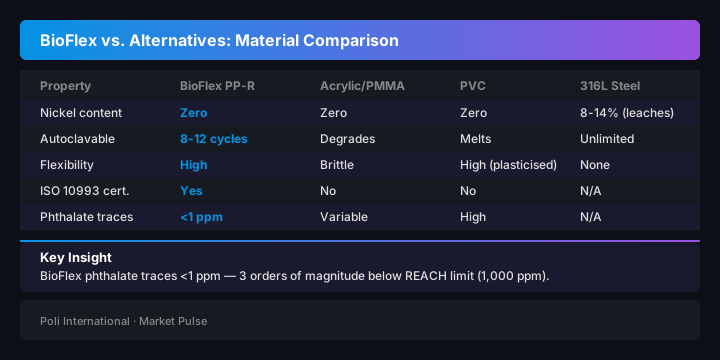
| Property | BioFlex PP-R | Acrylic/PMMA | PVC | 316L Steel |
|---|
| --- | --- | --- | --- | --- |
|---|---|---|---|---|
| Nickel content | Zero | Zero | Zero | 8-14% (can leach) |
| Autoclavable | 8-12 cycles | Degrades | Melts | Unlimited |
| Flexibility | High | Brittle | High (plasticised) | None |
| ISO 10993 certified | Yes | No | No | N/A |
| Phthalate traces | <1 ppm | Variable | High | N/A |
| REACH phthalate limit | 1,000 ppm | , | , | , |
BioFlex phthalate traces measure below 1 part per million, three orders of magnitude below the REACH restriction threshold of 1,000 ppm. This is not a claim. It is a laboratory result.
2. The Clinical Case: Why Flexibility Matters
Metal is rigid. When inserted into a piercing channel, it exerts constant force on the surrounding tissue. In oral piercings, tongue, labret, smiley, philtrum, this force is transmitted to teeth and gums. The clinical consequence is well documented: metal oral jewelry causes gum recession and enamel erosion through mechanical leverage. A metal barbell resting against the lingual surface of the mandibular incisors acts as a fulcrum. Every tongue movement applies pressure. Over months and years, the gingival margin recedes.
BioFlex eliminates this mechanism. The flexible shaft absorbs and distributes force rather than transmitting it. The barbell flexes with tongue movement rather than levering against teeth. For oral piercings specifically, the clinical advantage is unambiguous: flexible polymer shafts significantly reduce the mechanical trauma that leads to dental damage.
For initial piercings, the advantage is different but equally important. A fresh piercing swells. A rigid metal bar cannot accommodate swelling without the piercer installing a longer bar upfront, which then becomes too long once swelling subsides, creating a snag hazard. A flexible BioFlex shaft accommodates swelling through material compliance, reducing the need for bar length changes during the healing cycle.
3. Nickel Elimination: The Sensitisation Prevention Strategy
Nickel allergy affects approximately 11.4% of the general population, with prevalence reaching 19.8% in some European female cohorts before REACH restrictions took effect. The primary sensitisation route is piercing: inserting nickel-containing jewelry into an open wound with interstitial fluid accelerating metal ion release. The odds ratio for nickel allergy in pierced vs. non-pierced adults is 5.9.
316L surgical steel contains 8-14% nickel. Even 'nickel-free' steel contains trace amounts that may exceed the REACH migration threshold during the healing phase. Titanium solves this problem through material composition, ASTM F136 contains no nickel. BioFlex solves it the same way: PP-R contains no metals at all. Zero nickel content. Zero sensitisation risk. For clients with confirmed nickel allergy, or for piercers who want to eliminate the risk entirely, BioFlex is the material of choice.
4. Medical Imaging and MRI Compatibility
Metal body jewelry must be removed before MRI scans. Titanium is non-ferromagnetic and generally MRI-safe, but radiologists and MRI technicians routinely require removal of ALL metal before scanning, the policy is blanket, not material-specific. For patients with healing piercings who cannot remove jewelry without risking channel closure, this creates a problem.
BioFlex is radiolucent. It does not appear on MRI or CT scans. It contains no metal, so there is nothing to remove. For patients undergoing frequent imaging, oncology patients, neurology patients, orthopaedic follow-ups, BioFlex eliminates the metal-removal problem entirely. This is a niche application, but for the patients who need it, it is the difference between keeping and losing a piercing.
5. Market Trajectory: Double Revenue Within Three Years
The polymer segment's 8.3% CAGR makes it the fastest-growing material category in body jewelry, outpacing titanium (7.1%), precious metals (5.2%), and dramatically exceeding the declining acrylic/costume segment. The growth drivers are structural, not cyclical:
- Clinical data on metal-related dental damage is accumulating and spreading through consumer channels
- Nickel allergy awareness continues to rise, especially in European and North American markets
- MRI/medical imaging requirements create a permanent demand for non-metallic alternatives
- REACH and FDA regulatory frameworks increasingly favour certified materials over uncertified
- The segment is still small (12% share), there is significant room for expansion before market saturation
The polymer segment is not competing with titanium, it is competing with steel and acrylic. It is taking share from the materials that have safety and compliance problems, not from the materials that have solved them. This is why the growth is sustainable: the market is not choosing between polymer and titanium. It is choosing between a certified, clinically validated material and an uncertified one. That choice has an obvious answer.
---
FAQ
Q: Is BioFlex safe for initial piercings?
Yes. BioFlex is ISO 10993-6 certified for biological evaluation of implantable materials and is built on a USP Class VI biocompatible resin. Its flexibility accommodates swelling during healing, reducing the need for bar length changes. It has been in clinical use since the late 1990s.
Q: How does BioFlex compare to acrylic body jewelry?
They are completely different materials. BioFlex is medical-grade PP-R random copolymer with zero nickel and phthalate traces below 1 ppm. Acrylic (PMMA) is brittle, degrades under autoclaving, and is not biocompatible for long-term tissue contact. BioFlex is a certified implant material; acrylic is a fashion product.
Q: Can BioFlex jewelry be autoclaved?
Yes. BioFlex withstands 8-12 autoclave cycles before any degradation begins. After that, the material should be replaced, not because it is unsafe, but because the mechanical properties may begin to shift with repeated thermal cycling.


