Executive Summary
Amazon, Etsy, and direct-to-consumer (DTC) brands are disrupting the traditional body jewelry wholesale distribution model. Studios can now source directly from manufacturers, consumers can purchase 'implant-grade' jewelry without ever entering a studio, and anyone with a Shopify account can launch a body jewelry brand. The result is a market simultaneously more accessible and less trustworthy than at any point in the industry's history. Counterfeit 'titanium', steel with a coloured coating sold as ASTM F136, floods marketplace listings. Certification claims are made with zero documentation. And a single counterfeit incident can destroy a studio's reputation. In this environment, batch-level certification verification is no longer a compliance checkbox. It is the only competitive moat that separates legitimate suppliers from marketplace noise.
1. The Distribution Shift: Wholesale → DTC → Marketplace
Traditional body jewelry distribution followed a linear chain: manufacturer → wholesale distributor → studio → consumer. Each link added margin (typically 40-60% at each step), and each link provided a quality control gate. The distributor inspected incoming product; the studio inspected what they sold; the consumer trusted the studio.
E-commerce dismantled this chain in three phases:
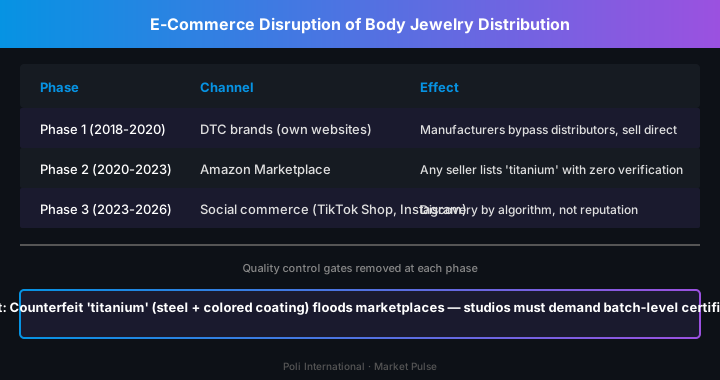
| Phase | Channel | Effect |
|---|---|---|
| Phase 1 (2018-2020) | DTC brands (own websites) | Manufacturers bypass distributors, sell direct to studios and consumers |
| Phase 2 (2020-2023) | Amazon Marketplace | Any seller can list 'titanium body jewelry' with zero verification |
| Phase 3 (2023-2026) | Social commerce (TikTok Shop, Instagram) | Product discovery driven by algorithm, not reputation |
The quality control gates are gone. A consumer searching 'titanium curved barbell' on Amazon is shown listings from dozens of sellers. Some sell certified ASTM F136 from established manufacturers. Many sell coloured steel with a 'titanium' label and a price point 70% lower. The consumer cannot tell the difference. The listing photos look identical. The five-star reviews are often for a different product variant entirely.
2. The Counterfeit Crisis: 'Titanium-Coloured' Is Not Titanium
The most common counterfeit pattern is simple: steel barbells are PVD-coated or anodised in titanium-like colours, then listed as 'implant-grade titanium' at a price that undercuts legitimate product. The coating, often TiN (titanium nitride), gives a gold appearance that photographs well. It is not biocompatible. It wears off into the piercing channel. And the underlying steel contains nickel at concentrations that exceed the REACH migration limit by an order of magnitude.
A studio that unwittingly stocks and sells counterfeit titanium takes on catastrophic reputational risk. A client who develops a nickel reaction from a piece sold as 'implant-grade' does not blame the Amazon seller, they blame the studio. The studio trusted the supplier. The supplier lied. The studio's Google reviews and Instagram comments bear the cost.
This scenario is not hypothetical. It is happening. The studios that protect themselves are those that demand batch-level material certification from every supplier, for every order, within 48 hours. A supplier who cannot produce an ASTM or ISO certificate is either selling uncertified material or sourcing from someone who is. Either way, the studio should walk away.
3. DTC Brands: Opportunity and Risk
Direct-to-consumer body jewelry brands offer a genuine value proposition: manufacturer-direct pricing, certification transparency, and consistent quality. BioFlex is the canonical example, a proprietary, clinically certified material sold directly with full documentation traceable to specific production batches.
But DTC also creates perverse incentives. A brand that sells primarily through its own website, rather than through studio distribution, has no piercer between the product and the consumer. The consumer selects their own size, length, and gauge, often incorrectly. The brand ships the product. The consumer inserts it into their own piercing without autoclave sterilisation. If the piercing becomes irritated, the brand blames the consumer ('wrong size') and the consumer has no recourse.
The DTC model works when the brand provides detailed sizing guidance, recommends professional insertion, and offers certification documentation. It fails when the brand treats body jewelry like fashion accessories rather than implant-adjacent medical devices.
4. Certification Verification: The New Competitive Moat
The studios winning in 2026 are not competing on price. They cannot, Amazon will always be cheaper. They are competing on trust, and trust is built on verification:
| Verification Step | What It Proves |
|---|---|
| Batch-level mill test certificate | Chemical composition of the specific production batch |
| ASTM/ISO standard number on documentation | Material meets published specification |
| Laser etching on jewelry | Physical traceability to the certificate |
| Supplier response time <48 hours | Supplier has documentation, not excuses |
The verification demand is rising from both directions: consumers increasingly ask about material sourcing before booking appointments, and regulators increasingly require documentation as a condition of market access. The REACH Monitor tracks regulatory changes affecting body jewelry in real time, studios that integrate regulatory awareness into their procurement process are future-proofing their supply chain.
5. Where the Market Is Heading
The body jewelry market is bifurcating along a certification fault line. On one side: certified, traceable, documented materials sold through channels that verify provenance, professional studios, manufacturer-direct DTC, and certified distributors. On the other side: uncertified materials sold through channels that optimise for price and volume, Amazon marketplace, AliExpress, social commerce. The two sides are not competing in the same market. They serve different consumers with different expectations.
For studios, the strategic choice is clear: invest in certification verification now. Audit every supplier. Demand documentation. Build the verification story into client consultations, because the clients who care about material provenance are the clients with disposable income who return for multiple piercings and refer their friends. The clients who shop on price alone are not your market. Let Amazon have them.
---
FAQ
Q: How can I tell if titanium jewelry from Amazon is genuine?
Request batch-level ASTM F136 certification from the seller. Look for laser etching on the jewelry. If the price is less than 50% of what a professional studio charges for the same size and style, the material is almost certainly not implant-grade titanium. Amazon marketplace listings are not verified for material authenticity.
Q: Is buying body jewelry directly from DTC brands safe?
DTC brands that provide full material certification, batch traceability, and detailed sizing guidance can be safe. The risk is that the consumer sizes incorrectly or inserts unsterilised jewelry. Professional piercing studios remain the safest source because they provide autoclave sterilisation and insertion by a trained piercer who verifies fit.
Q: What should studios demand from suppliers?
Batch-level mill test certificates for every order, delivered within 48 hours. The certificate should reference the specific ASTM or ISO standard and include the chemical composition of the batch. Laser-etched markings on the jewelry should match the certification documentation.