Initial Piercings and the Right Material: A Nuanced Guide from the Creator of BioFlex
Key Takeaways:
» For initial piercings, BioFlex PP-R offers specific mechanical advantages over rigid metal: flexibility reduces leverage pressure on the healing channel during movement.
» The fastest-healing initial piercing is one performed correctly, placed correctly, and cared for correctly, material is one factor among several, not a guarantee.
» Implant-grade titanium and implant-grade steel are acceptable initial piercing materials with long track records. BioFlex is not a criticism of those materials, it is an additional option with specific advantages in specific placements.
» Professional piercers have their own expertise and methods. The role of material choice is not to override a skilled piercer's judgement, it is to give clients better information for the conversations they have with their piercer.
» Body art is self-expression. The correct material is the one that serves the individual's healing, lifestyle, and aesthetic, not the one that any single manufacturer or association declares universal.
1. What Makes an Initial Piercing Different
An initial piercing is performed through intact, unmodified tissue. There is no existing channel, no established healing pathway, and no skin that has already adapted to the presence of a foreign object. The first weeks and months of a new piercing are a process of biological negotiation between the immune system and the jewellery.
During this period, the tissue around the jewellery goes through active inflammation, cell migration, and collagen remodelling. The channel that eventually becomes a stable fistula starts as an open wound track, soft, vascularised, sensitive to mechanical disturbance.
This is the context in which material properties matter most.
Not because any single material is dramatically superior to another in terms of toxicity or surface chemistry, implant-grade materials from reputable manufacturers are all biologically acceptable, but because the mechanical behaviour of the jewellery during those early months has a significant effect on how smoothly that healing process cellular phases of dermal recovery completes.
2. The Mechanics of Flexible vs Rigid During Healing
The human body is not stationary. A navel piercing flexes when you sit, stand, bend, and move. A nostril piercing is touched by fingers, pressed by glasses, bumped by clothing. A lip piercing makes contact with teeth, cups, cutlery, and kisses. An ear cartilage piercing lies against pillows, brushes against hair, and sits under headphones.
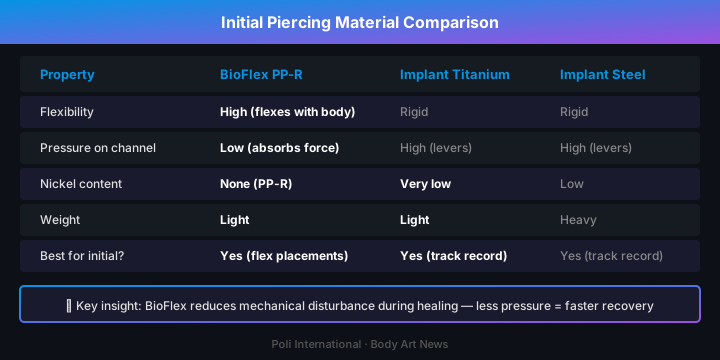
A rigid metal bar in any of these placements transmits every one of those mechanical events to the healing channel walls. When the abdomen flexes against a straight metal navel bar, the bar pushes against one wall of the channel. When the nose is touched, the metal post moves as a rigid lever. Metal jewellery does not absorb any of these forces, it redirects them to the tissue.
BioFlex PP-R, with its significantly lower Young's modulus than any metal, flexes under these same loads. A navel bend that would push a metal bar against one channel wall will cause a BioFlex bar to flex with the movement rather than transmitting it as pressure. The healing tissue experiences less repeated mechanical stimulation from the jewellery itself.
This is the core healing argument for BioFlex as an initial piercing material: not chemistry, but mechanics. Less pressure against healing channel walls means less repeated disruption to the granulation tissue forming the fistula.
3. What Professional Piercers Know That the Internet Doesn't
Professional piercers have decades of observation behind their material preferences. Many experienced piercers use implant-grade titanium for virtually all initial work and achieve excellent healing outcomes. Titanium's very low nickel content, anodisable surface, and light weight are genuine advantages, particularly for genital piercings and oral piercings where specific anatomical constraints apply.
The Association of Professional Piercers has developed materials standards based on this accumulated practical knowledge. Those standards are weighted toward metals. BioFlex is not on their approved list, which creates a confusing situation: a material certified to ISO 10993-6 (implant-grade, tests for local effects after implantation) and built on a USP Class VI biocompatible resin is not listed, while some materials carrying no comparable certification appear elsewhere in the market.
This is a regulatory and institutional history issue, not a materials science issue. The APP was built by and for metal-focused practitioners, and its standards were written around metal properties. This does not make those standards wrong, titanium done correctly heals beautifully. It means the standards are incomplete.
The practical message for clients: if your professional piercer recommends titanium for your initial piercing, that is a well-founded recommendation. If you want to discuss BioFlex as an alternative, that is a legitimate conversation. A professional piercer who has direct experience with BioFlex healing outcomes is the best guide for your specific placement.
4. Patrick's Deep Archive: Accompany the Primal Urge, Never Impose
*First-person from Patrick Poli, inventor of BioFlex® and founder of Poli International Co., Ltd.*
I invented BioFlex. I have been in this industry for 25 years. I have heard every argument about which material is best for initial piercings, and I have watched many of those arguments become political rather than clinical.
Here is what I actually believe.
Body art is one of the oldest human practices. Before surgery, before pharmaceuticals, before modern regulation, human beings were piercing and marking their bodies as an expression of identity, community, and self. Every culture that has existed has produced body modification. The urge to decorate one's own body in a way that feels true to oneself is not a fashion trend. It is something older and more fundamental than the body art industry that built up around it.
In 25 years I have never had a client come to me because they intellectually concluded that BioFlex was the superior material. They come because they want to express something about themselves, and they need a material that serves that expression safely. The material is in service of the intention.
This is why I do not believe in telling people they are wrong to want a specific piercing, or wrong to prefer a metal that their piercer has used for twenty years with excellent outcomes, or wrong to choose an aesthetic that requires a specific material.
What I believe in is information. BioFlex is better for specific applications, pregnancy, sports, concealment, initial piercings in high-movement placements. It is not a universal prescription. The goal is always the same: accompany the primal urge to express yourself, safely and lastingly. Impose nothing. Inform everything.
The rigid metal bar failed the pregnancy navel piercing not because metal is inherently wrong, but because the body changed and the material could not change with it. BioFlex changes with the body. That is the whole argument.
5. FAQ: BioFlex as Initial Piercing Material
Q: Can I request BioFlex for my initial piercing at any professional studio?
You can request it at any studio that carries BioFlex stock. Not all studios do. If your studio uses titanium exclusively and has strong healing results, that is also a legitimate choice. Ask what initial piercing materials they offer and what their experience looks like with each.
Q: Is BioFlex sterilisable for initial piercing use?
Yes. BioFlex PP-R withstands autoclave steam sterilisation at standard body art studio temperatures and pressures. It does not melt, distort, or release compounds under autoclave conditions. It can also be sterilised with ethylene oxide for single-use sealed packaging.
Q: Does a BioFlex initial piercing heal faster than titanium?
"Faster" is not the right frame. Healing speed depends primarily on placement, technique, anatomy, aftercare, and immune response. BioFlex may reduce one specific source of mechanical disruption, rigid leverage, in high-movement placements. This may contribute to a smoother healing process in some people. It does not overcome poor technique or inadequate aftercare.
Q: What about ASTM F136 titanium, is it really better than BioFlex?
ASTM F136 implant-grade titanium is an excellent material. Its surface oxide layer is biologically very well tolerated, its nickel content is negligible, and it can be anodised to a range of colours. For placements where mechanical flexibility is not a significant factor, earlobes, nostril, many cartilage placements, titanium is a strong choice. For high-movement placements, BioFlex's flexibility offers a specific mechanical advantage.
Q: Can I use BioFlex for genital piercings?
Genital piercings have specific anatomical and mechanical considerations requiring direct professional assessment. BioFlex PP-R is biocompatible and has been used in genital placements; whether it is optimal for a specific placement should be discussed with a piercer experienced in that anatomy.
*For complete BioFlex® technical documentation, see poliinternational.com/bioflex/.*