

Anticoagulants, Retinoids and Immunosuppressants Before a Needle

A technical reference for studios on the medications that actually change a procedure. Three mechanisms account for almost all of it: drugs that stop blood clotting, drugs that change how skin repairs itself, and drugs that suppress the immune response to a fresh wound. This page states what the published evidence supports for each, cites it, and marks the widely repeated claims that the evidence does not support rather than filling the gap with plausible reasoning.
Three Mechanisms, Not Thirty Drugs
A studio cannot memorise a formulary and does not need to. Almost every medication that matters at intake acts through one of three routes. The first is haemostasis. Anticoagulants and antiplatelet drugs interrupt the clotting cascade or stop platelets aggregating. The consequence at the needle is prolonged oozing rather than dramatic bleeding, and the practical cost is ink that will not settle and a piercing channel that fills with blood before it can close. The second is epidermal repair. Systemic retinoids change how fast the epidermis turns over and how much sebum the skin produces. This is the group that produces genuinely bad outcomes rather than merely messy ones. The third is immune response. Methotrexate, biologic agents and calcineurin inhibitors suppress exactly the inflammatory response a fresh wound depends on. The risk is infection and delayed closure, and it is the group where a specialist's clearance matters most. Most of what else appears on a client's list is irrelevant to the procedure. Ask which of the three a drug belongs to and the conversation becomes short.
Anticoagulants and Antiplatelets: Oozing, Not Haemorrhage
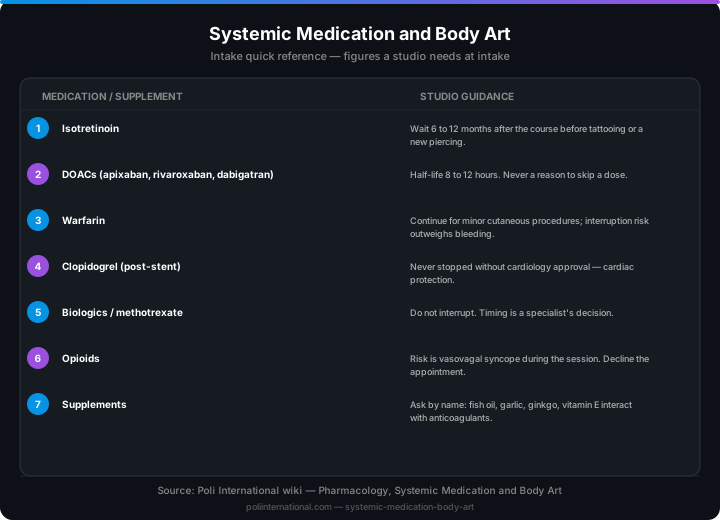
This is the largest group and the most misunderstood. Warfarin, the direct oral anticoagulants, the P2Y12 inhibitors (clopidogrel, prasugrel, ticagrelor) and low-molecular-weight heparin all raise bleeding at a skin-breaking procedure. Dermatologic surgery has studied this properly and the consensus is consistent: for minor cutaneous procedures the bleeding is manageable and the drugs are not stopped [1][3]. That matters because the instinct in a studio runs backwards. The temptation is to ask the client to skip a dose. The literature says the opposite - the thrombotic risk of interrupting therapy outweighs the bleeding risk of continuing it, and a systematic review of minimal-bleeding-risk procedures found continuous direct oral anticoagulant use acceptable rather than requiring interruption [2]. The dental literature reaches the same conclusion for a comparable minor procedure [4]. At the chair this means a client on anticoagulation is not automatically refused, but the session will bleed more, ink saturation will suffer and a piercing will take longer to settle. Those are quality and expectation problems, not safety emergencies. The safety line sits elsewhere: never advise a pause. If one is appropriate, only the prescriber can say so, and clopidogrel in particular is often prescribed after a cardiac stent where stopping carries real danger.
Isotretinoin: The One Real Contraindication
Isotretinoin is the drug on this page that most deserves a firm no. It alters epidermal cell turnover, thins the skin and suppresses sebum production. The concern for procedures during and shortly after treatment is impaired healing and abnormal scarring, and a 2026 review examining the safety of dermatological and surgical procedures during systemic isotretinoin is the current reference point [5]. Conventional professional guidance is a wait of 6 to 12 months after the course finishes. It is worth saying plainly where that figure comes from: three small case series from the 1980s. A 2017 systematic review with consensus recommendations found no good evidence for delaying most superficial skin procedures, including cutaneous surgery and laser hair removal, while advising against mechanical dermabrasion and fully ablative laser [10]. Tattooing and piercing were not studied. The studio wait is therefore precautionary and errs wide, because the failure mode is a permanent scar through work the client paid for. A piercing during treatment faces the same problem from the other direction. Fragile skin that heals slowly does not form a stable fistula, and the outcome is hypertrophic scarring or outright rejection.
Immunosuppressants: Infection, and Who Decides
Methotrexate, TNF inhibitors and other biologic agents, and calcineurin inhibitors all suppress parts of the immune response. A fresh tattoo or piercing is an open wound maintained for weeks, so the concern is bacterial infection and delayed closure rather than anything to do with the ink. One caveat belongs in the open, because it changes how the sources should be read. The perioperative literature on biologics and DMARDs is largely orthopaedic and rheumatological - joint replacement, not body art [6][7]. The mechanism transfers; the specific figures do not. Those sources establish that the concern is real. They do not quantify it for a piercing. The practical rule is the same across the group, and it is not the studio's call. Do not ask a client to interrupt a biologic. Scheduling relative to an injection cycle is a reasonable conversation for the client to have with their specialist, and the studio's job is to require that the conversation happened, not to design the timing.
Opioids: A Consent and Syncope Problem
Opioids belong on this page for a different reason from everything above. They do not meaningfully change how a tattoo heals. They change what happens during the session. The documented risk is vasovagal syncope - fainting - in a conscious person undergoing a painful needle procedure, alongside sedation, lowered blood pressure and nausea. The closest studied analogue is dentistry, where syncope risk factors and prevention during minor procedures are well described [9]. A tattoo chair and a dental chair pose the same problem: a conscious patient, a needle, and procedural pain. There is a second issue that is not clinical at all. Someone acutely under the influence of high-dose narcotics cannot give informed consent, and a studio that proceeds anyway has a problem no aftercare sheet will fix. Decline and rebook. Chronic prescribed pain medication is a different situation from acute intoxication, and is a matter for the client's prescriber rather than an automatic refusal. One practical note from the floor, which applies to any client at risk of fainting and not only to opioids. Experienced piercers learn to spot the people prone to it, and the cheap intervention is to send them out for a chocolate bar or something sugary, have them eat it, and then proceed. The second is about the room rather than the client: allow one companion at most, and have that person sit down. A relative who wants to watch and then faints turns one manageable situation into two.
Topical Anaesthetics: The Rebound Nobody Plans For
Numbing preparations containing epinephrine constrict blood vessels, which is exactly why they appear to work well early in a session. When the vasoconstriction wears off, rebound hyperaemia follows: rapid vascular dilation, intense bleeding and heavy plasma exudate at precisely the point when fresh ink is trying to settle. There is a second risk a studio is poorly placed to judge. Systemic absorption rises sharply on compromised skin, and a 2025 review of the systemic risks of topical anaesthetics in barrier-compromised patients is the reference for that concern [8]. The case to worry about is client-applied high-concentration cream, because dose, area and occlusion are all unknown to you. This page covers the interaction only; the full pharmacology of lidocaine, prilocaine and tetracaine has its own reference.
? Open question, not established
Does alcohol push ink out of a fresh tattoo?
The claim is that alcohol causes heavy plasma weeping which dilutes tattoo ink and pushes pigment out of the skin, producing patchy healed work. Part of the underlying physiology is documented: alcohol affects platelet function and coagulation, suppresses vasopressin and so promotes dehydration, and can lower blood glucose. More bleeding and oozing during a session is therefore a reasonable expectation, as is a lower pain threshold when hungover. The step from there to pigment being expelled is the part nobody has shown.
Held by: Practitioner consensus, repeated across studio aftercare sheets, trade blogs and - until 2026 - our own material. It is trade lore, not a research finding.
What would settle it: No study has measured healed pigment density against alcohol intake before a session. What would settle it is a controlled comparison of ink retention in matched work on drinkers and non-drinkers, assessed at full dermal maturation some months later rather than at scab-off. Until that exists, advise the 24 to 48 hour window for bleeding and pain threshold, which are documented, and stop there.
? Open question, not established
Do calcineurin inhibitors specifically impair tattoo repair?
The claim is that ciclosporin and related calcineurin inhibitors cause poor tissue repair after a tattoo, over and above the general infection risk that any systemic immunosuppression carries. The general part is textbook and not in question. The drug-specific claim about tissue repair in body art is the part with nothing behind it.
Held by: Studio guidance and medication reference material, including earlier versions of our own interaction checker. No source we could find attributes it to a study in a body-art context.
What would settle it: The perioperative evidence for this drug class sits in transplant and dermatology literature and does not address elective cosmetic wounds. What would settle it is healing-outcome data for tattoos or piercings in patients on calcineurin inhibitors, which does not currently exist. Treat the caution as precautionary, which is a defensible position, rather than as a measured risk.
? Open question, not established
Do recreational stimulants cause collapse in the chair?
The claim is that stimulants produce extreme vasovagal rebound and a high risk of cardiovascular emergency during a tattoo or piercing. The first half is confused rather than merely unproven: vasovagal syncope is a parasympathetic event, so naming it as the headline mechanism for a sympathomimetic does not describe anything coherent. What is genuinely well documented is raised blood pressure, tachycardia and tremor.
Held by: Studio safety material and harm-reduction guidance, repeated widely. The cardiovascular toxicity literature it borrows from concerns overdose and sustained heavy use, not a client sitting for a session.
What would settle it: Nobody has quantified adverse-event rates for body-art procedures performed on people under the influence of stimulants, and given the ethics of studying it, nobody is likely to. That is not a reason to proceed. The sound reason to decline is one no study is needed for: someone in that state cannot stay still or consent reliably.
Medication Intake Protocol
The whole page reduces to a short intake sequence. It takes under a minute of actual questions, though the conversation around it should take considerably longer. One principle governs the rest, and most studios have it backwards. Universal precautions are not a fallback for the client who does not disclose - they ARE the procedure. Cross-contamination control that only works when someone tells you the truth is not control at all, and any working piercer has unknowingly worked on people with a bloodborne condition. So a disclosed condition should never change your technique. What it changes is the advice you can give, and whether you proceed at all. Expect the conversation to change decisions, and treat that as the point rather than as lost work. In Patrick's studio roughly one client in five either stepped back or moved the appointment once they understood what was actually involved - a holiday that made proper aftercare impossible, a job where a fresh piercing was an extra burden and risk, the longer labret that has to stick out for weeks to allow for swelling, or an admission of alcohol or drugs in the previous two days. A studio whose consultations never change anyone's mind is not screening; it is processing.
- 1Ask an open question, not a tick box. "What do you take?" surfaces answers that "Do you have any medical conditions?" never will - someone on a statin and a blood thinner does not consider themselves ill.
- 2Name supplements explicitly. Fish oil, garlic, ginkgo, vitamin E, high-dose vitamin C. Clients do not classify these as medication and will not mention them unprompted.
- 3Ask about the last 24 hours. Alcohol and recreational drugs matter for consent and for staying still, and the question lands easily in a friendly conversation and badly on a form.
- 4Sort what you hear into the three mechanisms: bleeding, healing, or immune. Anything outside those three is usually not your concern.
- 5Never advise stopping or pausing a prescribed drug. This is the one rule on this page with no exceptions.
- 6Where the risk warrants it, ask for written clearance from the prescriber rather than a verbal assurance. A client who takes the time to come back with a letter has told you something about how they will handle aftercare too.
- 7Adjust expectations instead of refusing by default. A client on anticoagulation can usually be worked on if both sides accept that saturation will suffer and healing will run long.
- 8Refuse where refusing is genuinely correct: isotretinoin inside the wait window, and acute intoxication of any kind.
- 9Close by handing the decision back: "So now you know what is involved, do you still want me to do this, or do you want time to think about it and come back another day?" Ask it only when you are already confident the answer should be yes.
- 10Record that the question was asked and what was done about the answer.

Common Errors and Failure Modes
Each of these is something we have seen go wrong, and each has a straightforward correction.
- Telling a client to skip a dose. It comes from a good place and it is the most dangerous thing a studio can do. Refusing a session is always available to you; adjusting someone's cardiac medication never is.
- Asking about conditions instead of drugs. A tick box marked "any medical conditions" returns almost nothing useful, because most people on long-term medication do not think of themselves as having a condition.
- Treating supplements as harmless. The client on warfarin who also takes garlic capsules is compounding an effect that has published human studies behind it, and will not mention it unless asked by name.
- Refusing anticoagulated clients outright. The dermatologic evidence does not support blanket refusal; it supports adjusted expectations and a clear conversation about saturation and healing time.
- Accepting a verbal "my doctor says it's fine". Where the risk is real, ask for it in writing. This is as much for the client's protection as the studio's.
- Treating chronic prescribed opioids as equivalent to acute intoxication. They are different situations - one is a prescriber conversation, the other is a decline on the day.
- Quoting a mechanism because it sounds right. Three widely repeated claims on this page have no evidence behind them. Saying "we don't know" costs a studio nothing and is far better than being wrong in front of a client who checks.
Regulatory Framework by Jurisdiction
Medication sits outside the studio's legal competence in every jurisdiction on this page. The regulatory question is not whether a drug is restricted, it is who is authorised to advise on it. Everywhere below that person is the prescriber. The studio's lawful interest is narrower and more useful: screening, documentation, informed consent, and a decision about whether to proceed today.
- Directive 2001/83/EC (as amended): Prescription status and dosing decisions for anticoagulants, isotretinoin and immunosuppressants rest with the prescriber. A body artist has no authority to advise a client to skip or interrupt a dose, and doing so can amount to unauthorised practice of medicine under national law.
- UK Human Medicines Regulations 2012 (SI 2012/1916): Isotretinoin and anticoagulants are prescription-only medicines. Supplying them without a prescription is an offence, whoever asked.
- MHRA Pregnancy Prevention Programme (isotretinoin): The programme runs between prescriber, pharmacist and patient. The studio has no role in it beyond asking whether the client is on isotretinoin now, or when the course ended.
- GDPR Article 9: Medication status is special category health data. Recording it needs a lawful basis, normally explicit consent, plus a stated retention period and a route to deletion.
- Local authority special treatments licensing (UK): The licence covers premises and procedure. No licence grants authority to vary a prescription.
- Ireland, HPRA: Applies the same medicinal product framework as the MHRA, with no exemption for cosmetic or body art settings.
- FDA iPLEDGE REMS (isotretinoin): A single shared risk management programme, live since 1 March 2006, requiring registration by prescriber, patient and pharmacy. Studios have no access to it; ask the client when their course ended.
- 21 U.S.C. 355-1 (FDAAA 2007): The statutory basis for REMS. Isotretinoin is the reference case of a drug whose lawful distribution depends on documented counselling.
- State medical practice acts: Advising a client to interrupt anticoagulation is the practice of medicine, and state medical boards treat it that way regardless of studio licensing.
- OSHA 29 CFR 1910.1030: Requires an exposure control plan and hepatitis B vaccination offers. It sets no rules on client medication, which is why that silence is often mistaken for permission.
- HIPAA: Studios are generally not covered entities, so client health information falls under state privacy law and your own contract. Document to that standard rather than to a lower one.
- Australia, Poisons Standard (SUSMP): Isotretinoin and anticoagulants are Schedule 4, prescription only. State public health regulation licenses premises and operators, not clinical judgement.
- New Zealand, Medicines Act 1981: Isotretinoin remains prescription only, and advice on it belongs with the client's own prescriber.
- Singapore: prescription medicines are regulated by the Health Sciences Authority under the Medicines Act and the Health Products Act. Neither gives a tattoo studio any authority to advise on them.
- Japan, Pharmaceuticals and Medical Devices Act (PMD Act): Prescription medicines are dispensed with pharmacist counselling. A studio consent form is a record, not medical advice.
- ASEAN harmonisation: No member state licenses body artists to give medication advice. Where local guidance is silent, the prescriber's written instruction governs and the studio either proceeds or declines.
Patrick's Note
"When I was piercing, the consultation ran between ten and twenty-five minutes and almost none of it looked like screening. What job they did, what they were treated for, whether they had party time in the last twenty-four hours. Ice broken, a few jokes, two people talking. That is not a soft skill wrapped around the real questions. It IS the mechanism. Someone tells you about their medication, their condition, or last night only if the conversation has earned it. An interrogation gets a form filled in. A real conversation gets the truth, and the truth is the whole point of asking. About one client in five stepped back or rebooked once they understood what was actually involved - a holiday that made aftercare impossible, a hospital shift, the longer labret nobody had warned them about, or an admission of drink or drugs in the past two days. I counted every one of those as the conversation working. A studio whose consultations never change anyone's mind is not screening, it is processing."
Founder & Piercing Expert
Poli International
Common Questions
▸Can someone on blood thinners get a tattoo?
▸How long after isotretinoin can I be tattooed?
▸Does alcohol really push the ink out of a new tattoo?
▸Should a client stop methotrexate or a biologic before a piercing?
▸Why do supplements matter if the client is not on medication?
▸Which medications actually justify refusing a session?
Anatomical Plates
Free Body Art Wall Posters
Print-ready reference posters for your studio or your own wall. Free to download and display, embed on your own site with attribution. Click any poster to preview it full size before downloading.
Page map · Pharmacology, Systemic Medication and Body Art
- Pharmacology, Systemic Medication and Body Art
- Critical Numbers
- Isotretinoin
- Three Mechanisms, Not Thirty Drugs
- Anticoagulants and Antiplatelets
- Isotretinoin
- Immunosuppressants
- Opioids
- Topical Anaesthetics
- Does alcohol push ink out of a fresh tattoo?
- Do calcineurin inhibitors specifically impair tattoo repair?
- Do recreational stimulants cause collapse in the chair?
- Medication Intake Protocol
- Ask an open question
- Common Errors and Failure Modes
- Telling a client to skip a dose. It comes from a good place and it is the most…
- Regulatory Framework by Jurisdiction
- European Union & UK
- Patrick's Note
- Related Topics
Built from this page's own sections, so it always matches what is below. It is a map of the page, not a set of claims, and carries no citations of its own.
Technical Specifications
| Parameter | Standard / Value |
|---|---|
| Isotretinoin wait, after treatment ends | 6-12 months |
| DOAC half-life (apixaban, rivaroxaban, dabigatran) | ~5-17 hours (dabigatran longest) |
| Warfarin, minor cutaneous procedure | Continue |
| Clopidogrel after cardiac stent | Never stop without cardiology approval |
| Biologic therapy | Do not interrupt |
| Methotrexate | Specialist clearance |
| Opioids, acute high dose | Decline the session |
| Client-applied numbing cream with epinephrine | Avoid |
| Alcohol before a session | 24-48 hours |
| Aspirin, platelet function recovery | 7-10 days |
| Clopidogrel, offset before a procedure | 5-7 days |
| Lidocaine, maximum single dose (adult) | 4.5 mg/kg plain, 7 mg/kg with adrenaline |
Revision Deck
12 cards, taken directly from this page's specifications. Nothing here is generated: the deck is the same reviewed data as the table above. See the full table.
Printable wall chart (A4) — the critical numbers, the do-nots and the applicable standards on one page for the bench.
References
- [1]Management of antithrombotic medications in dermatologic surgery, Part 1. J Am Acad Dermatol. 2025. PMID 38735483https://pubmed.ncbi.nlm.nih.gov/38735483/
- [2]Continuous versus interrupted direct oral anticoagulants for minimal bleeding-risk surgical procedures: a systematic review. 2026. PMID 42027304https://pubmed.ncbi.nlm.nih.gov/42027304/
- [3]Clinical Consensus Statement: Perioperative Management of Prothrombotics, Antiplatelets, Anticoagulants and DMARDs. 2026. PMID 41872991https://pubmed.ncbi.nlm.nih.gov/41872991/
- [4]Perioperative Management of Antithrombotic Therapy in Patients Who Undergo Dental Procedures: A Systematic Review. 2023. PMID 37047909https://pubmed.ncbi.nlm.nih.gov/37047909/
- [5]Examining the safety of dermatological and surgical procedures in patients undergoing systemic isotretinoin. 2026. PMID 42522519https://pubmed.ncbi.nlm.nih.gov/42522519/
- [6]Perioperative Management of Biologic and Targeted Synthetic DMARDs in Orthopedic Surgery: Balancing Infection Risk. 2026. PMID 41753685https://pubmed.ncbi.nlm.nih.gov/41753685/
- [7]Perioperative biologic use and postoperative outcomes in patients with inflammatory arthritis: a systematic review. 2026. PMID 42063160https://pubmed.ncbi.nlm.nih.gov/42063160/
- [8]Systemic Risks of Topical Anesthetics in Barrier-Compromised Dermatologic Patients. 2025. PMID 40519459https://pubmed.ncbi.nlm.nih.gov/40519459/
- [9]Syncope in dentistry: risk factors, preventive strategies, and management. 2026. PMID 41640727https://pubmed.ncbi.nlm.nih.gov/41640727/
- [10]Isotretinoin and Timing of Procedural Interventions: A Systematic Review With Consensus Recommendations. JAMA Dermatol. 2017. PMID 28658462https://pubmed.ncbi.nlm.nih.gov/28658462/
- [11]Topical Analgesics: Pharmacology and Clinical Applications. Anesthesiology. 2025. PMID 40965053https://pubmed.ncbi.nlm.nih.gov/40965053/
- [12]Local Anesthetic Systemic Toxicity Caused by Non-Anesthesiologists: A Narrative Review of Case Reports. J Korean Med Sci. 2025. PMID 41185577https://pubmed.ncbi.nlm.nih.gov/41185577/
- [13]Risk of systemic toxicity with topical lidocaine/prilocaine: a review. J Drugs Dermatol. 2014. PMID 25226014https://pubmed.ncbi.nlm.nih.gov/25226014/
- [14]Tattoo-Associated Sarcoidosis. Am J Med. 2020. PMID 32445721https://pubmed.ncbi.nlm.nih.gov/32445721/
Put Science Into Practice
This technical standard is the architectural foundation for our professional analytical tools.