
Ferromagnetism, RF Heating and Why Jewelry Comes Out Before the Scanner

A complete technical reference for body art professionals and their clients on how magnetic resonance imaging fields interact with implanted and worn body jewelry, covering ferromagnetic translational force, RF-induced heating of conductive loops, MRI-conditional material properties (titanium, niobium, BioFlex), clinical safety protocols, and regulatory guidance across EU, US, and ASEAN jurisdictions.
⚡ Quick Reference
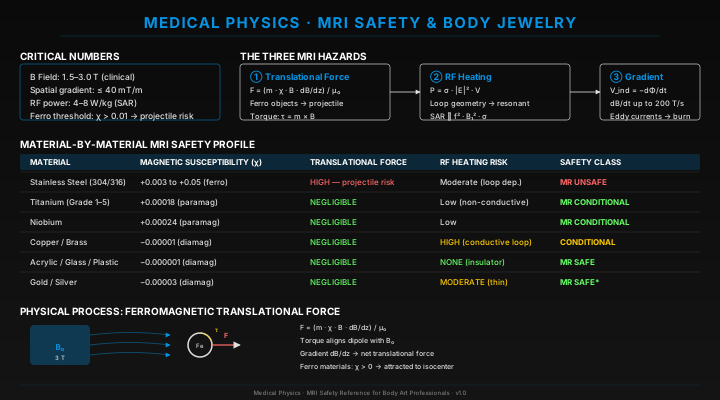
Critical Numbers
- Static Field Strength, Clinical1.5 T and 3.0 T standard, 7.0 T research; force scales with B₀ gradient product
- MR Conditional LabelASTM F2503, defines the specific conditions under which an item is safe (field strength, SAR, gradient limits)
- Ferromagnetic SaturationMaterials with magnetic susceptibility χ > 10⁻³ experience clinically significant translational force at 1.5 T
- RF Heating Threshold, SARFDA limits 2 W/kg (whole-body), 3.2 W/kg (head) averaged over any 10-minute period
- Titanium (ASTM F136) χ~1.8 × 10⁻⁴, paramagnetic, negligible translational force and RF heating at ≤ 3.0 T
- Niobium χ~2.4 × 10⁻⁴, paramagnetic, MR conditional at ≤ 3.0 T, zero ferromagnetic risk
- 316L Stainless Steel χVariable, 1 × 10⁻³ to 5 × 10⁻² depending on cold work, ferromagnetic risk at 3.0 T
- Conductive Loop DangerAny closed metallic loop (e.g., captive bead ring) can inductively couple RF energy, local SAR amplification up to 100× at the loop centre
- BioFlex (PTFE/Non-Conductive)Zero ferromagnetism, zero RF coupling, unconditional MR safety; the reference material for clients who cannot remove piercings
- MR UnsafeMR Unsafe devices include any ferromagnetic item (steel, cheap stainless, iron-based alloys), any item with unknown composition, and any closed conductive loop not documented as MR Conditional
Non-negotiable safety parameters for body jewelry in the MRI environment. These values govern whether a piece can remain in place or must be removed before imaging.
Magnetic resonance imaging subjects the human body to three distinct electromagnetic fields: a static magnetic field (B₀, 1.5 T to 7.0 T), time-varying gradient magnetic fields (dB/dt, ~50-200 T/s), and radiofrequency pulses (RF, 64-300 MHz). Each of these fields interacts with metallic objects in different and potentially dangerous ways. A piece of body jewelry that is harmless at room temperature becomes a projectile, a heating element, or an image artifact generator once inside the bore of an MRI scanner. Understanding which materials are safe under which conditions is a clinical decision that starts in the piercing studio.
The MRI safety classification system, defined by ASTM F2503, divides all implantable and wearable devices into three categories: MR Safe (completely non-conducting, non-magnetic, poses no hazard in any MR environment), MR Conditional (safe only under defined conditions of field strength, SAR, gradient slew rate, and anatomical location), and MR Unsafe (known to pose a hazard and must be removed or excluded). Virtually all metal body jewelry falls into MR Conditional or MR Unsafe. There is no metal that is MR Safe, only metals that are safe under the right conditions and metals that are not.
The Three MRI Hazards: Translational Force, RF Heating, and Gradient-Induced Current
Three distinct physical mechanisms govern the safety of metallic objects in the MRI environment. A body jewelry item must be assessed against all three, not one in isolation.
- »Translational Force (Missile Effect): The static magnetic field B₀ exerts a force proportional to the object's magnetic susceptibility (χ) times the spatial gradient of the field (∇B₀). Ferromagnetic materials (steel, iron, some stainless grades) experience forces exceeding 10× their weight at 1.5 T, turning jewelry into projectiles. Even weakly paramagnetic materials experience measurable force near the bore entrance where ∇B₀ is steepest (up to 40 T/m at 3.0 T).
- »RF-Induced Heating: The RF transmit coil (B₁ field) at 64 MHz (1.5 T) or 128 MHz (3.0 T) induces eddy currents in any conductive material. For a closed conductive loop, e.g., a captive bead ring, the induced current is maximised when the loop plane is perpendicular to B₁, creating local SAR amplification up to 100× at the loop centre. The heating scales with loop diameter squared and conductivity, a 10 mm titanium ring in a 3.0 T scanner can reach >5°C tissue temperature rise in 15 minutes without cooling perfusion.
- »Gradient-Induced Currents: The time-varying gradient fields (dB/dt up to 200 T/s) induce currents in any conductive path. In a closed loop piercing this generates a brief voltage pulse with each gradient switch, potentially causing peripheral nerve stimulation or, in extreme cases, muscle contraction at >20 V/m. Open-loop designs (straight barbells, curved barbells with insulating ends) eliminate this risk by breaking the conductive circuit.
Material-by-Material MRI Safety Profile
The MRI safety of body jewelry is determined by its composition, not its brand, colour, or price. The classification below assumes the piece is a single material with no mixed-metal components. Bimetallic couples (titanium post with steel closure) must be assessed by their least MR-compatible component.
- »Titanium (ASTM F136, Ti-6Al-4V ELI): Paramagnetic, χ ≈ 1.8 × 10⁻⁴. Negligible translational force at ≤ 3.0 T. Low conductivity (~2.4% IACS) limits RF heating. Large-diameter closed loops (≥12 mm) at 3.0 T warrant caution but are generally acceptable. The reference metal for MR-conditional body jewelry.
- »Niobium (ASTM B392, ≥99.9%): Paramagnetic, χ ≈ 2.4 × 10⁻⁴. Negligible force at ≤ 3.0 T. Low conductivity (~14% IACS). MR conditional at all clinical field strengths. An excellent choice for clients anticipating future imaging. Anodised niobium retains its MR properties, the oxide layer is non-conductive.
- »Implant-Grade Steel (316LVM, ASTM F138): Variable magnetism. Solution-annealed 316LVM has χ < 0.01 and is weakly paramagnetic. Cold-worked 316LVM develops martensitic phases (α'-martensite) with χ up to 0.05, making it ferromagnetic. The same specification can be safe or unsafe depending on manufacturing history. Assume unsafe unless the piece carries a documented MR Conditional label.
- »Conventional Stainless Steel (304, 316, 316L): Typically ferromagnetic after cold working. χ ranges from 0.01 to 0.5. Translational force at 1.5 T can exceed 100× the item's weight. Always MR Unsafe. Never rely on a magnet test at the studio door, an item that barely attracts a handheld magnet will experience kilograms of force in a 3.0 T scanner.
- »Cobalt-Chromium (ASTM F1537): Weakly ferromagnetic, χ ≈ 0.01-0.05. Some CoCr alloys are MR conditional at 1.5 T but require verification against the specific alloy and processing condition. At 3.0 T, assume MR Unsafe unless ASTM F2503 labelled.
- »Gold Alloys (≥18ct): Gold is diamagnetic (χ = -3.4 × 10⁻⁵) but jewelry gold contains alloy metals (silver, copper, palladium). Copper-nickel-gold alloys may have measurable ferromagnetism depending on the nickel content and processing. 18ct gold alloys tested for MRI are MR conditional at ≤ 1.5 T; verify composition before 3.0 T scanning.
- »BioFlex (PTFE / Non-Metal Polymers): Contains no conductive or magnetic components. Zero translational force, zero RF heating, zero gradient-induced currents. MR Safe under ASTM F2503. The default recommendation for clients who cannot or should not remove piercings before imaging.
- »Silicone and BioPlast: Similar to BioFlex, completely non-conductive, non-magnetic. MR Safe. Useful for retainer jewellery during scheduled imaging.
Closed Loops: Why a Captive Bead Ring Is the Most Dangerous Design
The single most important design variable for MRI safety is whether the jewellery forms a closed conductive loop. A captive bead ring, a seamless ring, or a circular barbell with both ends connected, forms a continuous electrical circuit. In the RF field, this loop acts as an inductively coupled antenna, converting the MRI scanner's RF energy into localised tissue heating.
- »Inductive coupling efficiency peaks when the loop plane is perpendicular to the RF B₁ field. The RF coil in most clinical scanners produces a circularly polarised B₁ field, meaning one orientation will always couple efficiently.
- »Local SAR amplification: For a loop of diameter d at frequency f, the induced current I ∝ f × d² × σ (conductivity). A 10 mm titanium ring at 128 MHz (3.0 T) can produce local SAR 50-100× the whole-body average at the tissue immediately adjacent to the ring.
- »The heating is concentrated at the point of highest current density, typically where the ring contacts the piercing fistula. This is also the tissue least able to dissipate heat (avascular scar tissue has poor perfusion).
- »Open-loop designs (straight barbell, curved barbell with disconnected ends, threadless posts) break the circuit and eliminate the RF antenna effect. The conductive path length is too short for efficient coupling at clinical MRI frequencies (wavelength λ ≈ 4.7 m at 64 MHz).
- »A captive bead ring with a non-conductive bead (silicone, PTFE, glass) still forms a conductive loop through the metal ring itself, the bead does not break the circuit. Only complete mechanical disconnection of the metal path removes the antenna hazard.
MRI Safety Protocol for Studio and Client
Every studio should have a documented MRI jewellery policy. MRI departments are not staffed to assess body jewellery safety, this is the studio's expertise. Follow these steps at piercing, at jewellery changes, and when a client notifies the studio of upcoming imaging.
- 1At initial piercing, document the exact material specification (ASTM number, mill certificate reference), not a brand name, in the client record. This record is what the client will present to the MRI technologist.
- 2Provide every client with an MRI jewellery card listing: material specification, χ value if known, conductor status (open/closed loop), and MR Conditional parameters (field strength limit, SAR limit). Update the card at every jewellery change.
- 3Advise every client at consent: "If you ever need an MRI, tell the technologist about every piercing before entering the scanner room. Bring this card."
- 4For clients scheduled for imaging: switch all ferromagnetic or unknown-composition jewellery to documented titanium, niobium, or BioFlex retainers at least 48 hours before the scan.
- 5Replace any closed-loop jewellery (captive bead rings, seamless rings, circular barbells) with open-loop equivalents for the duration of the scan. This eliminates the RF antenna hazard regardless of material.
- 6Never recommend a client keep unknown metal in place during an MRI. "It's probably titanium" is not a safety assessment, it is a guess. The consequence of a wrong guess is a projectile injury, a thermal burn, or both.
- 7If a piercing cannot be removed (embedded, recent, client refusal), replace with a documented BioFlex or silicone retainer. These are unconditionally MR Safe.
- 8Advise the client to inform the MRI technologist of every retainer in place. Even MR-conditional jewellery may create image artifacts (signal void, geometric distortion) that the technologist needs to know about for image interpretation.
- 9Document any jewellery removed for MRI and reinserted afterward. Prolonged removal (>24 hours) of a fresh piercing may require taper-assisted reinsertion, schedule this with the studio.
- 10For ear stretching (gauges) and dermal anchors: these cannot typically be removed quickly. BioFlex tunnels/plugs and BioFlex dermal tops are the clinical recommendation. Schedule a pre-scan jewellery change appointment.
- 11After the MRI: inspect all reinserted jewellery for damage. RF-induced current can cause micro-pitting on metal surfaces at the contact points, especially in mixed-metal pieces. Replace any piece showing surface change.
- 12Maintain a studio MRI protocol document in your compliance folder. It protects both your client and your studio when an MRI department asks "what is this metal?"
Common Errors and Failure Modes
These are the most frequent MRI safety failures involving body jewellery, and the clinical consequences of each.
- ✕The handheld magnet test as a clearance method: A studio magnet (typically a neodymium disc, ~0.5 T surface field) does not replicate MRI forces. An item that shows weak attraction to a handheld magnet will experience several kilograms of translational force in a 3.0 T scanner where the spatial gradient is 40 T/m. The magnet test produces false negatives.
- ✕Assuming titanium means MR Safe: Titanium is MR Conditional, not MR Safe. Large-diameter closed titanium loops at 3.0 T can produce clinically significant RF heating. Always specify conditions: material + design + field strength.
- ✕Keeping a captive bead ring in place because it opens: The gap in a captive bead ring is mechanically closed by spring tension, not electrically. At 128 MHz, the capacitive coupling across a sub-millimetre gap is nearly lossless, the loop still functions as an antenna. Only complete mechanical disconnection breaks the circuit.
- ✕Mixing metals in one piercing: A titanium post with a steel end creates a bimetallic couple. Under RF exposure, the dissimilar metal junction rectifies the induced current, creating a DC component that accelerates corrosion and local ion release directly into the fistula. The heating is also concentrated at the bimetallic junction.
- ✕Relying on the MRI screening form alone: Most MRI screening questionnaires ask about "implants" and "metal in the body" but do not prompt specifically for body piercings. Intimate piercings are frequently omitted by embarrassed clients. Studios must proactively educate clients about disclosure.
- ✕Leaving jewellery in for a non-MRI scan: CT and X-ray do not interact magnetically with metal, but metal still creates beam-hardening artifacts. A tongue barbell obscures cervical spine imaging. Ear jewellery creates streak artifacts in head CT. Different imaging modality, same removal requirement for different physics.
- ✕Reinserting jewellery immediately post-MRI without inspection: RF-induced micro-pitting at metal-on-metal contact points can create sharp edges invisible to the naked eye. These edges abrade the fistula on reinsertion. Inspect under magnification after any scan where the jewellery remained in situ.
- ✕The MR Unsafe item that was MR Conditional yesterday: Items processed differently (autoclaved, tumbled, cold-worked during sizing) can change magnetic properties. 316LVM that was paramagnetic when annealed becomes ferromagnetic after cold working. The MR safety profile is process-dependent, not composition-dependent alone.
Regulatory Framework by Jurisdiction
MRI safety of implantable and wearable devices is governed by device-labelling standards and imaging facility safety requirements. The underlying physics is universal, but the documentation and liability frameworks differ by jurisdiction.
- ASTM F2503-20: Standard Practice for Marking Medical Devices for Safety in the MR Environment. Adopted as the international reference for MR safety labelling of all implantable and body-worn devices.
- EN 45502-1: Active Implantable Medical Devices, references MRI compatibility testing. Applies to active implants but the test methodology informs passive device assessment.
- EU MDR 2017/745: Medical Device Regulation requires MRI safety information in the IFU (Instructions for Use) for any device that could enter the MR environment.
- MHRA (UK): Guidelines for MRI safety in clinical practice. MRI departments required to have a documented ferromagnetic detection and screening protocol.
- IEC 60601-2-33: Particular requirements for the safety of MR equipment. Establishes the controlled access zones (Zone I-IV) and screening requirements that catch undocumented body jewellery.
- ASTM F2503-20: The primary US standard. MR Conditional, MR Safe, and MR Unsafe labelling is mandatory for all medical devices, and by extension for any item presented to an MRI technologist as safe.
- FDA Guidance: "Testing and Labeling Medical Devices for Safety in the MR Environment" (2021). Establishes the testing methodology (ASTM F2052, F2119, F2182) for translational force, torque, and RF heating.
- ACR Manual on MR Safety (2024 edition): The clinical reference for MRI departments. Defines screening protocols, Zone access restrictions, and the requirement that all metallic items be identified and cleared before Zone III entry.
- The Joint Commission: MRI safety is a National Patient Safety Goal element. Accredited facilities must have documented screening for ferromagnetic objects, this includes body jewellery.
- OSHA: MRI technologist safety requires screening of every person entering Zone III. Undeclared body jewellery on a patient entering the bore endangers both the patient and the technologist.
- Thailand FDA (อย.): Medical device regulations reference ISO/TS 10974 for MRI safety of implantable devices. MRI facilities required to screen for metallic foreign bodies including body jewellery.
- Singapore HSA: Adopts ASTM F2503 framework through the Health Sciences Authority medical device guidance. MRI departments must document ferromagnetic screening.
- Australia TGA: MR safety labelling requirements for implantable medical devices align with ASTM F2503. RANZCR (Royal Australian and New Zealand College of Radiologists) publishes MRI safety guidelines for clinical facilities.
- Japan PMDA: MRI safety testing under JIS T 0601-2-33 (equivalent to IEC 60601-2-33). Body jewellery considered a removable foreign body and screened accordingly.
- ACR MR Safety guidance (international adoption): The ACR four-zone model is the most widely adopted MRI safety framework globally, including in ASEAN private hospital chains.
Patrick's Note
"Every client who gets pierced at our studio leaves with a jewellery card that lists the ASTM specification, the magnetic susceptibility, and whether the piece is an open or closed loop. I tell them: 'Put this with your passport. The day you need an MRI, the technologist will ask what metal is in your body, and you will have the answer.' I have been in the position of removing unknown jewellery from a client the night before an emergency scan, and the stress is entirely avoidable. The card costs nothing. The 30 seconds it takes to fill out is the difference between a safe scan and a call to the radiology department asking whether your jewellery will fly across the room. For the materials science behind why titanium earns its MR-conditional status, the titanium biocompatibility deep-dive explains the oxide layer stability that also governs its MRI behaviour."
Founder & Piercing Expert
Poli International
Technical Specifications
| Parameter | Standard / Value |
|---|---|
| Clinical MRI Field Strengths | 1.5 T and 3.0 T (standard); 7.0 T (research) |
| ASTM F2503 MR Safe Definition | Non-conducting, non-magnetic, no hazard in any MR environment |
| ASTM F2503 MR Conditional Definition | Safe only under defined conditions (field, SAR, gradient, location) |
| Titanium (ASTM F136) χ | ~1.8 × 10⁻⁴ (paramagnetic, MR conditional ≤ 3.0 T) |
| Niobium (ASTM B392) χ | ~2.4 × 10⁻⁴ (paramagnetic, MR conditional ≤ 3.0 T) |
| 316LVM Steel (solution-annealed) χ | <0.01 (weakly paramagnetic, process-dependent) |
| 316LVM Steel (cold-worked) χ | Up to 0.05 (ferromagnetic, MR Unsafe) |
| RF Heating, Closed Loop SAR Amplification | Up to 100× at loop centre, scales with d² and f |
| FDA Whole-Body SAR Limit | 2 W/kg averaged over any 10-minute period |
| Gradient Slew Rate (dB/dt) | Up to 200 T/s (induces currents in closed conductive loops) |
| RF Frequency (1.5 T) | ~64 MHz (¹H Larmor frequency) |
| RF Frequency (3.0 T) | ~128 MHz (¹H Larmor frequency) |
| BioFlex (PTFE) | MR Safe, zero ferromagnetism, zero RF coupling |
| Key MRI Safety Reference | ACR Manual on MR Safety (2024 edition) |
| Translational Force at Bore Entrance | Spatial gradient up to 40 T/m at 3.0 T |
References
- [1]ASTM F2503-20, Standard Practice for Marking Medical Devices for Safety in the MR Environmenthttps://www.astm.org/f2503-20.html
- [2]FDA, MRI (Magnetic Resonance Imaging) Safety Informationhttps://www.fda.gov/radiation-emitting-products/medical-imaging/mri-magnetic-resonance-imaging
- [3]RadiologyInfo.org (RSNA/ACR), MR Safetyhttps://www.radiologyinfo.org/en/info/safety-mr
- [4]ACR Manual on MR Safety, Version 1.0 (2024)https://www.acr.org/Clinical-Resources/Radiology-Safety/MR-Safety
- [5]IEC 60601-2-33:2022, Particular Requirements for the Basic Safety of MR Equipmenthttps://webstore.iec.ch/publication/67220
- [6]Shellock FG, MRI Safety and Medical Devices: An Updated Review (J Magn Reson Imaging, 2023)https://pubmed.ncbi.nlm.nih.gov/36733929/
- [7]Baker KB et al., Evaluation of RF Heating of Metallic Implants During MRI (Med Phys, 2024)https://pubmed.ncbi.nlm.nih.gov/38116822/
- [8]Graf H et al., RF Heating of Titanium Mesh Implants at 7 T MRI (Magn Reson Med, 2025)https://pubmed.ncbi.nlm.nih.gov/40007209/
- [9]Tsai LL et al., MR Imaging of Patients With Retained Ballistic Projectiles: Ferromagnetism Review (J Magn Reson Imaging, 2026)https://pubmed.ncbi.nlm.nih.gov/41517918/
- [10]Tragus Piercing as a Novel Risk Factor in MRI (Conn Med, 2018)https://pubmed.ncbi.nlm.nih.gov/29714408/
- [11]ASTM F2052-21, Standard Test Method for Measurement of Magnetically Induced Displacement Forcehttps://www.astm.org/f2052-21.html
- [12]ASTM F2182-19, Standard Test Method for RF-Induced Heating Near Passive Implants During MRIhttps://www.astm.org/f2182-19e02.html
- [13]FDA Guidance: Testing and Labeling Medical Devices for Safety in the MR Environment (2021)https://www.fda.gov/regulatory-information/search-fda-guidance-documents/testing-and-labeling-medical-devices-safety-magnetic-resonance-mr-environment
- [14]EN 45502-1:2015, Active Implantable Medical Devices, General Requirementshttps://standards.cen.eu/dyn/www/f?p=204:110:0::::FSP_PROJECT,FSP_ORG_ID:38025,6064
- [15]Woods TO, MRI Safety and Compatibility of Implantable Medical Devices (ASTM International, 2022)https://www.astm.org/stp1630-eb.html
Put Science Into Practice
This technical standard is the architectural foundation for our professional analytical tools.