# UK Expands SVHC Candidate List: 15 New Substances Now Under Supply Chain Scrutiny, What Body Art Professionals Must Know
n-Hexane and BPAF Are Now Notifiable Under UK REACH, You Have 45 Days to Respond to Any Client Request
Key Takeaways:
» On March 18, 2026, the UK proposed 15 new SVHCs to its Candidate List under UK REACH, two directly impact body art supply chains: n-hexane (solvent residue in pigments) and bisphenol AF, BPAF (plasticizer in epoxy molds and ink bottle polymers).
» Under UK REACH Article 33, any article containing an SVHC above 0.1% w/w triggers a 45-day response obligation when a consumer requests safety information.
» The UK's SVHC list now diverges from the EU's 253-substance Candidate List, studios serving both markets must track two separate frameworks.
» Studios holding >1 tonne/year of an affected article must notify ECHA via the SCIP database under the Waste Framework Directive.
» Authorization pathway timeline is typically 18–24 months from Candidate List placement, begin supplier diversification now, before authorization deadlines force supply disruption.
1. What the March 18 Expansion Actually Requires
When a substance is added to the SVHC Candidate List under UK REACH, it does not trigger an immediate ban. It triggers legal obligations that activate upon consumer request. Under UK REACH Article 33, any manufacturer, importer, or distributor of an article containing a Candidate List SVHC above 0.1% w/w must respond to consumer requests for substance information within 45 days. This threshold is binary, an article either triggers the duty or it does not. There is no proportionality argument for smaller studios.
The two substances with the highest direct relevance to body art supply chains are:
n-Hexane (CAS 110-54-3) is a volatile solvent classified under UK CLP as a specific target organ toxicant (STOT) causing repeated-exposure neurotoxicity. It is used in pigment synthesis, carrier fluid formulation, and as a manufacturing cleaning agent in jewelry production. n-Hexane does not appear on finished ink labels, it exists as a manufacturing residue. If a pigment or carrier supplier used n-hexane in synthesis or purification and residual concentrations exceed 0.1% w/w, the finished pigment becomes a notifiable article. ICH Q3C pharmaceutical guidelines set n-hexane limits at 50 ppm, body art standards do not yet have an equivalent, but this benchmark provides a practical reference for requesting supplier residual solvent analysis.
Bisphenol AF (BPAF) and its salts (CAS 1478-61-1) is classified as toxic to reproduction (Repr. 1B). BPAF is used as a cross-linking agent and process regulator in epoxy resins, specialty plastics, and precision-molded components. For body art, BPAF exposure pathways include: epoxy-based sterilization container components, precision-molded plastic caps for ink bottles, and specialty jewelry casting molds where residual epoxy contacts the finished metal. If a jewelry supplier uses BPAF-containing epoxy in production, or ink bottle packaging contains BPAF polymer components, notification obligations attach.
2. SVHC Notification Obligation Triggers by Studio Type
| Studio Activity | n-Hexane Trigger? | BPAF Trigger? | Action Required |
|---|---|---|---|
| Stock tattoo inks from manufacturer using n-hexane in synthesis | Possible if >0.1% residue | No | Request residual solvent analysis from pigment supplier |
| Use epoxy sterilization containers with BPAF-containing components | No | Possible if >0.1% | Request CoA from container supplier |
| Import jewelry from manufacturer using BPAF epoxy in molds | No | Possible if >0.1% | Request supplier SCIP notification status |
| Source ink from EU-compliant manufacturer already audited | Possibly excluded | Possibly excluded | Request written UK REACH Article 33 confirmation |
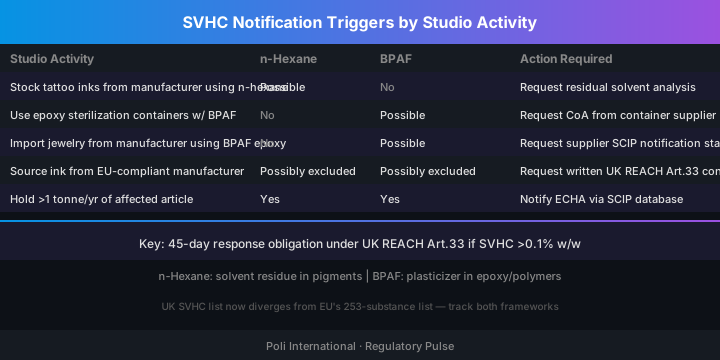
| Hold >1 tonne/year of affected article | Yes | Yes | Notify ECHA via SCIP database |
|---|
3. The Legal Machinery: Authorization Pathway and Documentation Requirements
Candidate List placement initiates a multi-stage regulatory process. After listing, substances enter the UK REACH authorization pathway, manufacturers must eventually apply for explicit permission to continue use, or phase out. The n-hexane authorization review is expected to focus on manufacturing uses; some suppliers may secure "currently unavoidable" exemptions. BPAF faces a Repr. 1B classification that makes exemptions less likely. Timeline from listing to first authorization deadline is typically 18–24 months, meaning supply disruption risk for non-exempt uses arrives in late 2027 to early 2028 if you do not begin diversification now.
The immediate compliance obligations under Article 33 and the Waste Framework Directive are three-tiered:
Consumer notification system: If a client asks whether their jewelry or ink contains an SVHC above 0.1%, you have 45 days to respond with a written answer. Prepare a template now. If you do not know the answer because you have not audited your suppliers, you are already in a compliance gap.
SCIP database notification: If you hold >0.1% SVHC in an article at >1 tonne/year, notify ECHA via echa.europa.eu/scip. Cross-reference your current suppliers against existing SCIP notifications to identify articles already notified by the supply chain above you, this tells you where your obligations already exist.
Supply chain traceability: You must be able to trace where the substance entered your supply chain and provide documentation to enforcement authorities on request. This mirrors the batch traceability infrastructure now standard for REACH Annex XVII-compliant tattoo ink, the same documentation discipline applied to jewelry and equipment procurement. The Nickel Sensitization 6× Risk Study covers why batch-level traceability is becoming the standard of care across body art materials, not just regulatory compliance.
4. Patrick's Deep Archive: Why the UK-EU Regulatory Fork Is the Compliance Challenge Nobody Planned For
In 25 years of supplying body art manufacturers, I've watched regulatory frameworks evolve incrementally, usually following EU direction, with the UK as a near-automatic follower. The post-Brexit SVHC fork changes that in ways I don't think most studios have fully absorbed.
What I've observed is that the compliance infrastructure most studios built between 2021 and 2023 was designed for a single framework: EU REACH Annex XVII and its SVHC Candidate List. The documentation systems, the supplier questionnaires, the batch tracking, all of it was architected around one regulatory reference. The March 2026 UK expansion creates a second reference with a different list, different threshold interpretations potentially in development, and different enforcement timelines.
My practical recommendation from decades of supply chain work: do not try to maintain two completely separate systems. Instead, build your supplier compliance documentation around the more restrictive requirement at every point, whichever of EU REACH or UK REACH imposes a stricter limit or an earlier deadline, that becomes your standard. This over-compliance approach costs nothing extra in documentation overhead and eliminates the dual-tracking problem entirely. For the specific context of how the UK and EU regulatory frameworks are diverging on tattoo ink CMR substance restrictions, which runs parallel to the SVHC expansion, see the UK REACH Regulatory Fork 2025 analysis.
5. FAQ: Technical Q&A
Q: How do I find out if my pigment supplier's inks contain n-hexane residue above 0.1%?
Request a residual solvent analysis report for each pigment batch you stock. If the supplier's SDS does not include residual solvent data, ask them to conduct analysis per ICH Q3C guidelines and provide batch-specific results. A supplier who cannot provide residual solvent analysis for products they represent as body art-safe is not meeting the documentation standard expected under UK REACH 2026. The 50 ppm ICH Q3C limit for n-hexane provides a practical reference even though body art-specific limits are not yet formalized.
Q: Does the 45-day response obligation apply to individual piercing clients asking verbally in-studio?
Yes. UK REACH Article 33 does not specify the format of the consumer request, verbal requests in your studio trigger the same 45-day written response obligation as formal written inquiries. Prepare a client-facing template statement now, referencing your supplier confirmations of absence of n-hexane and BPAF above 0.1% w/w. Keep the supplier documentation in your compliance file so the template response has evidentiary backing.
Q: If the EU Candidate List has 253 substances and the UK list is different, how do I know which one applies to my UK studio?
For UK studios, UK REACH governs. The EU Candidate List does not have direct legal force in the UK post-Brexit. However, because most body art supply chains are designed for EU compliance, EU-compliant articles will often also satisfy UK REACH obligations, but not always. The UK has authority to add or remove substances independently of EU decisions. Check the UK REACH Candidate List directly through the HSE website and compare it against the EU list quarterly to identify any divergences that affect your specific materials.
Conclusion: The 45-Day Clock Is Already Running
The March 18, 2026 UK SVHC expansion does not allow a preparation window, the 45-day response obligation activates on the date of listing, not on a future compliance date. Any client who asks about n-hexane or BPAF in your products today is entitled to a documented response within 45 days. Studios that cannot answer because they have not audited their suppliers are already in violation of UK REACH Article 33.
The supply chain audit required here is not complex, it is a direct written request to each jewelry and ink supplier confirming absence of n-hexane and BPAF above 0.1% w/w, backed by SDS or CoA documentation. The studios that execute this audit this week are protected. For the broader regulatory context connecting this SVHC expansion to the EU 2026/78 CMR restrictions and the UK REACH tattoo ink fork, see the EU Regulation 2026/78 CMR Restrictions and the UK REACH Regulatory Fork 2025.