Virat Kohli just dropped a full-sleeve evolution on his left arm—lotus, peony, and spiritual narrative flowing from wrist to shoulder—and the internet predictably lost its mind. But here's what matters: this isn't just a celebrity getting inked. This is a masterclass in how intentionality, storytelling, and structural design make the difference between ink that ages beautifully and ink that becomes regrettable driftwood in two years.
The lotus, according to Aliens Tattoo India, carries the metaphor we've all heard: rises from muddy water, untouched by filth, blooming with purity regardless of environment. Standard spiritual symbolism, sure. But what's technically interesting is the placement strategy and sleeve architecture. This isn't random. Kohli's sleeve exists as a cumulative narrative—it's not one standalone tattoo; it's an evolving canvas that reflects different phases of his career. That's not new conceptually, but the execution matters enormously, and that's where most people fail.
Why Intentional Design Prevents Regret
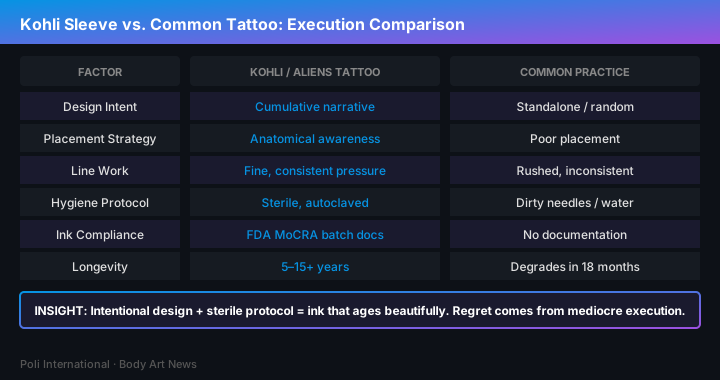
Here's the unvarnished truth: most people regret their tattoos not because of the symbolism—they regret them because of mediocre execution and poor design placement. In 2026, we're seeing a hard shift away from "big and loud" toward what the industry's calling "taste-driven" design. Kohli's approach mirrors that—fine line work, floral elements positioned for visual flow, materials and color clarity that will photograph well *and* age well.
The technical reason this matters: a lotus rendered with precision and anatomical awareness (placement on collarbones, wrists, areas that show line work clearly) holds up over five, ten, fifteen years because the negative space and line weight create depth that doesn't collapse into a muddy blob. Poor execution—rushed linework, inconsistent pressure, mismatched scale—degrades visibly within eighteen months.
But here's where the real story gets dark. While Kohli's team at Aliens Tattoo is operating at a level where hygiene and craftsmanship are non-negotiable, other studios are still playing fast and loose with the basics. The NYC-based Live by the Sword studio just got hit with a $3 million lawsuit from ex-piercers exposing dirty needles, insects, rats, and blood spills across their workspace. This isn't ancient history or a fringe operator—this is a "popular" studio that clients trusted. And the difference between Kohli's sterile, professional experience and what those piercers documented is the difference between art and hazard.
The regulatory landscape is tightening too. FDA MoCRA compliance is now mandatory by 2026, meaning every ink batch must be documented, every serious adverse event reported within 15 business days. That's not bureaucratic theater—it's the baseline that separates professional operations from cowboys. You want your lotus from an artist operating under that framework, not someone diluting ink with tap water and storing needles in a desk drawer.
What clients actually need to understand: a viral celebrity tattoo tells you the artist exists at a certain skill level. That's the minimum bar to clear. But it doesn't tell you whether they're using sterile water for ink dilution, whether they're autoclaving reusable equipment, whether they've got batch documentation on every bottle, or whether they'd recognize cross-contamination if it walked through the door. Kohli's sleeve probably cost six figures and involved consultations with a top-tier studio. Your $300 sleeve requires the same hygiene protocol, just applied to a smaller canvas.
The piercing community is experiencing the same bifurcation. 2026 trends emphasize "architectural ear design"—intentional placement, premium materials, structural balance rather than chaotic stacking. That shift isn't aesthetic; it's functional. Fewer piercings placed with precision and high-quality titanium jewelry equals fewer infections, better healing, less long-term damage. More piercings placed randomly with low-grade material equals higher infection rates and scarring. The engineering is the aesthetic.
Here's my take: Kohli's tattoo will age beautifully because it was designed with intentionality, executed by professionals in a sterile environment, and uses materials that meet current regulatory standards. The lotus will still be a lotus in ten years, still hold symbolism, still look purposeful. Meanwhile, thousands of people getting "meaningful" ink in studios that can't pass a basic safety audit are going to spend the next decade either regretting the design or dealing with infections they'll never fully trace back to the source.
The takeaway is brutal but simple: viral doesn't mean safe. Celebrity exposure doesn't mean you should walk into that studio. Craftsmanship and professionalism are inseparable, and the industry is finally being forced to prove it. Demand batch documentation. Ask about autoclaving. Watch where your artist's hands go. If they get defensive about hygiene basics, they're failing the actual art form, regardless of how pretty the portfolio looks.
1. FAQ: Tattoo Safety, Studio Standards, and Ink Compliance
Q: What makes a tattoo age well over 10–15 years?
Three factors dominate long-term appearance: line weight consistency, placement awareness, and pigment formulation. Fine linework placed in low-movement areas (collarbones, ribs, behind the ear) maintains definition because the dermis in those zones experiences minimal mechanical stress. Areas subject to constant movement, inner elbows, fingers, knuckles, experience repeated dermal remodelling, which accelerates pigment migration and line blur. Negative space is equally important: designs that rely on tight packing of multiple elements at small scale tend to merge as macrophage-mediated pigment redistribution occurs over years. Pigment quality matters too, inks formulated to comply with REACH restrictions (lower heavy metal content, no restricted azo pigments) tend to produce cleaner, more stable colours than unregulated formulations, partly because the restrictions on impurities also reduce the particles most prone to migration.
Q: How do I verify that a tattoo studio meets basic hygiene and regulatory standards before booking?
Start with three questions: Does the studio autoclave reusable equipment, and can they show you the spore test log that verifies the autoclave is functioning correctly? Do they use single-use pre-sterilised needles with sealed, tamper-evident packaging, opened in front of you? Can they provide the batch number and brand of the ink they intend to use on you? A studio that answers all three clearly and without irritation is operating at a minimum professional standard. If any question triggers defensiveness, evasion, or "we've never had a problem," treat that as a warning. Under FDA MoCRA, studios using inks in US jurisdictions are required to report serious adverse events within 15 days, a regulation that only functions if studios are documenting their materials at the batch level.
Q: What is FDA MoCRA and how does it affect tattoo studios in 2026?
The Modernization of Cosmetics Regulation Act extended FDA oversight to include tattoo inks and semi-permanent makeup products. From 2026, mandatory compliance includes: registration of facilities that manufacture or distribute tattoo inks; adverse event reporting within 15 business days for any serious reaction linked to a product; and accurate ingredient labelling on all ink containers. For studios, the operational implication is that you need to retain batch documentation for every ink used in a procedure. If a client develops a serious reaction and the batch number cannot be identified, the regulatory and liability chain becomes significantly more complicated. Studios sourcing inks from EU-compliant manufacturers are generally well-positioned, as EU REACH and EU Regulation 2022/1 on tattoo inks already mandate similar traceability standards.
Q: Why does architectural ear design reduce infection rates compared to random stacking?
Placement precision reduces cumulative piercing density in any given anatomical zone. When multiple piercings are clustered without anatomical planning, for example, three piercings in the helix within a 2 cm arc, the vascular supply to the cartilage between them is compressed, increasing the risk of avascular necrosis (tissue death from blood supply interruption) and creating overlapping healing fields where inflammatory exudate from one piercing can contaminate adjacent healing tissue. Architectural ear design distributes piercings across different anatomical structures (helix, antihelix, daith, tragus, conch) with spacing that respects individual vascular territories. Combined with high-quality implant-grade titanium initial jewellery, which minimises the inflammatory load on healing tissue, the result is substantially lower infection incidence and better long-term aesthetics than densely stacked piercings placed for trend rather than anatomy.
Q: Is a celebrity or heavily photographed tattoo a reliable signal of studio quality?
No, it is a signal of artistic skill at one tier, but skill and safety are independent variables. A studio can produce visually stunning work while maintaining poor sterilisation protocols, using non-compliant inks, or lacking regulatory documentation. The NYC studio named in recent litigation was considered a destination studio with strong visual branding. The inverse can also be true: a modest local studio with limited social media presence may operate to rigorous hygiene and compliance standards that exceed those of high-profile urban studios. Evaluate studios on the merits of their documented safety protocols, not on the celebrity cachet of their client list.