Pregnancy and Piercings: Why Rigid Metal Bars Are the Wrong Choice
Key Takeaways:
» The abdomen changes dramatically during pregnancy, a fixed-length metal bar cannot accommodate this; a BioFlex bar can be trimmed to any length without specialist tools.
» Navel piercings with rigid metal bars during pregnancy carry elevated risk of pressure necrosis and rejection as the skin stretches and the bar creates a fixed leverage point.
» BioFlex pregnancy belly bars accommodate all three trimesters and can be adjusted throughout gestation.
» Most navel piercings can be maintained through pregnancy and restored to original jewelry post-partum, but only with the right material during the pregnancy period.
» The risks of metal in pregnancy are not about toxicity, they are about mechanics. A rigid bar in expanding tissue will always lose that argument.
1. What Actually Happens to a Navel Piercing During Pregnancy
A navel piercing sits through approximately 8–12mm of skin at the upper rim of the navel, passing through a fold of abdominal tissue. In a non-pregnant state, this tissue is relatively stable, a standard curved barbell (typically 10–12mm, 14 gauge) sits without pressure at a fixed angle through a fixed depth of tissue.
During pregnancy, the abdominal wall undergoes progressive expansion. The skin stretches. Subcutaneous tissue thickens with increased vascular supply. The navel flattens, and in later pregnancy frequently inverts, the natural concavity becomes a flat or outward-pointing surface as intra-abdominal pressure increases.
A metal curved barbell is a rigid object with a fixed length and a fixed curvature. It cannot change with the tissue around it. As the abdomen expands, three mechanical problems emerge:
Pressure at the piercing entry and exit points. As the surrounding tissue expands and the bar remains fixed in length, the bar creates increasing pressure against the piercing channel walls. This is leverage trauma, the bar acts as a lever with the piercing channel as the fulcrum, pressing outward as the skin stretches away from the fixed bar length.
Migration and rejection. The body responds to sustained pressure by migrating the jewelry towards the skin surface. Rejection is irreversible, the channel closes and the tissue thins until the bar exits. In many cases rejection begins during pregnancy and becomes permanent, destroying a piercing the client had maintained for years.
Pain and discomfort. A rigid bar in rapidly expanding tissue is uncomfortable. Clothing contact, sleeping position, and the pressure of the growing uterus against the abdominal wall all interact with a fixed-length bar in ways that a flexible, trimable bar eliminates entirely.
2. BioFlex Pregnancy Bars: Mechanics, Not Marketing
BioFlex pregnancy belly bars are not a trend accessory. They are an engineering response to a mechanical problem.
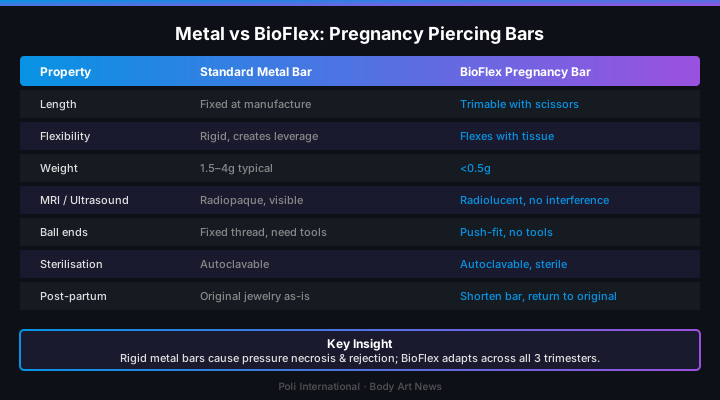
| Property | Standard Metal Bar | BioFlex Pregnancy Bar |
|---|---|---|
| Length | Fixed at manufacture | Trimable with scissors, adjust at any trimester |
| Flexibility | Rigid, creates leverage as skin expands | Flexes with tissue, distributes rather than concentrates force |
| Weight | 1.5–4g typical | <0.5g, negligible pull on the piercing channel |
| MRI / Ultrasound | Radiopaque, visible on imaging | Radiolucent, no interference with obstetric scans |
| Ball ends | Fixed thread, require tools | Push-fit or external thread, adjustable without tools |
| Sterilisation | Autoclavable | Autoclavable, supplied sterile |
| Post-partum | Original jewelry as-is | Shorten bar and return to original jewelry |
The trimability point is critical. As the abdomen expands, the bar needs to lengthen to accommodate the increased tissue depth between entry and exit points without the ends pressing inward. Then, post-partum, as the abdomen contracts, the bar needs to shorten again. Metal bars cannot be modified. BioFlex bars can be cut to any length with scissors, and replacement bars are inexpensive.
3. Trimester-by-Trimester: What to Expect
First trimester (weeks 1–12): Most women will not notice significant change to an established navel piercing. Some swelling and increased sensitivity is possible as vascular supply increases. Switching to BioFlex in the first trimester, before problems begin, is ideal. A standard 12–16mm BioFlex bar is typically appropriate at this stage.
Second trimester (weeks 13–26): Abdominal expansion becomes significant. The navel begins to flatten. This is when pressure from a rigid bar first becomes noticeable as discomfort. A longer BioFlex bar, typically 25–38mm, accommodates the increased tissue depth. Because BioFlex is trimable, the bar can be matched precisely to the client's current anatomy.
Third trimester (weeks 27–40): Maximum abdominal expansion. The navel is typically flat or everted. A BioFlex bar of 40–50mm, trimmed to the appropriate current length, accommodates this stage. Many women find that even at full term, a well-fitted BioFlex bar is comfortable and causes no tissue distress.
Post-partum: As the abdomen contracts, the BioFlex bar length should be reduced. Once the tissue has returned to close to pre-pregnancy dimensions (typically 3–6 months post-partum), the client can return to their original jewelry if the piercing channel is healthy.
4. Patrick's Deep Archive: Why BioFlex and Pregnancy Became Inseparable
In 2005, when the BioFlex pregnancy belly bar became a product line, I already understood the mechanics. The demand came directly from clients, and then from major retailers.
The large British retail chain Argos listed the BioFlex pregnancy banana bar because there was nothing else on the market that solved the problem correctly. This was not a niche specialist product for body art studios, it was mainstream because the problem was mainstream. Every woman with a navel piercing who became pregnant faced exactly the same mechanical challenge, and the market had no answer that was both certified and functional.
What I did not expect was how long it would take for the medical community to join the conversation. Midwives and OB/GYNs still routinely advise patients to simply remove navel piercings during pregnancy. That advice protects against the risks of rigid metal, but it results in the permanent loss of piercings the client had maintained for years, sometimes decades.
The correct advice, switch to a trimable BioFlex bar in the first trimester, prevents rejection, maintains the piercing channel, and eliminates the mechanical risks of rigid jewelry. It requires one appointment with a piercer who stocks BioFlex. The piercing is maintained throughout all three trimesters and original jewelry is reinstated post-partum. The knowledge gap is not in the technology. It is between the people who understand body jewelry (piercers) and the people managing the pregnancy (midwives, OBs). Both communities need to know this option exists.
5. FAQ: Technical Q&A
Q: When in pregnancy should I switch from metal to BioFlex?
As early as possible, ideally in the first trimester before any mechanical pressure begins. The switch is simple (one visit to a professional piercer) and the earlier it is made, the lower the risk of migration, rejection, or discomfort developing.
Q: Can I trim the bar myself?
Yes. BioFlex bars can be trimmed with clean household scissors. The cut end should be smoothed with a nail file and the ball end reattached. Many piercers will do this for you in two minutes. Do not attempt to trim a metal bar yourself.
Q: Is BioFlex safe for the foetus?
BioFlex is composed of PP-R (polypropylene random copolymer), no phthalates, no PVC, no heavy metals, no plasticisers. Phthalate-group traces are below 1 ppm by mass (the EU REACH SVHC threshold is 1,000 ppm, three orders of magnitude above BioFlex's measured content). The material is certified to ISO 10993-6 and built on a USP Class VI biocompatible resin [1].
Q: Can I have an ultrasound with a BioFlex bar in place?
BioFlex is radiolucent and produces no acoustic artefact in ultrasound imaging. The supervising sonographer may ask you to remove all jewelry regardless, follow their instructions. There is no material-based reason for BioFlex to interfere with obstetric ultrasound.
Q: What if I don't switch and keep my metal bar throughout pregnancy?
You risk progressive pressure on the piercing channel as the abdomen expands, migration of the jewelry towards the skin surface, and potential rejection, where the body extrudes the bar through the thinning skin. Once rejection begins, it is typically irreversible. The channel closes permanently. Switching to BioFlex in the first trimester is a small preventive measure with large long-term benefit.
Conclusion: Maintain Your Piercing Through Pregnancy
There is no reason a navel piercing should not survive pregnancy. The risk is not biological, it is mechanical. A rigid, fixed-length metal bar in rapidly expanding tissue will always lose the mechanical argument against the body's growth pressure. BioFlex, flexible, trimable, weightless, and certified to implant-grade standards, does not.
One appointment, one bar change. The piercing continues through all three trimesters. Post-partum, original jewelry is reinstated. The piercing the client has maintained for years is still there.
For specifications, bar lengths, and professional ordering, visit our BioFlex materials page.