# The Needle Grouping Paradox: Why Your Liner Configuration Doesn't Predict Trauma the Way You Think
Tight Groupings Don't Automatically Mean Less Trauma, The Physics Is More Complicated Than Studio Convention Suggests
Key Takeaways:
» Tight needle groupings produce synchronized entry trauma in a dense inflammation cone; loose groupings distribute trauma across wider dermal zones with staggered penetration, neither is universally superior.
» A 55–60 degree taper angle reduces perpendicular deviation and frictional drag on the upstroke, making it superior for color work at high voltage (9V+).
» Ink viscosity interacts directly with grouping width: thin ink (50 cp) performs better with tight groupings; thick ink (80 cp) flows more efficiently through the distributed pressure wells of loose groupings.
» The most persistent tattoos show ink distributed across 0.4–0.8mm of mid-dermal depth, a distribution that loose groupings support through natural depth sampling variance.
» Over-saturation risk is highest with tight groupings at high stroke speeds with standard-viscosity ink, the Hagen-Poiseuille fluid dynamics create faster ink-move that can exceed optimal deposition density.
1. The Entry Trauma vs. Volumetric Trauma Distinction
The studio convention that tighter needle groupings equal less trauma conflates two physically distinct events. Entry trauma is what happens at the moment of skin penetration, the stratum corneum breach and initial dermal disruption. Volumetric trauma is the total tissue disruption across all needle penetrations in a single machine cycle at operating frequency (100–150 Hz).
These do not scale linearly with grouping density, and that non-linearity is where studio convention breaks down. When a 0.30mm needle enters skin at 100–150 Hz, it experiences shear forces perpendicular to its axis. The epidermis varies 0.05–1.5mm in thickness depending on body location, age, and tension, it is not a uniform target. Research on wound healing mechanics confirms that sequential trauma in rapid succession generates different inflammatory cascades than simultaneous trauma spread across a wider area. A tight 5-round liner creates a dense inflammation cone, all five needles hitting the dermal layer within the same microsecond. A loose 5-round spread across 3mm produces staggered penetration across ~0.2mm of dermal depth difference, recruiting immune cells across a wider region.
The paradox: the loose grouping's distributed trauma pattern accelerates interstitial fluid flow and can increase ink dispersion in the first 48 hours, which is worse for blur control on high-turnover healing sites (inner arm, torso).
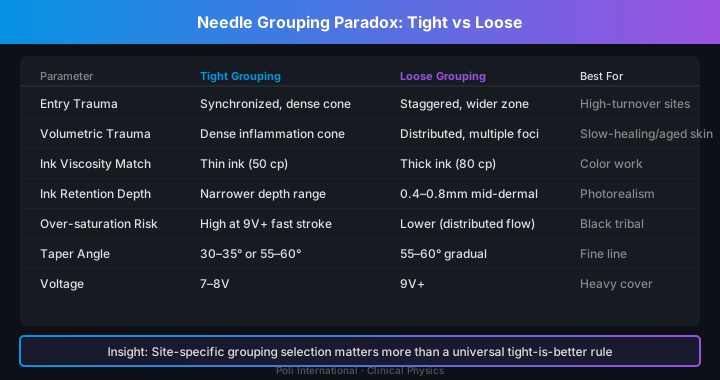
But on slower-healing areas (foot, hand, older skin), the loose grouping's multiple micro-focal points for phagocyte activity actually support better long-term ink retention by stabilizing pigment particles across a wider collagen network.
The practical protocol: for high-turnover healing sites, use tighter groupings to minimize the blur zone of early ink diffusion. For slow-healing or aged skin, the distributed trauma pattern of looser groupings supports ink permanence. Site-specific grouping selection matters more than a universal tight-is-better rule.
2. Taper Angle and Grouping Width Decision Matrix
| Configuration | Taper Angle | Voltage | Best Application | Mechanism |
|---|---|---|---|---|
| Tight grouping, steep taper | 30–35° | 7–8V | Black tribal, heavy cover | Efficient ink-move, minor depth deviation acceptable |
| Tight grouping, gradual taper | 55–60° | 7–8V | Fine line black work | Depth precision, low frictional drag |
| Loose grouping, gradual taper | 55–60° | 9V+ | Color, photorealism | Depth distribution, perpendicular needle path |
| Loose grouping, steep taper | 30–35° | 9V+ | Avoid | High frictional lag at speed negates grouping advantage |
| Tight grouping, high stroke speed | Any | 9V+ | Caution: over-saturation risk | Hagen-Poiseuille: fast ink-move in narrow channel |
3. The Viscosity-Grouping Interaction and Dermal Depth Targeting
Ink viscosity (50–80 centipoise for standard tattoo ink) interacts with needle spacing through fluid dynamics that most artists do not account for. When needles punch through skin, they create a pressure differential that draws ink from the cartridge toward the wound channel. A tight grouping produces a smaller, deeper pressure well, ink concentrates in a narrower zone, depositing higher density per pass. A loose grouping produces a larger, shallower pressure well, ink distributes across a wider area at lower concentration per unit area.
Hagen-Poiseuille fluid dynamics in confined geometries show that flow rate through parallel needle channels is inversely proportional to channel length and directly proportional to the pressure differential and the fourth power of channel radius. In practical terms: thin ink (50 cp) moves more efficiently through tight groupings; the higher pressure concentration overcomes viscous drag. Thick ink (80 cp) flows better through loose groupings because distributed pressure wells avoid the bottleneck effect in tightly packed needle channels.
Dermal depth targeting adds the third dimension. The dermis is stratified: papillary dermis (0.1–0.3mm, loose collagen, highly vascularized), mid-dermis (0.3–1mm, dense collagen bundles, optimal ink retention zone), and reticular dermis (1–2mm, tight collagen, granulomatous inflammation risk if over-penetrated). Dermatology research on ink particle distribution confirms the most persistent tattoos show pigment distributed across 0.4–0.8mm of mid-dermal depth, not concentrated in a thin layer. A tight grouping drills a narrow vertical column; if machine timing or hand angle varies, you risk missing the mid-dermal band entirely, depositing either too shallow (papillary zone, faster fading) or too deep (reticular dermis, inflammation risk). A loose grouping naturally samples across a range of depths, this built-in variance actually improves mid-dermal hit rate for color permanence work.