
Your Piercing and Your MRI: Why BioFlex Is the Only Safe Choice
Key Takeaways:
» BioFlex is composed of PP-R (polypropylene random copolymer), fully radiolucent, non-ferromagnetic, and non-conductive. It has no interaction with MRI scanner fields.
» Every major MRI safety protocol requires metal jewelry removal; BioFlex stays in without compromise to patient safety or image quality.
» Patients who cannot remove piercings, unhealed channels, cartilage placements, tunnels, have exactly one certified implant-grade polymer option: BioFlex.
» Radiolucency means BioFlex creates zero imaging artefact on MRI, X-ray, or CT, the jewelry is effectively invisible to diagnostic imaging.
» This problem was solved 25 years ago. The reason it is not in hospital pre-MRI protocols is a knowledge gap, not a technology gap.
1. The Problem Nobody Is Solving in Clinical Settings
Every day, somewhere in a hospital or imaging centre, a radiographer asks a patient the same question: "Do you have any piercings or body jewelry?" And every day, that question creates a problem the clinical environment is poorly equipped to handle.
The patient has a piercing. It may be healed or unhealed. Removing it risks closure of the channel, a real concern for fresh piercings, and a significant concern for tunnels or stretched placements where re-insertion is not straightforward. The patient may not have brought the correct jewelry tool. The radiographer is not a piercing professional. The scan needs to happen now.
The standard protocol, remove all metal before entering the scanner, exists for good reason. Ferromagnetic materials respond to the powerful static magnetic field of an MRI scanner (typically 1.5T or 3T in clinical settings). Susceptibility artefacts distort the image. Conductive materials can develop induced currents and localised heating under RF exposure. In the worst case, strongly ferromagnetic objects can be pulled towards the magnet with significant force.
What most radiographers do not know, and what most hospital jewelry-removal protocols do not address, is that this problem was solved more than twenty-five years ago.
2. What Radiolucent and Non-Ferromagnetic Actually Mean for Imaging
PP-R (polypropylene random copolymer), the base material of BioFlex, has two properties that make it categorically different from any metal in an imaging context.
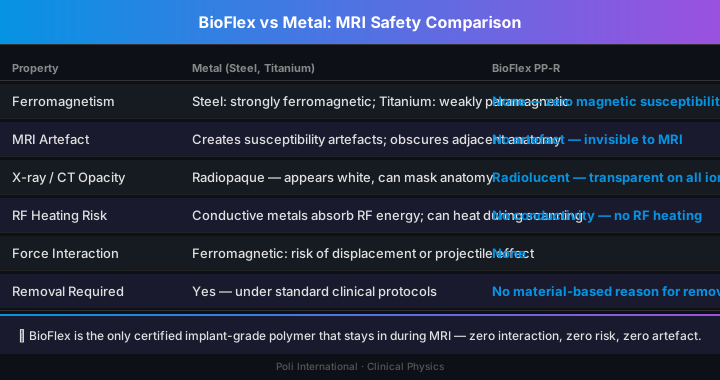
| Property | Metal (Steel, Titanium) | BioFlex PP-R |
|---|---|---|
| Ferromagnetism | Steel: strongly ferromagnetic. Titanium: weakly paramagnetic | None, PP-R has zero magnetic susceptibility |
| MRI Artefact | Creates susceptibility artefacts; obscures adjacent anatomy | No artefact, material is invisible to MRI |
| X-ray / CT Opacity | Radiopaque, appears white, can mask anatomy | Radiolucent, transparent on all ionising imaging |
| RF Heating Risk | Conductive metals absorb RF energy and can heat during scanning | No conductivity, no RF heating |
| Force Interaction | Ferromagnetic: risk of displacement or projectile effect | None |
| Removal Required | Yes, under standard clinical protocols | No material-based reason for removal |
Titanium, despite being the most biocompatible metal used in body jewelry, is technically paramagnetic, it has weak magnetic susceptibility. In a 3T scanner, this is enough to cause minor image artefact near the jewelry site for adjacent anatomical structures. It is not dangerous at body jewelry scales, but it can degrade diagnostic quality for scans of nearby tissue.
PP-R has no magnetic susceptibility and no electrical conductivity. BioFlex jewelry placed anywhere on the body creates no interaction with the MRI scanner field, neither mechanical, thermal, nor imaging artefact. The jewelry is, in effect, not there as far as the scanner is concerned.
3. The Clinical Scenarios Where This Matters Most
Unhealed piercings. A patient who had a piercing placed one week ago cannot safely remove it, removal risks permanent closure of the channel. If that jewelry is metal, the scan is compromised or must be delayed. If it is BioFlex, there is no issue.
Cartilage and anatomical piercings. Daith, tragus, and helix piercings in the ear sit within or adjacent to the skull base. MRI sequences for neurological assessment require clean imaging of adjacent anatomy. Metal jewelry in these locations creates artefact directly in the field of interest. BioFlex jewelry in the same location creates nothing.
Navel and abdominal piercings. Abdominal MRI, the modality of choice for liver, kidney, and gastrointestinal investigation, requires a clean anterior abdominal field. A navel piercing bar made of BioFlex is radiolucent and sits cleanly outside the plane of relevant anatomy.
Surgical settings. The question of piercing removal arises not just in MRI but in surgical prep, where diathermy and electrosurgery create similar concerns about conductive materials. BioFlex is non-conductive. In many procedures, a BioFlex retainer can remain in place where a metal bar must be removed.
Facial and oral piercings. Dental MRI, maxillofacial scanning, and ENT imaging are among the settings most sensitive to jewelry-related artefact. Tongue, lip, and nose piercings in BioFlex create no imaging interference.
4. Patrick's Deep Archive: The Question Nobody Asked
In over 25 years of manufacturing BioFlex, I have received direct contact from radiography departments, hospital purchasing teams, and individual patients who discovered, often at the last minute before a scan, that BioFlex solved a problem they did not know had a solution.
The most consistent finding is that clinical staff had no awareness BioFlex existed. The standard hospital response to a metal piercing before MRI is: "Remove it." The alternative, "Replace it with a certified non-metallic retainer", simply does not appear in most MRI safety protocols, because those protocols were written without knowledge of what was available.
The CNRS research group at the Institut Pluridisciplinaire Hubert Curien (IPHC-DEPE, Université de Strasbourg) used BioFlex transcutaneous rods as the attachment mechanism for GPS data loggers on king penguins at Crozet Island in the Southern Indian Ocean, a multi-year scientific deployment in one of the world's most hostile environments. The choice of BioFlex was not arbitrary: the material needed to be inert, flexible, non-metallic to avoid interference with the logger electronics, and capable of passing through living tissue without reaction. It performed across all four criteria over multiple field seasons [1].
The same properties that made BioFlex the material of choice for a polar penguin tracking study are the properties that make it the correct choice for any patient who needs an MRI.
5. FAQ: Technical Q&A
Q: Is BioFlex approved for use in MRI environments?
BioFlex is composed of PP-R (polypropylene random copolymer), which is non-ferromagnetic and non-conductive. It has no MRI-relevant properties and does not fall within the categories of materials requiring MRI-specific approval (which applies to active implants and metallic passive implants). The material is certified to ISO 10993-6 for implant-grade biocompatibility and built on a USP Class VI biocompatible resin [2].
Q: Can BioFlex jewelry remain in during an MRI scan?
There is no physical mechanism by which PP-R jewelry would interact with an MRI scanner. It has no magnetic susceptibility, no conductivity, and produces no imaging artefact. The decision to leave or remove any jewelry always remains with the supervising radiographer, but there is no material-based contraindication for BioFlex.
Q: Does BioFlex show up on X-ray or CT?
No. PP-R is radiolucent, it does not absorb X-rays and does not appear on plain radiographs or CT scans. This means no obscured anatomy, no diagnostic interference, and no artefact in reformatted images.
Q: What about PTFE, is it also MRI-safe?
PTFE shares non-ferromagnetic and non-conductive properties with PP-R. However, PTFE lacks BioFlex's ISO 10993-6 implant-grade certification and the same mechanical flexibility profile. BioFlex is not the only polymer that avoids MRI interactions, but it is the only one with full independent biocompatibility certification for long-term implant use.
Q: Where can I specify BioFlex retainers for MRI preparation in a clinical setting?
Poli International supplies BioFlex bar stock and finished retainer jewelry for professional and clinical use. Contact [email protected] or visit our BioFlex materials page for specifications and bulk ordering information.
Conclusion: The Scan That Should Not Be a Problem
Metal jewelry and MRI is a solved problem. PP-R polymer retainers have existed for over two decades. They are certified, non-metallic, radiolucent, non-conductive, and autoclavable for sterile supply. The reason this solution is not in every hospital's pre-MRI piercing protocol is not a failure of the technology, it is a failure of awareness.
If you are a radiographer, imaging centre manager, or pre-admission nurse updating your MRI safety documentation, BioFlex should be on your approved materials list. If you are a patient facing a scan, ask your piercer about BioFlex retainers before your appointment, not at the scanner door.
For full specifications, certifications, and ordering information, visit our BioFlex materials page.


