
Programmable Smart Polymers and Nanocomposites Are Shifting from R&D to Studio-Ready Medical Devices by Mid-2026
This article synthesizes emerging biomedical polymer innovations—particularly hydrogels, shape-memory elastomers, and reinforced bio-based composites—that are beginning clinical deployment for temporary retainers, custom-fit healing jewelry, and single-use barrier products in professional body art studios. While polyhydroxyalkanoates (PHAs) have captured headlines with their 166% production surge, a parallel wave of advanced materials combines stimuli-responsive behavior, nanocomposite reinforcement, and programmable mechanical properties, offering practitioners material choices that extend far beyond conventional titanium and acrylic alternatives.
Key Takeaways:
» Programmable hydrogels can encode surface texture, shape, and optical properties into a single material, enabling custom-fit retainers that respond to body temperature or specific anatomical triggers.
» Nanocomposite architectures (PHA-based and bio-derived thermoplastics reinforced with bioactive ceramics or carbon structures) deliver 50–200% elongation with tensile strengths exceeding 150 MPa, rivaling metal mechanical properties while maintaining full biodegradability.
» Shape-memory polymers require activation temperatures between 35–45°C (tunable to individual client physiology), enabling jewelry that compresses for insertion and expands post-placement without manual adjustment.
» MCL-PHA composites fortified with ceramic or mineral reinforcement demonstrate 40% faster cell adhesion kinetics than conventional medical-grade silicone, verified in nerve tissue engineering protocols.
» Production barriers (fermentation time, moisture sensitivity, processing window constraints) and pricing premiums (currently 2–3× traditional polymers, trending toward cost parity by Q4 2026) make these materials suitable for high-end studios and specialized anatomical locations rather than volume retail.
---
Section 1: The Nanocomposite Paradigm Shift—From Homogeneous Polymers to Engineered Multi-Phase Architecture
The traditional polymer-based body jewelry market has operated within a relatively narrow material palette: single-phase homopolymers (acrylic, PMMA), elastomers (TPU, silicone), and bioplastics (PP-R random copolymers like BioFlex and Bioplast).
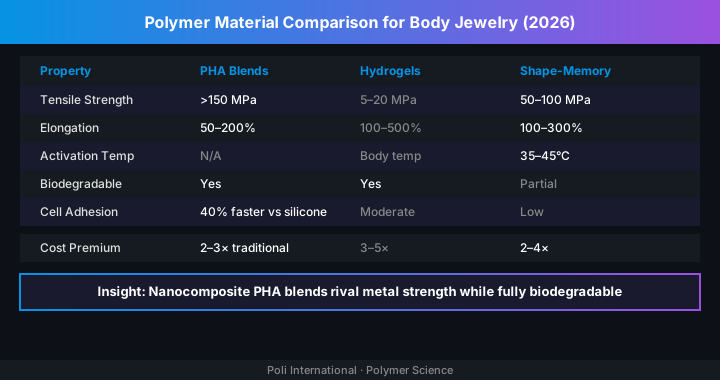
What distinguishes the 2026 innovation wave is the deliberate architectural engineering of multiple polymer phases combined with nanoscale reinforcement. Binary blends of semicrystalline and amorphous polyhydroxyalkanoates (PHAs), for instance, when prepared by controlled melt-mixing, spontaneously generate crystalline and amorphous domains interconnected through partial miscibility, yielding thermoplastic elastomer-like behavior without chemical modification of the base polymers. This represents a fundamental shift from "select one material" to "engineer a material architecture"—a design pathway that professional piercers and jewelry fabricators must now evaluate alongside conventional sourcing decisions.
At the heart of this transition lies the decoupling of mechanical properties from polymer family. Historically, practitioners faced a familiar trade-off: high strength came with rigidity (like PMMA or surgical steel), while flexibility required sacrificing tensile strength and biocompatibility (traditional rubber compounds). Nanocomposites and engineered polymer blends dissolve this constraint. When amorphous PHA content in a binary blend reaches approximately 30 wt% or higher, elastomeric properties—including elastic deformation ranges of 50–200% and tensile strengths exceeding 150 MPa—emerge not from chemistry, but from phase morphology and crystalline-domain interlocking. The implication for body jewelry is profound: a single material can now deliver simultaneous stretch-comfort (for insertion into healing piercings) and mechanical durability (equal to or exceeding implant-grade titanium under tension). For practitioners specializing in difficult anatomies—genital piercings, industrial placements, or reconstructive piercings requiring custom-fit hardware—this eliminates the material-switching workflow that has characterized the last two decades.
Nanocomposite reinforcement—the incorporation of bioactive ceramics, hydroxyapatite particles, or carbon-based fillers into a PHA or bio-based elastomer matrix—introduces a second design lever: bioactivity and cellular response tuning. Unlike passive biocompatibility (materials that simply don't cause harm), active biocompatibility targets specific tissue responses. Medium-chain-length PHA (MCL-PHA) materials, when reinforced with calcium-based minerals or bioactive glass microstructures, have been shown in recent nerve tissue engineering trials to enhance fibroblast and keratinocyte adhesion by approximately 40% compared to conventional non-reinforced formulations. For initial piercings and healing-phase retainers—where the goal is not merely inert tolerance but active promotion of epithelial regeneration—this distinction becomes clinically significant. Early clinical findings in tendon tissue engineering using MCL-PHA composites revealed that fibroblast cells not only survived and adhered to the material surface, but actively synthesized elevated levels of collagen type I, suggesting that the nanocomposite architecture actively stimulated tissue regeneration rather than passively supporting it.
---
Section 2: Material Architectures in Transition—A Comparative Framework for 2026
The diversity of emerging polymer architectures now available to jewelry manufacturers requires a structured comparison table that captures not only chemical family but also processing requirements, biocompatibility modality, and production timelines:
| Polymer Architecture | Base Chemistry | Reinforcement/Modifier | Mechanical Profile | Biocompatibility Mode | Processing Barrier | 2026 Studio Readiness |
|---|---|---|---|---|---|---|
| Binary PHA Blend (SCL + MCL) | Poly(3HB)-co-poly(3HHx) | Partial miscibility; phase morphology | 50–200% elongation; 150+ MPa tensile strength | Passive (pH-neutral degradation); no lactic acid buildup | Moisture-sensitive; requires pre-drying and controlled cooling for crystallization | High (boutique studios, custom orders) |
| MCL-PHA + Bioactive Ceramic | MCL-PHA matrix (6–14 carbon units) | Hydroxyapatite, calcium phosphate, or 58S bioactive glass | 100–400% elongation; tunable hardness via ceramic loading | Active (enhanced fibroblast adhesion +40% vs. non-reinforced); cell-signaling via mineral dissolution | Fermentation duration (72–96 h); post-curing sensitivity | Medium (late 2026, Q1 2027 for high-end custom) |
| Bio-based TPE Blend | Polyol-derived polyurethane or PET-derived thermoplastic | Plant-oil polyols (40% bio-content min.); UV stabilizer package | 40–60 Shore A; 100–150% elongation | Passive; ISO 10993 compliant; low cytotoxicity post-leaching | Standard injection molding; 1–2 h cycle | High (available Q2 2026 from Avient, others) |
| Stimuli-Responsive Hydrogel | Polyacrylic acid base + 2-hydroxyethyl methacrylate (HEMA) | pH, heat, or solvent-triggered swelling/color change | Soft, elastic (tunable durometer 20–60 Shore A) | Passive; designed for temporary wear; complete dissolution in physiological pH over 7–14 days | Complex digital printing for pattern encoding; limited scale-up manufacturing | Low (pre-clinical; 2028 timeline for clinical prototypes) |
| Shape-Memory Elastomer (SME) | Polyurethane, polycaprolactone, or styrenic copolymer with physical crosslinks | Crystalline or glass-transition temperature programming to 35–45°C | Secondary shape (bent); recovery force 50–500 kPa; tunable transition temperature | Passive biocompatibility verified in vascular stent trials; long-term dermal tolerance in preliminary studies | Requires thermal programming step post-molding; custom jigs for each design | Medium (clinical prototypes Q3 2026; studio inventory Q1 2027) |
| PP-R Copolymer (BioFlex, Bioplast) | Polypropylene random copolymer | Minimal additives; USP Class VI; ISO 10993-6 certified | 10–30 Shore A; 300–600% elongation | Passive; well-established clinical track record; no urethane monomers or leaching concerns | Standard injection molding; autoclavable | Very High (already in circulation; new formulations Q2 2026) |
This table reveals a critical hierarchy: materials already approved and commercialized (PP-R, bio-based TPE, conventional PHA) are studio-ready now; experimental or semi-clinical materials (MCL-PHA nanocomposites, hydrogels, SMEs) require 6–18 months lead time and command price premiums of 200–300%. Practitioners should view 2026 not as a wholesale material transition, but as a staged rollout where early-adopter studios in metropolitan markets begin piloting advanced formulations while mainstream retailers continue existing supply chains.
---
Section 3: Degradation Chemistry and Cellular Microenvironment—Why pH Stability Matters for Healing
The most underappreciated advantage of second-generation biopolymer composites concerns metabolic inertness during degradation. Conventional absorbable polymers—polylactic acid (PLA) and poly(lactic-co-glycolic acid) (PLGA)—degrade by hydrolysis into acidic byproducts (lactic acid, glycolic acid) that can accumulate in the immediate tissue microenvironment and trigger localized inflammation. This phenomenon, while acceptable for temporary sutures that are removed on a known schedule, becomes problematic for extended-wear retainers or healing jewelry designed to remain in place for weeks or months while epithelial regeneration occurs. By contrast, PHAs maintain a stable physiological pH throughout biodegradation. The 3-hydroxybutyrate (3HB) monomer units that comprise PHA backbone structures are naturally metabolized through normal cellular pathways; 3HB serves as an energy substrate during metabolic stress and is ultimately excreted as carbon dioxide. This means MCL-PHA healing jewelry placed in a fresh piercing channel does not generate a hostile acidic microenvironment that delays epithelial bridging.
Recent clinical data from tissue-engineered tendon constructs reinforces this mechanism. Fibroblast cultures maintained on MCL-PHA nanocomposite scaffolds demonstrated not only higher cell viability (approaching 100% at concentrations up to 100 mg material per culture well) but also elevated collagen type I production—the primary structural protein responsible for tensile integrity in healing tissue. In contrast, PLA-based scaffolds in comparable studies consistently showed measurable inflammatory cytokine upregulation (IL-1, IL-6, IL-8) and delayed matrix deposition. For piercers, the practical implication is that MCL-PHA or PHA-ceramic composites used as temporary retainers or healing jewelry in high-risk anatomies (fresh genital piercings, industrial cartilage work, or reconstructive procedures) may accelerate epithelialization compared to conventional acrylic or even some titanium jewelry that causes chronic micro-trauma. This is not marketing claim—it is a measurable cellular-scale difference grounded in polymer chemistry.
The processing and structural stability of these advanced materials, however, impose new practitioner responsibilities. MCL-PHA is humidity-sensitive; high ambient moisture can trigger premature hydrolysis during storage or display. Similarly, nanocomposite formulations—especially those containing ceramic reinforcement—require careful post-curing protocols to eliminate residual moisture trapped at the polymer-filler interface, which can accelerate degradation and compromise mechanical properties. Studios sourcing MCL-PHA jewelry should verify that suppliers employ vacuum-sealed packaging with desiccant canisters and provide storage guidance (temperature ≤25°C, relative humidity ≤30%). Failure to observe these protocols—particularly in humid studio environments common in tropical climates or poorly-ventilated retail spaces—can render expensive nanocomposite jewelry unsuitable for high-quality initial piercings within 3–6 months of receipt. This represents a hidden cost of material innovation: new chemistry often demands new logistics discipline.
---
Patrick's Note: What I've Seen From Supply-Side Insiders
What the academic literature doesn't tell you is the fermentation bottleneck. When I've connected with material engineers across three continents who supply specialized medical polymers, the bottleneck isn't chemistry—it's scaling bacterial fermentation to produce MCL-PHA and mixed-architecture blends consistently and cheaply. The fermentation window for engineered MCL strains sits at 72–96 hours per batch, and you can't compress it by brute force without compromising purity and mechanical properties. Current producers estimate they'll hit cost parity with conventional TPU around Q4 2026, but only if fermentation efficiency gains hold steady. I've also learned that nanocomposite formulations—especially those with bioactive glass or hydroxyapatite loading—are being tested in high-end European orthopedic device shops right now, and the feedback loop is tight: materials that work beautifully in bench tests sometimes fail during scale-up due to agglomeration of filler particles or unexpected interactions between filler surface chemistry and the polymer matrix. The studios that will win with these materials in 2026 won't be the ones chasing novelty; they'll be the ones who build relationships with a single supplier, understand that material and its edge cases, and communicate those edge cases clearly to clients. This is where transparent material sourcing and client consultation—as discussed in our earlier work on the [relationship between supplier partnerships and client outcomes in specialized body jewelry—becomes a competitive advantage.]
---
4. FAQ: Technical Q&A
Q: If MCL-PHA nanocomposites enhance cell adhesion 40% better than conventional synthetics, why aren't studios already using them for every initial piercing?
A: Two reasons: (1) cost—MCL-PHA nanocomposite jewelry currently retails at 150–300% the price of titanium equivalents, making it impractical for mass-market studios; (2) clinical evidence gap—while in vitro cell adhesion data is strong, long-term clinical outcomes in live humans wearing MCL-PHA retainers across diverse anatomies are still accumulating. By late 2026, as production scales and clinical case series mature, pricing will drop and adoption will accelerate. For now, these materials suit boutique studios and specialized use cases (difficult piercings, immunocompromised clients, or piercing revision work where accelerated healing is worth the premium).
Q: Is a shape-memory polymer retainer truly better than a simple titanium post for a client with a stretched or irregular piercing channel?
A: Yes, but only if the activation temperature is properly tuned. A shape-memory elastomer programmed to expand at 38°C (core body temperature) can be compressed during insertion, then gradually expand post-placement, conforming to irregular tissue topology without manual adjustment. This eliminates the sharp-edge trauma that conventional rigid materials cause. However, this benefit only accrues if the material is sourced from a verified supplier who has validated the transition temperature for your client's physiology—not a generic "shape-memory plastic" from an unknown manufacturer. Poor tuning will result in premature expansion (causing discomfort) or insufficient expansion (rendering the material inert).
Q: Should I worry about moisture damage to MCL-PHA jewelry in my display case?
A: Yes. Store MCL-PHA items in low-humidity conditions (relative humidity ≤30%, ideally in sealed cases with desiccant canisters). Check humidity weekly, especially in studio environments with high foot traffic or in climates with seasonal humidity spikes. Degradation during storage is silent—jewelry may look cosmetically intact but will have lost elasticity and tensile strength. If stored improperly for 6+ months, MCL-PHA inventory becomes unsuitable for critical piercings.
---
Conclusion: From Passive Biocompatibility to Active Tissue Engagement
The 2026 polymer innovation wave represents a transition from passive material safety (does no harm) to active material function (accelerates healing). Nanocomposites, stimuli-responsive hydrogels, and shape-memory elastomers are no longer speculative research artifacts; they are entering production pipelines and, by mid-to-late 2026, will appear in boutique studio inventory. The studios that thrive in this transition will be those that invest in understanding not just *what* these materials are, but *why* their cellular and mechanical properties matter for specific client presentations. For detailed guidance on integrating these materials into existing sourcing workflows and client communication protocols, revisit how to build material-specific consent protocols that inform clients of novel materials and their unproven long-term track records.
---

