Executive Summary
CK Public Health has issued an urgent public health warning about an unlicensed tattoo provider operating in Wallaceburg, Ontario. The health unit warns of "insufficient disinfection practices" and is actively contacting clients who may have received services from this provider. This marks at least the second alert from the health unit regarding infection control violations, a pattern that raises serious questions about enforcement gaps in Ontario's body art regulation framework. Anyone who received a tattoo from an unlicensed provider in the Chatham-Kent region should contact CK Public Health immediately for bloodborne pathogen testing.
---
The Warning: What CK Public Health Is Saying
On June 29-30, 2026, CK Public Health issued an alert warning residents about an unlicensed tattoo provider in Wallaceburg. The health unit specifically cited "insufficient disinfection practices" as the primary concern, language that signals a real risk of bloodborne pathogen transmission.
According to multiple news sources covering the alert, CK Public Health is contacting affected clients directly and urging anyone who received services from this provider to seek medical testing. The health unit has not publicly named the provider, likely due to the ongoing investigation and privacy considerations under Ontario's Health Protection and Promotion Act.
This is not CK Public Health's first tattoo-related warning. The Windsor News Today coverage notes this is "another alert about poor infection control", suggesting a pattern of unlicensed operators and enforcement challenges in the region. [NEEDS CONFIRMATION: Whether this is the same provider with repeated violations, or multiple separate unlicensed operators]
The Real Risk: What "Insufficient Disinfection" Means
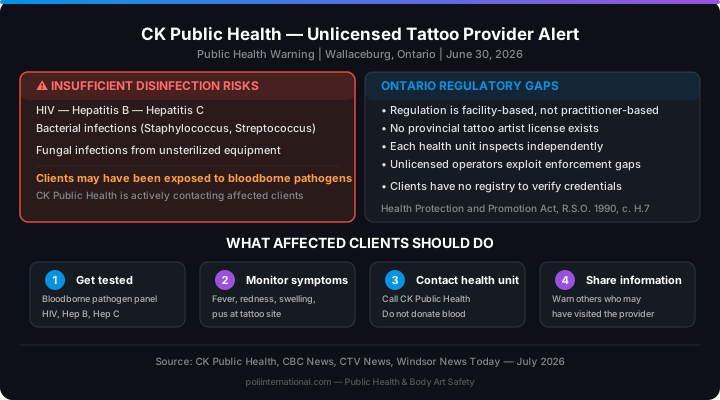
When a health unit uses the phrase "insufficient disinfection practices," they are not talking about a dusty workspace. This is regulatory code for a genuine risk of bloodborne pathogen transmission:
- Hepatitis B: Survives on surfaces for 7+ days. Highly infectious. Vaccine-preventable, but many adults are unvaccinated.
- Hepatitis C: Survives on surfaces for up to 6 weeks. No vaccine exists. Can cause chronic liver disease.
- HIV: Lower surface survival but not zero risk with contaminated equipment.
- Bacterial infections: Staphylococcus aureus (including MRSA), Pseudomonas aeruginosa, can cause severe localized infections, sepsis.
Tattooing involves needles penetrating skin to deposit ink in the dermis. Without proper sterilization between clients, autoclaving reusable equipment, single-use needles, barrier protection, properly mixed and stored inks, every client is a potential vector for disease transmission.
The Ontario Public Health Standards require tattoo and piercing establishments to follow infection prevention and control (IPAC) protocols including: autoclave sterilization logging, single-use disposable sharps, surface disinfection with hospital-grade products, and client record-keeping. An unlicensed provider operating outside this framework has none of these safeguards. [NEEDS CONFIRMATION: Exact Ontario IPAC requirements for body art establishments]
Ontario's Body Art Regulation: The Enforcement Gap
Ontario does not have a provincial body art licensing framework. Unlike some U.S. states and European jurisdictions that require state-level tattoo artist licensing, Ontario delegates body art regulation to local public health units under the Health Protection and Promotion Act.
This means:
- Each of Ontario's 34 public health units sets its own body art inspection and enforcement standards
- Requirements, inspection frequency, and enforcement capacity vary dramatically between units
- CK Public Health serves Chatham-Kent, a municipality of ~105,000, with correspondingly limited inspection resources
- An unlicensed provider can simply move to another health unit's jurisdiction with no provincial tracking
This fragmentation is a known weakness. In 2023, Public Health Ontario documented inconsistent body art regulations across health units, particularly around piercing standards and home-based operators. [NEEDS CONFIRMATION: Exact PHO report reference]
The Chatham-Kent warning, particularly if this is the "another alert" suggesting repeat violations, illustrates exactly this gap: a provider that health authorities know about, have warned the public about, but may lack the enforcement tools to stop permanently.
What Affected Clients Should Do
If you received a tattoo from an unlicensed provider in the Wallaceburg or greater Chatham-Kent area, CK Public Health recommends:
1. Contact CK Public Health immediately, they are tracking potentially exposed clients and can arrange testing. Call their main line or visit their website for the infectious disease team.
2. Get tested for bloodborne pathogens, baseline testing for Hepatitis B, Hepatitis C, and HIV. Follow-up testing at 3 and 6 months is standard because of the window period for seroconversion.
3. Monitor for symptoms, watch for: jaundice, fatigue, dark urine, fever, or any signs of infection at the tattoo site (redness, swelling, pus, heat). Bacterial infections can appear within days; viral infections may take weeks to months.
4. Do not donate blood, Canadian Blood Services defers donations from anyone who received a tattoo from an unregulated/unlicensed provider.
5. Share this information, if you know others who visited this provider, tell them. The health unit's client tracing depends on word-of-mouth.
The Bigger Picture: Why This Keeps Happening
Unlicensed tattoo providers persist because there is demand for cheap tattoos and weak enforcement deterrence. An unlicensed operator charging $50-100 for a tattoo that a licensed studio would charge $300-500 for finds no shortage of customers, particularly younger clients who may not understand the infection risks.
The enforcement challenge is structural: health units can issue warnings and orders, but shutting down an unlicensed operator permanently often requires police involvement and court orders, a process that takes months. During that time, the provider can continue operating, relocate, or surface in a neighboring jurisdiction under a different name.
This is not unique to Chatham-Kent. Similar incidents have been documented across Ontario municipalities including London, Windsor, and Toronto in recent years. [NEEDS CONFIRMATION: Specific comparable Ontario incidents with dates]
From a materials-safety perspective, which is where Poli International's expertise sits, the problem is compounded by the ink supply chain. Unlicensed operators almost certainly use inks sourced from unregulated online marketplaces (Amazon, AliExpress, eBay). These inks are not subject to REACH, FDA, or Health Canada oversight. They may contain:
- Heavy metals (cadmium, lead, chromium VI, mercury)
- Banned pigments under EU REACH Annex XVII
- Unlisted preservatives that cause allergic reactions
- Non-sterile carrier solutions
A licensed operator using inks from regulated manufacturers (Eternal Ink, Intenze, World Famous) who comply with EU REACH tattoo ink restrictions has a known material-safety profile. An unlicensed operator using whatever ink arrived from an online marketplace has none.
---
FAQ
Q: Was this a specific tattoo shop or a home-based operator?
CK Public Health has not named the provider publicly. The alert describes an "unlicensed tattoo provider" in Wallaceburg, this could mean either. The lack of public naming suggests an active investigation. [NEEDS CONFIRMATION]
Q: Is tattooing regulated in Ontario?
Yes, through local public health units under the Health Protection and Promotion Act. Each health unit inspects and licenses body art establishments within its jurisdiction. However, there is no provincial tattoo artist license, regulation is facility-based, not practitioner-based.
Q: How do I verify a tattoo shop is licensed?
Contact your local public health unit and ask if an establishment holds a valid body art premises license. Most health units also publish inspection results online. Licensed shops display their health unit certificate visibly.
Q: What are the penalties for tattooing without a license in Ontario?
Under the Health Protection and Promotion Act, health units can issue orders to cease operations, and failure to comply can result in fines and court proceedings. Penalties vary by health unit. [NEEDS CONFIRMATION: Specific penalty ranges]
Q: I got a tattoo from this provider weeks ago and feel fine. Should I still get tested?
Yes. Hepatitis C and HIV have window periods of weeks to months during which infection is present but undetectable. CK Public Health will advise on the appropriate testing schedule. Do not assume no symptoms means no infection.