
# The Physics of Laser Tattoo Removal — Why Selective Photothermolysis Works (and When It Doesn't)
Executive Summary
Laser tattoo removal is clinical physics — specifically, selective photothermolysis, the principle that a laser can destroy a target structure (tattoo pigment) without damaging surrounding tissue if three conditions are met. The wavelength must be preferentially absorbed by the target. The pulse duration must be shorter than the thermal relaxation time of the target. And the fluence must be sufficient to raise the target temperature above its destruction threshold. Get any of these wrong, and the treatment fails — either by leaving pigment intact or by burning healthy skin.
What Selective Photothermolysis Actually Means
Anderson and Parrish defined selective photothermolysis in their landmark 1983 *Science* paper (PMID 6836297). The laser delivers a pulse of light at a specific wavelength that is absorbed by the tattoo pigment (the chromophore). The absorbed energy converts to heat. If the heat rise is fast enough and hot enough, the pigment particle thermally decomposes. If the pulse is short enough, the heat does not diffuse into surrounding tissue.
The three variables are:
- Wavelength (λ): Must match the pigment's absorption spectrum. Black absorbs all visible wavelengths, which is why Nd:YAG 1064 nm works well. Red pigment absorbs green (532 nm). Blue and green absorb red (694-755 nm). White and yellow reflect most wavelengths — they are the hardest to remove.
- Pulse duration (τ): Must be shorter than the target's thermal relaxation time. Tattoo ink particles (40-300 nm) have TRTs in the nanosecond range. Q-switched lasers deliver 5-20 ns pulses — fast enough. Continuous-wave lasers cannot selectively target pigment because their pulse is effectively infinite relative to the TRT.
- Fluence (J/cm²): Must exceed the pigment's damage threshold but stay below skin's damage threshold. Typical clinical fluences range from 2-12 J/cm² depending on wavelength and spot size.
When all three align, the pigment particle reaches several hundred degrees Celsius in nanoseconds and fragments. The immune system clears the debris over weeks.
Why Some Tattoo Colors Resist Lasers
The physics of pigment absorption is the limiting factor. Bäumler et al. (2000) analyzed the absorption spectra of 41 tattoo pigment compounds (PMID 10636999) and found that commercial inks span a wide range of optical properties. Black carbon-based pigments absorb across the entire visible spectrum. Red pigments containing iron oxide or organic azo compounds absorb strongly in the green range. Blue and green copper phthalocyanine pigments absorb in the red range.
The problem colors are white (titanium dioxide), yellow (cadmium sulfide), and flesh-toned pigments — they reflect most of the visible spectrum. Laser light bounces off rather than being absorbed. No heat generation means no pigment destruction. Clinicians sometimes observe paradoxical darkening: the laser reduces titanium dioxide to a darker oxidation state, making the tattoo more visible rather than less.
The practical implication: a single-wavelength laser cannot treat all colors. Clinics need at minimum a dual-wavelength system (1064 nm + 532 nm) or a multi-wavelength platform (adding 694 nm ruby or 755 nm alexandrite) to address the full color spectrum.
Nanosecond vs. Picosecond — Does the Physics Difference Matter?
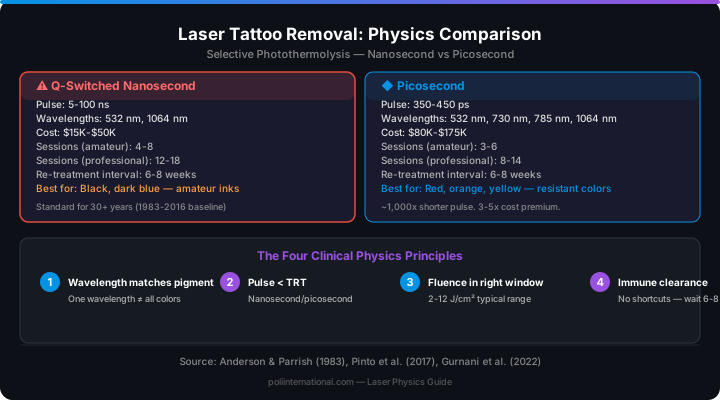
Q-switched (nanosecond) lasers have been the standard for 30 years. Picosecond lasers deliver pulses roughly 1,000 times shorter. The physics argument was compelling: if a 5 ns pulse shatters pigment via photothermal heating, a 500 ps pulse adds a photoacoustic shockwave component that fragments particles into even smaller pieces.
Pinto et al. (2017) tested this in a randomized controlled trial (PMID 27518129), comparing a 1064 nm picosecond Nd:YAG against a 1064 nm nanosecond Nd:YAG on professional black tattoos. The picosecond device showed superior clearance after a standardized number of sessions. The difference was statistically significant for black ink and more pronounced for previously treated, recalcitrant tattoos.
But the clinical advantage has limits. Picosecond devices cost 3-5 times more than nanosecond systems. For amateur tattoos with superficial, low-density pigment, the difference may not justify the cost premium. For professional, multi-colored, previously treated tattoos — particularly those with blue and green pigments — the picosecond advantage is real.
What Determines the Number of Sessions
The physics sets hard limits on session count. Gurnani et al. (2022) published a systematic review of 1,263 patients (PMID 32763326) and found complete removal typically requires 6-12 sessions at 6-8 week intervals. Amateur tattoos average 4-6 sessions. Professional tattoos with dense, layered pigment average 10-15.
Each laser pulse only destroys the fraction of pigment particles that absorbed enough energy. Larger particles have longer thermal relaxation times and may not fully heat during the pulse. Deeper particles are shadowed by overlying pigment. Between sessions, the body clears debris via the lymphatic system — but this takes 4-8 weeks, which is the physiological bottleneck. Spacing sessions closer than 6 weeks does not accelerate results; it adds cost and skin trauma.
Variables that increase session count include: tattoo age (older tattoos have less superficial pigment, paradoxically requiring more sessions), location (extremities have slower lymphatic drainage), color palette (multi-color = more sessions), and smoking (smokers clear debris more slowly due to impaired microcirculation).
The Immune System's Role in Clearance
The laser does not remove the tattoo — it shatters the pigment. Macrophages in the dermis phagocytose the fragments and transport them to regional lymph nodes for clearance. Each session triggers an inflammatory cascade that takes weeks to resolve. Stacking sessions too closely overwhelms the lymphatic system with debris and increases the risk of granuloma formation.
For individuals with impaired immune function — whether from immunosuppressants, diabetes, or chronic smoking — pigment clearance is slower and more sessions are required. This is not a laser problem; it is a host-response problem.
Clinical Physics Takeaways
Laser tattoo removal works when the physics is respected and fails when it is ignored:
1. Wavelength must match the pigment. One wavelength cannot treat all colors effectively.
2. Pulse duration must be shorter than the thermal relaxation time. Q-switched and picosecond lasers satisfy this; continuous-wave lasers do not.
3. Fluence must be sufficient but not excessive. Higher fluence does not mean faster clearance — it means higher risk of scarring and hypopigmentation.
4. Session spacing is limited by biology, not technology. The lymphatic system needs 6-8 weeks to clear debris.
5. Some pigments will never fully clear. White, yellow, and certain flesh-toned inks do not absorb available laser wavelengths well enough.
The physics is not negotiable. The laser does what the laser does. The rest is host biology, and that varies from client to client.
The laser delivers fluences of 2–12 J/cm² in pulses as short as 5–20 nanoseconds, rapidly heating pigment particles to several hundred degrees Celsius. This thermal energy transfers to surrounding dermal tissue and stimulates nociceptors (pain receptors) far more abruptly than a tattoo needle. Additionally, the photoacoustic shockwave from the expanding pigment particle creates a stinging sensation that most patients describe as more intense than the mechanical trauma of needle insertion. Rarely, because white titanium dioxide and yellow cadmium sulfide pigments reflect most of the visible spectrum instead of absorbing it — without absorption, selective photothermolysis cannot generate the heat needed to fragment the particles. Even with high-fluence treatments, clinicians often see paradoxical darkening where titanium dioxide reduces to a darker oxidation state rather than clearing. Complete removal typically requires multiple passes with multiple wavelengths and may still leave visible residue. Picosecond lasers (500–900 ps) produce a stronger photoacoustic shockwave than nanosecond Q-switched lasers (5–20 ns), shattering pigment into smaller fragments that the immune system clears faster. Pinto et al. (2017) found in a randomized controlled trial (PMID 27518129) that picosecond pulses achieved clearance in statistically fewer sessions — typically 2–3 fewer — for black and blue inks. However, for colors with poor absorption (yellow, white), neither technology succeeds without a matching wavelength at sufficient fluence. Selective photothermolysis exploits the principle that melanin in skin has a different absorption spectrum than tattoo chromophores. An Nd:YAG 1064 nm laser targets black carbon ink while being absorbed minimally by melanin, allowing safe treatment on Fitzpatrick skin types I–IV. Dual-wavelength systems (1064 nm + 532 nm) can switch wavelengths to avoid competing with epidermal melanin — the 532 nm green beam, for example, requires caution on darker skin due to higher melanin absorption in the green spectrum. No — intense pulsed light (IPL) devices deliver millisecond-range pulses, but tattoo ink particles (40–300 nm) have thermal relaxation times in the nanosecond range. Because IPL pulses are roughly 1,000,000 times longer than the target's TRT, heat diffuses into surrounding dermis before the pigment reaches destruction temperature, causing perifollicular burns and scarring while leaving ink intact. Only Q-switched (nanosecond) or picosecond lasers meet the pulse-duration condition for selective photothermolysis required for safe tattoo clearance.FAQ
Why does laser tattoo removal hurt more than getting the tattoo?
Can white or yellow tattoos ever be fully removed?
Is a picosecond laser really better than a nanosecond laser for removal?
How do lasers differentiate between tattoo ink and my skin pigment?
Can a cheap IPL device remove tattoos at home?

