
# Tattoo Machine Buyer's Guide 2026: Rotary vs Coil vs Pen
Key Takeaways:
» Rotary and pen machines now dominate the professional market — coils are a niche choice for specific lining styles, not daily drivers
» The $300–$600 range is the sweet spot for working artists; anything under $200 is a disposable training tool
» Battery life below 6 hours is unacceptable for a wireless machine in 2026 — hot-swappable batteries are the minimum standard
» Ergonomics and adjustable stroke length matter more than brand loyalty; your hands will fail before your machine does
The 2026 Machine Landscape: What the Data Actually Shows
The market has made its decision. Rotary-driven machines — especially pen-style form factors — now account for the majority of professional daily drivers. Coil machines haven't disappeared, but they've moved from workhorses to specialty tools for artists who prefer the tactile feedback of electromagnetic operation. Pneumatic systems remain a niche for specific applications.
The research is clear: buyer priorities have shifted to ergonomics for 6–8 hour sessions, adjustable stroke lengths, and modularity. Artists are no longer buying one machine for everything. They're buying two or three machines optimized for lining, shading, and color packing.
Machine Architecture Comparison: What You're Actually Buying
| Machine Type | Drive | Price Range | Best For | Weight | Battery Life |
|---|---|---|---|---|---|
| Rotary | Direct-drive motor | $200–$800 | Versatile daily use | 120–200g | 6–10 hours |
| Coil | Electromagnetic coils | $300–$1,000 | Traditional lining, custom setups | 250–400g | N/A (wired) |
| Pen-style | Rotary (pen form) | $150–$600 | Modern styles, long sessions | 90–160g | 6–10 hours |
| Pneumatic | Air-driven | $300–$700 | Lightweight, sterile applications | 80–120g | N/A (air supply) |
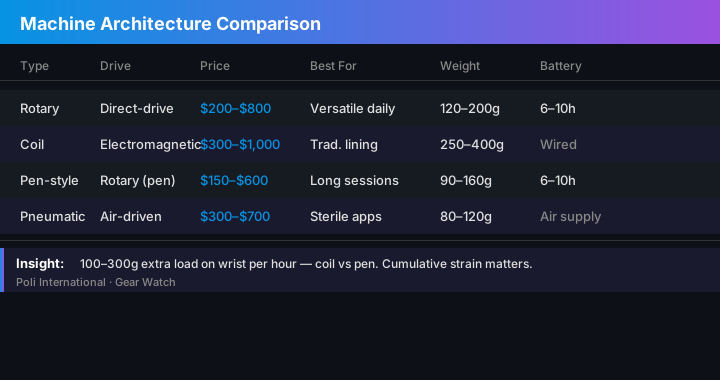
The weight difference between a coil machine and a pen-style rotary is not trivial. At 250–400 grams versus 90–160 grams, that's 100–300 grams of additional load on your wrist and hand for every hour of a six-hour session. Do the math on cumulative strain.
Brands That Matter in 2026
| Brand | Key Models | Price Range | Standout Feature |
|---|---|---|---|
| FK Irons | Spektra Flux, EXO, ONE | $400–$800 | Wireless performance, app connectivity |
| Cheyenne | Hawk Spirit, Sol Nova Unlimited | $350–$700 | Professional-grade reliability, hot-swap batteries |
| Bishop | Wand Packer, Shader, Liner | $400–$700 | Task-specific optimization, adjustable give |
| InkJecta | Flite Nano series | $300–$500 | Lightweight, consistent stroke |
| Dragonhawk | Mast series | $100–$250 | Budget entry point, functional |
| Peak | Various | $100–$300 | Apprentice-friendly, basic reliability |
Notice the gap between $250 and $300. That's the line between "training tool" and "professional instrument." Cross it deliberately.
Wired vs Wireless: The Trade-Offs You Need to Know
| Factor | Wired | Wireless |
|---|---|---|
| Weight | Lighter (no battery) | Heavier (battery onboard) |
| Session duration | Unlimited | 6–10 hours per charge |
| Mobility | Tethered to power supply | Full freedom of movement |
| Maintenance | Fewer failure points | Battery degradation over time |
| Cost | Lower entry price | Premium for battery tech |
| Reliability | Consistent power delivery | Voltage drop as battery drains |
The contrarian take: wireless is not universally better. If you do eight-hour sessions daily, battery degradation means you'll replace the machine or battery pack within 18–24 months. Wired machines from reputable brands can run for years with proper maintenance. The freedom of wireless is real, but so is the cost.
Buyer Segment Recommendations
Apprentice / Budget ($100–$300):
You're learning. You don't need a $700 machine. Get a Dragonhawk Mast or Peak rotary. Accept that you'll replace it within a year. Focus on understanding stroke length, needle depth, and hand speed. Your first machine is a training tool, not an investment.
Professional Daily Driver ($300–$600):
This is where the actual value lives. Cheyenne Hawk Spirit, FK Irons Spektra Flux, or InkJecta Flite Nano. Look for adjustable stroke length (3.0–4.5mm range), ergonomic grip design, and reliable battery life. Buy two: one for lining, one for shading. Your hands will thank you.
Specialist ($600+):
You know what you need. Bishop Wand series for task-specific performance. FK Irons EXO for top-tier wireless. At this price, you're paying for precision engineering, advanced materials, and warranty support. If you're not making $100k+ annually, this is overkill.
The Five Technical Specs That Actually Matter
1. Stroke Length (mm):
Short stroke (3.0–3.5mm) for lining. Medium stroke (3.5–4.0mm) for shading. Long stroke (4.0–4.5mm) for color packing. Adjustable stroke machines exist, but dedicated machines perform better for each task.
2. Give / Needle Depth Adjustment:
The resistance and rebound of the needle mechanism. More give means softer shading. Less give means crisper lines. Adjustable give is a feature worth paying for — it lets you tune the machine to your technique.
3. Weight (grams):
Under 150g for pen-style. Under 200g for rotary. Anything heavier will fatigue your hand in sessions over four hours. Coil machines are heavy. Accept that trade-off or don't buy one.
4. Battery Life (hours):
Minimum 6 hours for a wireless machine. Hot-swappable batteries are preferred — you can't charge mid-session. If a machine claims 8 hours but tests at 5, it's not worth your money.
5. Maintenance Requirements:
Rotary and pen machines require less maintenance than coils. No springs to replace, no contact points to adjust. But they do require periodic cleaning of the drive mechanism and bearing lubrication. Ignore maintenance and your $600 machine becomes a paperweight.
The Coil Machine Argument: When It Still Makes Sense
Coil machines are not dead. They offer a tactile feedback that rotary machines cannot replicate. Some artists prefer the "snap" of a coil liner for precise, tight lines. Custom coil setups from specialized builders can outperform any production rotary for specific applications.
But the data is clear: coils are heavier, louder, require more maintenance, and have a steeper learning curve. They're also harder to sterilize thoroughly due to their complex geometry.
If you're an apprentice, skip coils. If you're a professional with five years of experience and want to experiment, buy one used from a reputable builder. If you're a specialist doing high-end traditional work, you already know whether coils work for you.
FAQ
Q: Should I buy a wireless machine or stick with wired?
A: Buy wireless if you value mobility and do sessions under 6 hours. Buy wired if you do marathon sessions, want consistent voltage, or are on a tight budget. The best setup is one wireless machine for mobility and one wired machine as a backup.
Q: How many machines does a working artist actually need?
A: Minimum two — one liner and one shader. Most professionals own three to five machines. The key is having dedicated tools for lining, shading, and color packing. One machine doing everything is a compromise, not an optimization.
Q: Is the $150 Dragonhawk worth buying as a backup machine?
A: Yes, but only as a backup. It will work for basic applications. It will not match the consistency or ergonomics of a $400 machine. Treat it as an emergency tool, not a daily driver.
---
Shop smart. Your hands will thank you.