How a Fake Texas Tattoo Ban Went Viral — And What It Exposed About Our Industry
Key Takeaways:
» The biggest tattoo story this fortnight was a completely false claim that Texas is banning tattoos by 2028.
» The “ban” came from a misread, misrepresented legal story that never actually said tattoos would become illegal.
» Viral fear outran slow facts, amplified by creators chasing views, not accuracy.
» The real risks in tattooing are ink chemistry, infection control, and regulatory creep, not sudden blanket bans.
» Studios need a crisis script and communication plan ready, or the next viral rumor will define them before they can respond.
1. The Fake Ban That Beat the Facts
The most-shared body art story in the last two weeks wasn’t a celebrity back piece or a catastrophic blowout — it was a viral claim that tattoos will be illegal in Texas by 2028, and that claim is flat-out wrong. A widely shared video and follow‑on posts turned a vague legal discussion into “Tattoos are getting banned,” and the fear was enough to trend statewide on search and social. The detailed breakdown on Poli Journal shows the Texas tattoo ban scare for what it was: a social-media panic, not a legislative move against our industry. The source it was supposedly based on never actually said tattoos would become illegal, but once the “ban” headline took off, nuance was dead on arrival.
According to that analysis of the episode, no bill text, no docket entry, and no official statement supported the idea of a Texas-wide tattoo prohibition — the rumor was built on interpretive sand, then hardened by repetition until it felt real to the public. The panic mirrors exactly how other body art myths spread, like “all red ink causes cancer” or “MRI machines rip tattoos off your skin,” where a kernel of technical reality gets inflated into a horror story. The same piece points out that people already distrust both regulators and tattoo safety, which makes them primed to believe a dramatic ban narrative instead of a boring “nothing to see here” reality.
This is the same psychological terrain where misinformation about ink toxicity, allergic reactions, and pigment migration thrives, and it is the reason I keep writing about topics like the real relationship between needle geometry and dermal recovery trauma instead of chasing clickbait. When the public hears “risk,” they mentally jump straight to “prohibition,” and creators who understand that reflex can milk it for views in a few seconds of video. Unfortunately, the fallout lands on working studios: phones blowing up, clients trying to “get in before the ban,” and artists spending unpaid hours debunking something that never should have been believed in the first place.
2. Fear vs. Reality: How This Compares to Actual Tattoo Regulation
Let’s stack the viral Texas non‑story against real, documented regulatory moves that actually changed the rules for tattooing, because the contrast is the whole point.
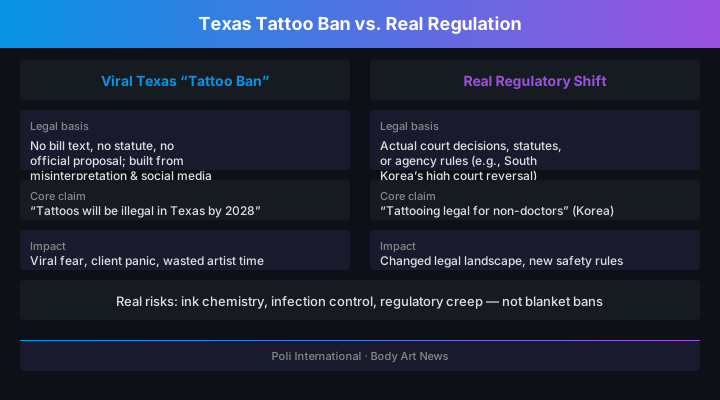
| Feature | Viral Texas “Tattoo Ban” | Real Regulatory Shift (Examples) |
|---|---|---|
| Legal basis | No bill text, no statute, no official proposal; built from misinterpretation and amplification in social media posts dissected in Poli’s Texas tattoo ban scare breakdown | Actual court decisions, statutes, or agency rules, such as South Korea’s high court reversing its 1992 ruling that treated tattooing as a medical act and lawmakers subsequently legalizing non‑medical tattooing documented by BBC’s report on Korea’s tattoo legalization |
| Core claim | “Tattoos will be illegal in Texas by 2028” | “Tattooing is now legal for non‑doctors” (Korea), or “Tattoo ink is classified as higher‑risk and faces new safety requirements,” as seen when European bodies moved to tighten pigment rules discussed in debates like WHO IS DEFINING YOUR SAFETY? |
| Evidence trail | No citations to legislative calendars or official registers; rumor propagated by reaction content calling out a supposed future ban but admitting the underlying story didn’t show one | Court rulings, government press releases, regulatory opinions by bodies like SCCS or national health ministries, and industry association guidance from groups such as UKAPP or NTA |
| Impact on studios | Panic calls, booking rushes “before it’s illegal,” confusion about long‑term viability — all based on fiction | Licensing obligations, pigment reformulation, registration of studios, health inspection protocols, and new documentation burdens that change workflows and purchasing decisions |
| Timeline | Instant — the story went from one creator’s post to trending status in days | Slow and bureaucratic — for example, Korea’s fight for legal recognition stretched over decades before the high court and lawmakers finally aligned per BBC’s coverage of the legalization process |
| Real risk category | Reputation and trust damage, misinformation about tattoo legality, unnecessary fear about lifelong access to body art | Tangible clinical and engineering issues like ink composition limits, sterilization standards, age regulations, and labeling requirements, similar to what I discussed when explaining how tattoo ink was designated “higher‑risk” by certain regulators in the regulatory proof‑of‑concept discussion |
This matters because the shape of the Texas rumor mimics genuine regulatory creep — it just skips the paperwork and jumps straight to the nightmare. That’s exactly what made it go viral: it had the emotional punch of a real ban without the tedious nuance of actual legislative process. Meanwhile, real-world moves, like classifying tattoo ink as higher risk or forcing pigment reformulation, often barely register with the public even though they change your day‑to‑day practice far more than any imaginary prohibition.
That asymmetry is dangerous. When false bans get more airtime than real safety standards, it becomes harder to have adult conversations about things that genuinely matter: pigment particle size, aromatic amines, preservative systems, how heavy-metal limits interact with long-term pigment stability in vivo, and so on. A fake legal apocalypse sucks oxygen away from the real engineering problems that actually decide whether your work heals cleanly, lasts, and keeps your client out of dermatology clinics.
3. The Technical Deep Dive: How This Panic Machine Works (And How to Beat It)
Let’s talk mechanics — not of tattoo machines this time, but of misinformation dynamics in a regulated craft.
Social and search data around the Texas scare show a familiar pattern: short‑form videos using captions like “Tattoos BANNED by 2028?!” or “They’re coming for your ink” rake in views in the first 24–48 hours. The Poli Journal breakdown notes that posts calling out the claim as false actually used the original fear as their hook, meaning that even corrective content had to repeat the myth to get traction. That is how an idea with no statutory backing, no bill number, no committee hearing still becomes “common knowledge” for thousands of viewers — every react video amplifies the headline before refuting it, and many viewers never watch long enough to hear the correction.
Contrast that with how actual regulation is built. When the European regulators moved tattoo inks into a higher‑risk category or restricted certain pigments, they published draft opinions, impact assessments, transitional timelines, and ppm threshold tables for substances of concern. Those documents specify things like primary aromatic amines capped at low ppm levels, or PAH contamination thresholds, or the 0.1% (1,000 ppm) threshold that defines whether a substance is a “Substance of Very High Concern” under REACH. That 0.1% number is the same reference point that makes our verified <1 ppm phthalate levels in BioFlex® look almost comically low by comparison — three orders of magnitude under the line, as we detailed when talking about phthalate content and polymer safety in flexible body jewelry. Real regulation lives in these numbers, not in vague “they’re banning tattoos” vibes.
Now, what does this mean operationally for a studio in Texas or anywhere else?
- You need a crisis script ready. When a client asks, “Are tattoos going to be illegal here?” your front desk should have a clear, one‑sentence response: “No, that rumor is false; there is no law or bill in Texas that bans tattoos.” If they want more, you point them to a concise explainer — ideally hosted on your own site or shared from a credible industry breakdown.
- Train your staff to separate clinical risk from legal risk. Tattooing does carry risk: infection, allergic reactions, poor aseptic technique, and material incompatibilities. That is where real engineering and microbiology live. I’ve written at length about how needle configuration and stroke parameters change trauma depth and healing speed, which is far more relevant to your client than some imaginary future ban. When staff can explain the difference between “regulated for safety” and “prohibited,” you rob the rumor of its power.
- Expect real regulation to move slowly but bite deeply. Texas today, Korea yesterday, the EU pigment battle last year — none of that landed out of nowhere. There were consultations, draft bills, and warning shots from agencies and associations. When something big is genuinely coming, you see it in trade press, not just TikTok. That’s why I watch not only mainstream news but also things like local Brazilian proposals to create “Legal Tattoo” and “Legal Piercing” seals that certify compliance with sanitation norms, as in the Campinas initiative to flag studios that follow specific health legislation, visible in local chamber coverage of the Tatu Legal and Piercing Legal project. Those programs are an early sign of where enforcement is going: more documentation, more visible certification, more data.
- Use the panic as a teaching moment. When people ask about the Texas scare, redirect them: “The law isn’t banning tattoos, but the attention on tattoo safety is real. Here’s what matters: ink quality, sterilization, and trained practitioners — and here are our protocols.” That is your chance to talk about autoclave logs, single‑use setups, and why you say no to certain clients or placements when the anatomy, healing window, or materials are wrong, exactly the kind of judgment I described when unpacking long-term healing outcomes in high-movement piercings.
Technical bottom line: laws rarely jump straight to bans. They start by reclassifying risk, tightening standards, and demanding proof — of ink composition, of sterilization, of practitioner competence. The Texas rumor had none of those fingerprints. If you train yourself to look for the paperwork, you’ll spot the fakes instantly.
4. Patrick’s Note: Why This One Pissed Me Off
What I’ve seen in studios over the past two weeks is the same pattern I’ve watched for decades: artists doing damage control for a crisis they did not create. Phones ringing off the hook, clients in a mild panic trying to “get a sleeve before they outlaw it,” and owners losing a full day’s work explaining that a law which does not exist is not, in fact, about to destroy their livelihood. It reminds me uncomfortably of the way flexible polymer jewelry got painted with the same brush as cheap PVC garbage — regulators slapped “temporary use only” onto a whole category based on TPU behavior, and suddenly BioFlex® and Bioplast, which are medical‑grade PP-R random copolymers with ISO 10993‑6 and USP Class VI data, were treated like bargain-bin knockoffs with no evidence. I unpacked that whole mess in my breakdown of polymer myths vs. actual clinical performance in BioFlex® and Bioplast jewelry, and this Texas scare feels like the same movie: lazy generalization, no data, massive impact.
My honest take: the thing practitioners miss here is that information hygiene is now part of studio hygiene. You can run a perfectly sterile room and still lose trust if you let nonsense run unchecked in your feeds and your waiting room. Treat viral myths the same way you treat contaminated instruments: identify, isolate, and neutralize. Have a pinned post, an email template, a front‑desk script. Use these moments to demonstrate that you understand both the art and the engineering — why rumors about bans are false, and why legitimate conversations about ink safety, needle design, and healing biology are where clients should focus their worry. The studios that master this are going to be the ones clients trust when the next “they’re banning tattoos” cycle hits.
5. FAQ: Technical Q&A
Q: Is there any credible evidence that Texas is actually banning tattoos by 2028?
No. The breakdown of the viral story makes it clear that the underlying source never stated tattoos would become illegal and that the “ban” claim is a misinterpretation amplified by social media reaction content. There is no cited bill text, statute, or official proposal to support a statewide prohibition.
Q: Could a state realistically outlaw tattooing altogether in the current regulatory climate?
It would be extremely unlikely and legally vulnerable; modern regulatory moves target safety standards, licensing, ink composition, and age limits, not blanket prohibition of an established cultural practice. When governments have shifted positions — like South Korea’s reversal of its doctor‑only rule and subsequent legalization of non‑medical tattooists reported by the BBC — the trend has been toward structured acceptance, not total bans.
Q: What should studios do when a viral scare like this hits their region?
Respond fast, clearly, and publicly: post a short, factual correction citing the absence of any actual law or bill and pin it where your clients will see it. Internally, brief your staff with a one‑sentence answer, then use client conversations to shift attention to your real safety protocols — ink sourcing, sterilization, and practitioner training — which are the factors that genuinely affect client outcomes.
Q: How do I tell the difference between a fake panic and a real regulatory change that will affect my practice?
Look for paperwork and institutions: real changes come with bill numbers, court decisions, agency guidance, or association alerts, and you will see them discussed in trade media and by professional organizations. If a story lives only in sensational short‑form videos with no links to official documents, assume it is incomplete at best and verify through trusted channels before changing anything in your practice.
Conclusion: Control the Narrative Before It Controls You
The Texas “tattoo ban” scare is the perfect case study in how a total fabrication can hijack the conversation while the real work — making tattooing safer by design — gets sidelined. Your job as a professional is not just to push ink or steel; it is to own the narrative about what is actually happening to your craft, grounded in evidence and experience. The studios that treat misinformation management as seriously as infection control are the ones that will still be standing when the next viral panic sweeps through the feed. If you want a template for how to handle that with numbers instead of drama, start with the same kind of data‑driven approach we used when laying out the engineering reality behind the EU’s pigment bans and tattoo ink chemistry.