Why this question matters more than most people think
Walk into any high-street accessory shop or scroll through an online marketplace and you will find acrylic stretching kits. They are inexpensive, they come in bright colours, and they look harmless. For someone starting their stretching journey, the appeal is obvious: why pay more for steel or glass when acrylic does the same job at a fraction of the cost?
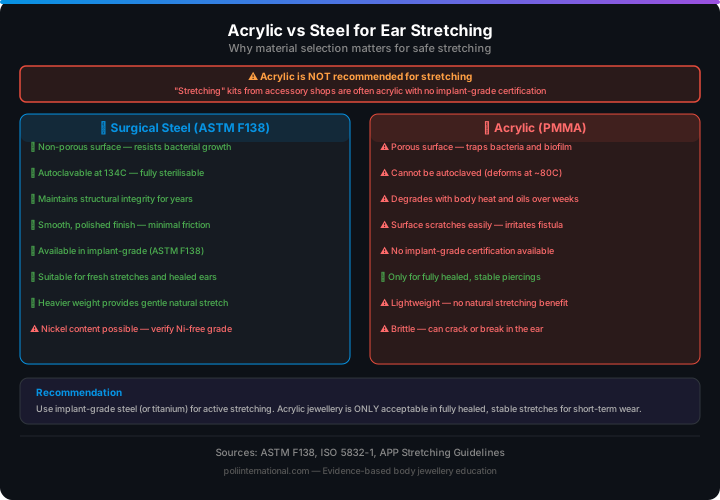
The answer is in the surface. A healing stretch is not a healed lobe. The tissue inside a fresh stretch is unprotected epithelium, the same cells that line an open wound. What touches that tissue matters: the material's surface roughness, its porosity, its chemical stability, and its capacity to shed bacteria into the healing channel. Acrylic fails on several of these measures, and the failures are not cosmetic. They are safety failures.
This article breaks down the materials science behind acrylic and steel stretching jewellery so you can make an informed choice, whether you are a piercer advising a client or someone navigating your first stretch at home.
What acrylic stretching jewellery is actually made of
PMMA has legitimate medical applications. It is used in intraocular lenses, bone cement, and some dental prosthetics. In those applications, however, the PMMA is polymerised under controlled conditions, sterilised, and implanted once, not repeatedly inserted into healing tissue. The manufacturing standards for medical-grade PMMA bear no resemblance to the standards for a set of acrylic plugs sold through a general marketplace.
The critical distinction is surface quality. Implant-grade PMMA is polished to a near-molecular smoothness. Commercial acrylic plugs, particularly at the entry-level price point, have a microscopically rough surface that a stretching fistula does not tolerate well.
The porosity problem: why acrylic harbours bacteria that steel does not
Acrylic is different. PMMA is not a truly porous material in the sponge sense, but its surface at the microscopic level is irregular enough that bacteria find it easier to anchor. More importantly, acrylic cannot be autoclaved at the temperatures required for sterilisation without deforming. Steam sterilisation at 134 °C will soften and warp PMMA. Cold sterilisation with glutaraldehyde or hydrogen peroxide plasma can work but is rarely done for consumer-grade jewellery.
The practical consequence: an acrylic plug inserted into a fresh stretch introduces surface-adhered bacteria into tissue that is actively healing. The same stretch fitted with an implant-grade steel or titanium plug presents a surface that is inhospitable to bacterial colonisation and can be sterilised before insertion.
Chemical stability: what leaches out of acrylic under body-temperature wear
A healed lobe with a fully formed fistula has a keratinised lining that offers some barrier protection. A fresh stretch does not. The tissue is raw, the blood supply to the area is elevated, and any chemical that leaches from the jewellery surface has a direct pathway into the tissue.
There is a related issue of heat retention. Acrylic is a thermal insulator. Steel and titanium are thermal conductors. A steel plug dissipates body heat efficiently. An acrylic plug traps it, raising the local temperature of the fistula slightly. Warmer tissue supports faster bacterial metabolism, which is exactly what a healing stretch does not need.
Why implant-grade steel (ASTM F138) is the safer choice
This matters for stretching for three reasons:
- Surface finish: ASTM F138 jewellery can be polished to an Ra (roughness average) below 0.1 micrometres, a surface that bacteria cannot colonise effectively and that does not abrade healing tissue.
- Nickel encapsulation: The chromium oxide passivation layer on properly manufactured ASTM F138 steel encapsulates the nickel in the alloy, preventing it from leaching into tissue. Generic surgical steel does not reliably achieve this, which is why nickel release is a known problem with unbranded steel jewellery.
- Sterilisation compatibility: ASTM F138 steel can be autoclaved at 134°C without any change to its properties. You can sterilise it before every stretch.
Where glass and titanium fit in the picture
Steel is not the only safe option. Borosilicate glass (Pyrex) stretching plugs have a surface that is even smoother than polished steel and carries zero risk of metal ion release. Glass cannot be autoclaved at the same temperatures as steel, but it can be sterilised with chemical agents that do not leave residues. The trade-off is fragility: a dropped glass plug shatters, whereas a steel plug does not.
Titanium, particularly ASTM F136 (Ti-6Al-4V ELI), is another option that combines the strength of steel with the near-zero nickel release of glass. Titanium is more expensive than steel and harder to machine, which is why it is less common in entry-level stretching kits. But for anyone with a confirmed nickel sensitivity, titanium eliminates the metal-allergy variable entirely.
The key point is that all three of these materials share the properties acrylic lacks: a smooth, non-porous surface, sterilisation compatibility, chemical stability at body temperature, and a regulatory framework (ASTM or equivalent) that defines what the material must be and how it must be tested.
Material comparison for stretching jewellery
| --- | --- | --- | --- | --- | --- |
|---|---|---|---|---|---|
| Surface porosity | Microscopically rough; supports biofilm | Variable; depends on finish quality | Passivated; Ra below 0.1 µm | Passivated; Ra below 0.1 µm | Near-zero porosity; smoothest surface |
| Autoclavable (134°C) | No: deforms at sterilisation temperature | Yes | Yes | Yes | No: risk of thermal fracture; cold sterilise only |
| Chemical stability at body temperature | Plasticisers and pigments may leach | Stable if passivated; nickel release if not | Stable; chromium oxide passivation layer encapsulates nickel | Stable; titanium dioxide passivation layer | Completely inert; no leaching |
| Nickel content | None | 8–14% nickel; release depends on passivation quality | 10–14% nickel; encapsulated by passivation layer | None (nickel-free) | None |
| Thermal conductivity | Low (insulator): traps heat at fistula | High (conductor): dissipates heat | High (conductor): dissipates heat | Moderate (conductor) | Low (insulator) |
| Fragility | Durable (does not shatter) | Durable | Durable | Durable | Fragile: shatters on impact |
| Regulatory standard | No body-jewellery-specific standard | No guaranteed standard; buyer must verify | ASTM F138 (implant-grade) | ASTM F136 (implant-grade) | No body-jewellery-specific standard |
| Colour availability | Unlimited (any pigment) | Silver only (uncoated) | Silver only (uncoated) | Anodisable to multiple colours | Limited (clear, frosted, coloured glass) |
| Cost (approximate, per pair) | Lowest (£2–£8) | Low (£3–£12) | Moderate (£8–£25) | Higher (£12–£40) | Moderate (£8–£25) |
| Recommended for stretching | No: not for healing tissue | No: verify grade; risk of unverified nickel release | Yes: preferred metal option | Yes: best for nickel-sensitive individuals | Yes: preferred non-metal option |
Key Takeaways:
- Acrylic (PMMA) plugs are not safe for stretching: the surface is microscopically rough, cannot be autoclaved, and may leach plasticisers and pigments into healing tissue.
- The colour choice that makes acrylic attractive for healed jewellery is the same property that makes it risky for stretching: pigments and additives that are not bonded into the polymer matrix.
- Implant-grade steel (ASTM F138) provides a passivated, sterilisation-compatible surface with encapsulated nickel, making it the standard metal choice for safe stretching.
- Titanium (ASTM F136) offers the same surface quality as implant-grade steel with the additional benefit of being completely nickel-free, which is relevant for anyone with a confirmed nickel sensitivity.
- Borosilicate glass offers the smoothest surface of any available material and is chemically inert, making it the safest non-metal option for stretching.
- Generic surgical steel is not a reliable substitute for ASTM-certified steel: without independent verification of the passivation quality and nickel release rate, you cannot assume it is safe for a healing stretch.
If you are currently stretching with acrylic and experiencing redness, swelling, persistent discharge, or a bump that does not respond to saline aftercare, remove the acrylic jewellery and switch to a sterile, implant-grade material. A reaction to the material itself is one of the most common causes of persistent irritation during stretching.
Frequently asked questions
Q: Can I wear acrylic plugs in healed stretched ears?
For short-term wear in a fully healed, well-established fistula, acrylic carries lower risk than during stretching because the tissue is keratinised and acts as a barrier. For long-term daily wear, the same concerns apply: pigment leaching, bacterial adhesion on the rough surface, and the material's inability to be sterilised. If you choose to wear acrylic in healed lobes, limit wear duration, clean the jewellery thoroughly between uses, and never sleep in it. Some piercers draw the line this way: acrylic is for occasional cosmetic wear in fully healed stretches only, never for stretching, never for long-term continuous wear, and never for piercings anywhere on the body other than well-healed earlobes.
Q: Is there such a thing as medical-grade acrylic for stretching?
Medical-grade PMMA exists and is used in intraocular lenses and bone cement. It is not the same product sold as acrylic body jewellery. Medical-grade PMMA is manufactured to ISO 10993 biocompatibility standards, polymerised under controlled conditions, and sterilised. Consumer acrylic plugs do not meet these standards. If a product is labelled medical-grade acrylic, ask for the specific ISO 10993 certification and the manufacturer’s test data. Without that documentation, treat it as generic PMMA.
Q: Why do so many stretching kits include acrylic if it is not safe?
Acrylic is included because it is cheap to produce and customers buy it. The body jewellery market is largely unregulated at the consumer level, and there is no authority that prevents the sale of acrylic stretching kits. The presence of a product on the shelf does not indicate that it has been evaluated for safety by any regulatory body. The same marketplace logic applies to externally threaded jewellery, piercing guns, and low-grade mystery-metal jewellery: demand exists, production is cheap, and enforcement is thin. The responsibility falls to the buyer and to the piercer who advises them.
Q: Can I use acrylic tapers to stretch and then switch to steel plugs?
Using an acrylic taper to stretch and then immediately inserting a steel plug reduces the contact time but does not eliminate the risk. The stretching action itself, even for a few seconds, abrades the healing tissue against the rough acrylic surface. Tapers also encourage stretching by force rather than by waiting for the tissue to relax naturally, which is the safer method called dead stretching. If you are going to stretch, use a single-flare glass or implant-grade steel plug and wait for the fistula to loosen on its own before inserting the next size.
Q: What is the absolute safest material for a first stretch?
Borosilicate glass single-flare plugs. Glass is chemically inert, has the smoothest surface of any available material, and cannot release metal ions. It is also non-porous and can be cold-sterilised. For anyone stretching for the first time and wanting to eliminate every variable that could cause a reaction, glass is the gold standard. The main limitation is that glass plugs are heavier in larger sizes, which can cause discomfort at very large gauges, but for sizes up to 00 g (10 mm), weight is rarely an issue.
Also compare
- Ear stretching timeline: how long to wait between each gauge size
- Gauge converter: convert between gauge, millimetres, and inches
- Material certification checker: verify whether your jewellery meets ASTM or ISO standards
- Reaction triage wizard: work out whether your piercing problem is irritation, allergy, or infection
- Polymer science for body jewellery: the chemistry of plastics in piercing applications
- Metallic biocompatibility: how metals interact with living tissue
- Ear stretching blowout guide: what a blowout is, how to treat it, and how to prevent it
- Surgical steel hypoallergenic truth: what implant-grade really means for nickel content
- Nickel allergy and body jewellery: how to recognise, test for, and avoid nickel reactions