DRAFT, pending Patrick review. Reply APPROVE / WAIT / DISMISS.# How big can I stretch my ears before they won't close? The point of no return explained
July 2026 · Ear Stretching Safety · Poli International
Stretched ears are a commitment. At some point, the tissue stretches past what it can recover from without surgery. Here is what the research and professional experience tell us about the point of no return, why 0g is the common threshold, and what reconstruction looks like if you change your mind.## What does the "point of no return" actually mean?
When you stretch your earlobe, you are mechanically enlarging a healed piercing by gradually displacing tissue beyond its original circumference. The skin, connective tissue, and the fistula (the internal channel of healed skin inside the piercing) all adapt to the larger diameter. Below a certain gauge, the tissue is elastic enough to retract when jewellery is removed. Above that size, the skin has been permanently remodelled: the hole shrinks some, but it will not close on its own.
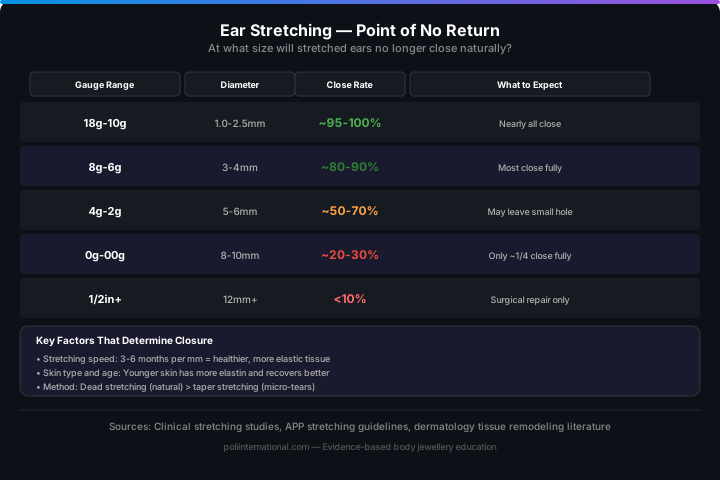
The "point of no return" is the gauge at which an earlobe will no longer close back to a standard earring size (18g to 20g) without surgical intervention. It is not a hard cliff. Some people can leave out 00g jewellery for months and see their lobes shrink to 4g or 6g, while others find their 2g holes never fully close. But as a working rule, the threshold sits between 0g (8 mm) and 00g (10 mm) for most people.
The term itself is not medical: it comes from the body modification community and professional piercers, grounded in decades of collective experience rather than controlled clinical studies. There is no randomised trial on lobe closure rates at different gauges. What we have is consistent reporting from piercers, body modification artists, and individuals who have stretched and then attempted to reverse the process, plus the underlying biology of how skin remodels under sustained tension.
Why 0g (8 mm) is the common threshold
At 0g (8 mm), several anatomical changes have accumulated:
- Permanent tissue displacement. To reach 0g, the lobe has been expanded roughly 5 to 6 times its original piercing diameter. The collagen and elastin fibres in the dermis, which give skin its ability to snap back, have been stretched past their elastic limit and are now partially replaced with less elastic scar-like connective tissue.
- Micro-tears and repair cycles. Each stretch, even when done correctly with single-gauge increments and adequate healing time, produces micro-tears in the fistula wall. The repair process deposits collagen that is denser and less flexible than the original tissue. Over multiple stretches, the cumulative effect is a stiffer, less elastic channel.
- Reduced blood supply. As the fistula expands, the capillary density per unit area decreases. Thinner, less vascularised tissue is slower to heal and less capable of contracting back to a smaller diameter. This is the same mechanism that makes large-gauge stretched lobes prone to thinning if stretched too fast.
Below 2g (6 mm), most stretched lobes retain enough elasticity to close significantly when jewellery is left out for weeks or months. By 0g, enough structural change has occurred that the hole is typically permanent, though it may shrink considerably from its stretched size. At 00g (10 mm) and beyond, closure without surgery becomes unlikely in virtually all cases.
What factors change whether your ears will close
Not everyone hits the point of no return at exactly the same gauge. Several variables determine how much your lobes can retract:
Stretching speed and technique
Ears stretched slowly, with 3 to 6 months between each full millimetre increase, develop healthier, more elastic fistulae. The tissue has time to remodel without significant scar formation. Fast stretching (skipping sizes, jumping 2 mm or more at once, or using tapers to force a stretch before the tissue is ready) produces scar tissue: the body's emergency repair response to tearing. Scar tissue does not contract. Ears stretched carefully to 00g may close more than ears stretched aggressively to 2g.
Skin type and age
Younger skin has more elastin and generally recovers better from mechanical stress. Collagen quality declines with age, meaning a 40-year-old's stretched lobes may be less resilient than a 20-year-old's. Skin type also matters: people with naturally thinner or less elastic skin (common in certain genetic connective-tissue differences) may reach the point of no return at smaller gauges. This is under-studied and amounts to clinical observation from experienced piercers rather than formal evidence [NEEDS VERIFICATION].
Stretching method
Dead stretching (inserting the next size of single-flare plug when the ear has naturally relaxed enough to accept it) produces cleaner, more uniform tissue than taper stretching, which can create uneven pressure and micro-tears. Taping (wrapping PTFE or bo
For most people, 0g (8 mm) is the threshold at which the hole will not close back to a standard 18g or 20g piercing without surgery. While the lobe may shrink to 4g or 6g over months of leaving jewellery out, the tissue has been permanently remodelled due to collagen fibre displacement and reduced capillary density, making full closure biologically unlikely. At 00g (10 mm) and beyond, closure without surgical intervention is virtually impossible. The cumulative micro-tears from stretching, combined with the replacement of elastic elastin fibres with denser scar-like connective tissue, leave the fistula permanently patent. Most cases require a scalpel excision procedure to remove the epithelialised channel and suture the lobe closed. If your lobes are below the point of no return, visible shrinkage begins within 24 to 48 hours of jewellery removal, with most contraction occurring in the first 2 to 4 weeks. The tissue continues to tighten slowly for up to 6 months, but by 3 months, you will have a reliable indication of the final size. At 0g, expect stabilisation at 4g to 2g rather than a return to standard earring gauge. Fast stretching—skipping sizes, jumping 2 mm or more at once, or using tapers before the tissue is ready—produces excessive scar tissue rather than healthy, elastic fistula remodelling. This scar tissue is denser and less vascularised, significantly raising the likelihood of reaching the point of no return at a smaller gauge, such as 2g or 4g, and increasing the risk of lobe thinning or blowouts. Yes. Younger individuals (under 25) generally have more elastin and collagen flexibility, and their skin may retract more after stretching, potentially delaying the point of no return by one or two gauge sizes. Older skin has reduced elastin content and lower regenerative capacity, meaning the permanent remodelling threshold can occur at a smaller diameter, sometimes as low as 4g (5 mm), due to diminished capillary density and slower healing.FAQ
Will my ears close if I stretch to 0g?
Can I reverse a stretched ear without surgery after 00g?
How long does it take for stretched ears to shrink if they are going to?
What happens if I stretch my ears too fast?
Does age affect whether stretched ears will close?