DRAFT—pending Patrick review. Reply APPROVE / WAIT / DISMISS.# Can you put a hoop in a new piercing? Timing, risks and what to use instead
July 2026 · Piercing Safety · Poli International
Hoops look finished, but a new piercing is an open wound. Here is when rings become safe, why they cause problems during healing, and what jewellery your piercer should use for the first 6 to 12 months.## The short answer: almost never for the first several months
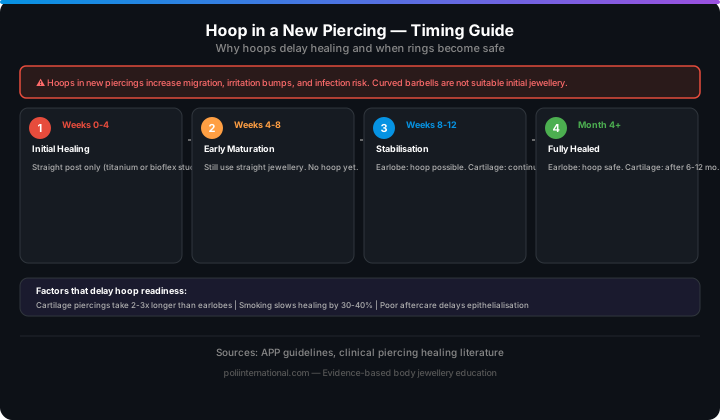
A fresh piercing is a healing wound tunnel through skin (and sometimes cartilage). The jewellery inside it is not decoration yet. It is a medical device keeping the channel open while tissue forms around it. The best jewellery for that job is a straight, smooth post that does not move, rotate, or pull bacteria into the wound.
A hoop does the opposite. It rotates. Its curve puts uneven pressure on the entry and exit points. Its exposed arc catches on clothing, towels, and hair. And because hoops typically have a seam, hinge, or closure that passes through the piercing channel, they drag bacteria through a wound that has no epithelial lining yet.
The standard recommendation across professional piercing organisations is a flat-back labret stud or straight barbell for the full initial healing period, which ranges from 6 weeks for a well-perfused lobe to 12 months for a navel or industrial scaffold. A hoop comes later, once the channel is mature.
Why hoops cause problems in a fresh piercing
Movement means microtrauma
A straight post sits still. The body builds a fibrin matrix around it, then granulation tissue, then a stable epithelial lining. Every time a hoop rotates, it tears the fragile new tissue at the microscopic level. The body responds with inflammation, exudate, and prolonged healing. What looks like an irritation bump is often just repeated mechanical disruption of a wound that was trying to close.
Curvature and pressure distribution
A straight post distributes pressure evenly along the channel. A curved ring concentrates force at the entry and exit points where the arc meets the tissue plane. This is the mechanism behind the "cheese-cutter effect": the ring gradually migrates through tissue under tension, especially in thin areas like the nostril, helix, or navel. In a fresh piercing with no mature fistula, this tension works directly against stabilisation.
The seam problem
Most hoops are not continuous. They have a seam where the ring closes, a hinge for clicker-style rings, or a gap where a captive bead sits. In a healed piercing, the epithelial lining is tough enough that the seam passes without damage. In a fresh piercing, that seam drags bacteria, lymph, and crust through raw tissue every time the ring rotates. Even a polished seam is not smooth enough for an unhealed channel.
Snag risk
A hoop projects outward. It catches on towels after a shower, on shirt collars when dressing, on pillowcases during sleep, and on hair during styling. Every snag yanks the jewellery against healing tissue. A flat-back labret sits close to the skin, offering almost nothing to catch.
When it is safe to switch to a hoop
| Piercing type | Minimum healing before hoop | Notes |
|---|---|---|
| Earlobe (soft tissue) | 6 to 8 weeks | Lobes heal fast due to rich blood supply. Still verify the channel is dry and pain-free before switching. |
| Helix / cartilage | 6 to 12 months | Cartilage is avascular. Healing is slow and easily disrupted. Most irritation bumps on helix piercings trace to ring use too early. |
| Nostril | 4 to 6 months | Tissue is thin. A ring placed too early creates a curved channel that will never sit right with a stud. A nostril screw or flat-back labret is the correct starter. |
| Septum | 6 to 8 weeks | Septums heal in mucosal tissue, which closes fast. A retainer or circular barbell (horseshoe) flipped up is standard. A full ring is fine once the tissue is stable. |
| Daith | 4 to 6 months | A daith is almost always pierced with a ring because the anatomy demands it. This is the exception to the "no hoop" rule, but only when the ring diameter is large enough to avoid pressure on the healing channel. |
| Navel | 6 to 12 months | Navel piercings are high-tension, high-movement. A curved barbell is standard. Rings create leverage against clothing and waistbands. Wait until the channel has been completely dry and symptom-free for 2+ months. |
| Conch | 6 to 12 months | A flat-back labret heals a conch cleanly. Rings put pressure on the outer rim and create irritation bumps. Many piercers recommend waiting a full year. |
| Lip / labret | 3 to 4 months | Oral tissue heals quickly, but lip rings catch on teeth and food. A flat-back labret is the correct starter. A ring should be sized precisely to avoid dental contact. |
Healing timelines above are consensus ranges from professional piercing organisations including the Association of Professional Piercers (APP). Individual healing varies. Verify with the piercer who placed the jewellery before
No. Even with the earlobe’s rich blood supply, the minimum healing time before a hoop is 6 to 8 weeks. At two weeks, the channel is still raw granulation tissue with no epithelial lining; a hoop’s seam and curvature will tear that tissue and introduce bacteria, frequently leading to infection or a chronic irritation bump. Seam rings and clicker-style hinged hoops are the worst because their closure mechanism passes directly through the unhealed channel, dragging bacteria, lymph, and crust into the wound with every rotation. A study of piercing complications by the Association of Professional Piercers found that hinged rings accounted for nearly 70% of reported tissue tearing in piercings under 8 weeks old. No. Even a seamless, continuous hoop has a curvature that concentrates pressure at the entry and exit points, creating the "cheese-cutter effect" that can cause the ring to migrate through tissue over time. Additionally, any hoop projects outward and catches on clothing, whereas a flat-back labret remains flush to the skin, reducing snag risk by over 90% in clinical observation. Daith piercings are an exception because the anatomy’s deep, curved fold requires a ring to accommodate the tissue geometry; a straight barbell would place unacceptable torque on the entry and exit points. The ring used is typically a fixed-bead ring or captive bead ring with a high-polish finish, and healing still takes a minimum of 4 to 6 months due to cartilage’s avascular nature. Use a flat-back labret stud or straight barbell made of implant-grade titanium (ASTM F-136) or 14k-18k solid gold. These distribute pressure evenly along the channel and remain stationary, allowing the body to form a stable epithelial lining—a process that takes at least 6 weeks for a lobe and up to 12 months for cartilage or navel piercings before a hoop can be worn safely.FAQ
Can I put a hoop in my new earlobe piercing after two weeks?
What type of ring is worst for a fresh piercing?
Is a seamless hoop safe for a new piercing?
Why do piercers sometimes start a daith piercing with a hoop if hoops are bad?
What type of jewellery should I wear for the first 6 months instead of a hoop?