Anodised Titanium vs PVD Coating: Which Colour Finish Lasts on Body Jewellery
Key Takeaways:
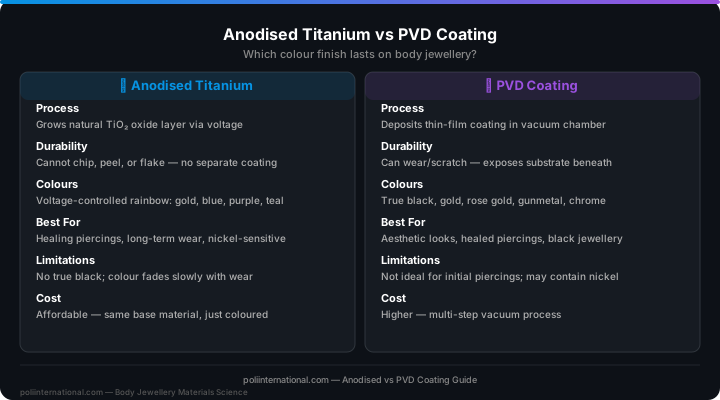
» Anodisation grows the natural TiO₂ oxide layer on titanium through electrochemical voltage, it cannot chip, peel, or flake because there is no separate layer to separate
» PVD (Physical Vapour Deposition) deposits a thin-film coating in a vacuum chamber, it is the only way to achieve true black titanium, but it can wear and expose the substrate beneath
» For a healing piercing, anodised titanium is the safer default: identical biocompatibility to bare implant-grade titanium, no foreign coating, no delamination risk
» PVD is excellent for healed jewellery where black or exotic metallic finishes matter, but piercers should inform clients that PVD is a coating, not the metal itself
» Voltage determines colour in anodisation (gold at 15V, purple at 50V, blue at 70V); PVD colour depends on the deposited material (zirconium nitride for gold tones, titanium aluminium nitride for black)
1. Why Titanium Body Jewellery Comes in Colours, and the Two Ways to Produce Them
Titanium in its raw milled state is a neutral silver-grey. It is functional, implant-grade, and completely unremarkable to look at. The colours you see on anodised titanium jewellery are not paint, pigment, or dye. They are light interference, produced by a transparent oxide layer grown electrochemically on the surface of the metal. PVD coating is a different process entirely: a separate material layer deposited on top of the metal in a vacuum chamber.
These two methods produce colour through fundamentally different mechanisms, and that difference determines everything about how the finish behaves in a healing piercing, in daily wear, and over years. If you are selecting jewellery for a client or for yourself, understanding this distinction matters more than knowing the colour name.
2. How Anodisation Works: Growing Colour, Not Painting It
Anodisation is an electrochemical process. The titanium piece is submerged in an electrolyte bath, voltage is applied, and the surface of the metal oxidises. The oxide layer that forms is titanium dioxide (TiO₂), the same compound that makes titanium biocompatible in the first place. The oxide is not a coating, it is the titanium surface itself, transformed.
The colour comes from thin-film optical interference. Light hits the top surface of the transparent TiO₂ layer, and some reflects. The rest travels through, hits the titanium-oxide boundary beneath, and reflects back. The two reflected waves interfere with each other. The colour you see depends on the oxide thickness, which is controlled precisely by the anodising voltage.
At low voltage (~15V), the oxide is roughly 30 nanometres thick and produces gold. As voltage increases, the oxide thickens and the colour cycles through the interference spectrum: purple at ~50V (70 nm), blue at ~70V (90 nm), teal at ~85V (105 nm), green at ~100V (120 nm), and magenta at ~110V (140 nm). Above 110V, the oxide becomes thick enough that the interference effect degrades into muddy grey-brown tones. True black is physically impossible through anodisation alone, the physics of thin-film interference cannot produce it.
| Property | Anodised Titanium | PVD-Coated Titanium |
|---|---|---|
| Mechanism | TiO₂ oxide layer grown electrochemically | Separate material deposited in vacuum |
| Colour source | Thin-film light interference | Intrinsic colour of coating material |
| Black possible? | No, physics doesn't allow it | Yes, titanium aluminium nitride (TiAlN) |
| Can it chip or peel? | No, no separate layer exists | Yes, coating can wear over time |
| Biocompatibility in healing | Identical to bare implant-grade titanium | Dependent on coating material; TiAlN is biocompatible, others vary |
| Durability in daily wear | Excellent, surface reforms oxide if scratched | Good but finite, high-friction contact points wear first |
| Colour range | Gold, bronze, purple, blue, teal, green, magenta | Gold, rose gold, black, chrome, blue, rainbow |
3. How PVD Works: Deposition, Not Transformation
PVD is a vacuum-chamber process. The titanium jewellery is placed in a chamber, the air is evacuated, and a solid source material, the coating, is vaporised by high-energy bombardment. The vaporised atoms condense on the jewellery surface, forming a thin film typically 0.5 to 5 micrometres thick.
The coating material determines the colour. Titanium aluminium nitride (TiAlN) produces black. Zirconium nitride produces warm gold tones. Titanium carbonitride gives rose gold. Chromium nitride gives a silver-chrome finish. These coatings are generally biocompatible in healed piercings, and TiAlN in particular has a strong clinical track record in orthopaedic implant coatings.
But PVD is a coating. It adheres to the surface. Under friction, threaded components rubbing together, a client fidgeting with a ring, daily contact with clothing, the coating can wear. High-contact points like threaded ends or ring closures are the first to show substrate exposure. This does not make PVD unsafe. It means PVD jewellery requires the same disclosure you would give for any coated product: the colour is on the surface, not in the metal.