# FDA Tattoo Ink Regulation 2026: MoCRA Compliance Is Not Optional
Key Takeaways:
» MoCRA facility registration and product listing deadlines are now in effect, non-compliance means your ink supply chain is illegal
» California Prop 65, Oregon, and New York impose stricter chemical bans than federal law, creating a patchwork you must navigate
» FDA testing programs have already triggered recalls and warning letters; 2026 enforcement will accelerate
» Artists who cannot verify manufacturer compliance are accepting liability, ignorance is not a defense
The MoCRA Timeline Is Here
The Modernization of Cosmetics Regulation Act of 2022 is no longer a future concern. By 2026, all facilities manufacturing or distributing tattoo inks in the United States must be registered with the FDA. Product listings must include full ingredient formulations. Adverse event reporting systems must be operational.
This is the first federal framework that treats tattoo inks as cosmetics with enforceable standards. If your supplier cannot provide proof of FDA facility registration, you are buying unregulated product. Period.
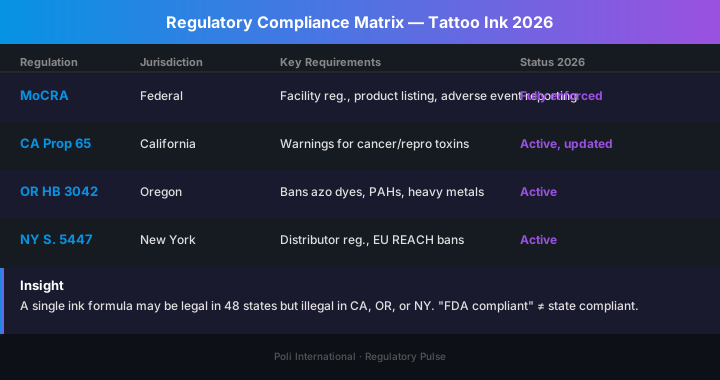
Federal vs. State: The Compliance Matrix
One federal standard would be simple. Instead, you get this:
| Regulation | Jurisdiction | Key Requirements | Status 2026 |
|---|---|---|---|
| MoCRA | Federal | Facility registration, product listing, adverse event reporting | Fully enforced |
| California Prop 65 | California | Warnings required for chemicals known to cause cancer or reproductive toxicity | Active, frequently updated |
| Oregon HB 3042 | Oregon | Bans specific pigments including certain azo dyes and heavy metals | Active |
| New York S. 5447 | New York | Registration of ink distributors, pigment bans mirroring EU REACH | Active |
The practical reality: a single ink formula may be legal in 48 states but illegal in California, Oregon, or New York. Manufacturers who claim "FDA compliant" without state-level verification are either ignorant or deceptive.
California Prop 65: The De Facto National Standard
California Proposition 65 requires businesses to provide warnings if products contain chemicals known to cause cancer, birth defects, or reproductive harm. For tattoo inks, this means any product containing heavy metals like lead, cadmium, or chromium must carry a warning label.
Here is the engineering truth: most black inks contain carbon black with trace heavy metals. Most colored inks use organic pigments that break down into compounds on the Prop 65 list. If your ink does not have a Prop 65 warning, verify why. Either the manufacturer has reformulated to eliminate listed chemicals, or they are ignoring compliance.
The state attorney general has pursued tattoo ink manufacturers. Warning letters have been issued. This is not theoretical.
Oregon and New York: The REACH-Inspired Bans
Oregon HB 3042 and New York's ink regulations borrow directly from the EU REACH Annex XVII framework. They ban specific azo dyes that can release carcinogenic aromatic amines, certain polycyclic aromatic hydrocarbons (PAHs), and heavy metals above trace thresholds.
For manufacturers, this means reformulating products that were acceptable five years ago. For artists, it means checking that every bottle in your station complies with the strictest state in your distribution chain.
If you ship to Oregon or New York, your entire inventory must meet those standards. There is no carve-out for "professional use only."
FDA Testing and Enforcement: What the Data Shows
Between 2024 and 2026, the FDA has:
- Issued warning letters to manufacturers for inadequate adverse event reporting
- Conducted laboratory testing that identified unauthorized pigments and contaminants
- Initiated recalls for inks containing microorganisms and heavy metals exceeding action levels
The testing programs are not random. They target specific pigments and manufacturers based on adverse event reports. If your clients are experiencing unusual reactions, the FDA wants to know. And if your ink supplier is on their radar, you will find out through a recall notice.
What Artists Must Verify When Buying Ink
You are the last line of defense. Here is the checklist:
1. FDA facility registration number, Ask for it. Verify it on the FDA website.
2. Product listing confirmation, The specific ink you are buying must be listed.
3. State-specific compliance documentation, Prop 65, Oregon, New York certifications.
4. Ingredient list with CAS numbers, Not "proprietary blend." Full disclosure.
5. Batch-specific testing results, Heavy metals, microbial limits, pigment identity.
If your supplier hesitates on any of these, find another supplier. Your license is not worth their secrecy.
The 2026–2028 Trajectory
MoCRA implementation will continue through 2028 with additional labeling requirements and potentially mandatory safety testing protocols. The FDA is actively considering adopting elements of the EU REACH Annex XVII restricted substances list.
The direction is clear: more regulation, stricter enforcement, and zero tolerance for non-compliance.
FAQ
Q: Do I need to register my tattoo studio as a facility under MoCRA?
A: No. MoCRA facility registration applies to manufacturers and processors, not individual studios. However, if you mix or repackage inks for resale, you may qualify as a manufacturer.
Q: Can I still use ink that was purchased before MoCRA took effect?
A: Yes, but only if the manufacturer was compliant at the time of manufacture. If the ink was produced by an unregistered facility, it is technically illegal to distribute or sell.
Q: What happens if I use an ink that later gets recalled?
A: You are required to stop using it and notify affected clients if adverse events occurred. Failure to do so increases your liability exposure.
Q: Is there a national database of compliant inks?
A: Not yet. The FDA maintains a list of registered facilities, but not a product-by-product compliance database. Third-party verification services are emerging.
Q: Will MoCRA apply to permanent makeup inks?
A: Yes. MoCRA covers all tattoo inks, including those used for cosmetic tattooing and micropigmentation.
---
Verify your ink supply chain today. If your manufacturer cannot produce compliance documentation, you are operating on borrowed time.