
# Korean Wireless Tattoo Pens Are Finally Solving the Problem Nobody Talks About
Key Takeaways:
» The real problem with wireless tattoo pens isn't battery life — it's voltage sag that changes needle throw mid-session
» Korean OEM manufacturers are shipping adaptive power management systems that maintain constant motor voltage regardless of battery charge
» These $180–$320 pens match or exceed the electrical consistency of $600–$900 premium systems
» For artists running multiple stations, three Korean pens cost less than one premium wireless system with spare batteries
The Voltage Sag Problem Is Real
Lithium-ion cells in wireless tattoo pens typically operate between 3.3V and 4.2V. A fully charged pack at 4.2V delivers one hit characteristic. At 3.6V — roughly 40% remaining — the same voltage setting produces a softer strike. Experienced artists feel this and adjust. But the machine isn't consistent, and neither is the result.
The math is straightforward. A rotary machine drawing 1.5A at 8V pulls roughly 12W. Through the boost converter, at 3.7V battery voltage, that's ~3.5A from the cell. As the cell discharges, internal resistance increases, voltage droops further under load, and the converter's efficiency curve shifts. The output voltage at the motor terminals drifts by 0.3–0.5V per session — enough to change needle throw by a measurable fraction of a millimeter.
For lining, that's the difference between a crisp pull and a blowout. For color packing, it's saturation inconsistency the client will see in two weeks.
This is engineering, not opinion. Every lithium cell has a discharge curve. Most wireless pen controllers don't compensate for it. The artist does — by adjusting hand speed, angle, or the voltage dial — which is exactly what a machine is supposed to eliminate.
Adaptive Power Delivery: What Korean Shops Are Doing Differently
The Korean approach — visible in recent OEM designs from Seoul-based engineering firms — decouples the user's voltage setting from the raw battery output. Instead of "set 8V, get whatever the battery can sustain," the controller monitors actual motor terminal voltage in real time and adjusts the boost converter's duty cycle to maintain it.
This isn't new in electronics. It's standard in precision motor control for drones, medical devices, and CNC spindles. But it's new in tattoo equipment at the sub-$400 price point.
Three specific innovations are showing up in 2025–2026 Korean designs:
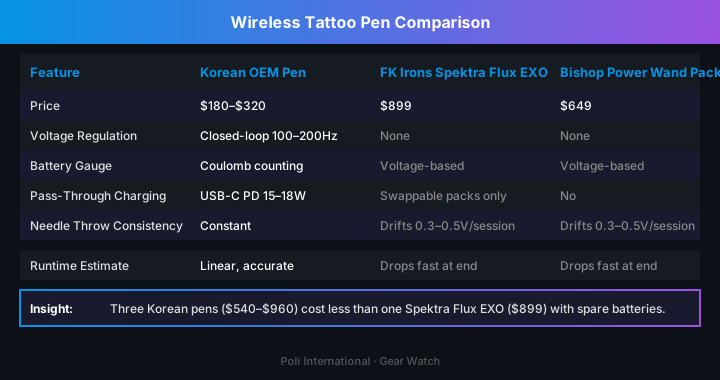
1. Closed-Loop Voltage Regulation. The controller samples motor terminal voltage at 100–200Hz and adjusts PWM duty cycle within 1–2 cycles. Net result: the motor sees the same effective voltage at 90% battery and 15% battery. Needle throw stays constant.
2. State-of-Charge Gauging With Coulomb Counting. Most budget wireless pens estimate battery from voltage alone — which is why the indicator drops from "full" to "20%" in the last 30 minutes. Korean OEMs are adopting fuel-gauge ICs that track total energy in/out, giving artists a linear, predictable runtime estimate. When it says 45 minutes remaining, it means 45 minutes.
3. Pass-Through Operation. Several new Korean pens support USB-C PD pass-through: plug in, keep tattooing while charging at 15–18W. The power path management IC routes wall power to the motor while directing excess to the battery. Zero downtime. Neither FK Irons' Spektra Flux (swappable packs, no pass-through) nor Bishop's Power Wand (excellent runtime, no voltage compensation) offers this.
The Price Point That Changes the Math
A Korean OEM pen with adaptive power management, coulomb-counting fuel gauge, and USB-C PD retails through distributors at $180–$320.
Compare: FK Irons Spektra Flux EXO — $899. Bishop Power Wand Packer — $649. Cheyenne HAWK Pen — approximately $700.
The component cost difference explains maybe $30–40 of that gap. The rest is brand markup, distribution margin, and R&D amortization. Korean OEMs operate on thinner margins and higher volume — they sell to distributors in 40+ countries, not through direct-to-consumer marketing campaigns.
For an artist building a multi-machine station, the math is compelling: three Korean wireless pens with adaptive power delivery cost less than one Flux EXO with spare batteries. And the stroke consistency is, by the numbers, more predictable across a full discharge cycle.
This doesn't make the premium brands obsolete. FK Irons' build quality is exceptional. Bishop's customer support is legendary. Cheyenne's needle stabilization is still the reference standard. But when a $250 pen matches or exceeds the electrical consistency of an $899 system, the value proposition shifts — and artists notice.
What This Means for Piercing Equipment
The piercing industry hasn't seen the same wireless revolution — most professional piercing tools remain single-use, hand-pressure instruments. But the underlying technology matters. The same adaptive power management ICs showing up in Korean tattoo pens could drive wireless piercing tools: dermal punches with controlled insertion depth, or rotary piercing devices with consistent RPM under load.
Poli International doesn't manufacture equipment, but we track these developments because our customers do. A piercer who also tattoos — increasingly common in multi-service studios — benefits from understanding which equipment innovations cross disciplines. Battery management that keeps needle depth consistent applies whether that needle is depositing ink or creating a channel for jewelry.
FAQ
Q: Are Korean wireless tattoo pens reliable for daily professional use?
The top-tier OEM pens — those using name-brand lithium cells (Samsung, LG) and TI or STMicro boost converter ICs — are mechanically comparable to premium Western brands. The weak point is usually the battery connector, not the electronics. Check for gold-plated contacts and a mechanical retention mechanism, not just friction fit.
Q: Does adaptive power delivery actually make a difference in the tattoo?
Yes, if you're doing work where stroke consistency matters — fine-line, stipple shading, color packing. If you're running a 7RL at moderate speed for bold traditional work, you won't notice. If you're pulling a single-needle portrait, the difference between 3.4mm and 3.7mm throw is visible.
Q: Should I switch from FK Irons or Bishop to a Korean OEM pen?
Not necessarily. If your current machine delivers consistent results and you know its behavior, switching introduces a learning curve. But if you're adding a second or third station, or your current wireless pen has voltage sag issues you're compensating for, the new Korean designs are worth testing. Most distributors offer trial periods — rent before you commit.
Q: What is the regulatory status of these pens in the EU?
Korean OEM pens sold through EU distributors should carry CE marking under the EMC and Low Voltage directives. Tattoo machines are not medical devices under EU MDR, so ISO 13485 doesn't apply. But the battery itself must comply with IEC 62133 (safety of lithium cells). Verify the distributor provides a Declaration of Conformity — if they won't, skip it. This is the same standard Poli International applies to our own equipment evaluations.