
South Korea's Supreme Court Just Killed the 34-Year Tattoo Ban — What Actually Changes
South Korea's Supreme Court didn't just rule on a single case today. It formally ended a regulatory era that had been strangling one of the world's most technically sophisticated tattoo industries since 1992. The Court overturned the conviction of tattooist Kim Do-yoon, applying the logic it established on May 22: tattooing is not a medical act. It's artistic expression.
For 34 years, South Korea was the anomaly among developed nations — a country where every tattoo artist was, by legal definition, practicing medicine without a license. An estimated 50,000-plus artists worked in the shadows, building what became known globally as "K-tattooing" — hyper-realistic, technically precise work that commanded premium pricing from international clients. While their art traveled the world, the artists themselves faced criminal prosecution at home.
This ruling changes the legal architecture. It doesn't solve everything overnight — the regulatory scaffolding still needs to be built — but it removes the criminal classification that made every tattoo studio a potential crime scene.
The 1992 Logic and Why It Survived So Long
The 1992 precedent that classified tattooing as a medical act wasn't arbitrary.
It came from a specific legal interpretation: any procedure that penetrates the dermis with a needle creates a wound. Wound creation constitutes a medical procedure. Ergo, tattooing is medicine.
This wasn't unique to South Korea, incidentally. Japan held a similar position until its own Supreme Court ruling in 2020. The difference is that South Korea held onto it for six more years, during which time the global tattoo industry underwent a complete transformation — REACH ink restrictions in the EU, FDA cosmetic classification in the US, and the emergence of ISO standards for sterilization in body art environments.
The practical result: while European regulators were debating permitted pigment concentrations at the parts-per-million level, Korean artists couldn't legally advertise their studios or process credit card payments. The regulatory conversation had moved from "should this be legal" to "what's the safe cobalt limit in blue pigments" — but South Korea was stuck at gate one.
What the Three 2026 Rulings Actually Say
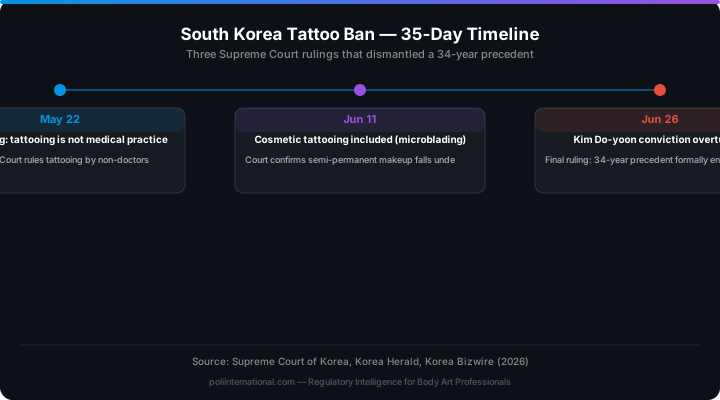
The Supreme Court didn't issue a single ruling. It released a sequence of three decisions in 2026 that, taken together, dismantle the 1992 framework:
May 22: The landmark ruling. The Court declared that tattooing by non-doctors does not constitute unlicensed medical practice. This was the structural shift — the reclassification from "medical procedure" to "artistic expression."
June 11: Cosmetic tattooing specifically ruled not to be medical practice. Semi-permanent makeup artists — a massive and predominantly female workforce in Korea — got explicit legal standing. This was strategically important because cosmetic tattooing has different hygiene profiles and different client demographics than decorative tattooing, making it harder for medical associations to argue a one-size-fits-all risk model.
June 26 (today): Kim Do-yoon's individual conviction overturned. This is the enforcement signal: the Court isn't just establishing principles — it's applying them to specific cases. Past convictions based on the 1992 interpretation now have a clear path to appeal.
The Regulatory Vacuum and What Must Be Built
Here's where things get technically interesting. Ending a ban creates a regulatory vacuum. You've removed the criminal classification, but you haven't built the replacement infrastructure. South Korea now needs:
Licensing standards. What qualifies someone to tattoo professionally? Apprenticeship hours? Written exams on bloodborne pathogens? Portfolio review? Different jurisdictions handle this differently — the US model favors state-level licensing with 1,000-2,000 apprenticeship hours; the EU model leans on health department certification. Korea gets to choose, and the choice matters for industry structure.
Hygiene and sterilization protocols. Underground tattooing means no standardized autoclave use, no spore testing, no regulated sharps disposal. The Korean Tattoo Association and emerging licensing bodies now need to establish protocols equivalent to what the Alliance of Professional Tattooists or the UK's Tattoo Hygiene Rating Scheme provide elsewhere.
Ink regulation. This is the sleeper issue. The EU's REACH regulation restricted over 4,000 chemicals in tattoo inks starting in 2022 — including specific limits on cobalt, nickel, and PAHs. South Korea now needs to decide: adopt EU-style chemical restrictions, align with FDA's lighter-touch cosmetic classification, or develop its own standards. The ink supply chain will adapt to whatever framework emerges, and Korean manufacturers who've been supplying the underground market need clarity to build compliant product lines.
What This Means for the Global Body Art Industry
The South Korean ruling matters beyond the peninsula for three reasons.
First, it removes the last major developed-nation example of a medical-license requirement for tattooing. Every jurisdiction that still criminalizes non-medical tattooing just lost its strongest comparative precedent. Countries considering crackdowns — and there are always a few — can no longer point to South Korea as the model.
Second, it unlocks one of the most technically sophisticated tattoo workforces in the world. Korean artists working in photorealism, fine-line, and micro-realism have been training in conditions that would be illegal anywhere else. Now they can operate openly, teach openly, and export their techniques. Expect an acceleration in Korean influence on global tattoo aesthetics.
Third, it creates a new regulatory laboratory. When Japan decriminalized tattooing in 2020, it moved toward local-level regulation that remains fragmented. South Korea has an opportunity to build a centralized, coherent framework from scratch — and if it succeeds, it becomes the template for other Asian markets still wrestling with tattoo legalization.
What the Industry Should Do Now
The criminal threat is gone. The administrative work begins.
Korean tattoo associations need to engage with the health ministry immediately, before bureaucrats draft regulations without practitioner input. The pattern in other countries has been consistent: governments that regulate without industry consultation produce unworkable standards that drive artists back underground. The Korean Tattoo Association should present a draft licensing framework within 90 days, not wait for the government to write one.
Individual artists should begin documenting their sterilization practices, apprenticeship records, and client consent procedures. When licensing applications open, those with documented histories will move faster than those starting from zero.
For the international industry: ink manufacturers exporting to South Korea should audit their product lines against REACH standards now. The most likely regulatory outcome is alignment with EU chemical restrictions, and reformulating after regulations drop is more expensive than preparing ahead.
And for tattoo artists everywhere: this ruling is evidence that legal architecture can change. The argument that "it's always been this way" isn't a structural fact — it's a temporary condition. South Korea just proved that a 34-year legal precedent can be dismantled in 35 days, from May 22 to June 26, 2026.
FAQ
Will all previously convicted tattoo artists be exonerated?
Not automatically, but the Kim Do-yoon ruling establishes a clear precedent. Each conviction will likely require individual appeal, but the legal basis for those convictions — the 1992 medical-act interpretation — has been formally overturned.
When can tattoo shops legally open in South Korea?
Shops can begin the commercial registration process now that the activity is no longer criminalized. However, professional licensing requirements and health department certifications are still being developed. Expect a 6-12 month transition period before a comprehensive framework is in place.
Does this affect cosmetic tattooing (semi-permanent makeup)?
Yes. The June 11 ruling specifically addressed cosmetic tattooing, establishing that procedures like microblading and semi-permanent eyeliner are not unlicensed medical practice.
How does South Korea's new stance compare to EU ink regulations?
South Korea currently has no ink-specific chemical regulations. The most likely path is alignment with EU REACH standards, which restrict over 4,000 substances. But this hasn't been legislated yet — it's the next regulatory frontier.
What was Kim Do-yoon convicted of originally?
Kim Do-yoon, one of South Korea's most prominent tattooists, was convicted of practicing medicine without a license — the standard charge applied to tattoo artists under the 1992 classification. Today's ruling overturns that conviction and, by extension, validates the estimated 50,000-plus artists operating under the same legal shadow.


