The viral “no-jewelry” piercing hack that will wreck your teeth and soft tissue
Key Takeaways:
» Magnet “studs” behind the lip or in the mouth are not piercings — they’re uncontrolled clamp force on living tissue.
» Neodymium magnets can generate far higher pressure than safe jewelry backs, causing ischemia, necrosis, and tooth damage.
» Ingested magnets can perforate the gut and require emergency surgery, especially when more than one is swallowed.
» There is no piercing technique, anatomy, or material where opposing loose magnets inside the mouth are clinically acceptable.
» Artists and studios should publicly discourage this trend and educate clients on safe oral jewelry geometry and materials.
---
1. What the “magnet piercing” trend is actually doing to tissue
The latest body-mod circus on TikTok and Instagram is a batch of “no-piercing lip studs” and “instant snake bites” using tiny neodymium magnets placed inside the lip or in the mouth to mimic labrets and bites without a needle. The setup is simple: a fake “stud” on the outside, a raw magnet behind the lip or against the gums, clamping the tissue between them to stay in place. Influencers are framing it as a “non‑permanent piercing hack,” which is exactly the problem — it’s not a piercing at all, it’s prolonged tissue compression with no exit channel for swelling, fluid, or motion.
Clinically, what those magnets are doing is a crude version of a vascular clamp on mucosa: squeezing soft tissue hard enough to hold a device in place, for hours, with no engineered control over compression, edge geometry, or load distribution. In a real oral piercing, we deliberately pair post length, disc diameter, and surface finish to manage pressure and edema, the same way we manage the relationship between needle taper angle and dermal cellular regeneration speed. With magnets, you’ve got none of that—just whatever crush force two rare‑earth pills generate at that gap distance.
A lot of viral clips are bragging that “it doesn’t even hurt,” which is not reassuring; that’s exactly what you see in slow ischemic damage when pressure is high enough to choke microvasculature but not high enough to trigger acute pain immediately. Oral mucosa is heavily vascularized, so it tolerates abuse for a while, but once you mix sustained compression with the bacterial load of saliva, you’ve engineered a perfect little necrotic pocket. From there, your risk profile looks less like “cute lip bling” and more like minor pressure ulcer plus opportunistic infection.
This trend also blurs the line between jewelry and foreign bodies in a way that makes real aftercare impossible. Clients see endless TikToks of magnet “fake piercings” that pop on and off, and assume oral structures are fair game for any novelty they find on Amazon. That’s how you end up with people thinking it’s fine to wedge magnets into non‑pierced tongues or cheeks, the same way they think acrylic tongue bars from discount packs are acceptable when they’ve never seen the micro‑pitting and biofilm those surfaces collect compared to properly polished implant‑grade stems.
---
2. How magnets compare to real oral jewelry
Let’s put some structure on this. There are three main things that matter for oral jewelry safety: contact pressure, surface and edge geometry, and material behavior in a wet, mechanically active environment.
Here’s the rough comparison:
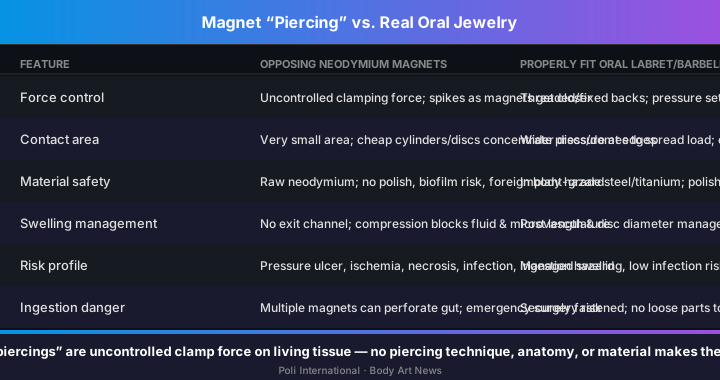
| Feature | Opposing neodymium magnets in lip/mouth | Properly fit oral labret / barbell |
|---|---|---|
| Force control | Uncontrolled clamping force that increases sharply as magnets get closer; can spike well above safe tissue pressure. | Threaded or fixed backs, pressure determined by post length and disc size, adjusted for swelling. |
| Contact area | Very small area; most cheap magnets are tiny cylinders or discs, concentrating pressure at edges. | Wider discs or domes to spread load, with designed geometry tuned for oral or dermal contact. |
| Edge geometry | Sharp or minimally chamfered edges from sintering/plating; high risk of localized trauma and ulceration. | Polished radiused edges, engineered to minimize snagging and shear on mucosa and enamel. |
| Material & coating | Sintered neodymium-iron-boron with thin nickel or multi‑layer plating; coating can chip or corrode, exposing toxic core. | Implant‑grade titanium, steel or certified medical‑grade polymers like BioFlex®, designed for long‑term tissue contact. |
| Movement & shear | Constant micro‑sliding with speech and eating, so the magnet edges saw against tissue and enamel. | Movement is predictable and constrained by post geometry; hardware stays indexed on tissue plane. |
| Failure mode | De‑magnetization, plating cracks, magnet fractures; ingestion risk that can escalate to bowel perforation if multiple magnets are swallowed. | Thread loosening or wear over time; failure tends to be gradual and obvious during cleaning and checks. |
The biggest hidden variable here is force vs. contact area. A small neodymium magnet pair can generate several newtons of attractive force at close range, focused into just a few square millimeters. That’s well above the threshold where you start compromising blood flow if the load is sustained. In proper jewelry design we fight to spread load: bigger backing discs, flexible stems where appropriate, and enough post length to let tissue breathe during that initial inflammatory window. That same logic underpins why we designed BioFlex® labret backs with broad, low‑profile contact faces rather than tiny points of pressure.
Then there’s material behavior: neodymium magnets are basically sintered metal crackers with a shiny coat. Once that coating chips in the mouth (and it will, because teeth win), the core is exposed to saliva and acids. Neodymium‑iron‑boron is not a biocompatible substrate; it corrodes aggressively, generating metal ions and debris that have no business being in an open mucosal micro‑wound you’ve just created by clamping your lip all afternoon. Compare that to something engineered for mucosal contact, like a polished titanium labret or a certified polymer post, where corrosion resistance and surface energy are tightly controlled to minimize irritation and plaque adherence.
From a biomechanics standpoint, magnets inside the oral cavity also create constant lateral shear you’ll never see in a correctly fitted labret. Every time the client talks, chews, or swallows, the magnet slides, pivots, and re‑seats, turning the compressed spot into a friction ulcer. That’s the same failure pathway we watch for when artists stubbornly ignore how much thread friction in internally threaded jewelry affects inflammatory response, except here you’re adding uncontrolled force and a brittle, chipping core.
---
3. Clinical risk profile: from enamel damage to surgical emergencies
The monotone “don’t do this” warnings floating around social don't explain *why* this is bad in engineering terms, so let’s break it down the way a studio should be thinking about risk.
1. Local soft tissue damage (short term)
Sustained focal pressure from a magnet pair can exceed safe capillary perfusion pressure within minutes, especially in thinner lip tissue. Keep it there for hours and you’re courting:
- Ischemia and early necrosis in the compressed zone
- Micro‑tears when the magnet slides, creating entry points for oral flora
- Ulceration that’s slower to heal than a clean needle channel, because there’s no linear track, just a mashed zone of damage
This is the opposite of the controlled trauma you get when you optimize needle geometry and tissue load for piercing; you’re not creating a predictable wound your body knows how to rebuild, you’re just crushing and scuffing a patch of mucosa repeatedly.
2. Enamel and periodontal damage
Magnets inside the mouth are tiny hardened bodies with almost no give. When they snap together or into alignment near the dental arch, they can:
- Chip enamel, especially on incisors and canines
- Concentrate force at the gumline, traumatizing periodontal ligaments
- Create hidden plaque traps against the tooth surface, accelerating demineralization
Once you’ve spent years engineering minimal‑trauma oral jewelry that doesn’t erode enamel or overload the PDL, watching clients snap uncontrolled magnets around their teeth feels like fingernails on a chalkboard.
3. Ingestion and GI perforation
One magnet swallowed is a choking and obstruction risk; two or more swallowed separately are a perforation risk. Magnets in different loops of bowel can attract each other through tissue, pinching and necrosing the wall between them. Pediatric surgery literature is full of case reports where this escalates to emergency laparotomy and bowel resection. That’s not theoretical; it’s a known pattern every time magnet toys trend.
Piercing clients replicating this trend with magnet pairs in the mouth are one cough or laugh away from swallowing them. There is no safe way to “train” clients around this; the hazard sits entirely in the design of the device.
4. Material toxicity and corrosion
Once the plating on neodymium magnets cracks, the underlying alloy corrodes rapidly in moist environments. That corrosion releases rare‑earth and transition metal ions into local tissue, turning your already compromised mucosal patch into a metal‑loaded wound. Unlike certified implant alloys or medical‑grade PP‑R polymers, these cores are never validated against ISO 10993 for irritation, sensitization, or systemic toxicity in human tissue.
Studios already fight uphill against blanket “flexible jewelry is bad” narratives that lump counterfeit TPU and PVC pieces in with genuine BioFlex® and Bioplast. Toss uncoated or poorly plated magnets into the mix and you hand regulators and journalists another “see, body jewelry is dangerous” headline — when in reality the danger comes from casual consumer hacks, not from engineered jewelry systems that actually pass biocompatibility standards.
---
4. Patrick’s Note: How I’d talk about this to a client
What I’ve seen in studios when a trend like this hits is the same pattern: a wave of DMs asking “Can you do this safely?” followed by at least one walk‑in with some sketchy gadget in a blister pack. My honest answer is simple: there is no version of opposing magnets in the mouth that I’d sign my name under. Not as a manufacturer, not as a piercer, not as a client.
Looking back at three decades of sourcing and materials testing, the whole point of systems like BioFlex® was to *control* how force is transmitted to tissue: broad contact surfaces, predictable flex modulus, ultra‑low phthalate content, and clean recovery curves that line up with what we know about dermal and mucosal healing. The magnet hacks are the opposite philosophy — maximum gimmick, zero engineering. If you want to give your clients a genuinely safer option for movement and comfort, you’re far better off understanding when flexible vs. rigid body jewelry actually improves biomechanics in a piercing than chasing trends built for views instead of longevity.
---
5. FAQ: Technical Q&A
Q: Is there any scenario where magnets are acceptable as part of body jewelry?
Static magnets encapsulated inside a properly engineered, fully sealed implant‑grade housing *outside* the oral cavity are a different discussion, but loose opposing magnets clamping soft tissue are never acceptable. In the mouth specifically, the combination of saliva, tooth impact, and constant motion makes magnet use fundamentally unsafe from both mechanical and corrosion standpoints.
Q: Could a studio “modify” these magnet kits to make them safer for clients?
No. You cannot retrofit a fundamentally uncontrolled force system into something clinically respectable by adding tape, silicone sleeves, or disclaimers. The risk profile—pressure necrosis, enamel damage, swallowed magnet perforation—comes from the core mechanism. The responsible move is to refuse to use or endorse them and steer clients toward properly pierced labrets or lip jewelry with known-safe materials and geometries.
Q: Are the risks really worse than a poorly done lip piercing with bad jewelry?
They are different and, in some respects, less forgiving. A bad lip piercing with low‑grade metal can still be salvaged if you swap hardware and manage the channel; at least there is a defined tract and load path. With magnet clamps, there is no channel, only diffuse tissue injury, and the ingestion hazard exists every second the magnets are in the mouth. You can fix bad hardware; you cannot engineer physics out of magnet pairs clamping soft tissue and rattling around near the airway.
---
Conclusion: Stop the Magnet Hacks, Elevate the Jewelry
If you’re an artist or studio, this is one of those moments where you have to be louder than the algorithm. Opposing magnets in the mouth are not “edgy” or “innovative,” they’re a classic consumer product hazard masquerading as body art. The engineering is wrong at every layer: uncontrolled compressive load, brittle corroding cores, terrible edge geometry, and a built‑in path to GI catastrophe if they’re swallowed. That’s not a gray area; it’s a hard no.
Your leverage here is education. Explain to clients *why* you use specific disc sizes, post lengths, and materials for oral work, the same way you’d walk them through how needle geometry and trauma management affect long‑term tissue recovery. Once people understand that good jewelry is basically micro‑engineering for their anatomy, cheap magnet hacks stop looking clever and start looking like what they are: shortcuts that gamble with their teeth, their soft tissue, and sometimes their gut.
---