Internal vs. External Threading: The Body Jewelry Detail That Quietly Decides How You Heal
Key Takeaways:
» External threading runs the sharp screw thread along the post, so it drags across the inside of a fresh piercing channel on every insertion and removal.
» Internal threading keeps the post perfectly smooth and moves the thread to a tiny pin on the attachment, so nothing abrasive ever passes through tissue.
» For initial and healing piercings, internally threaded or threadless implant-grade jewelry is the professional standard, not a luxury upgrade.
» The difference is pure mechanical engineering: thread pitch, surface finish, and edge geometry decide how much micro-trauma your fistula absorbs.
» Cheap externally threaded steel is the single most common reason a "mystery" irritated piercing never fully settles.
---
1. What "threading" actually means on a piece of body jewelry
Almost every barbell, labret, or curved bar is a two-part system: a post that sits through the piercing, and a removable end (a ball, disc, gem, or attachment) that screws on to hold it in place. How those two parts join is the entire conversation, and it splits into two camps.
On externally threaded jewelry, the screw thread is cut into the end of the post itself, like a tiny bolt, and the decorative end has a tapped hole that twists onto it. That means the threaded section, the part with raised, sharp ridges, has to travel through the piercing channel every single time you insert or change the jewelry. On internally threaded jewelry the logic is flipped: the post is smooth all the way along its working length, the threaded hole is tapped *inside* the post, and a short threaded pin lives on the attachment instead. Nothing with a cutting edge ever touches the wall of your fistula.
It sounds like a trivial manufacturing choice. It is not. It is the same kind of detail I keep coming back to when I write about how needle geometry and tissue load shape dermal recovery, because the surface that contacts living tissue determines how cleanly that tissue rebuilds. A healing piercing is an open wound with an epithelial tunnel forming around the post. Run a coarse thread through that tunnel and you are effectively re-injuring it on a microscopic level, restarting the inflammatory clock you have been waiting weeks to run down.
2. Internal vs. external threading, side by side
Here is the comparison the way a studio should weigh it, feature by feature.
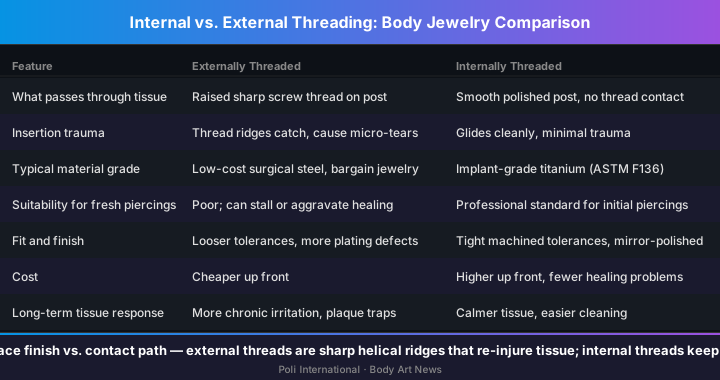
| Feature | Externally threaded | Internally threaded |
|---|---|---|
| What passes through tissue | The raised, sharp screw thread on the post. | A perfectly smooth, polished post. No thread contact. |
| Insertion trauma | Thread ridges catch and scrape the fistula wall, causing micro-tears. | Glides through cleanly; trauma approaches that of the original channel. |
| Typical material grade | Common on low-cost surgical steel and bargain jewelry. | Standard on implant-grade titanium (ASTM F136) and quality polymers. |
| Suitability for fresh piercings | Poor; can stall or aggravate healing. | The professional standard for initial and healing piercings. |
| Fit and finish | Looser tolerances, more plating, more edge defects. | Tight machined tolerances, mirror-polished, fewer snag points. |
| Cost | Cheaper up front. | Higher up front, lower in healing problems and remakes. |
| Long-term tissue response | More chronic irritation, plaque traps in thread valleys. | Calmer tissue, easier cleaning, more predictable healing. |
The headline number behind all of this is surface finish versus contact path. An external thread is, by design, a series of sharp helical ridges. Even a well-made one has a cutting profile, that is what lets it bite into the tapped end and stay put. Force that profile through a soft, vascular tunnel and you get exactly the friction-driven micro-trauma I warn about when artists ignore how much thread contact in the wrong place provokes an inflammatory response. Internal threading removes the variable entirely by keeping the working surface smooth, so the only thing your tissue ever feels is a polished post.
Material grade compounds the effect. External threading clusters at the cheap end of the market, usually on mystery-metal "surgical steel" with thick, chip-prone plating and loose tolerances. Internal threading lives at the quality end: implant-grade titanium machined to tight specs, or properly engineered medical-grade polymers. When you buy internal, you are almost always buying better metallurgy and better polishing in the same purchase.
3. The biomechanics: why a smooth post heals and a thread fights you
Think about what the post is doing during the days and weeks after a piercing. The body lays down a delicate epithelial lining along the channel, the same controlled-trauma rebuild I describe in the needle work, where a predictable wound heals far better than a crushed or scraped one. That lining is fragile early on. Anything that abrades it sets healing back.
An external thread abrades it three ways. First, on insertion, the ridges physically scrape the channel wall, opening fresh micro-tears that bleed and weep. Second, during wear, the valleys between thread ridges become microscopic traps for biofilm, dead cells, and product residue, a maintenance nightmare sitting right at the wound interface. Third, on removal and changes, you repeat the scraping in reverse. Every jewelry change becomes a small re-injury.
A smooth internally threaded post sidesteps all three. Insertion is a clean glide, the wear surface is polished and wipes clean, and changes do not re-traumatize the channel. This is also where my materials background bleeds in: with BioFlex and other quality polymers, the same principle drove the design toward smooth, internally threaded or threadless geometries with broad, low-stress contact faces rather than sharp points of pressure. The goal is always the same, transmit as little mechanical insult to living tissue as the design will allow. If you want the wider picture on when a flexible polymer post beats a rigid one for movement-heavy placements, that is a related but separate decision from threading, and both matter.
There is a third option worth naming: threadless (press-fit or push-pin) jewelry, where the attachment has a slightly bent pin that wedges into the hollow post by tension alone. It shares internal threading's core virtue, a smooth post through the tissue, and many top studios treat internal and threadless as the two acceptable choices, with external threading simply off the table for anything that has to heal.
4. Patrick's Note: the call I make at the counter
What I have seen over three decades of sourcing is that external threading is rarely a conscious decision by the wearer, it is a default they inherited from whoever sold them cheap jewelry. Someone walks in with a piercing that has been "a bit angry for months," we look at the bar under good light, and there it is: a coarse external thread that has been sawing through the channel on every change since day one. Swap it for a properly polished internally threaded titanium piece and, more often than not, the tissue starts behaving within a couple of weeks. Nothing else changed.
My honest position as a manufacturer and a piercer is that external threading has no place in an initial or healing piercing, full stop. I will not sign my name under it. For healed, stable piercings you have more latitude, plenty of people wear external threading for years without drama once the channel is mature, but even then you are accepting more plaque buildup and rougher changes for no real benefit. The cost gap is small and shrinking. When the downside is "the wound you paid me to create heals worse," paying a little more for internal or threadless is not an upgrade, it is the baseline. The studios that explain this to clients, the way I explained why the magnet piercing trend wrecks oral tissue, are the ones whose clients stop having mystery healing problems.
5. FAQ: Technical Q&A
Q: How can I tell if my current jewelry is internally or externally threaded?
Take the end off and look at the post. If the screw thread (the ridged, bolt-like part) is on the post, it is externally threaded. If the post is smooth and the thread is a small pin on the ball or attachment, it is internally threaded. If the end has a smooth bent pin and just pushes in with no twisting at all, it is threadless.
Q: Is external threading always bad, even for a healed piercing?
Not always catastrophic, but never ideal. In a fully healed, stable channel many people wear it without obvious problems. The drawbacks remain: rougher insertion and removal, more plaque trapping in the thread valleys, and generally lower overall material quality. For any piercing that still has to heal, it is the wrong choice.
Q: Does internally threaded jewelry cost much more?
Usually somewhat more, because it is machined to tighter tolerances and tends to come in better materials like implant-grade titanium. The premium is modest compared to the cost of stalled healing, repeated jewelry changes, or a piercing that has to be retired and redone.
Q: Internal threading or threadless, which should I pick?
Both keep a smooth post in the tissue, which is the part that matters. Threadless can be easier and faster to change once you are comfortable with the press-fit, while internal threading locks positively and will not pop loose. Either is appropriate for a fresh piercing; external threading is not.
---
Conclusion: A small thread with an outsized verdict
Threading is one of those details that sounds like jewelry trivia and turns out to govern the whole healing experience. External threading drags a sharp screw profile through an open wound; internal and threadless keep a polished post in contact with tissue and nothing else. The engineering verdict is not close. If you are getting pierced, or restocking a studio case, ask the question out loud, "is this internally threaded or threadless?", and treat anything externally threaded as suitable only for long-healed piercings, if at all. Your tissue cannot read the price tag, but it can absolutely feel the thread.