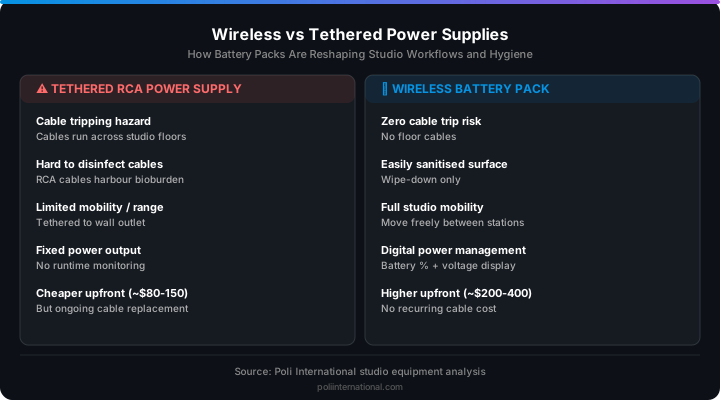
The shift from tethered RCA power supplies to wireless battery packs in tattoo equipment is not a trend. It is a structural change in how studios manage power, hygiene, and workflow. Walk into any major convention today, and you will see fewer cords dragging across workstations and more charging docks lining countertops. The engineering parallels to construction's corded-to-cordless shift are exact: same battery chemistries, same trade-offs in runtime versus weight. But tattooing has unique constraints, sterilization protocols, voltage precision, and long session duty cycles, that demand a harder look at what these systems actually deliver.
The technology: battery chemistry, voltage, and thermal limits
Most wireless packs use Li-ion or Li-Po cells. Li-Po offers a thinner form factor for better machine balance; Li-ion provides higher energy density and cycle life. Both operate at 5V to 12V with 2W to 10W output, adequate for most rotary machines. The real question is voltage stability under load.
Voltage sag, the drop when the motor draws current, separates good packs from bad. A pack reading 8V at idle that drops to 7.2V under a 4mm stroke at 120Hz produces inconsistent needle penetration. Premium packs from FK Irons and Bishop use digital regulation circuits that compensate in real time. Budget units from Dragonhawk and Mast use analog pass-through designs that drift as the battery depletes.
Thermal management is equally critical. A corded supply dissipates heat through its chassis, away from the work area. A battery pack sits on the machine, inches from the artist's hand and the client's skin. During sessions over three hours, internal temperatures can exceed 50°C, triggering throttling that reduces output. Artists doing full-day bookings report performance drops in the afternoon with packs lacking active cooling. Look for published maximum continuous discharge current and thermal shutdown thresholds, if the manufacturer doesn't list them, assume throttling.
The market: three tiers with different engineering philosophies
The wireless battery market has split into three distinct tiers, each with different priorities.
China-based brands, Dragonhawk and Mast dominate the budget and mid-range. Their packs use generic 18650 Li-ion cells, basic voltage regulation, and plastic housings. Prices range from $40 to $120. They work for short sessions but suffer voltage drift after 60-90 minutes of continuous use. The charging circuits are often unprotected, leaving a pack plugged in overnight degrades cell lifespan. For a solo artist doing occasional work, they are functional. For a high-volume studio, they are a liability.
Western premium, FK Irons and Bishop have built complete ecosystems. FK Irons uses proprietary cell packs with digital displays and hot-swap capability. Bishop's Power Wand line uses a magnetic mount that allows pack swaps in under two seconds. Both use high-discharge cells rated for 15A to 20A continuous current, eliminating voltage sag under heavy shading. Prices run $200 to $400 per pack. The trade-off is vendor lock-in: you cannot use a Bishop pack on an FK Irons machine without an adapter, and adapters introduce resistance.
German precision, Cheyenne integrates the battery into the machine body rather than using detachable packs. This improves balance but means sending the entire machine for battery replacement after 300-500 cycles. Cheyenne's packs use medical-grade protection circuits and are tested to IEC 62133 standards, rare in this market.
Studio and safety implications: hygiene protocols meet electrical engineering
Removing the RCA cord eliminates a documented contamination vector. Cords drag across floors, catch in chair casters, and collect blood and ink spatter. Wireless packs remove that path. But the packs themselves are not autoclavable. Every unit on the market requires barrier film wrapping for each client. The plastic housing, display screen, and charging contacts cannot survive steam sterilization. Any battery pack used clinically must be wrapped in single-use barrier film covering all exposed surfaces, including the charging port.
IP ratings matter. A pack rated IP54 is protected against splashing water and dust, it withstands routine cleaning with disinfectant wipes. A pack with no IP rating should not be in a studio. If the manufacturer doesn't publish one, assume the pack will fail if cleaning solution enters the housing.
Multi-artist studios need charging infrastructure. A full-time artist doing four sessions daily needs at least two packs per machine. For a six-artist studio, that is twelve packs plus a centralized charging station with overcurrent protection and individual cell monitoring. Daisy-chaining USB-C chargers on a power strip is a fire risk. Install a dedicated charging cabinet with thermal monitoring and automatic shutoff.
What to look for: certifications, weight, and real-world runtime
Ignore marketing language about "smart technology." Look for three things.
First, certifications. IEC 62133 means the pack passed international safety testing for cell construction, overcharge protection, and short-circuit prevention. UL 2054 is the US equivalent. CE marking indicates compliance with EU safety directives. If a pack lists none of these, it has not been independently tested. Do not use it professionally.
Second, weight balance. A battery pack adds 80-150 grams to the machine. Where that weight sits determines hand fatigue. Top-heavy packs strain wrist extensors within two hours. Look for packs mounted low on the machine body or integrated into the grip. Bishop's magnetic system and Cheyenne's integrated designs score well. Stick-style packs extending above the motor housing score poorly.
Third, real-world runtime at load. Manufacturer claims of "8 hours" are measured at low voltage with minimal needle contact. A realistic test: runtime at 8V with a 3mm stroke at 100Hz. Premium packs deliver 4-5 hours. Budget packs deliver 2-3 hours. Plan charging accordingly.
FAQ
Can I sterilize a battery pack in an autoclave?
No. Battery packs contain lithium cells and circuit boards that cannot withstand 121-134°C autoclave temperatures. Use single-use barrier film wrapping for each client, covering all exposed surfaces including the charging port. Replace immediately if punctured.
How many battery packs does a full-time artist need?
Two per machine minimum, one in use, one charging. For back-to-back sessions without gaps, three per machine. Always keep a wired power supply as backup.
What is the most important safety certification?
IEC 62133 for international use, UL 2054 for the US. These test for cell overcharge, external short circuit, and thermal runaway. Do not use an uncertified pack in a professional studio.
References
- International Electrotechnical Commission. (2017). IEC 62133-2:2017 - Secondary cells and batteries containing alkaline or other non-acid electrolytes. Geneva, Switzerland.
- Underwriters Laboratories. (2021). UL 2054 - Standard for Household and Commercial Batteries. Northbrook, IL.
- European Committee for Standardization. (2023). CE marking requirements for battery-powered medical devices. Brussels, Belgium.
- FK Irons. (2025). FK Irons Battery Pack Technical Specifications. Los Angeles, CA.
- Bishop Tattoo Supply. (2025). Power Wand Ecosystem Engineering Brief. Las Vegas, NV.
- Cheyenne Tattoo. (2025). Cheyenne Battery System Certification Documentation. Berlin, Germany.
- Centers for Disease Control and Prevention. (2023). Guide to Infection Prevention for Outpatient Settings: Environmental Infection Control. Atlanta, GA.