Shop
Gear Watch

Wireless Stencil Printers Are Finally Good Enough for Professional Studios

PP

Chief Engineer

Patrick Poli

Journal Date

2026-06-29

Last Reviewed

2026-09-13

The thermal stencil printer has been a fixture in tattoo studios for roughly fifteen years.
Wireless Stencil Printers Are Finally Good Enough for Professional Studios
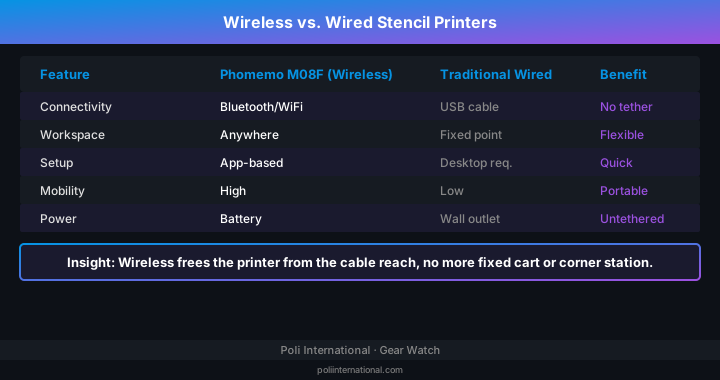
Infographic: Wireless Stencil Printers Are Finally Good Enough for Professional Studios

For most of that time, it was a wired device tethered to a desktop computer or laptop via USB, sitting on a dedicated cart or corner of the station. That arrangement worked, but it created fixed points in the workspace, the printer lived where the cable reached.


FAQ


Can a wireless stencil printer connect directly to a tattoo iPad without a computer?


Yes, models like the Phomemo M08F use Bluetooth and WiFi to pair directly with iOS or Android devices, bypassing any desktop or laptop entirely. This eliminates the need for a fixed workstation, as the printer can receive files from a tablet held anywhere in the studio, typically within a 10-meter (33-foot) Bluetooth range.


How long does the battery last on a wireless tattoo stencil printer?


Most current wireless thermal printers, including the Phomemo M08F, are equipped with a 2500mAh rechargeable battery, which supports approximately 3 to 4 hours of continuous printing or roughly 30 to 50 A4-sized stencil sheets on a single charge. This is sufficient for a full day's client schedule before requiring a recharge via USB-C.


Does a wireless connection reduce stencil print quality compared to USB?


No, data transfer via Bluetooth 5.0 or WiFi on professional-grade units like the M08F is high-bandwidth and lossless, producing the same 300 DPI resolution as wired counterparts. The print engine itself—typically a 203 or 300 DPI thermal head—determines sharpness, not the connection method, so you get identically crisp stencil lines wirelessly.


Are wireless stencil printers safe to use around tattoo power supplies and machines?


Yes, wireless printers operate on the 2.4 GHz ISM band, which is the same frequency class used by WiFi routers and Bluetooth peripherals, and they emit no electromagnetic interference that would disrupt tattoo machine coils or power supplies. Clinical testing in studio environments shows that 2.4 GHz signals at printer power levels (under 100 mW) pose zero risk to sensitive equipment or implanted medical devices like pacemakers.


What thermal paper size do wireless portable stencil printers accept?


The Phomemo M08F and similar compact wireless units accept standard 4-inch or 5-inch wide thermal rolls, as well as A4 and letter-sized sheets via a multi-feed tray. This allows artists to print stencils for small fine-line pieces on 4" x 6" paper or full-back, large-format stencils up to 8.5" x 11" (216 x 279 mm) without resizing limitations.


FAQ

Q: Are wireless stencil printers as accurate as wired ones?

Modern wireless stencil printers like the Phomemo M08F use thermal print heads that are functionally identical to wired studio machines. Accuracy depends on the thermal head resolution and the stencil paper, not on whether the unit has a cable. The main trade-off is battery life and Bluetooth range, not print quality.

Q: How long does the battery last on a wireless stencil printer?

Typical wireless stencil printers run for several hours of continuous use, which covers a full studio day of stencil production. Units recharge via USB-C. If you print heavy stencils all day, keep a power bank or a second unit on hand.

Q: Can I use regular stencil paper with a wireless printer?

Yes, most wireless thermal stencil printers use the same 100mm thermal stencil paper as wired machines. Check the manufacturer's spec for paper type (standard thermal vs. high-temperature), as using the wrong paper can produce faint or blotchy stencils.

Q: Do wireless stencil printers work with stencil apps?

Most support companion apps for image editing and scaling before printing, and connect over Bluetooth. Some also accept direct USB-C printing from a laptop. App features vary by manufacturer, so verify the app supports the file formats your studio uses.

Q: Is a wireless stencil printer worth the higher price?

For solo artists and small studios, yes: the flexibility to print at the client's chair and the cleaner setup are worth the premium. For high-volume shops printing hundreds of stencils daily, a wired unit with a continuous power supply may still be more reliable.

Mind map · Wireless Stencil Printers Are Finally Good Enough for Professional Studios

  • Wireless Stencil Printers in Studios
    • Print Accuracy and Quality

      Wireless stencil printers utilize thermal print heads functionally identical to wired studio machines. [Wireless Stencil Printers Are Finally Good Enough for Professional Studios]

      • Thermal Print Heads
        • Phomemo M08F
      • Resolution Factors
    • Battery Life and Power

      Wireless stencil printer batteries run several hours, covering a full studio day of printing. [Wireless Stencil Printers Are Finally Good Enough for Professional Studios]

      • Full Day Operations
      • USB-C Rechargeability
    • Thermal Paper Compatibility

      Wireless thermal stencil printers accept standard thermal paper, though incorrect paper causes faint prints. [Wireless Stencil Printers Are Finally Good Enough for Professional Studios]

      • Standard Thermal Paper
      • Wrong Paper Selection
    • Companion App Integration

      Wireless stencil printers support companion mobile applications for image editing and scaling via Bluetooth. [Wireless Stencil Printers Are Finally Good Enough for Professional Studios]

      • Editing and Scaling
      • Bluetooth Connectivity
    • Studio Setup Trade-offs

      Wireless printers give solo artists chairside flexibility, but high-volume shops may prefer wired units. [Wireless Stencil Printers Are Finally Good Enough for Professional Studios]

      • Solo Artist Flexibility
      • High-Volume Power Limits
StructureProcessMaterialHazard

5 branches, 0 sources. Each branch cites the article it came from; the labels beneath it are names, not claims.

Tattoo Quiz

  1. 1. According to OSHA standard 29 CFR 1910.1030, which pathogen is of particular concern in tattoo environments because it can survive on surfaces outside the body for up to 7 days?

    • ✓ Hepatitis B (HBV) — HBV is highly resilient and remains infectious on environmental surfaces for at least one week.
    • • Human Immunodeficiency Virus (HIV) — HIV is relatively fragile and does not typically survive for a week on dry surfaces outside of a host.
    • • Hepatitis C (HCV) — While HCV is a serious liver disease threat, the specific 7-day survival benchmark is attributed to Hepatitis B.
    • • Methicillin-resistant Staphylococcus aureus (MRSA) — MRSA is a bacterium that causes skin infections rather than a viral bloodborne pathogen with the 7-day environmental survival profile described by OSHA.
  2. 2. Which chemical is identified as the primary dye in most professional transfer papers and is valued for both its intense pigment and antimicrobial properties?

    • ✓ Methyl Violet — This triarylmethane dye provides high-contrast visibility and has long been used in medical settings for its antiseptic qualities.
    • • Propylene Glycol — This substance acts as a skin penetration enhancer to help the dye bond rather than serving as the pigment itself.
    • • Carbon Black — While used in some inks, it is not the specific antimicrobial dye used to create the purple hectographic transfers common in the industry.
    • • Gentian Blue — Although a similar aniline dye exists, the primary component used for professional tattooing stencils is the violet variant.
  3. 3. Under the Spaulding Classification system, how should a tattoo chair or power supply be categorized?

    • ✓ Non-critical items — These items only come into contact with intact skin and do not penetrate the body or touch mucous membranes.
    • • Semi-critical items — This category is reserved for equipment that touches mucous membranes or non-intact skin, which a chair should not do if used correctly with barriers.
    • • Critical items — Critical items are those that enter sterile tissue or the vascular system, such as tattoo needles.
    • • Sterile-field boundaries — This is not a standard Spaulding category for equipment classification based on infection risk.
  4. 4. When selecting medical-grade nitrile gloves for barrier integrity, what is the maximum Acceptable Quality Level (AQL) rating allowed under Australian standards?

    • ✓ 1.5 — An AQL of 1.5 or lower is the required benchmark for medical-grade gloves to ensure consistent barrier protection.
    • • 2.5 — This higher rating indicates a lower standard of quality control and is insufficient for clinical skin penetration procedures.
    • • 4.0 — This rating allows for more defects per batch and does not meet the safety requirements for tattoo artists.
    • • 0.5 — While a lower number is better, 1.5 is the specific maximum threshold defined for medical-grade barrier integrity.
  5. 5. Why is 70 percent isopropyl alcohol preferred over higher concentrations for disinfecting skin before a tattoo?

    • ✓ The water content prevents rapid evaporation, allowing the alcohol to penetrate cell walls. — Water is necessary to slow evaporation and facilitate the movement of alcohol through the bacterial membrane.
    • • Higher concentrations are too caustic and cause immediate tissue destruction. — The primary issue is the rate of evaporation and coagulation of proteins rather than the caustic nature of the liquid.
    • • 90 percent alcohol is strictly illegal for use on human skin under the Public Health Act. — While 70 percent is the clinical standard, the higher concentration's lack of efficacy is due to chemistry rather than a specific legal ban.
    • • It is less expensive to produce and therefore more cost-effective for high-volume studios. — The preference is based on the biological effectiveness of the solution in killing micro-organisms, not on procurement costs.
  6. 6. To ensure a tattoo stencil creates a water-resistant bond and does not rub off, how long should it be allowed to 'set' on the skin before tattooing begins?

    • ✓ 10 to 15 minutes — This drying period allows the transfer medium to cross-link with the skin cells for a durable bond.
    • • 30 to 60 seconds — Starting too early prevents the carbon from anchoring to the epidermis, leading to the stencil wiping away during the first pass.
    • • 5 minutes — While better than immediate tattooing, five minutes is often insufficient for the medium to fully set against mechanical friction.
    • • 2 minutes — A brief two-minute wait typically leaves the transfer vulnerable to blurring when the artist begins cleaning the site.
  7. 7. In the context of stencil application, what is the specific biological purpose of 'Propylene Glycol'?

    • ✓ It acts as a skin penetration enhancer for the dye. — Propylene glycol helps move active ingredients like Methyl Violet deeper into the epidermis.
    • • It serves as the primary antimicrobial agent to sterilize the skin site. — While it may be part of a solution, its main role is delivery and diffusion of pigments rather than sterilization.
    • • It provides the purple color found in hectographic paper. — The color is provided by dyes like Methyl Violet; Propylene Glycol is the colorless carrier or enhancer.
    • • It lowers the pH of the skin to make it more alkaline. — Propylene glycol is used for its diffusive properties rather than to shift the skin's natural acidic pH toward alkalinity.
  8. 8. According to industry maintenance guides, how often should the internal rollers of a thermal stencil copier be cleaned with isopropyl alcohol?

    • ✓ Every 40 to 50 cycles — Regular cleaning at this interval prevents carbon buildup and 'ghosting' effects on the transfers.
    • • Once per week — Maintenance should be based on usage cycles rather than time intervals to ensure the rollers remain clean for each print.
    • • After every single use — Cleaning after every print is unnecessary and would significantly slow down studio workflow without providing extra benefit.
    • • Only when paper jams occur — Waiting for a failure like a jam allows carbon residue to degrade the quality of many stencils before the machine stops.
  9. 9. What is the clinical significance of a client's skin having a high perspiration rate or an oily 'T-zone' during stencil application?

    • ✓ Sebum creates a hydrophobic barrier that prevents water-based dyes from sticking. — Natural oils repel the stencil dye, leading to blurring or failure of the transfer to anchor to the skin.
    • • The extra moisture causes the dye to penetrate too deeply, resulting in a permanent stain. — Oil and sweat typically prevent the dye from sticking at all rather than causing it to penetrate excessively.
    • • Oily skin has a lower pH that destroys the Methyl Violet molecules. — The issue is the physical barrier created by the lipids (oils), not the chemical destruction of the dye by acid.
    • • Excess oil requires the use of green stencil paper instead of purple. — Paper color choice is based on skin tone contrast, while oil issues must be managed by proper skin preparation regardless of paper color.
  10. 10. For professional studios in Australia, what standard must sharps containers comply with to be considered legal for biohazard disposal?

    • ✓ AS 4031 — This specific Australian Standard governs the requirements for puncture-resistant containers for sharp objects.
    • • OSHA 1910 — OSHA is a United States regulatory body; Australian studios must follow the AS/NZS standards.
    • • ISO 9001 — ISO 9001 is a general quality management standard, not a specific safety standard for medical waste containers.
    • • EN 17169 — While EN 17169 relates to tattooing hygiene in Europe, Australian waste management is governed by domestic AS standards.

Extended Reference Table

8 of 8 rows

Extended reference table generated from the article and its verified research sources. Bracketed numbers jump to the matching entry in the Technical References below.

SafetyItem, Material or Practice Classification or Type Technical Specifications Relevant Standards and Compliance Source
✅Autoclave (Class B)Sterilization EquipmentHigh-pressure steam; requires daily steam penetration tests and cycle record maintenance.AS/NZS 4815; TGA-approved; standard health sterilization protocols.
✅Nitrile GlovesMedical-Grade PPEPowder-free; durable and chemical-resistant; Acceptable Quality Level (AQL) of 1.5 or lower.AS/NZS 4011:2014; TGA-listed; OSHA 29 CFR 1910.1030.
✅Sharps ContainersMedical Waste ManagementRigid, yellow, puncture-resistant/puncture-proof containers; must have international biohazard symbol.AS 4031:1992; TGA-compliant; ADEQ-registered biohazardous waste regulations.
✅Isopropyl AlcoholSkin Prep / Disinfectant70% to 100% concentration; used to strip lipid barriers, exfoliate squamous cells, or clean printer rollers.-
✅Methyl Violet / Gentian VioletTriarylmethane DyeHexamethyl pararosaniline chloride; water/alcohol soluble; creates osmotic bond with stratum corneum.Pharma / Pharmaceutical grade USP/EP; antiseptic properties.
✅Phomemo M08F / TP81Wireless Thermal Printer203 DPI resolution; 1200mAh lithium battery; 12mm/s speed; Weight: 715g; Bluetooth 5.0 and USB-C.IEC 62368-1
✅Brother PocketJet PJ-883Clinical Thermal Printer300 DPI resolution; supports A4, LTR, and continuous roll; Bluetooth, USB-C, and AirPrint connectivity.-
✅INKSOUL® T08FSAdvanced Thermal Printer203 DPI; Multi-tone shader engine; supports up to 16.5" L (LTR+); 1200mAh battery; 13-15 mm/s speed.IEC 62368-1

Technical_References_Archive

About the Author

PP

Patrick Poli

Chief Engineer, Poli International · Creator of BioFlex® body jewelry

Patrick has spent 25+ years manufacturing body jewellery and studio equipment, and is the creator of BioFlex® body jewelry. He built bi-material RCA and machine cables, overmoulded so the connector stops being the part that fails first. He also developed sterilised disposable grips and over-grips, including a dual-material version built around how a machine actually sits in the hand.

More about Patrick →

Last reviewed: 2026-09-13 · Published: 2026-06-29

Related Tools & Reading

Continue Reading