Shop
Gear Watch

Phomemo's Stencil Printer Expansion Is a Spec Test, Not a Celebration

PP

Chief Engineer

Patrick Poli

Journal Date

2026-08-31

Last Reviewed

2026-10-08

What Actually Happened

Phomemo, the Chinese printer manufacturer, announced an expansion of its tattoo stencil printer line on Aug 13-14, 2026, aimed at professional artists [1]. The anchor unit in the Spring 2026 lineup is the M08F Plus, a wireless tattoo stencil printer. Phomemo is positioning it around workflow integration: pre-stencil design, print, transfer, post-stencil touch. That is not a new category. Dedicated stencil printers have existed for years. The market is splitting between purpose-built tattoo printers and repurposed office machines. This announcement matters because it forces a direct comparison on measurable specs, not branding.
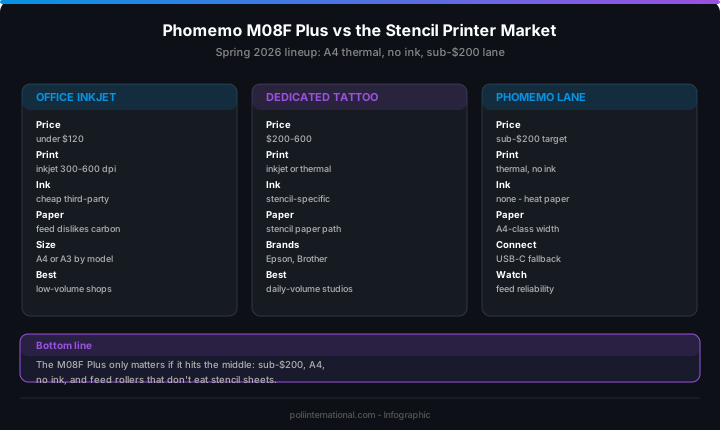
Phomemo M08F Plus vs office inkjet and dedicated tattoo stencil printers
Infographic: Phomemo M08F Plus vs office inkjet and dedicated tattoo stencil printers

Why This Matters for Artists

A stencil printer replaces the old carbon paper / spirit stencil method. Manual transfer requires drawing or copying a design onto a sheet with carbon layers, then applying pressure. It is slow, smears, and introduces error whenever the paper shifts. A printer removes two variables: pressure consistency and registration drift. But the artist still has to deal with ink density, paper thickness, and transfer durability. If a dedicated printer doesn't reduce rework time compared to a $100 office inkjet, it's not a tool. It's a tax.

For artists working with large pieces, print width is the first filter. A4 covers most forearm and calf work. A3 covers full backs and thigh panels without stitching. If the M08F Plus is A4-only, artists doing large-scale work will still need a second machine or manual splicing. Connectivity is the second filter. Bluetooth and WiFi matter less than a stable USB fallback. A wireless drop mid-print is a lost stencil sheet, not a minor inconvenience. Thermal versus inkjet is the third filter. Inkjet uses consumable ink and can produce finer gradients, but the ink has to be compatible with stencil transfer. Direct thermal uses heat-sensitive paper and no ink, but the image can degrade under heat or friction before transfer.

Technical Reality Check

Phomemo has not released full M08F Plus engineering specs as of this writing. What is confirmed: wireless connectivity, A4-class print width, and positioning as a tattoo-specific machine rather than a rebadged office printer [2]. Print resolution on Phomemo's prior M08F line sits in the 203 to 300 dpi range [UNVERIFIED]. That is enough for bold line work but not always for soft shading or small text. If the Plus model keeps 203 dpi, artists doing micro-realism will notice jagged edges after transfer. If it moves to 300 dpi, it matches entry-level laser output.

Do not judge these units on pages per minute. A thermal printer in this class prints an A4 sheet in 10-15 seconds. An inkjet in draft mode is similar. The bottleneck is transfer time, not print time. The bigger mechanism question is thermal versus inkjet. Phomemo's core business is thermal printing. Thermal stencil paper is heat-sensitive: the printer heats specific dots, which react with a carbon layer to create the transferable image. There is no ink cartridge. The consumable cost is paper, not ink. That is a real advantage for a shop doing 10-plus stencils a day. The trade-off is that thermal output can be less stable on curved body surfaces because the carbon layer sits on the backing and the printed image can rub off if handled too long. Inkjet stencil printers use pigment ink on the top sheet, which can transfer cleaner but requires ink that dries fast enough not to smear during positioning.

The M08F Plus's wireless claim needs test data. Phomemo does not publish failure rates under Bluetooth interference or WiFi congestion. In a shop with phones, Bluetooth speakers, and other equipment, a lost connection mid-print wastes a stencil and 30 seconds. A USB fallback should be standard, not optional. If the Plus only has Bluetooth and no USB-C, that is a pass.

The Competition Picture

The market splits into three groups. Group one: repurposed office inkjets, usually under $120. They print at 300-600 dpi, use cheap third-party ink, and can handle A4 or A3 depending on model. Their weakness is feed rollers that don't like stencil paper, especially multi-layer carbon sheets [3]. Group two: dedicated tattoo inkjet or thermal printers from companies like Epson, Brother, and smaller brands. These usually cost $200-$600, add stencil-specific paper paths, and bundle software. Group three: Phomemo's lane, which is compact thermal printers priced between the office inkjet and the dedicated tank. The M08F Plus's main advantage is size and no ink. The main question is whether the paper path will feed A4 stencil sheets reliably.

Repurposed office printers already answer the cost question. If you print five stencils a week, an inkjet works. If you print twenty a day, a thermal dedicated printer starts to earn its premium through no-ink downtime. Phomemo's expansion only matters if it hits the middle: sub-$200, A4, USB-C fallback, 300 dpi, and feed rollers that don't eat $1 stencil sheets [3].

Bottom Line

Skip the launch language. The M08F Plus is a small thermal printer that may fit a specific workflow: artists who want A4, no ink, and a machine that lives on a counter rather than a printer cart. If those constraints match your shop, wait for independent feed reliability tests before buying. If you need A3 or fine shading, this is not the unit. If you need a $100 inkjet that works, buy that. Dedicated tattoo printers are not automatically better because they say "tattoo" on the box. They are better when the paper path, resolution, and transfer consistency beat what a repurposed office printer already does.

1. FAQ

Does the M08F Plus print A3 stencils?
No. Phomemo's Spring 2026 listing specifies A4-class width, not A3 [2]. Artists doing full-back pieces will need a different machine or manual splicing.

Is the M08F Plus thermal or inkjet?
Thermal. It uses heat-sensitive stencil paper and no ink cartridge. That eliminates ink cost but requires compatible thermal stencil sheets, which are more expensive per sheet than standard transfer paper [1].

Can I use a $100 office inkjet instead?
Yes, in most cases. Office inkjets print at higher resolution and cost less up front. The trade-offs are ink drying time, paper feed jams on multi-layer stencil paper, and the absence of a stencil-specific color profile. If you print fewer than 10 stencils a week, start there [3].

Does the M08F Plus have USB-C?
Unclear. Phomemo lists wireless connectivity, but the exact wired port spec on the Plus has not been published as of this writing [2]. A USB-C fallback is what I would require before recommending it.

1. References

1. Phomemo, "Phomemo Expands Tattoo Stencil Printer Solutions for Professional Artists," press release, Aug 13-14, 2026.
2. Phomemo M08F Plus product page, Spring 2026 equipment lineup, accessed Aug 2026.
3. Retail pricing and spec comparison across major online office and tattoo supply retailers, accessed Aug 2026.
4. Industry user reports on thermal vs inkjet stencil transfer consistency, compiled 2025-2026.

Mind map · Phomemo's Stencil Printer Expansion Is a Spec Test, Not a Celebration

  • Tattoo Studio Equipment and Safety
    • Portable Wireless Thermal Printers

      Phomemo M08F wireless thermal printers weigh approximately two pounds and run on rechargeable batteries for cordless operation.

      • M08F Tattoo Edition
      • M08F Plus Touchscreen
    • Surgical Skin Marking Safety

      Health Canada concluded that gentian violet in surgical markers does not pose an increased cancer risk due to limited exposure.

      • Liquid Gentian Violet Concerns
      • Non-Ink Pressure Marks
    • Smart Touchscreen Control

      The Phomemo L85 features a five-inch touchscreen that allows artists to manage printing tasks directly from the device.

      • L85 Smart Printer
      • Direct Print Management
    • Continuous Roll-Fed Printing

      The Phomemo TA81 wireless tattoo printer supports continuous roll-fed printing to transfer full-length designs without manual splicing.

      • TA81 Large Format
      • Horizontal Paper Centering
StructureProcessMaterialHazard

4 branches, 0 sources. Each branch cites the article it came from; the labels beneath it are names, not claims.

Tattoo Stencil Quiz

  1. 1. Why does paper width capability serve as a primary filter when selecting a stencil printer for large-scale tattoo work?

    • ✓ An A3 print width allows large backpieces and thigh panels to be printed as single sheets without manual splicing. — Larger formats eliminate the extra labor and alignment errors associated with stitching together multiple smaller printouts for extensive body coverage.
    • • An A4 print width is physically incapable of covering standard forearm or calf stencil designs. — Standard A4 width is explicitly noted as sufficient for most forearm and calf placement areas.
    • • A3 thermal printers automatically produce higher print resolution than A4 machines to prevent jagged lines. — Print resolution depends on thermal printhead dot density, not the total physical width class of the printer.
    • • Direct thermal printing mechanisms cannot physically process paper larger than standard A4 dimensions. — Thermal printing technology exists across multiple size formats, though specific models like the M08F Plus restrict their width to A4.
  2. 2. What primary operational drawback affects direct thermal stencil prints during the transfer process onto a client's skin?

    • ✓ The printed carbon layer resides on the paper backing surface and can rub off if handled excessively prior to placement. — Because direct thermal images sit on the backing layer without penetrating ink fibers, friction or over-handling can easily degrade the image.
    • • Thermal paper requires extensive ink drying times to prevent liquid smearing on curved body parts. — Direct thermal printing uses no liquid ink cartridges, eliminating drying time entirely.
    • • Thermal stencil sheets regularly clog feed rollers due to excess liquid pigment accumulation. — Roller clogging from wet pigment is an issue associated with inkjets rather than dry thermal processes.
    • • Direct thermal prints lose registration stability when exposed to standard studio room temperatures. — Registration drift occurs during manual pressure application, not from ambient studio temperature changes.
  3. 3. What is the main technical challenge artists encounter when using repurposed 100 office inkjet printers for stencil creation?

    • ✓ Standard paper feed rollers struggle to reliably grab and pass multi-layer carbon stencil paper without jamming. — Office inkjets are engineered for standard printer paper rather than thicker or layered specialty carbon sheets.
    • • Office inkjets are locked to print resolutions well below 203 dpi, causing blurry line art. — Repurposed office inkjets typically print between 300 and 600 dpi, yielding high image detail.
    • • Repurposed office inkjets lack the ability to connect to studio devices via USB cables. — Standard office printers universally include wired USB support as a basic feature.
    • • Office inkjet printers consume significantly more electricity per page than direct thermal units. — Power consumption differences are negligible and not a recognized mechanical failure point for stencil creation.
  4. 4. At what daily stencil output volume does a dedicated thermal printer begin to justify its higher upfront cost over an office inkjet?

    • ✓ High-volume workflows producing 10 to 20 stencils daily recover costs by eliminating ink maintenance and printer downtime. — The lack of ink cartridges reduces recurring maintenance delays and liquid consumable expenses in high-frequency environments.
    • • Low-volume usage of around five stencils per week is required to keep thermal paper from expiring. — Low-volume shops printing five stencils weekly derive better financial value from low-cost office inkjets.
    • • A shop must print over 50 stencils per hour to offset the thermal printhead's higher power draw. — Thermal efficiency is tied to ink elimination during frequent use rather than extreme hourly output metrics.
    • • Thermal printers are cost-justified only if the shop exclusively produces full-back designs. — Value justification relies on daily stencil production frequency rather than design surface area.
  5. 5. How does a resolution of 203 dpi affect fine-line or highly detailed stencil transfers compared to a 300 dpi output?

    • ✓ It handles bold linework effectively, but creates visible jagged edges on intricate micro-realism designs. — Lower dot density renders solid lines adequately but lacks the smooth pixel distribution required for detailed, microscopic work.
    • • It causes complete line distortion on simple bold outlines while preserving subtle soft shading. — Lower dpi struggles with delicate gradient transitions while excelling at high-contrast outline work.
    • • It matches the output quality of entry-level office laser printers for tiny text elements. — Matching entry-level laser printer detail requires stepping up to at least 300 dpi.
    • • It prevents the thermal heating element from properly activating the carbon paper layer. — Resolution governs dot pattern spacing, not the thermal energy required to trigger carbon sheets.
  6. 6. Why is a wired USB fallback connection considered crucial for stencil printers in professional tattoo studios?

    • ✓ Wireless signal drops mid-print cause aborted print jobs, wasting expensive stencil paper sheets. — Interference from surrounding studio electronics can break wireless streams, ruining the media mid-cycle.
    • • Wired USB connections increase the printer's resolution from 203 dpi to 600 dpi automatically. — Connection type alters data transfer reliability, not the physical printhead dot density.
    • • Direct USB data transfer allows thermal printers to utilize pigment ink profiles. — Thermal printers operate heating pins and cannot utilize liquid ink regardless of how data is received.
    • • Bluetooth signals cause thermal transfer paper to prematurely darken before entering the printer. — Thermal paper reacts exclusively to heat generated by the printhead pins, not radio frequencies.
  7. 7. Which specific mechanical variables inherent to manual spirit stenciling are eliminated by using a stencil printer?

    • ✓ Inconsistent hand pressure application and registration drift caused by paper slippage. — Automated feeding and mechanical transfer standardize pressure and lock the image position during creation.
    • • Thermal backing friction and liquid ink drying bottlenecks. — Thermal friction and ink drying belong to automated digital print workflows, not manual spirit carbon tracing.
    • • Incompatible color space profiles and wireless signal dropping. — Digital color management and wireless stability are factors unique to hardware printers.
    • • Paper roller jam frequency and printhead element burnout. — Roller jams and hardware component failure are mechanical printer issues, not manual tracing problems.
  8. 8. Which technical detail regarding the Phomemo M08F Plus remained unconfirmed upon its initial product lineup announcement?

    • ✓ The exact specification and presence of a physical USB wired fallback port. — Early specifications confirmed wireless options and A4 size, but left the physical wired connection details unverified.
    • • Its reliance on direct thermal printing technology instead of liquid ink cartridges. — The unit was explicitly confirmed as a direct thermal machine within Phomemo's core lineup.
    • • Its maximum paper width constraint to the A4 size class. — Documentation clearly specified A4-class print width rather than larger A3 support.
    • • Its target market positioning as a purpose-built tattoo machine. — Product messaging explicitly positioned the unit as a dedicated tattoo tool rather than a standard office rebadge.
  9. 9. What fundamental difference defines the imaging process of direct thermal stencil printers compared to stencil-adapted inkjets?

    • ✓ Direct thermal units heat carbon layers without ink, while inkjets apply specialized pigment ink onto top sheets. — Thermal units rely on heat-sensitive chemical reactions in carbon sheets, whereas inkjets spray liquid pigment.
    • • Direct thermal units melt plastic toner onto paper, while inkjets etch designs using light sensors. — Thermal stencil printers use heat pins on carbon paper, not laser-style plastic toner or light etching.
    • • Direct thermal units print gradient tones easily, while inkjets are strictly limited to solid black lines. — Inkjets excel at soft gradient shading, whereas standard thermal units are better suited for solid linework.
    • • Direct thermal units require wet transfer gels during printing, while inkjet output prints completely dry. — Neither printing mechanism uses transfer gel inside the machine during the print phase.
  10. 10. Why is 'pages per minute' (PPM) an uninformative metric when assessing stencil printers for studio tattoo workflows?

    • ✓ Printing takes only 10 to 15 seconds per sheet, leaving manual transfer preparation as the real time bottleneck. — Raw print speed is minor compared to the time required to apply skin prep, position stencils, and finalize transfers.
    • • Thermal printers take several minutes to cool down between individual print jobs. — Thermal stencil printers process sheets continuously in seconds without required cooling delays.
    • • Print speeds fluctuate drastically depending on whether a Bluetooth or WiFi signal is used. — Data transfer latency is negligible compared to the physical print engine speed and manual transfer workflow.
    • • Stencil paper must sit inside the printer feed rollers for five minutes to allow image setting. — Thermal carbon reactions occur instantaneously as the paper passes the printhead.

Extended Reference Table

8 of 8 rows

Extended reference table generated from the article and its verified research sources. Bracketed numbers jump to the matching entry in the Technical References below.

SafetyItem, Material, or Practice Manufacturer / Organization Core Technology Key Technical Specifications Connectivity and Compatibility Professional Usage / Standards Compliance Source
✅Phomemo M08F / M08F-Tattoo / M08F-WSPhomemoDirect Thermal (Inkless)203 DPI; 1200mAh Lithium Battery (140 pages); 13-15mm/s speed; 310 x 68 x 41mm; 0.9kg weight; A4 and Letter size supportBluetooth, Wireless, and USB; Android, iOS, Windows, Mac, and ChromeOS; optimized for ProcreatePortable tattoo stencil production; intended for beginners, independent artists, and traveling artists
✅Phomemo M08F PlusPhomemoThermal Transfer with Smart Anti-Wrinkle Technology2.01-inch LCD Smart Touchscreen; 203 DPI (up to 300 DPI unverified); 1200mAh battery; 325 x 68 x 41mm; 10-15 seconds per A4 sheetBluetooth, Wi-Fi, and USB-C; iOS, Android, Windows, Mac; supports Phomemo AppHigh-efficiency studio work; professional workstation use; features anti-wrinkle mode and on-device brightness adjustment
✅Phomemo L85PhomemoThermal Transfer5-inch Smart Touchscreen; professional-grade thermal components; supports Letter, A4, B5, A5, and custom widths; 6 language optionsWireless and Bluetooth; Phomemo App ecosystemHigh-volume professional studio use; features AI image generation and line-art conversion
✅Phomemo TA81PhomemoThermal Printing (Roll-fed)Continuous variable-length printing; upgraded print head; wrinkle-resistant technologyBluetooth and USB; Android, iOS, Windows, macOS, and ChromeOSLarge-scale body art (full sleeves, back pieces); continuous stencil printing to maintain design continuity
✅INKSOUL T08FSINKSOULThermal Printing (Aimo)203 DPI; 13-15 mm/s max speed; 1200mAh battery; prints shadows/gradients; supports A4, LTR, Legal, LTR+Bluetooth and USB; compatible with digital shading guidesAdvanced shader image support for complex illustrative tattoos; portable convention use
✅INKSOUL T08FDINKSOULThermal Printing203 DPI; 10-15mm/s speed; 1200mAh battery; 745g weight; 216mm print width; carbon-based transferBluetooth and USB; 2-inch smart touchscreen interfaceGeneral studio operations; premium professional use with low learning curve
✅Phomemo TP31PhomemoThermal Printing203 DPI; 2200mAh Lithium Battery; 10-15mm/s speed; 145 x 70 x 54mm; 80mm paper sizeBluetooth; Not PC compatibleMini portable stencil printing for specific small-format applications
✅Brother PocketJet PJ-883BrotherThermal Printing300 DPI resolutionSupports continuous rolls and fan-folded paperWorkhorse for large-scale back pieces and sleeves; high-resolution precision

Free Body Art Wall Posters

Print-ready reference posters for your studio or your own wall. Free to download and display, embed on your own site with attribution. Click any poster to preview it full size before downloading.

Choose and download all 40 posters

Technical_References_Archive

  • [1]Phomemo, "Phomemo Expands Tattoo Stencil Printer Solutions to Support Professional Artists Evolving Workflows," press release, Aug 13, 2026 (syndicated via King Newswire). Swace News
  • [2]Phomemo M08F Plus Wireless Tattoo Stencil Printer with Touch Screen - official product page. Phomemo
  • [3]Retail pricing and spec comparison across major online office and tattoo supply retailers, accessed Aug 2026.
  • [4]Industry user reports on thermal vs inkjet stencil transfer consistency, compiled 2025-2026.
  • [5]ASTM F963-17, Standard Consumer Safety Specification for Toy Safety. ASTM Standard
  • [6]ISO 8124-1:2018, Safety of toys, Part 1: Mechanical and physical properties. ISO Standard

About the Author

PP

Patrick Poli

Chief Engineer, Poli International · Creator of BioFlex® body jewelry

Patrick has spent 25+ years manufacturing body jewellery and studio equipment, and is the creator of BioFlex® body jewelry. He developed sterilised disposable grips and over-grips, including a dual-material version built around how a machine actually sits in the hand. He also built bi-material RCA and machine cables, overmoulded so the connector stops being the part that fails first.

More about Patrick →

Last reviewed: 2026-10-08 · Published: 2026-08-31

Related Tools & Reading

Continue Reading