Shop
Gear Watch

EO Sterilized Tattoo Needles: Blue Box

PP

Chief Engineer

Patrick Poli

Journal Date

2026-08-10

Last Reviewed

2026-10-11

Most tattoo artists under 35 have never sterilized a needle. That is not a lost craft; it is the product of a thirty-year shift in how tattoo equipment is manufactured, packaged, and sold. The company story behind that shift is worth studying, because the equipment decisions a studio makes today are built on it.

CAM Supply, founded in California in 1993 by Dennis Woo Sr., is a useful lens. Over three decades it introduced pre-sterilized needles, disposable tubes, and needle configurations that became industry standards. Now run with Dennis Woo Jr. alongside the founder, the company shows what happens when an equipment maker treats infection control as an engineering problem instead of a marketing slide. It is also a reminder that the disposables revolution was not inevitable. Someone had to design, validate, and ship it.

The disposables shift is the biggest safety change in tattoo equipment history

Before pre-sterilized needles reached the mainstream, the studio workflow was different: needles were bought loose, grouped by hand, mounted on bars, and sterilized on site in an autoclave. Done properly, that process works. Done sloppily, it does not. The problem is that everything depends on the artist or shop staff executing a validated cycle correctly, every single time, for years.

Pre-sterilized needles remove most of that variable. The needle arrives in a sealed pouch with a sterilization indicator and an expiry date. If the pouch is intact and the indicator has changed color, the product is sterile at the moment of opening. The shop no longer needs to prove its cycle worked; the manufacturer already did. The same logic pushed tubes toward disposability, eliminating the weakest link in the old workflow: cleaning, drying, and re-sterilizing hollow metal tubes where biofilm can survive a short cycle.
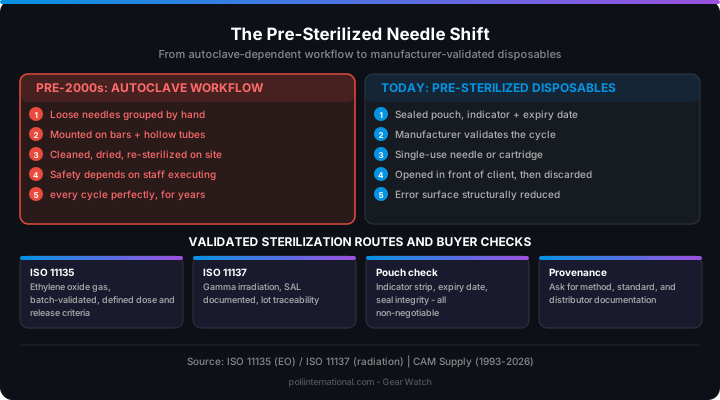
Pre-sterilized needles vs autoclave workflow comparison
Infographic: Pre-sterilized needles vs autoclave workflow comparison

How pre-sterilized needles are actually made

The engineering starts with the steel. Tattoo needles are drawn from stainless wire, typically 304 or 316L, ground to a taper, and grouped into configurations: round liner, round shader, magnum, flat, and their stacked variants. The taper geometry and the crimp that binds the group determine how ink is carried and deposited. Two machines can use identical packaging and deliver completely different results on skin.

Sterilization is where the standards matter. The two validated routes are ethylene oxide gas, governed by ISO 11135, and gamma irradiation, governed by ISO 11137. Both are batch-validated processes with defined dose, exposure, and release criteria. What you should look for is not the word "sterile" on the box but the evidence trail: a documented SAL (sterility assurance level), lot traceability, and a physical indicator that the pouch actually went through the process. A pouch with an expired date or a broken seal is not sterile, regardless of what the label says.

The cartridge revolution and the manufacturing landscape

The cartridge system compressed the whole assembly: needle, membrane, and tube in one disposable unit that clicks into a pen. It cut setup time, removed the needle bar, and made cross-contamination between clients structurally harder. CAM Supply's own line, from the CAM x Ami James cartridges to the Legend Premium G2 and SF Premier ranges, shows how far the format has come. The membrane, the part that keeps ink from traveling up into the machine, is the component that separates a good cartridge from a bad one.

The manufacturing geography has also shifted. The volume center for needles and cartridges is now Asia, with Chinese factories supplying much of the global market and Korean manufacturers leading wireless pen design. CAM Supply is the counterpoint: a California-based, family-run company that has kept engineering and artist collaboration in-house for three decades. The market needs both. The low-cost Asian supply chain democratized equipment; the legacy brands carry the validation history that buyers can audit.

What the shift means for studio workflow and hygiene

In practice, the disposables model simplifies compliance. The artist opens a sealed pouch in front of the client, uses the needle or cartridge once, and discards it into a sharps container. There is no tube to clean, no load to run, no log to keep for that item. That is a meaningful reduction in error surface, and it is why regulators and insurers have moved toward single-use equipment where it is practical.

The same philosophy applies to body jewelry. At Poli International we validate materials and single-use protocols rather than assume them, and the needle supply chain deserves the same scrutiny as implant-grade steel. If you cannot tell a client where a needle was made, how it was sterilized, and under which standard, you have a supply chain gap, not a purchase order.

What to check before you buy

First, the pouch: indicator strip, expiry date, and seal integrity are non-negotiable. Second, the standard: ask for the sterilization method and the governing ISO standard, and check that the distributor can document it. Third, the configuration: verify the grouping and taper match the work you do, and test a box on your own machines before committing to a brand. Fourth, compatibility: cartridge systems are not universal, so confirm the drive bar, membrane, and grip fit your pen model. Fifth, storage: needles and cartridges are sterile only if stored dry, away from heat and humidity, and used before expiry.

A pre-sterilized needle is not a magic bullet. It is a manufactured guarantee that the highest-risk part of the process arrives sterile and stays that way until you open it. That is a big upgrade over "trust the autoclave," and it is the standard that thirty years of equipment engineering has now made the baseline.

6. Reading the Box: EO Sterilization, Blue Box Needles, and What Suppliers Actually Sell

"Blue box tattoo needles with EO sterilization" is one of the most consistent search phrases landing on this page, and it tells me artists are trying to decode packaging claims rather than study manufacturing history. That is the right instinct. Ethylene oxide sterilization is the standard method for pre-sterilized tattoo needles and cartridges because it penetrates sealed blister packaging without melting the plastic components, unlike autoclave heat, which is why EO is specified on the box, not assumed. A valid EO indicator strip, a lot number, and an expiry date are the three things that separate a real sterile batch from a printed claim.

The "blue box" phrasing is largely a market shorthand, not a regulated standard. Colour-coded packaging varies by manufacturer and tells you almost nothing about sterility on its own. What matters is the sterilization method declared on the label, the presence of a chemical indicator, and whether the supplier can produce documentation on request. I have spent twenty-five years watching suppliers trade on packaging aesthetics while the actual compliance paperwork goes missing. Ask for the EO validation record before you reorder, a supplier who cannot produce it is telling you something.

A significant share of the queries reaching this article are not about needles at all, they are people trying to work out whether camsupply.com.cn, needlesupply.com and similar domains are beauty brands or legitimate tattoo supply houses. The honest answer is that domain names prove nothing. Many of these sites mix cosmetics, tattoo equipment and general beauty listings under one storefront, which makes brand identity impossible to verify from the homepage alone. Before buying, check whether the supplier publishes a physical address, a business registration, and a named sterilization standard. If the site cannot answer those three questions, treat the "pre-sterilized" claim as unverified regardless of how the box is coloured.

For studios, the practical rule is simple: buy from suppliers who can name their sterilization method, trace their batches, and answer a technical question without forwarding you to a sales team. That standard has not changed in thirty years, only the packaging has. For a closer look at how equipment and material decisions compound over a studio's lifetime, read our breakdown on body art safety standards before your next restock.

7. FAQ: Pre-sterilized needles and disposables

Q: Are pre-sterilized needles safe to use straight from the pouch?
Yes, if the pouch is intact, the sterilization indicator shows the correct color, and the expiry date has not passed. Those three checks are the entire protocol. If any fail, the item is not sterile and must not be used.

Q: Can a studio still safely autoclave reusable tubes?
Yes, if the cycle is validated and logged every time. The risk is not the autoclave itself; it is the consistency of cleaning, loading, and cycle execution over years of daily use. Disposable tubes remove that recurring human variable, which is why most studios have moved to them.

Q: How do I know a cartridge system is compatible with my tattoo pen?
Check the drive bar geometry, the membrane, and the grip fit against the manufacturer's compatibility list. Cartridge formats look similar but are not interchangeable across all pens, and a poor membrane seal can pull ink into the machine and ruin both the cartridge and the motor.

8. References

1. Tattoo Life, "CAM Supply: A story of innovation in service of tattooing," August 9, 2026.
2. CAM Supply, "About Us" - company history, founded 1993, product catalog (Legend G2, SF Premier, CAM x Ami James cartridges).
3. InkedMag, "Smart Tools for Skin Art," June 24, 2026.
4. ISO 11135 (sterilization of health care products, ethylene oxide) and ISO 11137 (sterilization by radiation) - validation standards.

Mind map · EO Sterilized Tattoo Needles: Blue Box

  • Why Pre-Sterilized Needles Became Standard
    • Autoclave Reprocessing Risks

      Manual autoclave operations introduce risk because safety depends on consistently executing a validated cycle over years of daily studio use.

      • Inconsistent Cleaning and Loading
        • Biofilm Survival in Tubes
      • Manual Autoclave Settings Error
        • Unvalidated Steam Cycles
    • Single-Use Disposable Advantages

      Pre-sterilized single-use needles reduce error surface and simplify regulatory compliance by eliminating on-site cleaning, drying, and autoclaving.

      • Simplified Regulatory Compliance
        • No On-Site Autoclave Logs
      • Reduced Human Error Surface
        • Consistent Factory Validation
    • Disposable Needle Cartridge Evolution

      Disposable cartridge membranes prevent cross-contamination by stopping ink and blood from traveling up into the tattoo machine.

      • Integrated Needle Membrane Units
        • Prevention of Fluid Backflow
      • Rapid Configuration Changes
        • Pen Grip Compatibility
    • Package Sterility Verification

      Tattoo needles are only guaranteed sterile if the pouch is sealed, the physical indicator is correct, and the expiration date has not passed.

      • Three Mandatory Inspection Checks
        • Intact Sealed Pouches
        • Sterilization Color Indicator Strip
        • Valid Unexpired Dates
StructureProcessMaterialHazard

4 branches, 0 sources. Each branch cites the article it came from; the labels beneath it are names, not claims.

Tattoo Sterilization Quiz

  1. 1. Which specific ISO standards govern the two validated sterilization routes for pre-sterilized tattoo needles?

    • ✓ ISO 11135 for ethylene oxide gas and ISO 11137 for gamma irradiation. — Ethylene oxide gas exposure and gamma irradiation are the two batch-validated sterilization routes governed respectively by ISO 11135 and ISO 11137 standards.
    • • ISO 11135 for gamma irradiation and ISO 11137 for ethylene oxide gas. — This option reverses the governing standards assigned to ethylene oxide gas processing and radiation processing.
    • • ISO 9001 for ethylene oxide gas and ISO 13485 for gamma irradiation. — These standards govern general quality management systems and medical device manufacturing quality rather than specific sterilization validation methods.
    • • ISO 17025 for chemical processing and ISO 14001 for radiation safety. — These standards relate to testing laboratory competence and environmental management rather than medical device sterilization protocols.
  2. 2. What critical hygienic function does the internal membrane serve within a tattoo needle cartridge system?

    • ✓ It prevents ink and fluid from traveling upward into the machine body and motor. — The membrane acts as a physical barrier that stops ink backflow, protecting the drive mechanism and reducing cross-contamination risks.
    • • It regulates the exact depth of needle taper penetration into the skin surface. — Taper depth and needle penetration are determined by needle geometry, tip design, and machine adjustment rather than the barrier membrane.
    • • It provides a visual physical indication that the unit underwent gamma irradiation. — Sterilization process validation is verified by the indicator strip on the outer pouch packaging rather than internal structural components.
    • • It maintains the structural temper and spring tension of the stainless steel wire. — Wire properties and spring tension depend on metal alloy selection and mechanical housing design rather than the fluid-barrier membrane.
  3. 3. Why did the tattoo industry shift away from the traditional workflow of cleaning and autoclaving reusable metal tubes in-studio?

    • ✓ Reusable tube reprocessing relies on human execution for cleaning, drying, and autoclaving, introducing recurring procedural variables. — Single-use disposables eliminate human operational variables in cleaning residual biofilm from narrow hollow tubes and executing validated autoclave cycles consistently over years.
    • • Stainless steel metal tubes warp and degrade structurally when subjected to autoclave steam heat. — High-grade stainless steel easily withstands repeated heat cycles, but internal bioburden and human procedural mistakes present infection risks.
    • • Metal tubes cannot hold liquid ink efficiently compared to modern molded plastic channels. — Metal tubes conduct ink effectively, but cleaning residual biofilm from narrow hollow metal interiors presents a recurring hygiene risk.
    • • Health regulators passed international bans forbidding the use of steam autoclaves in tattoo studios. — Autoclaving remains a valid process when logged and executed correctly, though regulators favor single-use equipment to simplify compliance.
  4. 4. Which three packaging checks must an artist verify on a pre-sterilized needle pouch prior to client use?

    • ✓ An intact pouch seal, a correct indicator color change, and an unexpired date. — These three packaging checks confirm that the product reached sterility and remained protected from environmental contamination up to the point of opening.
    • • A matched lot number, verified wire taper geometry, and correct drive bar length. — While mechanical compatibility is necessary for operation, these checks do not verify the sterile state of the needle inside the pouch.
    • • An ISO registration stamp, distributor invoice proof, and a signed studio log entry. — Administrative documentation supports supply chain audits but does not confirm the immediate sterility of an individual opened package.
    • • Proper membrane tension, undamaged plastic housing, and a matching autoclave pressure log. — Pre-sterilized disposables bypass studio autoclave logging, and housing checks do not replace the mandatory visual sterility indicators on the pouch.
  5. 5. Which specific stainless steel alloys are standard for drawing tattoo needle wire?

    • ✓ 304 and 316L stainless steel. — These specific grades of surgical stainless steel wire provide the required corrosion resistance and mechanical properties for needle tapers.
    • • 410 and 420 stainless steel. — These martensitic stainless steel grades are typically used for cutlery and surgical blades rather than drawn tattoo needle wire.
    • • 302 stainless steel and 1095 carbon steel. — High-carbon steels oxidize easily, making them unsuitable for sterile, single-use skin-penetrating tools.
    • • Grade 5 titanium and 316 surgical steel. — Titanium alloys are common in implantable body jewelry, whereas drawn tattoo needle wire specifically uses 304 or 316L stainless steel.
  6. 6. How do different global manufacturing regions contribute to the modern tattoo equipment supply chain?

    • ✓ Asian factories supply high-volume needles and lead wireless pen design, while legacy domestic brands carry auditable validation histories. — High-volume Asian manufacturing democratized access to disposable equipment, while established domestic companies maintain transparent engineering collaboration and audit trails.
    • • European facilities handle all high-volume cartridge production, while Asian plants produce only reusable metal grips. — Asian factories serve as the global volume center for disposable needles and cartridges, while also pioneering wireless pen machine design.
    • • Domestic North American plants handle all mass production, while foreign distributors perform local sterilization validation. — Mass volume production is centered in Asia, whereas legacy domestic brands focus on specialized engineering, validation histories, and distributor documentation.
    • • Korean facilities produce raw steel wire, while Chinese facilities specialize exclusively in building autoclave units. — Raw steel wire drawing occurs across industrial supply chains, while Korean manufacturers lead specifically in wireless pen machine design.
  7. 7. What documentation forms a complete sterility evidence trail for pre-sterilized tattoo needles beyond the word 'sterile' on the box?

    • ✓ A documented Sterility Assurance Level (SAL), lot traceability, and a physical process indicator. — Genuine sterility verification requires transparent documentation of target microbial reduction standards, lot traceability, and physical proof of exposure.
    • • A brand guarantee badge printed directly on the outer display box. — Marketing text without batch-specific validation criteria does not constitute physical or regulatory proof of sterilization processing.
    • • An active studio autoclave log accompanied by a distributor purchase invoice. — Studio autoclave logs record local heat sterilization equipment rather than the industrial validation trail of factory-sealed disposables.
    • • A custom needle taper geometry diagram and high-density housing specification. — Structural needle geometry affects ink delivery and performance but provides no evidence regarding microbiological processing.
  8. 8. What role did CAM Supply play in altering tattoo studio hygiene workflows beginning in the 1990s?

    • ✓ It introduced factory pre-sterilized needles and disposable tubes, treating infection control as an engineering problem. — Founded in California in 1993 by Dennis Woo Sr., the company shifted studio workflow away from manual needle grouping and in-house autoclaving by commercializing pre-sterilized disposables.
    • • It developed the first wireless pen machines and mandated ISO compliance across Asian manufacturing hubs. — Wireless pen innovations emerged later in the industry's evolution, long after early pioneer brands established pre-sterilized needle bars and disposable tubes.
    • • It drafted health laws that explicitly made reusable metal equipment illegal in tattoo studios. — Equipment manufacturers create validated tools and single-use standards, but government health regulators enact local operational mandates.
    • • It patented stainless steel wire drawing and taper grinding machinery for industrial production. — Stainless steel wire drawing machinery predated the company's application of pre-sterilized packaging and single-use tubed needle assemblies.
  9. 9. What operational failure can occur if a tattoo cartridge with an compromised or defective membrane seal is used on a tattoo pen?

    • ✓ Ink can be drawn upward into the pen motor, ruining the machine and creating cross-contamination hazards. — An ineffective membrane allows ink and biological fluids to bypass the fluid barrier, damaging internal motor components and risking cross-client contamination.
    • • The needle grouping will instantly alter its taper geometry during operation. — Taper geometry is fixed during needle grinding and crimping and is not mechanically altered by fluid membrane integrity.
    • • The physical sterilization indicator strip on the pouch will revert to its original unexposed color. — Pouch indicators react to industrial ethylene oxide gas or gamma radiation and do not change based on mechanical fluid dynamics during tattooing.
    • • The needle drive bar will decouple permanently from the stroke mechanism upon contact with skin. — Drive bar retention depends on grip and machine drive geometry rather than the internal fluid-barrier membrane seal.
  10. 10. Which environmental conditions are required to maintain the sterility of pre-sterilized tattoo needles prior to use?

    • ✓ Storing packages dry, protected from heat and humidity, and using them before the expiration date. — Packaging material maintains a sterile barrier only when stored away from moisture and extreme heat that can compromise pouch seals before expiration.
    • • Keeping sealed needle pouches inside an active steam autoclave unit between sessions. — Subjecting pre-sterilized disposable packaging to steam autoclave cycles destroys the paper-poly seal integrity and invalidates manufacturer validation.
    • • Soaking sealed needle packages in liquid chemical disinfectant prior to client setup. — Chemical soaks can compromise paper pouch barriers and introduce liquid contamination into the sterile field.
    • • Maintaining freezer storage below zero degrees Celsius until the moment of opening. — Pre-sterilized single-use packaging requires clean, dry room-temperature conditions rather than cold-storage or freezing protocols.

Extended Reference Table

8 of 8 rows

Extended reference table generated from the article and its verified research sources. Bracketed numbers jump to the matching entry in the Technical References below.

SafetyItem, Material, or Practice Description and Application Standard, Compliance, or Specification Source
✅Moist Heat Sterilization (Prevacuum / B-Cycle)Fractionated vacuum cycle for wrapped instruments, textiles, and hollow items. Requires 134°C at 2.1 bar for 3.5–18 minutes or 121°C for 30 minutes.EN 13060, ISO 17665[8]
✅Moist Heat Sterilization (Gravity)Steam displacement cycle for solid, non-porous instruments. Parameters typically involve 121°C at 1.1 bar for 15–30 minutes.ISO 17665
✅Biological Monitoring (Spore Testing)Weekly minimum validation of autoclave efficacy using Geobacillus stearothermophilus indicators to confirm microbial lethality.ANSI/AAMI ST79, ISO 11138, NSW Health Protocols[8]
✅Ethylene Oxide (EO) Gas SterilizationLow-temperature chemical process for heat-sensitive devices, including pre-packaged single-use needles and cartridges.ISO 11135[9], [9]
✅Sterilization by Radiation (Gamma)Validated sterilization method using defined radiation doses for single-use medical and tattoo equipment.ISO 11137[9]
✅Needle Manufacturing MaterialMedical-grade stainless steel wire (304 or 316L) drawn and ground for corrosion resistance and biocompatibility.ASTM F138[9], [9]
✅Cartridge Safety MembraneA barrier within needle cartridges designed to prevent the backflow of ink and biological fluids into the machine motor.EN 17169, CE Marking[9], [9]
✅Surface DisinfectionApplication of EPA-registered hospital-grade disinfectant to workstations; includes 70% Isopropyl Alcohol for non-porous cords.Manufacturer-specified dwell time (3–10 minutes)[8]

Free Body Art Wall Posters

Print-ready reference posters for your studio or your own wall. Free to download and display, embed on your own site with attribution. Click any poster to preview it full size before downloading.

Choose and download all 40 posters

Technical_References_Archive

About the Author

PP

Patrick Poli

Chief Engineer, Poli International · Creator of BioFlex® body jewelry

Patrick has spent 25+ years manufacturing body jewellery and studio equipment, and is the creator of BioFlex® body jewelry. He developed sterilised disposable grips and over-grips, including a dual-material version built around how a machine actually sits in the hand. He also built bi-material RCA and machine cables, overmoulded so the connector stops being the part that fails first.

More about Patrick →

Last reviewed: 2026-10-11 · Published: 2026-08-10

Related Tools & Reading

Continue Reading