Shop
Polymer Science

Sterilization and Polymer Degradation: Why Gamma, EO, and Steam Don't Treat Body Jewelry Equally

PP

Chief Engineer

Patrick Poli

Journal Date

2026-07-31

Last Reviewed

2026-10-14

Sterilization and Polymer Degradation: Why Gamma, EO, and Steam Don't Treat Body Jewelry Equally

Key Takeaways:

» Gamma irradiation crosslinks some polymers and scissions others; BioFlex (PP-R) tolerates it, PTFE and acrylic do not
» Ethylene oxide sterilization leaves reactive residuals that must be aerated to ISO 10993-7 limits
» Steam autoclave adds hydrolysis to thermal stress, the fastest degradation route for condensation polymers
» Matching polymer to sterilization method is a specification decision, not a workflow afterthought
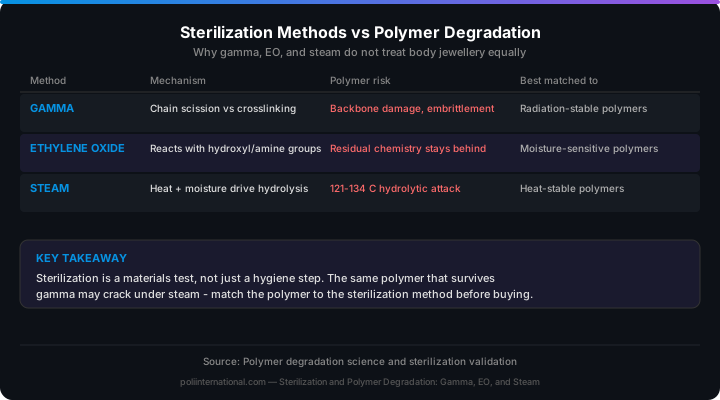
Sterilization method comparison: gamma, ethylene oxide, and steam effects on polymers
Infographic: Sterilization method comparison: gamma, ethylene oxide, and steam effects on polymers

Sterilization is a materials test, not just a hygiene step

Every sterilization cycle is also a materials test. Gamma photons deposit energy into the polymer backbone. Ethylene oxide reacts with hydroxyl and amine groups. Steam autoclave drives water into the matrix at 121-134 °C. A jewelry item that survives a cycle biologically can be damaged chemically, and the damage shows up later as cracking, discoloration, or lost flexibility in the piercing.

The body jewelry industry standardizes around three modalities: gamma irradiation (ISO 11137), ethylene oxide (ISO 10993-7), and steam autoclave. Each attacks polymers by a different mechanism. Understanding the mechanism separates a specification that survives fifty cycles from one that embrittles after five.

Gamma irradiation: chain scission versus crosslinking

Gamma radiation transfers energy to polymer chains, producing free radicals. Two competing reactions follow: crosslinking, where radicals on adjacent chains bond and stiffen the material, and chain scission, where the backbone breaks and molecular weight drops. The ratio is polymer-specific.

Polypropylene random copolymer, the BioFlex base, sits on the favorable side. It crosslinks preferentially at clinical doses of 25-40 kGy, which is why BioFlex jewelry can be gamma sterilized without losing structural integrity. Medical-grade PDMS behaves similarly, tolerating repeated gamma cycles with minimal mechanical drift.

PTFE is the failure case. Its carbon-fluorine backbone scissions readily under gamma, releasing radicals and turning the surface brittle. Gamma-sterilized PTFE is a known degradation route, so PTFE jewelry and gamma irradiation should not be combined. Acrylic (PMMA) also scissions, yellowing and cracking after repeated exposure.

Ethylene oxide: chemistry that stays behind

EO sterilizes by alkylating microbial proteins, and it works at low temperature, the reason it was adopted for heat-sensitive polymers. The trade-off is residue. EO and its byproducts, ethylene chlorohydrin and ethylene glycol, remain adsorbed in the polymer and must be removed by aeration.

ISO 10993-7 sets the exposure limits: 4 mg per device for EO and 9 mg for ethylene chlorohydrin in adult devices. Porous polymers and elastomers hold more residue than dense ones, so aeration time is not a constant. It depends on polymer type, wall thickness, and surface area.

For body jewelry, the practical question is whether the item was aerated after the cycle. A supplier that lists EO sterilized without an aeration specification is not delivering a finished medical device. It is delivering a half-finished one.

Steam autoclave: heat, moisture, and hydrolysis

Steam sterilization combines 121-134 °C heat with saturated moisture and pressure. For polymers that hydrolyze, such as polyesters, polyamides, and polycarbonate, this is the most aggressive modality. Water penetrates the matrix and attacks ester or amide bonds, reducing molecular weight and surface hardness with every cycle.

Acrylic and polycarbonate jewelry visibly degrade: crazing, whitening, and cracking after repeated autoclave cycles. PTFE and silicone, by contrast, are hydrolysis-stable and autoclave repeatedly without chemical damage, which is why silicone retainers are the standard for surgical settings.

BioFlex PP-R is steam-tolerant within its heat deflection limits, but the specification matters. Repeated autoclaving at 134 °C sits close to the polymer's thermal ceiling, and cycle count should be tracked the same way instruments are tracked. See the autoclave sterilization wiki for the instrument-side protocol.

Matching the polymer to the sterilization method

The correct approach is to specify all three variables together: polymer, sterilization modality, and cycle count. A medical-grade silicone retainer can take gamma, EO, or steam. PTFE should be EO or steam, never gamma. Acrylic should not be steam sterilized at all, and gamma only with a documented dose limit.

This is a supply-chain question as much as a chemistry question. When a manufacturer certifies a material, the certification should name the sterilization method the polymer was qualified with. A material certified after gamma sterilization has different mechanical properties than the same material certified as molded, and the difference is exactly where cracks start later. The material certification checker walks through the documentation you should ask for, and the polymer science wiki covers the material properties side.

Frequently Asked Questions

Can BioFlex body jewelry be gamma sterilized?

Yes. Polypropylene random copolymer crosslinks preferentially under gamma irradiation, so clinical doses between 25 and 40 kGy do not embrittle it. This is one of the reasons BioFlex is qualified for medical and hospital contexts where gamma is the default modality.

Is ethylene oxide residue dangerous in body jewelry?

Only above the ISO 10993-7 limits, but the burden is on the supplier to demonstrate aeration. Residual EO and ethylene chlorohydrin are skin and mucosal irritants. A piece that ships directly from a sterilization cycle without aeration can cause contact reactions at the piercing site.

Why does acrylic jewelry crack after autoclaving?

Steam at 134 °C exceeds the glass transition range of PMMA and drives water into the matrix. The combination of thermal softening and hydrolytic stress produces crazing and cracking that accumulates with every cycle. Acrylic should be sterilized with low-temperature methods or replaced with a hydrolysis-stable polymer.

Can silicone retainers be autoclaved repeatedly?

Yes. Medical-grade PDMS is hydrolysis-stable and tolerates repeated steam cycles without chemical degradation. Silicone retainers are the standard choice for surgical and MRI contexts precisely because of this combined stability.

References

1. ISO 11137-1:2006. Sterilization of health care products. Radiation. Part 1: Requirements for development, validation and routine control of a sterilization process for medical devices. Geneva: International Organization for Standardization; 2006.
2. ISO 10993-7:2008. Biological evaluation of medical devices. Part 7: Ethylene oxide sterilization residuals. Geneva: International Organization for Standardization; 2008.
3. Shintani H. Ethylene oxide gas sterilization of medical devices. Biocontrol Science. 2017;22(1):1-16.
4. Charlesby A. Atomic Radiation and Polymers. Oxford: Pergamon Press; 1960.

Mind map · Sterilization and Polymer Degradation: Why Gamma, EO, and Steam Don't Treat Body Jewelry Equally

  • Polymer Jewelry Sterilization Compatibility
    • Gamma Irradiation Energy Effects

      Gamma radiation initiates radical chemistry in the polymer backbone, driving chain scission, crosslinking, or oxidation that changes material properties.

      • Polymer Chain Scission Action
      • Polymer Crosslinking Mechanism
    • Ethylene Oxide Gas Sterilization

      Ethylene oxide gas sterilizes devices by alkylating critical biological molecules like proteins and DNA.

      • ISO Residual Gas Limits
        • Ethylene Oxide Residue Cap
        • Ethylene Chlorohydrin Limit
      • Aeration Phase Requirements
    • Steam Autoclave Heat Effects

      Steam autoclave sterilization exposes materials to high-pressure saturated steam at temperatures between 121 and 134 degrees Celsius.

      • Polycarbonate Autoclave Damage
        • Polycarbonate Crazing And Cloudiness
      • Hydrolysis Degradation Risks
    • Fluoropolymer Sterilization Compatibility

      Polytetrafluoroethylene is hydrolysis-stable and resists steam autoclave degradation.

      • Steam Hydrolysis Resistance
      • Radiation Embrittlement Risks
        • PTFE Carbon Fluorine Scission
    • Polypropylene Copolymer Capabilities

      BioFlex random copolymer withstands steam autoclave sterilization up to twelve cycles at 134 degrees Celsius.

      • BioFlex Injection Molding
      • Autoclave Thermal Stability
StructureProcessMaterialHazard

5 branches, 0 sources. Each branch cites the article it came from; the labels beneath it are names, not claims.

Polymer Sterilization Quiz

  1. 1. What primary chemical mechanism causes PTFE body jewelry to become brittle and fail when exposed to gamma irradiation?

    • ✓ Chain scission along its carbon-fluorine backbone. — Gamma photons target the carbon-fluorine bonds in fluoropolymers, breaking the main chain and causing severe embrittlement.
    • • Excessive crosslinking that stiffens the material beyond flexibility. — Crosslinking increases stiffness and structural integrity rather than causing brittle breakdown, which is not what occurs in PTFE under gamma exposure.
    • • Rapid hydrolysis triggered by absorbed gamma radiation photons. — Hydrolysis requires high-temperature water or moisture, whereas gamma radiation operates via free-radical photon transfer.
    • • Thermal softening above its glass transition temperature. — Thermal softening occurs during high-heat processes like autoclaving rather than room-temperature gamma irradiation.
  2. 2. Why does BioFlex (polypropylene random copolymer) maintain its structural integrity during clinical gamma sterilization doses of 25 to 40 kGy?

    • ✓ It preferentially crosslinks, forming bonds between adjacent polymer chains. — Radicals formed on adjacent polypropylene chains bond together at clinical dose levels, reinforcing the matrix structure.
    • • It resists all energy absorption from gamma radiation photons. — Polypropylene absorbs energy from gamma photons, but the resulting chemical reaction forms stabilizing crosslinks rather than breaking the chain.
    • • It completely neutralizes free radicals through built-in chemical additives. — The material's resistance stems from its intrinsic chemical behavior under radiation rather than added radical neutralizing agents.
    • • It undergoes hydrolysis, which softens the material to prevent brittle cracking. — Hydrolysis is driven by steam and moisture in condensation polymers, whereas BioFlex tolerates gamma radiation through crosslinking.
  3. 3. Under ISO 10993-7, what is the maximum allowable limit for ethylene oxide (EO) exposure residual per adult device?

    • ✓ 4 mg — ISO 10993-7 establishes four milligrams per device as the maximum acceptable residual limit for adult devices to prevent tissue toxicity.
    • • 9 mg — Nine milligrams is the ISO threshold designated for ethylene chlorohydrin residuals rather than pure ethylene oxide gas.
    • • 25 kGy — Twenty-five kilograys represents a typical clinical radiation dosage for gamma sterilization rather than a gas residual limit.
    • • 121 mg — One hundred twenty-one degrees Celsius is standard autoclave operating temperature, not an ethylene oxide concentration standard.
  4. 4. What is the maximum allowable residual limit set by ISO 10993-7 for ethylene chlorohydrin in adult devices?

    • ✓ 9 mg — ISO 10993-7 limits ethylene chlorohydrin, a toxic reaction byproduct of ethylene oxide, to nine milligrams for adult devices.
    • • 4 mg — Four milligrams is the specified threshold for primary ethylene oxide residuals rather than ethylene chlorohydrin.
    • • 40 kGy — Forty kilograys defines the upper limit for typical gamma irradiation dosing rather than chemical gas byproduct limits.
    • • 134 mg — One hundred thirty-four degrees represents an autoclave temperature ceiling rather than a byproduct residue limit.
  5. 5. Why must body jewelry sterilized with ethylene oxide (EO) undergo an aeration process before distribution?

    • ✓ Absorbed sterilant gas and reactive byproducts are skin and mucosal irritants that must be removed. — Adsorbed ethylene oxide gas and its reactive byproducts like ethylene chlorohydrin cause severe skin and mucosal contact reactions if not thoroughly aerated.
    • • Aeration is required to cool down the polymer after high-temperature exposure. — Ethylene oxide operates as a low-temperature sterilization method, making thermal cooling unnecessary.
    • • Moisture must be driven out of the matrix to prevent immediate hydrolytic breakdown. — Aeration targets the removal of volatile chemical residuals rather than moisture extracted during steam processes.
    • • Exposure to air crosslinks the polymer backbone to restore lost tensile strength. — Aeration allows gas diffusion out of the polymer matrix but does not induce structural crosslinking of the polymer backbone.
  6. 6. Which sterilization modality presents the highest risk of rapid hydrolytic degradation for condensation polymers like polyesters and polycarbonate?

    • ✓ Steam autoclave — Combining temperatures between 121 °C and 134 °C with saturated moisture drives water molecules directly into ester and amide bonds, cleaving the polymer chains.
    • • Gamma irradiation — Gamma radiation degrades polymers via free radical scission or crosslinking without utilizing moisture or hydrolytic cleavage.
    • • Ethylene oxide gas — Ethylene oxide is a low-temperature gaseous alkylating process that does not introduce hydrolytic moisture stress.
    • • Dry cold aeration — Aeration is a post-sterilization gas diffusion step rather than an active sterilization modality that induces chemical reaction.
  7. 7. What structural failure occurs when acrylic (PMMA) jewelry is repeatedly sterilized in a steam autoclave at 134 °C?

    • ✓ Crazing, whitening, and cracking due to thermal softening and hydrolytic stress. — Saturated steam at high temperatures exceeds the glass transition point of PMMA, driving water into the matrix and producing visible micro-cracks and discoloration.
    • • Excessive chain crosslinking that increases surface hardness and prevents flexibility. — Steam heat combined with moisture breaks polymer backbones via hydrolysis rather than inducing structural crosslinking.
    • • Accumulation of adsorbed toxic ethylene chlorohydrin residuals. — Ethylene chlorohydrin residuals result from ethylene oxide gas processing rather than steam autoclaving.
    • • Radiation-induced free radical formation that turns the material yellow. — Free radical formation and yellowing are characteristic degradation pathways of gamma radiation exposure rather than hydrolytic steam damage.
  8. 8. Why are medical-grade polydimethylsiloxane (PDMS) retainers preferred for surgical and MRI settings?

    • ✓ PDMS is hydrolysis-stable and withstands repeated steam autoclaving without chemical degradation. — Polydimethylsiloxane possesses a stable backbone resistant to water penetration and thermal stress at high autoclave temperatures.
    • • PDMS crosslinks under gamma radiation to become completely rigid. — Silicone retains its mechanical flexibility across modalities rather than stiffening into a rigid structure under radiation.
    • • PDMS requires zero aeration time following low-temperature ethylene oxide treatment. — While silicone is steam-stable, ethylene oxide sterilization still requires appropriate aeration to clear adsorbed gas.
    • • PDMS absorbs saturated steam to continuously increase its structural flexibility. — Silicone maintains stable mechanical properties in steam environments rather than continuously absorbing water to change flexibility.
  9. 9. What happens to acrylic (PMMA) when subjected to repeated gamma irradiation?

    • ✓ The polymer backbone scissions, causing yellowing and cracking over time. — Radiation energy breaks the polymethyl methacrylate backbone, reducing molecular weight and causing visible yellowing and cracking.
    • • The polymer crosslinks into a highly stable, autoclavable matrix. — PMMA undergoes chain scission under gamma exposure rather than crosslinking into a heat-stable material.
    • • Moisture enters the matrix and causes rapid hydrolytic cleavage of amide bonds. — Hydrolytic cleavage of amide bonds occurs in moisture-heavy environments like steam autoclaves rather than dry gamma radiation.
    • • Residual ethylene glycol forms on the surface, creating a toxic chemical layer. — Ethylene glycol formation is a byproduct of ethylene oxide gas sterilization in the presence of water, not gamma irradiation.
  10. 10. When a manufacturer provides certification for a medical-grade polymer, what key detail must be documented regarding material properties?

    • ✓ The specific sterilization modality used during material qualification. — Post-qualification mechanical properties depend heavily on the specific sterilization mechanism, requiring explicit modality naming on certification documents.
    • • The total number of piercing client installations the jewelry can endure. — Material certification evaluates material compatibility and qualification under specific chemical or radiation stress rather than tracking usage cycles in clients.
    • • The ambient room humidity required during the storage of the unsterilized polymer. — Storage environment recommendations do not replace material qualification testing under specific sterilization modalities.
    • • The exact trade association standards that override international ISO requirements. — International standards like ISO set defined technical benchmarks, whereas trade association guidance provides educational support.

Extended Reference Table

8 of 8 rows

Extended reference table generated from the article and its verified research sources. Bracketed numbers jump to the matching entry in the Technical References below.

SafetyItem, Material, Practice or Standard Material Class or Description Manufacturing Process Compliance, Standards or Specification Key Properties or Limitations Recommended Applications Source
✅BioFlex / Bioplast (PP-R)Medical-grade polypropylene random copolymer (PP-R); semi-crystalline thermoplastic; carbon-carbon backbone.Injection molding (monolithic 3D geometry) or extrusion; compatible with 134 °C autoclave.ISO 10993, USP Class VI, REACH Article 33Flexural modulus ≈ 1,200 MPa; melting point 145 – 155 °C; zero nickel; radiolucent; non-ferromagnetic; autoclavable (8–12 cycles); embrittlement if gamma irradiated (though some sources note preferential crosslinking at 25-40 kGy).Initial and long-term body piercings; oral piercings to prevent gum recession; pregnancy navel bars; MRI-safe retainers.[8], [9], [10]
✅Titanium (Ti6Al4V ELI / Grade 23)Titanium alloy with 6% Aluminum and 4% Vanadium (Extra Low Interstitials).Machined and polished to mirror finish; can be electro-polished and anodized for color.ASTM F136, ASTM F1295, ISO 5832-3, ASTM F67, ASTM F86.High strength-to-weight ratio (tensile ≈ 860 MPa); non-ferromagnetic; radiolucent; nickel-free; prismatic surface when electropolished; does not chip or flake.Initial body piercings; orthopedic implants; MRI environments; long-term wear (greater than 24 hours).[8]
✅Surgical Steel (316L / 316LVM)Chromium-Nickel-Molybdenum low-carbon stainless steel alloy.Machined and polished to a mirror finish.ASTM F138, ISO 5832-1, ISO 10993-6, ISO 10993-10, ISO 10993-11, EN 1811:2023, EEC Nickel Directive.Contains 6–13% nickel; release rate < 0.2 µg/cm ² /week; density 8.0 g/cm ³ ; chromium oxide layer susceptible to corrosion by chlorine.Initial body piercings; temporary surgical implants; healed piercings only for 316 grade.[8]
✅PTFE (Polytetrafluoroethylene)Synthetic fluoropolymer; fully fluorinated carbon-fluorine backbone (commonly known as Teflon).Extrusion and CNC machining; cannot be injection-molded due to high melt viscosity.USP Class VI, EN 1811:2023, ASTM D1894, ASTM F754.Lowest coefficient of friction (0.05–0.10); flexural modulus ≈ 500 MPa; chemically inert; subject to creep/cold flow; turns brittle or degrades if gamma irradiated.Initial piercings for nickel-sensitized patients; large gauge plugs; medical examinations; mucosal tissue contact.[8], [9], [10]
✅Medical-Grade SiliconePolydimethylsiloxane (PDMS) elastomer; platinum-cured preferred.Molded, crosslinked, or platinum-curing; compatible with 134 °C autoclave or EtO.ISO 10993, ASTM D2240, ASTM D624 Die B.Shore A 30–70; elongation 300–700%; low tear strength (25-45 kN/m); non-ferromagnetic; hydrolysis-stable; tolerates repeated steam cycles.Plugs, tunnels, o-rings, and flexible retainers for surgeries and medical imaging.[8], [10]
✅Ethylene Oxide (EO) SterilizationGaseous alkylating agent; low-temperature chemical sterilization process.Injection into chamber at 400–800 mg/L; alkylation of microbial proteins.ISO 11135:2014, ISO 10993-7.Effective for heat-sensitive polymers; requires aeration to remove toxic/carcinogenic residuals; EO limit 4 mg for limited-contact devices.Sterilization of heat-sensitive polymeric medical devices, electronics, and complex geometries.[10], [11]
✅Gold (14k or Higher)Precious metal alloy (yellow, rose, or white).Alloyed for biocompatibility; solid construction.Nickel-free and Cadmium-free standards.Must be 14k or higher; alloys above 18k are too soft and scratch easily; plating/vermeil is prone to chipping.Initial body piercings.[8]
✅GlassLead-free glass (Fused quartz, Borosilicate, Soda-lime, Pyrex).-ASTM F1538, Lead-free.Inert; non-crystalline solid; must be uncolored for certain medical applications; can be sterilized in an autoclave.Initial piercings; safe alternative to metals for MRI or surgery.

Free Body Art Wall Posters

Print-ready reference posters for your studio or your own wall. Free to download and display, embed on your own site with attribution. Click any poster to preview it full size before downloading.

Choose and download all 40 posters

Technical_References_Archive

  • [1]ISO 11137-1:2006. Sterilization of health care products. Radiation. Part 1: Requirements for development, validation and routine control of a sterilization process for medical devices. Geneva: International Organization for Standardization; 2006. iso.org/standard/33952.html
  • [2]ISO 10993-7:2008. Biological evaluation of medical devices. Part 7: Ethylene oxide sterilization residuals. Geneva: International Organization for Standardization; 2008. iso.org/standard/34213.html
  • [3]Shintani H. Ethylene oxide gas sterilization of medical devices. Biocontrol Science. 2017;22(1):1-16. [PMID 28367865](https://pubmed.ncbi.nlm.nih.gov/28367865/)
  • [4]Charlesby A. Atomic Radiation and Polymers. Oxford: Pergamon Press; 1960. shop.elsevier.com/books/atomic-radiation-and-poly...
  • [5]PMID 37730855 Grillo et al. Evaluation of hernia surgical meshes sterilised with ethylene oxide for adoption under UK regulations.. Surg Endosc. 2023;37(12):9556-9562.
  • [6]PMID 42467903 Zhu et al. Development and application of lyophilized Bacillus atrophaeus spore pellets as an reference material of enumeration for onsite validation of medical sterilization equipment.. J Appl Microbiol. 2026;137(8).
  • [7]PMID 40289578 Shenoy et al. Multisociety guidance for sterilization and high-level disinfection.. Infect Control Hosp Epidemiol. 2025;46(6):561-583.
  • [8]BioFlex vs PTFE: Why PP-R Random Copolymer Wins Every Time | Poli International: poliinternational.com/blog/bioflex-vs-ptfe-why-pp-r-wins-bod
  • [9]BioFlex®, The Original Certified Flexible Body Jewelry | Poli International: poliinternational.com/bioflex
  • [10]BioFlex®: Not Urethane, Not TPU – Truth From the Creator. | Poli International: poliinternational.com/blog/bioflex-is-not-what-the-internet-
  • [11]Jewelry for Initial Piercings - Association of Professional Piercers: safepiercing.org/jewelry-for-initial-piercings

About the Author

PP

Patrick Poli

Chief Engineer, Poli International · Creator of BioFlex® body jewelry

Patrick has spent 25+ years manufacturing body jewellery and studio equipment, and is the creator of BioFlex® body jewelry. He spent two years developing it as a PP-R random copolymer, tested to ISO 10993 and built on a USP Class VI resin. He also developed antimicrobial silver-ion body jewellery with Clariant’s polymer laboratory, years before a pandemic made the idea obvious.

More about Patrick →

Last reviewed: 2026-10-14 · Published: 2026-07-31

Related Tools & Reading

Continue Reading