Shop
Polymer Science

Creep and Stress Relaxation in Polymer Body Jewelry: Why Flexible Materials Lose Their Shape

PP

Chief Engineer

Patrick Poli

Journal Date

2026-08-07

Last Reviewed

2026-10-11

Creep and Stress Relaxation in Polymer Body Jewelry: Why Flexible Materials Lose Their Shape

Key Takeaways:

» Polymers are viscoelastic: they deform with time, not just with load, so a flexi post or o-ring that fits today can fit differently in six months
» Creep is time-dependent strain under constant stress; it is why polymer barbells and retainers permanently stretch or bend
» Stress relaxation is the same physics seen from the other side: an o-ring or gasket loses tension while held at constant deformation
» Crosslink density, molecular weight, and operating temperature determine how fast a polymer creeps
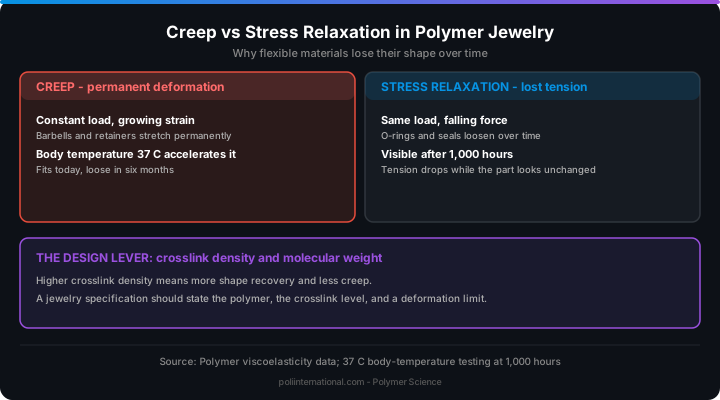
Creep versus stress relaxation in polymer body jewelry: why flexible materials lose their shape over time
Infographic: Creep versus stress relaxation in polymer body jewelry: why flexible materials lose their shape over time

Time is part of the material

Metals obey Hooke's law to a first approximation: apply a stress, get an immediate strain, and the strain stays until the stress is removed. Polymers do not behave that way. Between the elastic response of a spring and the viscous response of a fluid sits the viscoelastic regime, and body jewelry polymers operate squarely inside it.

Every polymer jewelry item is time-dependent. A BioFlex flexi post, a silicone o-ring, a PTFE retainer, an acrylic taper, all respond to load in two stages: an instantaneous elastic component, then a slow deformation that depends on how long the load has been applied. A polymer part is never fully characterized by a single number such as Shore hardness or tensile strength.

Two phenomena dominate long-term behavior: creep and stress relaxation. They are the same molecular physics viewed from different boundary conditions, and understanding both explains the most common field complaint about flexible jewelry: it loses its shape.

Creep: permanent deformation under constant load

Creep is the increase in strain over time when a polymer is held under a constant stress. The barbell in a healed piercing carries a steady, low-level load from tissue pressure, gravity, and ornament weight. Over weeks and months, the polymer chains slowly rearrange, and the material elongates in the direction of the stress.

The creep curve for a semicrystalline polymer such as polypropylene random copolymer, the BioFlex base, has three stages. Primary creep is fast and decelerating, driven by chain uncoiling. Secondary creep is the long plateau where strain accumulates slowly and steadily; this is the regime most jewelry spends its service life in. Tertiary creep is accelerating deformation that ends in rupture, which is why a flexi post carrying a heavy ornament for a year can suddenly snap without warning.

Creep is not recoverable by unloading: some deformation is viscous flow, and viscous flow is permanent. An acrylic taper that has crept under insertion stress will not spring back, and a polymer barbell that has elongated will not shorten again. ISO 899-1 for tensile creep and ASTM D2990 for flexural creep quantify this behavior by holding a specimen at constant load and recording strain against time.

Stress relaxation: why o-rings lose tension

Stress relaxation is creep's mirror image. Instead of holding the load constant and watching strain increase, the part is held at constant deformation while the resisting force decays. A silicone o-ring stretched around a barbell post, a polymer gasket compressed between two pieces, a flexi post bent into a fixed curve, all are held at constant strain. Over time, the chains redistribute stress internally, and the force the part exerts on its surroundings drops.

This is the mechanism behind the complaint that polymer o-rings and gaskets loosen. The o-ring is not wearing away, it is relaxing. The loss of tension follows an approximately logarithmic curve, fast in the first hours and slower afterward, which is why a new o-ring feels tight and loose a week later.

Not all polymers creep at the same rate, and the differences are controllable at the molecular level. Three variables dominate.

Crosslink density is the strongest lever. In a thermoset elastomer such as medical-grade silicone (PDMS), crosslinks are permanent chemical bonds between chains. Higher crosslink density means chains cannot slide past one another easily, so creep and stress relaxation slow dramatically. This is why Shore hardness and creep resistance track together in silicone: a harder durometer is, in effect, a more heavily crosslinked network with less viscous flow. The trade-off is flexibility.

Molecular weight matters for thermoplastics. Long chains form entanglements that act as temporary crosslinks, and higher molecular weight means more entanglements per chain. Polypropylene random copolymer with adequate molecular weight creeps far less than a low-molecular-weight grade.

Temperature is the third lever, and it acts exponentially. Creep rate rises steeply as the operating temperature approaches the polymer's glass transition or melting range. A polymer part worn against the body sits at roughly 32-37 °C, warm enough to matter: the same material will creep measurably faster in an earlobe than on a shelf.

What a jewelry specification should actually state

A specification that only names the material and Shore hardness is incomplete. The properties that predict long-term fit are time-dependent, so the specification should state them that way.

For a flexi post or retainer, the useful number is the creep strain at a defined stress and temperature after a defined period, for example percent elongation at 1 MPa and 37 °C after 1,000 hours, tested to ISO 899-1. For an o-ring or sealing component, the useful number is the percent retained force after a defined relaxation period, tested at the actual service strain. For any polymer that will be sterilized, note that sterilization cycles alter the molecular structure and shift the creep and relaxation behavior; the sterilization and polymer degradation article covers that interaction.

If a client reports that a polymer piece has stretched, loosened, or changed fit over months of wear, that is not a manufacturing defect. Choosing a crosslinked elastomer for sealing roles, specifying adequate molecular weight for thermoplastics, and accounting for body temperature in the design separate a part that holds its shape from one that does not. The material certification checker and the polymer science wiki cover the documentation side.

Frequently Asked Questions

Why does my silicone o-ring keep loosening?

The o-ring is not wearing away, it is stress relaxing. Held at constant stretch, the polymer chains redistribute internal stress over time, and the force the ring exerts drops on an approximately logarithmic curve. Specify the retained force after relaxation, not the initial force, and use a higher durometer silicone if tension loss is a problem.

Can a polymer barbell stretch permanently?

Yes. Under the constant low load of tissue pressure and ornament weight, a thermoplastic such as polypropylene random copolymer undergoes creep. The early stages are partly recoverable, but the viscous component is permanent.

Why does acrylic jewelry change shape but BioFlex does not?

Acrylic (PMMA) is an amorphous thermoplastic with no crosslinks and no crystalline phase, so its chains slide past one another readily under load and temperature. Polypropylene random copolymer has a crystalline fraction that acts as physical crosslinks, slowing creep.

Does body temperature make polymer jewelry deform faster?

Yes. Chain segment mobility increases with temperature, and creep rate rises steeply as the operating temperature approaches the polymer's glass transition or melting range. Jewelry worn at 32-37 °C creeps measurably faster than the same material stored at room temperature.

References

1. ISO 899-1:2017. Plastics. Determination of creep behaviour. Part 1: Tensile creep. Geneva: International Organization for Standardization; 2017.
2. ASTM D2990-17. Standard Test Methods for Tensile, Compressive, and Flexural Creep and Creep-Rupture of Plastics. West Conshohocken, PA: ASTM International; 2017.
3. Ferry JD. Viscoelastic Properties of Polymers. 3rd ed. New York: John Wiley & Sons; 1980.
4. Callister WD, Rethwisch DG. Materials Science and Engineering: An Introduction. 10th ed. Hoboken: John Wiley & Sons; 2018.
5. Schneider F, et al. Mechanical properties of silicones for MEMS. Journal of Micromechanics and Microengineering. 2008;18(6):065008.

Mind map · Creep and Stress Relaxation in Polymer Body Jewelry: Why Flexible Materials Lose Their Shape

  • Polymer Jewelry Creep and Relaxation
    • Viscoelastic Behavior of Polymers

      Polymers are viscoelastic materials that deform with time under constant stress or lose tension under constant strain.

      • Creep Strain Under Constant Stress
        • Permanent Elongation of Barbells
      • Stress Relaxation at Constant Strain
        • Logarithmic Tension Loss in O-Rings
    • Semicrystalline Thermoplastic Creep Stages

      Semicrystalline polymer creep progresses through primary uncoiling, secondary steady-state, and accelerating tertiary stages before failure.

      • Primary Creep Chain Uncoiling
      • Secondary Creep Steady State
      • Tertiary Creep Accelerating Rupture
    • Thermoset Silicone Crosslink Properties

      Thermoset elastomers like medical-grade silicone use permanent crosslinks to reduce chain sliding and slow down long-term viscous flow.

      • Silicone Elongation and Hardness
      • Silicone Low Tear Strength Limitation
    • Standard Testing for Polymer Creep

      Standard testing holds plastic specimens under constant tensile load to record and quantify time-dependent creep strain.

      • ISO Tensile Creep Test Standard
      • ASTM Flexural Creep Test Standard
StructureProcessMaterialHazard

4 branches, 0 sources. Each branch cites the article it came from; the labels beneath it are names, not claims.

Polymer Creep Quiz

  1. 1. What mechanism causes a silicone o-ring on a barbell post to lose tension over time without wearing away?

    • • Viscous flow under constant load causing permanent elongation of the ring. — This describes tensile creep under constant load rather than stress relaxation at a fixed deformation.
    • ✓ Internal stress redistribution among polymer chains held at constant strain. — Holding a viscoelastic material at fixed deformation causes internal stress to decay as polymer chains rearrange over time.
    • • Thermal degradation resulting from prolonged exposure to body heat. — While body heat accelerates rate changes, the fundamental mechanism driving tension loss at constant deformation is stress relaxation.
    • • Accelerating chain uncoiling occurring during the tertiary creep stage. — Tertiary creep involves accelerating strain leading to rupture under constant load, not force decay under constant strain.
  2. 2. During which stage of creep does polymer body jewelry spend most of its functional service life?

    • • Primary creep, where rapid chain uncoiling occurs. — Primary creep is an initial, short-lived stage characterized by fast, decelerating deformation.
    • ✓ Secondary creep, characterized by a steady plateau of slow strain accumulation. — The secondary creep stage represents the long, steady plateau where strain accumulates predictably over months of wear.
    • • Tertiary creep, where accelerating deformation leads to structural rupture. — Tertiary creep is a brief, final phase of rapidly accelerating strain that ends in physical failure.
    • • Viscoelastic equilibrium, where all molecular motion ceases completely. — Viscoelastic polymers continuously undergo time-dependent chain movements rather than reaching complete molecular stillness under load.
  3. 3. Why is creep deformation in polymer body jewelry considered permanent rather than fully elastic?

    • ✓ Part of the deformation is viscous flow, which cannot be recovered upon unloading. — Viscoelastic response includes a viscous fluid component that represents irreversible molecular sliding.
    • • Body heat permanently severs all chemical bonds in the polymer backbone. — Body heat increases chain mobility but does not inherently break covalent chemical bonds in the backbone.
    • • Semicrystalline regions dissolve permanently under steady mechanical stress. — Mechanical strain causes chain rearrangement and uncoiling rather than the dissolution of crystalline phases.
    • • Constant load converts the solid material into a purely amorphous gas. — Mechanical load rearranges solid-state polymer chains without causing a phase change into a gas.
  4. 4. Which standardized test method specifically quantifies the flexural creep behavior of plastic materials?

    • • ISO 899-1 — ISO 899-1 specifically standardizes the determination of tensile creep behavior in plastics.
    • ✓ ASTM D2990 — ASTM D2990 provides standard test methods specifically designated for flexural as well as tensile and compressive creep.
    • • ISO 10993 — ISO 10993 addresses biological evaluation of medical devices rather than mechanical creep testing of plastics.
    • • ASTM F136 — ASTM F136 is a material specification for implant-grade titanium alloy, not polymer creep testing.
  5. 5. How does increasing the crosslink density affect a thermoset elastomer like medical-grade silicone?

    • • It accelerates viscous flow by allowing polymer chains to glide past one another. — Crosslinks act as chemical bridges that prevent polymer chains from freely sliding past one another.
    • ✓ It reduces creep and stress relaxation while increasing durometer hardness. — Permanent chemical bonds restrict chain movement, lowering viscous flow and yielding a firmer, more stable network.
    • • It completely eliminates the material's crystalline fraction, making it amorphous. — Medical-grade silicone elastomers are already non-crystalline networks; crosslinking establishes chemical network ties rather than altering crystal phases.
    • • It lowers the material's glass transition temperature below normal storage levels. — Crosslinking strengthens network rigidity and reduces long-range chain mobility without significantly lowering glass transition temperatures.
  6. 6. Why does acrylic (PMMA) jewelry lose its shape more readily under load than BioFlex?

    • • PMMA has a high crosslink density that makes its structure brittle under load. — Acrylic is an uncrosslinked thermoplastic, so deformation stems from chain sliding rather than high crosslinking.
    • • BioFlex contains permanent covalent crosslinks created during thermal processing. — BioFlex is based on polypropylene random copolymer, a thermoplastic whose resistance comes from crystalline domains rather than permanent covalent crosslinks.
    • ✓ Acrylic is an amorphous thermoplastic lacking physical crosslinks or crystalline phases. — Without crystalline regions or crosslinks to anchor chains, PMMA polymer chains slide past each other easily under stress.
    • • BioFlex undergoes rapid stress relaxation that prevents permanent shape change. — BioFlex resists creep deformation rather than preventing shape change through stress relaxation.
  7. 7. What curve pattern characterizes the rate at which a stretched polymer o-ring loses tension?

    • • A linear rate where tension drops by an equal amount every day. — Stress decay is non-linear, dropping rapidly early on before slowing down.
    • ✓ An approximately logarithmic curve with rapid initial drop followed by slower relaxation. — Internal stress redistribution occurs rapidly in the first hours of constant strain and decelerates over time.
    • • An exponential growth curve where force increases until the ring snaps. — Stress relaxation describes force decay over time, not force accumulation or exponential growth.
    • • A constant step-function dropping only during thermal sterilization cycles. — Tension loss occurs continuously over time at constant strain rather than exclusively during sterilization.
  8. 8. How does wearing polymer jewelry at body temperature (32–37 °C) affect its deformation rate compared to shelf storage?

    • • Body heat slows down deformation by causing polymer chains to re-align cleanly. — Thermal energy increases molecular motion, which accelerates deformation rather than stabilizing chains.
    • ✓ Higher operating temperature increases chain segment mobility, sharply increasing creep rate. — Creep rate rises steeply as operating temperature approaches the polymer's glass transition or melting range.
    • • Body temperature cures thermoplastics, converting them into permanent thermoset networks. — Body temperature is far too low to induce chemical crosslinking or curing in worn thermoplastics.
    • • Thermal expansion perfectly balances mechanical strain, keeping the jewelry shape static. — Thermal expansion does not negate viscoelastic creep, which proceeds faster at elevated temperatures.
  9. 9. What property specification best predicts the long-term sealing performance of a polymer o-ring?

    • • Initial tensile strength measured immediately after molding. — Initial tensile strength does not account for time-dependent stress decay occurring under sustained strain.
    • ✓ Percent retained force after a defined relaxation period at service strain. — Measuring retained force under actual service deformation accounts for stress relaxation over time.
    • • Total elongation at break recorded during rapid tensile rupture testing. — Ultimate elongation at break reflects short-term failure limits rather than long-term force retention.
    • • Shore durometer hardness measured before any mechanical strain is applied. — Shore hardness alone does not provide the time-dependent force loss data needed to predict long-term sealing fit.
  10. 10. In thermoplastic body jewelry, how do long molecular chain lengths help reduce creep?

    • • Long chains eliminate all viscous flow by converting thermoplastics into thermoset rubbers. — High molecular weight increases viscosity and entanglement density, but it does not convert a thermoplastic into a chemical thermoset.
    • ✓ Chain entanglements act as temporary physical crosslinks that hinder molecular sliding. — Increased chain length creates entanglements that restrict relative chain movement under load.
    • • High molecular weight lowers the glass transition temperature below body temperature. — Higher molecular weight generally maintains or slightly increases transition thermal thresholds rather than lowering them below body temperature.
    • • Long chains reduce material density, allowing the polymer to compress harmlessly under load. — Creep resistance comes from restricted chain movement via entanglements, not density reductions or unconstrained compression.

Extended Reference Table

8 of 8 rows

Extended reference table generated from the article and its verified research sources. Bracketed numbers jump to the matching entry in the Technical References below.

SafetyItem, Material or Practice Primary Function Resistance to Creep Relaxation Maximum Service Temperature Standards, Compliance or Specification Sterilization Compatibility Source
✅BioFlex (PP-R / Polypropylene Random Copolymer)Flexible implant-grade body jewelry for initial healing, high-movement sites, and pregnancyViscoelastic response providing dimensional stability; slowed by crystalline fraction acting as physical crosslinks155°C (Melting Point); stable across 35–40°C body temperature rangeISO 10993, USP Class VIAutoclavable (134°C B-cycle), EtO, Gas plasma; Avoid Gamma
✅PTFE (Polytetrafluoroethylene / Teflon)Initial piercings, mucosal tissue contact, and industrial sealing gasketsLow; exhibits cold flow and time-dependent slow deformation under sustained load260°C (briefly); <180°C recommended for long-term usageUSP Class VI, EN 1811:2023, ASTM D1894, ASTM F754, ISO, FDAEtO, Gas plasma; Avoid Autoclave (if under load) and Gamma
✅Medical-Grade Silicone (PDMS)Plugs, tunnels, o-rings, and sealing componentsHigh; improved by higher crosslink density and higher durometer; tear strength 25–45 kN/m-ISO 10993, EN 1811:2023, ASTM D2240, ASTM D624 Die BAutoclavable (134°C), EtO, Gas plasma; Gamma increases crosslinking
✅Filled PTFE (Glass, Carbon, Graphite, or Bronze)Reinforced gaskets and mechanical components for high-load or corrosive environmentsHigh; filler particles provide rigid internal structure, reducing creep by 30–70% compared to virgin PTFE~260°CASTM D621, ASTM D638, ISO-
✅Ti-6Al-4V ELI (Titanium Alloy)Settled piercings, MRI-safe applications, and nickel-allergic clientsHigh (Moderately rigid)-ASTM F136-
✅316L Stainless SteelSettled piercings and low-movement anatomical sites requiring positional stabilityHigh (Rigid)-ISO 5832-1-
✅PHA (Polyhydroxyalkanoates)Temporary biodegradable implant applicationsTunable stiffness (Flexural modulus 1,000–3,500 MPa)-EN 1811:2023EtO, Gas plasma; Autoclave may deform; Avoid Gamma
✅PLA (Polylactic acid)Absorbable surgical sutures and fixation devicesDegrades via hydrolysis to lactic acid-FDA GRAS, EN 1811:2023EtO, Gas plasma; Avoid Autoclave (hydrolyses) and Gamma

Free Body Art Wall Posters

Print-ready reference posters for your studio or your own wall. Free to download and display, embed on your own site with attribution. Click any poster to preview it full size before downloading.

Choose and download all 40 posters

Technical_References_Archive

About the Author

PP

Patrick Poli

Chief Engineer, Poli International · Creator of BioFlex® body jewelry

Patrick has spent 25+ years manufacturing body jewellery and studio equipment, and is the creator of BioFlex® body jewelry. He spent two years developing it as a PP-R random copolymer, tested to ISO 10993 and built on a USP Class VI resin. He also developed antimicrobial silver-ion body jewellery with Clariant’s polymer laboratory, years before a pandemic made the idea obvious.

More about Patrick →

Last reviewed: 2026-10-11 · Published: 2026-08-07

Related Tools & Reading

Continue Reading