Shop
Polymer Science

Flexible Retainers in 2026: Why Polymer Identity Matters More Than the Word “Medical”

PP

Chief Engineer

Patrick Poli

Journal Date

2026-10-03

Last Reviewed

2026-10-04

Choose flexible jewelry by polymer chemistry, certification, and mechanical behaviour—not by the word “retainer”

Key Takeaways:

» A flexible retainer is not automatically a medical-grade product; verify the named polymer, manufacturer, batch documentation, and relevant biocompatibility testing.

» BioFlex® and Bioplast are PP-R random copolymers, not TPU or urethane materials, and should not be evaluated as interchangeable with TPU brands.

» TPU, PTFE, silicone, and PP-R each behave differently under tissue pressure, sterilisation, flexing, and long-term wear.

» For oral, eyebrow, cartilage, high-movement, and MRI-related use cases, flexibility can reduce mechanical loading—but only when the jewelry maintains dimensional stability.

» A studio should document sterilisation compatibility and reject anonymous polymer jewelry, regardless of how convincing its packaging looks.

1. The material name is not a safety specification

Flexible body jewelry is often discussed as if “plastic” were a single material category. It is not. PP-R random copolymer, TPU, PTFE, silicone, and soft TPE have different molecular structures, additives, surface properties, creep behaviour, and sterilisation limits. Treating them as equivalent is a purchasing error disguised as simplicity.

The distinction matters most when jewelry remains in contact with healing tissue or an established channel for extended periods. A retainer must do more than avoid metal: it must resist unwanted deformation, tolerate the intended sterilisation method, maintain a smooth surface, and have evidence appropriate to its use. A label such as “medical,” “implant-safe,” or “biocompatible” is not a substitute for identifying the actual resin and its test basis.

The most important chemistry correction is straightforward: BioFlex® is PP-R, a polypropylene random copolymer, with ISO 10993 certification and a USP Class VI biocompatible resin base. Bioplast is also PP-R. Neither is TPU, and TPU products from other manufacturers are chemically different competing materials. The chemistry divide between PP-R and TPU body jewelry should be treated as a specification issue, not a branding argument.
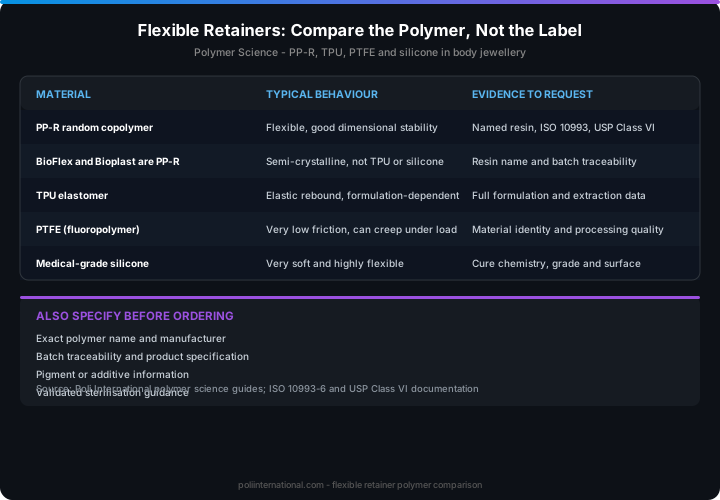
Comparison table of PP-R, TPU, PTFE and silicone flexible retainer materials
Infographic: Flexible retainer polymers compared by behaviour and evidence to request

2. Compare the polymer before comparing the product

FeaturePP-R random copolymerTPUPTFEMedical-grade silicone
Material familySemi-crystalline polypropylene copolymerThermoplastic polyurethane elastomerFluoropolymerCross-linked PDMS elastomer
Typical mechanical behaviourFlexible with comparatively good dimensional stabilityElastic rebound; formulation-dependentVery low friction; can creep under loadVery soft and highly flexible
Primary risk to assessMisidentified or counterfeit material; processing and sterilisation limitsAdditive or oligomer migration; formulation variabilityPermanent deformation and shape retentionSurface damage, contamination retention, or tissue bonding in unsuitable use
Relevant evidenceNamed resin, ISO 10993 data, USP Class VI documentationFull formulation and extraction or cytotoxicity dataMaterial identity and processing qualityCure chemistry, grade, surface, and biocompatibility data
Useful applicationsOral, cartilage, eyebrow, high-movement, MRI-compatible, and long-term jewelry where certifiedUse only when the exact medical formulation and intended contact are documentedLow-friction retainers and selected established channelsSoft plugs, tunnels, and selected fully healed applications
Sterilisation questionConfirm validated cycle; do not assume every method is suitableFormulation-specificMethod- and geometry-specificCure- and product-specific

The table is a selection framework, not a ranking. Material performance is application-specific. A very soft polymer may feel comfortable in the hand yet deform excessively in a channel. A more elastic polymer may recover its shape well but carry a greater documentation burden because TPU properties vary substantially with hard-segment chemistry, catalysts, stabilisers, pigments, and processing history.

For studios, the useful question is not “Which plastic is safest?” It is: Which identified material has evidence for this contact, this anatomy, this duration, and this sterilisation process?

3. The technical issue is dimensional stability, not softness

A fresh or irritated piercing is a mechanically active system. Clothing catches, sleeping positions apply leverage, facial movement changes the direction of force, and oral jewelry is repeatedly loaded by teeth, lips, and gums. A rigid bar can transmit force directly into the channel. A flexible product can reduce that leverage—but excessive softness or creep can create a different problem by allowing the jewelry to bend, migrate, or change its effective geometry.

Creep is time-dependent deformation under sustained load. Stress relaxation is the reduction in internal force when a polymer is held at a fixed deformation. Both are relevant to retainers. The practical consequence is that a product that looks correctly sized at insertion may not behave the same way after weeks of pressure, heat, movement, and exposure to saliva or cleaning agents. The studio must evaluate the finished jewelry, not merely the resin’s marketing description.

PP-R products such as BioFlex® and Bioplast are not equivalent to soft silicone or TPU simply because all are flexible. Their semi-crystalline structure gives them a different balance of stiffness, flexural recovery, and shape retention. Available product information identifies BioFlex® as certified as passing the ISO 10993 biological tests and built on a USP Class VI resin; those are useful indicators, but they do not eliminate the need to inspect the actual supplier and product.

TPU requires especially careful specification. “Medical-grade TPU” can describe multiple formulations, and the phrase does not reveal whether the product contains pigments, processing aids, stabilisers, residual oligomers, or other extractable substances. A supplier should be able to identify the formulation and provide relevant testing rather than relying on a generic statement that TPU is used in medical devices.

PTFE has a long medical history and very low friction, making it useful in selected retainer applications. Its weakness is mechanical: under sustained tissue pressure, thin or poorly supported PTFE can deform permanently. This is why low friction should not be confused with excellent shape retention. The comparison of PTFE and PP-R retainers is most useful when it is read as a geometry-and-use comparison rather than a claim that one polymer replaces every other option.

Silicone occupies a different position again. Medical-grade silicone can be extremely soft and comfortable, but softness increases the importance of surface finish, geometry, cleanliness, and tissue condition. Silicone products should not be selected solely because they are pliable. Cure system, grade, surface texture, and intended use all matter.

4. Patrick's Note: The Fear Behind “Flexible”

The thing you are actually worried about is that a flexible retainer will quietly turn a clean piercing into a material experiment. It will not—if you know what polymer you are buying and why it belongs in that particular anatomy.

“Flexible” is not a certification, and “medical” is not a molecular formula. PP-R, TPU, PTFE, and silicone can all be useful, but they do not share the same chemistry or mechanical behaviour. BioFlex® and Bioplast are PP-R random copolymers; they should not be bundled into a TPU category simply because a catalogue wants fewer columns. The long-term wear record of flexible BioFlex® sports jewelry makes the practical point: flexibility is valuable when it reduces leverage without sacrificing the jewelry’s working shape.

5. FAQ: Technical Q&A

Q: Is TPU interchangeable with BioFlex® or Bioplast?

No. BioFlex® and Bioplast are PP-R random copolymers, while TPU is a polyurethane elastomer with different chemistry and formulation variables. A studio should assess each product by its own resin identity, certification, finished geometry, and sterilisation instructions.

Q: Which locations benefit most from flexible jewelry?

Oral piercings can benefit when the jewelry’s design reduces contact with teeth and gums. Eyebrow, cartilage, and other high-movement sites may also benefit because flexible jewelry can reduce levering during sleep, sport, clothing changes, or accidental impact. The piercer still must select appropriate length, gauge, ends, and placement; flexibility does not correct poor sizing.

Q: What documentation should a retailer request from a supplier?

Request the exact polymer name, manufacturer, product specification, batch traceability, biocompatibility evidence, pigment or additive information, and validated sterilisation guidance. For PP-R, ISO 10993 and USP Class VI documentation are relevant evidence points; for TPU, silicone, and PTFE, the evidence must correspond to the exact formulation and finished product rather than to the polymer family in general.

Conclusion: Specify the Material

A safe flexible-retainer policy begins with polymer identification, not colour, price, or the word “medical.” PP-R, TPU, PTFE, and silicone can serve different clinical and practical roles, but they must not be treated as interchangeable soft plastics.

For purchasing teams, the immediate action is simple: remove anonymous polymer jewelry from the approved list, record the material and certification for every retained product, and match the polymer’s mechanical behaviour to the anatomy and use case. The technical guide to medical-grade elastomers for body jewelry provides the appropriate comparison framework for that audit.

Further Reading

  • Medical Elastomers for Body Jewelry: PP-R, TPU, PTFE, and Silicone Are Not Interchangeable
  • How Long Can You Wear BioFlex®? The Creator Answers
  • Creep and Stress Relaxation in Polymer Body Jewelry: Why Flexible Materials Lose Their Shape
  • Mind map · Flexible Retainers in 2026: Why Polymer Identity Matters More Than the Word “Medical”

    • Flexible Polymer Retainers in 2026
      • Polymer Identity Over Generic Labels

        BioFlex and Bioplast are polypropylene random copolymers rather than TPU elastomers. [Flexible Retainers in 2026: Why Polymer Identity Matters More Than the Word “Medical”]

        • Polypropylene Random Copolymer Identity
          • BioFlex and Bioplast PP-R Resins
          • ISO 10993 Implantation Certification
        • Pitfalls of Generic Medical Labels
          • Vague Marketing Language Risks
      • Specific Polymer Family Comparison Framework

        PP-R, TPU, PTFE, and silicone possess distinct molecular structures and sterilization limits. [Flexible Retainers in 2026: Why Polymer Identity Matters More Than the Word “Medical”]

        • Thermoplastic Polyurethane Formulation Variability
          • Additive and Oligomer Migration Risks
        • Fluoropolymer and Elastomer Characteristics
          • PTFE Low Friction Behavior
          • Medical Grade Silicone Pliability
      • Dimensional Stability and Mechanical Loading

        Polymer retainers undergo viscoelastic creep deformation and stress relaxation under tissue pressure. [Flexible Retainers in 2026: Why Polymer Identity Matters More Than the Word “Medical”]

        • Time Dependent Polymer Creep
          • Permanent Deformation Under Stress
        • Stress Relaxation Internal Decay
          • Reduction in Internal Retaining Force
      • Studio Supply Chain and Documentation

        Studios must require batch traceability and biocompatibility evidence while rejecting anonymous polymer jewelry. [Flexible Retainers in 2026: Why Polymer Identity Matters More Than the Word “Medical”]

        • Mandatory Supplier Verification Protocols
          • Batch Traceability and Resin Data
          • Validated Sterilization Guidance Verification
    StructureProcessMaterialHazard

    4 branches, 0 sources. Each branch cites the article it came from; the labels beneath it are names, not claims.

    Polymer Safety Quiz

    1. 1. What specific chemical material family do BioFlex® and Bioplast body jewelry belong to?

      • ✓ Polypropylene random copolymer (PP-R) — BioFlex® and Bioplast are semi-crystalline polypropylene random copolymers rather than urethane or rubber elastomers.
      • • Thermoplastic polyurethane elastomer (TPU) — TPU represents a chemically distinct family of polyurethane elastomers with different formulation variables and processing additives.
      • • Fluoropolymer (PTFE) — PTFE is a low-friction fluoropolymer, whereas BioFlex® and Bioplast are polypropylene-based materials.
      • • Cross-linked PDMS elastomer (Silicone) — Silicone consists of cross-linked polydimethylsiloxane, which exhibits very soft elastomer behavior unlike semi-crystalline PP-R.
    2. 2. Which pair of evidence standards specifically validates the biocompatibility and resin safety of BioFlex® material?

      • ✓ ISO 10993 testing and a USP Class VI resin base — The source material identifies BioFlex® as holding ISO 10993 certification and utilizing a USP Class VI biocompatible resin base.
      • • ASTM F136 specifications and ISO 5832-3 compliance — ASTM F136 and ISO 5832-3 apply to implant-grade metallic titanium alloys rather than flexible polymers.
      • • ISO 9001 quality management and USP Class IV classification — ISO 9001 covers general manufacturing quality management systems rather than specific polymer biocompatibility testing.
      • • ASTM F2999 jewelry guidelines and ISO 13485 registration — While ISO 13485 covers medical device quality management, the specific evidence cited for BioFlex® resin safety includes ISO 10993 and USP Class VI.
    3. 3. In polymer mechanics, how is 'creep' defined when evaluating flexible retainers?

      • ✓ Time-dependent deformation under sustained load — Creep describes how a polymer slowly changes shape or deforms permanently over time when subjected to continuous pressure.
      • • The reduction in internal force when held at a fixed deformation — This definition describes stress relaxation rather than creep.
      • • Immediate elastic recovery after physical bending — Immediate shape recovery refers to elastic rebound rather than time-dependent creep.
      • • The release of additives and oligomers into surrounding tissue — Chemical leaching refers to additive migration or extraction rather than mechanical deformation.
    4. 4. Despite its low surface friction, what is the main mechanical weakness of PTFE retainers under continuous tissue pressure?

      • ✓ Permanent deformation and shape retention loss under sustained load — Thin or unsupported PTFE can creep and permanently bend under continuous mechanical pressure from surrounding tissue.
      • • High surface drag that irritates healing tissue channels — PTFE is noted for having extremely low surface friction, making high drag inaccurate.
      • • Rapid dissolution when exposed to human saliva — PTFE has high chemical resistance and does not dissolve in body fluids.
      • • Excessive elasticity that snaps jewelry back with leverage — PTFE lacks high elastic rebound and is prone to plastic creep under load instead.
    5. 5. Why does generic 'medical-grade TPU' require more detailed documentation than simply relying on its marketing label?

      • ✓ TPU properties vary significantly due to additives, stabilisers, pigments, and catalysts — TPU encompasses wide formulation variations, meaning exact additive content and extraction data must be verified for the specific product.
      • • TPU cannot be safely manufactured without heavy toxic metal bases — TPU can be formulated for medical applications, but individual formulations differ in additives and processing aids.
      • • TPU is chemically identical to semi-crystalline polypropylene — TPU is a polyurethane elastomer, chemically distinct from semi-crystalline polypropylene copolymers.
      • • TPU permanently hardens into rigid glass upon contact with body heat — TPU remains an elastomer at body temperature and does not undergo thermal vitrification in tissue channels.
    6. 6. What primary risk must be evaluated when using medical-grade silicone retainers in unsuitable or unhealed applications?

      • ✓ Surface damage, contamination retention, or tissue bonding — Extremely soft silicone requires careful surface finish and application assessment to avoid trapping contaminants or sticking to compromised tissue.
      • • High mechanical leverage transmitted directly to the channel — Silicone is exceptionally soft and flexible, meaning excessive rigid leverage is not its primary risk.
      • • Magnetic torque interference during nuclear magnetic resonance imaging — Silicone is non-metallic and non-magnetic, making magnetic torque irrelevant.
      • • Excessive stiffness that prevents physical bending — Silicone is categorized as a very soft, highly flexible cross-linked elastomer.
    7. 7. How does 'stress relaxation' manifest in a flexible polymer bar held in a bent position within a piercing?

      • ✓ Internal forces within the polymer decrease over time while held at fixed deformation — Stress relaxation specifically describes the reduction in internal restoring force when a material remains deformed at a constant shape.
      • • The bar continuously expands in outer diameter until filling the channel — Stress relaxation involves internal force decay, not volumetric thermal expansion.
      • • The polymer rapidly shifts from an amorphous to a metallic crystal matrix — Polymers do not transform into metallic crystal matrices during mechanical loading.
      • • The material absorbs water until its tensile strength doubles — Stress relaxation is a mechanical viscoelastic force reduction, not a moisture-induced strengthening mechanism.
    8. 8. Under what condition does flexible jewelry effectively reduce mechanical loading in high-movement anatomical sites?

      • ✓ When the jewelry maintains dimensional stability while flexing — Flexibility only prevents leverage damage if the retainer holds its intended structural shape rather than bending out of control or creeping.
      • • When the material is soft enough to bend without any internal resistance — Excessive softness allows jewelry to migrate or collapse, creating alternative mechanical issues.
      • • When the retainer completely eliminates the need for correct length sizing — Flexibility does not compensate for incorrect initial length, gauge, or placement by the piercer.
      • • When the polymer is uncertified and anonymous to ensure maximum pliability — Anonymous materials present unverified health and creep risks regardless of how soft they feel.
    9. 9. What documentation should a studio demand from a supplier before placing a flexible polymer product on their approved list?

      • ✓ Exact resin name, batch traceability, biocompatibility testing, and validated sterilisation cycle — Proper safety verification requires identifying the exact raw resin, manufacturing batch, biological safety data, and compatible sterilisation protocol.
      • • A standard marketing claim verifying the product is plastic and medical-grade — The word 'medical' is a non-specific marketing label that does not substitute for chemical resin specifications and testing.
      • • A verbal guarantee that the polymer is soft and flexible to the touch — Tactile feel in hand provides no technical data regarding biocompatibility, additive migration, or creep behaviour.
      • • Trade association endorsements in place of ISO or USP material test reports — Trade associations do not issue material test standards or regulate chemical safety; formal test data (e.g., ISO, USP) is required.
    10. 10. What structural characteristic gives PP-R copolymers like BioFlex® distinct flexural recovery compared to TPE elastomers?

      • ✓ A semi-crystalline polymer molecular structure — The semi-crystalline structure of PP-R random copolymers provides a specific balance of stiffness, flexural recovery, and dimensional stability.
      • • A fully cross-linked silicone PDMS network — Cross-linked PDMS networks are unique to silicone elastomers, not polypropylene copolymers.
      • • An amorphous fluoropolymer molecular matrix — Fluoropolymers like PTFE have distinct carbon-fluorine structures, unlike polypropylene random copolymers.
      • • Variable hard-segment polyurethane block linkages — Hard-segment polyurethane linkages define TPU materials, not semi-crystalline PP-R copolymers.

    Extended Reference Table

    8 of 8 rows

    Extended reference table generated from the article and its verified research sources. Bracketed numbers jump to the matching entry in the Technical References below.

    SafetyItem, Material, Practice or Standard Material Class or Description Manufacturing Process Compliance Standards Key Properties or Limitations Recommended Applications Source
    ✅BioFlex / Bioplast (PP-R)Medical-grade polypropylene random copolymer (PP-R); semi-crystalline thermoplastic (~40-55% crystallinity) with ethylene copolymerizationInjection-moulded as a single piece or extruded; compatible with 134 °C autoclave (8-12 cycles)ISO 10993; USP Class VI; REACH SVHC-freeFlexible; flexural modulus approx. 1,200 MPa; melting point 145-155 °C; autoclavable; non-porous; radiolucent; zero nickel content; density 0.90 g/cm3; undergoes chain scission and becomes brittle under gamma radiation; viscoelastic response where crystalline fraction acts as physical crosslinks slowing creep; reduces mechanical loading while maintaining working shape; quality depends on genuine manufactureInitial and long-term body piercings; oral, eyebrow, cartilage, and high-movement sites; pregnancy navel bars; MRI-safe retainers and surgery-related swaps; dental splints[9] [10] [11]
    ✅PTFE (Polytetrafluoroethylene / Teflon)Synthetic fluoropolymer; fully fluorinated carbon backbone -(CF2-CF2)n-; extremely low surface energy (18-20 mN/m) with weak interchain forcesExtruded as rod, CNC machined, or compression molded (cannot be injection-moulded); cannot be autoclaved under load; requires EtO or gas plasma sterilizationUSP Class VI; ASTM D1894; ASTM F754; EN 1811:2023; ISO; FDA; RoHSLowest coefficient of friction (0.05–0.10); flexural modulus ~500 MPa; max service temp <180 °C long term (max service temp 260 °C); exhibits cold flow and high creep especially above 100 °C where heat and load can loosen threaded connections; maximum chemical inertness; resists biofilm adhesion; fails in load-bearing surgical applications; non-metallic and lightweight; decorative ends threaded onto PTFE rod rotate freely; potential for poor fit or finish during long-term useInitial piercings for nickel-sensitized patients; mucosal tissue contact contact; large gauge plugs/jewelry; retainers and nonmetallic replacements for medical/dental examinations or surgeries; historical surgical implants[9], [10], [11]
    ✅Surgical Steel (316L / 316LVM)Chromium-Nickel-Molybdenum low-carbon stainless steel (6–15% nickel trapped under a chromium oxide layer); austenitic surgical stainless steelWrought steel processing; must be polished to a smooth mirror finish free of nicks, scratches, and burrsASTM F138; ISO 5832-1; EN 1811:2023; ISO 10993-6; ISO 10993-10; ISO 10993-11; EEC Nickel DirectiveRigid metal (~193 GPa Young's modulus; 400x stiffer than flexible polymers); durable; density ~8.0 g/cm3; initially non-magnetic; nickel release rate < 0.2 µg/cm2/week; compliant forms are inert and biocompatible and withstand autoclave heat and pressure; non-compliant or 316 grade chromium oxide layer is susceptible to corrosion by chlorine/saline and can cause soft tissue/nerve damage, excess scar tissue, or allergic reactions in up to 10% of populationBody piercing jewelry for initial or settled piercings and low-movement sites requiring positional stability; temporary surgical implants (staples, wires); short-term wear (<24hrs) in fully healed piercings; prohibited for initial piercings or implants in Europe if non-compliant[9] [10] [12]
    ✅Titanium / Titanium Alloys (Ti6Al4V ELI / Commercially Pure)Lightweight metal; Titanium alloy with 6% Aluminum and 4% Vanadium (Extra Low Interstitials) or commercially pure titaniumMechanical mirror polishing followed by electropolishing and ASTM F86 surface preparation; can be anodized for colorASTM F136; ASTM F1295; ASTM F67; ISO 5832-3; ASTM F86High strength-to-weight ratio (tensile ~860 MPa); non-ferromagnetic; radiolucent; density ~4.5 g/cm3; excellent corrosion resistance; high creep resistance; non-toxic and highly biocompatible; ideal for nickel sensitivity; withstands autoclave sterilization; anodized colors are aesthetically versatile but may fade from friction, body chemistry, chlorine bleach, or strong oxidizers; contains metal so unsafe for MRIs requiring non-metallic jewelryInitial body piercings and long-term wear; oral piercings (tongue, lip, labret); permanent surgical implants and orthopedic implants; bone scaffolds; MRI environments (when non-metallic non-interference is not required)[9] [10] [12] [11]
    ✅Medical-Grade Silicone (PDMS)Polydimethylsiloxane (PDMS) elastomer / silicone rubber; platinum-cured preferred; thermoset elastomer with permanent chemical crosslinksPlatinum-curing; compression molding, transfer molding, injection molding, overmolding, or extrusion; crosslinked; compatible with 134 °C autoclave, EtO, and gas plasmaISO 10993; USP Class VI; EN 1811:2023; ASTM D2240; ASTM D624 Die BShore A 30–70; elongation at break 300–700%; tensile strength 7–10 MPa; tear strength 25-45 kN/m; high flexibility and elastic rebound; hydrophobic; non-toxic and avoids immunological rejection; high crosslink density provides high creep resistance; low tear strength makes it unsuitable for jewelry with sharp edges or screw threads; experiences stress relaxation; risks include surface damage, contamination retention, or tissue bonding if used improperlyPlugs, tunnels, o-rings, sealing components, and flexible retainers for medical devices, catheters, stents, surgeries, and medical imaging[9] [10]
    ✅Bioabsorbable Polymers (P(4HB) / PHA / PLA)Resorbable aliphatic polyesters; bio-derived PHA homopolymers, copolymers (P34HB), or bio-based PLABacterial fermentation under nitrogen stress for PHA; synthesized polymer for PLAFDA approved / GRAS; USP Class VI; ISO 13485; ISO 10993; EN 1811:2023Highly ductile and elastic (PHA elongation 300-1,014%, tensile strength 13.8-150 MPa, Tm 53-180 °C); tunable stiffness (flexural modulus 1,000–3,500 MPa); degrades via hydrolysis into non-inflammatory byproducts (4-hydroxybutyrate or lactic acid); deforms under autoclave heat; sensitive to gamma radiationAbsorbable surgical sutures and fixation devices; heart valve scaffolds; mesh for soft tissue repair (GalaFlex); wound dressings; temporary biodegradable implants[9]
    ✅Filled PTFE (Glass, Carbon, Graphite, or Bronze)Particle-reinforced fluorinated thermoplastic matrixCompounding virgin PTFE with rigid filler particlesASTM D621; ASTM D638; ISOReduces creep by 30–70% compared to virgin PTFE; increased rigidity; chemical resistance may be compromised depending on filler particle typeReinforced gaskets and mechanical components for high-load or corrosive environments
    ✅ASTM F86 Surface Passivation and PolishingStandard surface treatment and cleaning practice for metallic surgical implantsMechanical mirror polishing followed by electropolishing to remove contaminants (tumbling media, polishing compounds, dust, fingerprints) and electro-chemical passivationASTM F86Ensures the smoothest and cleanest metal surface; prevents callused scar tissue and inflammation caused by surface imperfections or particulate contaminantsPreparation and finishing of all metallic body jewelry prior to insertion[12]

    Free Body Art Wall Posters

    Print-ready reference posters for your studio or your own wall. Free to download and display, embed on your own site with attribution. Click any poster to preview it full size before downloading.

    Choose and download all 40 posters

    Technical_References_Archive

    About the Author

    PP

    Patrick Poli

    Chief Engineer, Poli International · Creator of BioFlex® body jewelry

    Patrick has spent 25+ years manufacturing body jewellery and studio equipment, and is the creator of BioFlex® body jewelry. He developed antimicrobial silver-ion body jewellery with Clariant’s polymer laboratory, years before a pandemic made the idea obvious. He also spent two years developing it as a PP-R random copolymer, tested to ISO 10993 and built on a USP Class VI resin.

    More about Patrick →

    Last reviewed: 2026-10-04 · Published: 2026-10-03

    Continue Reading