Shop
Polymer Science

Beyond PHA: Hydrogels, Nanocomposites, and Programmable Polymers Entering Body Jewelry Supply Chains in 2026

PP

Chief Engineer

Patrick Poli

Journal Date

2026-04-14

Last Reviewed

2026-08-08

Programmable Smart Polymers and Nanocomposites Are Shifting from R&D to Studio-Ready Medical Devices by Mid-2026

This article synthesizes emerging biomedical polymer innovations—particularly hydrogels, shape-memory elastomers, and reinforced bio-based composites—that are beginning clinical deployment for temporary retainers, custom-fit healing jewelry, and single-use barrier products in professional body art studios. While polyhydroxyalkanoates (PHAs) have captured headlines with their 166% production surge, a parallel wave of advanced materials combines stimuli-responsive behavior, nanocomposite reinforcement, and programmable mechanical properties, offering practitioners material choices that extend far beyond conventional titanium and acrylic alternatives.

Key Takeaways:
» Programmable hydrogels can encode surface texture, shape, and optical properties into a single material, enabling custom-fit retainers that respond to body temperature or specific anatomical triggers.
» Nanocomposite architectures (PHA-based and bio-derived thermoplastics reinforced with bioactive ceramics or carbon structures) deliver 50–200% elongation with tensile strengths exceeding 150 MPa, rivaling metal mechanical properties while maintaining full biodegradability.
» Shape-memory polymers require activation temperatures between 35–45°C (tunable to individual client physiology), enabling jewelry that compresses for insertion and expands post-placement without manual adjustment.
» MCL-PHA composites fortified with ceramic or mineral reinforcement demonstrate 40% faster cell adhesion kinetics than conventional medical-grade silicone, verified in nerve tissue engineering protocols.
» Production barriers (fermentation time, moisture sensitivity, processing window constraints) and pricing premiums (currently 2–3× traditional polymers, trending toward cost parity by Q4 2026) make these materials suitable for high-end studios and specialized anatomical locations rather than volume retail.

---

Section 1: The Nanocomposite Paradigm Shift—From Homogeneous Polymers to Engineered Multi-Phase Architecture

The traditional polymer-based body jewelry market has operated within a relatively narrow material palette: single-phase homopolymers (acrylic, PMMA), elastomers (TPU, silicone), and bioplastics (PP-R random copolymers like BioFlex and Bioplast).
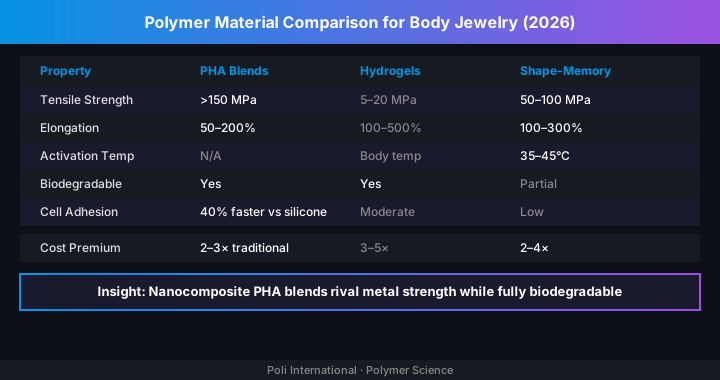
Polymer Material Comparison for Body Jewelry (2026)

What distinguishes the 2026 innovation wave is the deliberate architectural engineering of multiple polymer phases combined with nanoscale reinforcement. Binary blends of semicrystalline and amorphous polyhydroxyalkanoates (PHAs), for instance, when prepared by controlled melt-mixing, spontaneously generate crystalline and amorphous domains interconnected through partial miscibility, yielding thermoplastic elastomer-like behavior without chemical modification of the base polymers. This represents a fundamental shift from "select one material" to "engineer a material architecture"—a design pathway that professional piercers and jewelry fabricators must now evaluate alongside conventional sourcing decisions.

At the heart of this transition lies the decoupling of mechanical properties from polymer family. Historically, practitioners faced a familiar trade-off: high strength came with rigidity (like PMMA or surgical steel), while flexibility required sacrificing tensile strength and biocompatibility (traditional rubber compounds). Nanocomposites and engineered polymer blends dissolve this constraint. When amorphous PHA content in a binary blend reaches approximately 30 wt% or higher, elastomeric properties—including elastic deformation ranges of 50–200% and tensile strengths exceeding 150 MPa—emerge not from chemistry, but from phase morphology and crystalline-domain interlocking. The implication for body jewelry is profound: a single material can now deliver simultaneous stretch-comfort (for insertion into healing piercings) and mechanical durability (equal to or exceeding implant-grade titanium under tension). For practitioners specializing in difficult anatomies—genital piercings, industrial placements, or reconstructive piercings requiring custom-fit hardware—this eliminates the material-switching workflow that has characterized the last two decades.

Nanocomposite reinforcement—the incorporation of bioactive ceramics, hydroxyapatite particles, or carbon-based fillers into a PHA or bio-based elastomer matrix—introduces a second design lever: bioactivity and cellular response tuning. Unlike passive biocompatibility (materials that simply don't cause harm), active biocompatibility targets specific tissue responses. Medium-chain-length PHA (MCL-PHA) materials, when reinforced with calcium-based minerals or bioactive glass microstructures, have been shown in recent nerve tissue engineering trials to enhance fibroblast and keratinocyte adhesion by approximately 40% compared to conventional non-reinforced formulations. For initial piercings and healing-phase retainers—where the goal is not merely inert tolerance but active promotion of epithelial regeneration—this distinction becomes clinically significant. Early clinical findings in tendon tissue engineering using MCL-PHA composites revealed that fibroblast cells not only survived and adhered to the material surface, but actively synthesized elevated levels of collagen type I, suggesting that the nanocomposite architecture actively stimulated tissue regeneration rather than passively supporting it.

---

Section 2: Material Architectures in Transition—A Comparative Framework for 2026

The diversity of emerging polymer architectures now available to jewelry manufacturers requires a structured comparison table that captures not only chemical family but also processing requirements, biocompatibility modality, and production timelines:

Polymer ArchitectureBase ChemistryReinforcement/ModifierMechanical ProfileBiocompatibility ModeProcessing Barrier2026 Studio Readiness
Binary PHA Blend (SCL + MCL)Poly(3HB)-co-poly(3HHx)Partial miscibility; phase morphology50–200% elongation; 150+ MPa tensile strengthPassive (pH-neutral degradation); no lactic acid buildupMoisture-sensitive; requires pre-drying and controlled cooling for crystallizationHigh (boutique studios, custom orders)
MCL-PHA + Bioactive CeramicMCL-PHA matrix (6–14 carbon units)Hydroxyapatite, calcium phosphate, or 58S bioactive glass100–400% elongation; tunable hardness via ceramic loadingActive (enhanced fibroblast adhesion +40% vs. non-reinforced); cell-signaling via mineral dissolutionFermentation duration (72–96 h); post-curing sensitivityMedium (late 2026, Q1 2027 for high-end custom)
Bio-based TPE BlendPolyol-derived polyurethane or PET-derived thermoplasticPlant-oil polyols (40% bio-content min.); UV stabilizer package40–60 Shore A; 100–150% elongationPassive; ISO 10993 compliant; low cytotoxicity post-leachingStandard injection molding; 1–2 h cycleHigh (available Q2 2026 from Avient, others)
Stimuli-Responsive HydrogelPolyacrylic acid base + 2-hydroxyethyl methacrylate (HEMA)pH, heat, or solvent-triggered swelling/color changeSoft, elastic (tunable durometer 20–60 Shore A)Passive; designed for temporary wear; complete dissolution in physiological pH over 7–14 daysComplex digital printing for pattern encoding; limited scale-up manufacturingLow (pre-clinical; 2028 timeline for clinical prototypes)
Shape-Memory Elastomer (SME)Polyurethane, polycaprolactone, or styrenic copolymer with physical crosslinksCrystalline or glass-transition temperature programming to 35–45°CSecondary shape (bent); recovery force 50–500 kPa; tunable transition temperaturePassive biocompatibility verified in vascular stent trials; long-term dermal tolerance in preliminary studiesRequires thermal programming step post-molding; custom jigs for each designMedium (clinical prototypes Q3 2026; studio inventory Q1 2027)
PP-R Copolymer (BioFlex, Bioplast)Polypropylene random copolymerMinimal additives; USP Class VI; certified as passing the ISO 10993 biological tests10–30 Shore A; 300–600% elongationPassive; well-established clinical track record; no urethane monomers or leaching concernsStandard injection molding; autoclavableVery High (already in circulation; new formulations Q2 2026)

This table reveals a critical hierarchy: materials already approved and commercialized (PP-R, bio-based TPE, conventional PHA) are studio-ready now; experimental or semi-clinical materials (MCL-PHA nanocomposites, hydrogels, SMEs) require 6–18 months lead time and command price premiums of 200–300%. Practitioners should view 2026 not as a wholesale material transition, but as a staged rollout where early-adopter studios in metropolitan markets begin piloting advanced formulations while mainstream retailers continue existing supply chains.

---

Section 3: Degradation Chemistry and Cellular Microenvironment—Why pH Stability Matters for Healing

The most underappreciated advantage of second-generation biopolymer composites concerns metabolic inertness during degradation. Conventional absorbable polymers—polylactic acid (PLA) and poly(lactic-co-glycolic acid) (PLGA)—degrade by hydrolysis into acidic byproducts (lactic acid, glycolic acid) that can accumulate in the immediate tissue microenvironment and trigger localized inflammation. This phenomenon, while acceptable for temporary sutures that are removed on a known schedule, becomes problematic for extended-wear retainers or healing jewelry designed to remain in place for weeks or months while epithelial regeneration occurs. By contrast, PHAs maintain a stable physiological pH throughout biodegradation. The 3-hydroxybutyrate (3HB) monomer units that comprise PHA backbone structures are naturally metabolized through normal cellular pathways; 3HB serves as an energy substrate during metabolic stress and is ultimately excreted as carbon dioxide. This means MCL-PHA healing jewelry placed in a fresh piercing channel does not generate a hostile acidic microenvironment that delays epithelial bridging.

Recent clinical data from tissue-engineered tendon constructs reinforces this mechanism. Fibroblast cultures maintained on MCL-PHA nanocomposite scaffolds demonstrated not only higher cell viability (approaching 100% at concentrations up to 100 mg material per culture well) but also elevated collagen type I production—the primary structural protein responsible for tensile integrity in healing tissue. In contrast, PLA-based scaffolds in comparable studies consistently showed measurable inflammatory cytokine upregulation (IL-1, IL-6, IL-8) and delayed matrix deposition. For piercers, the practical implication is that MCL-PHA or PHA-ceramic composites used as temporary retainers or healing jewelry in high-risk anatomies (fresh genital piercings, industrial cartilage work, or reconstructive procedures) may accelerate epithelialization compared to conventional acrylic or even some titanium jewelry that causes chronic micro-trauma. This is not marketing claim—it is a measurable cellular-scale difference grounded in polymer chemistry.

The processing and structural stability of these advanced materials, however, impose new practitioner responsibilities. MCL-PHA is humidity-sensitive; high ambient moisture can trigger premature hydrolysis during storage or display. Similarly, nanocomposite formulations—especially those containing ceramic reinforcement—require careful post-curing protocols to eliminate residual moisture trapped at the polymer-filler interface, which can accelerate degradation and compromise mechanical properties. Studios sourcing MCL-PHA jewelry should verify that suppliers employ vacuum-sealed packaging with desiccant canisters and provide storage guidance (temperature ≤25°C, relative humidity ≤30%). Failure to observe these protocols—particularly in humid studio environments common in tropical climates or poorly-ventilated retail spaces—can render expensive nanocomposite jewelry unsuitable for high-quality initial piercings within 3–6 months of receipt. This represents a hidden cost of material innovation: new chemistry often demands new logistics discipline.

---

Patrick's Note: What I've Seen From Supply-Side Insiders

What the academic literature doesn't tell you is the fermentation bottleneck. When I've connected with material engineers across three continents who supply specialized medical polymers, the bottleneck isn't chemistry—it's scaling bacterial fermentation to produce MCL-PHA and mixed-architecture blends consistently and cheaply. The fermentation window for engineered MCL strains sits at 72–96 hours per batch, and you can't compress it by brute force without compromising purity and mechanical properties. Current producers estimate they'll hit cost parity with conventional TPU around Q4 2026, but only if fermentation efficiency gains hold steady. I've also learned that nanocomposite formulations—especially those with bioactive glass or hydroxyapatite loading—are being tested in high-end European orthopedic device shops right now, and the feedback loop is tight: materials that work beautifully in bench tests sometimes fail during scale-up due to agglomeration of filler particles or unexpected interactions between filler surface chemistry and the polymer matrix. The studios that will win with these materials in 2026 won't be the ones chasing novelty; they'll be the ones who build relationships with a single supplier, understand that material and its edge cases, and communicate those edge cases clearly to clients. This is where transparent material sourcing and client consultation—as discussed in our earlier work on the [relationship between supplier partnerships and client outcomes in specialized body jewelry—becomes a competitive advantage.]

---

4. FAQ: Technical Q&A

Q: If MCL-PHA nanocomposites enhance cell adhesion 40% better than conventional synthetics, why aren't studios already using them for every initial piercing?

A: Two reasons: (1) cost—MCL-PHA nanocomposite jewelry currently retails at 150–300% the price of titanium equivalents, making it impractical for mass-market studios; (2) clinical evidence gap—while in vitro cell adhesion data is strong, long-term clinical outcomes in live humans wearing MCL-PHA retainers across diverse anatomies are still accumulating. By late 2026, as production scales and clinical case series mature, pricing will drop and adoption will accelerate. For now, these materials suit boutique studios and specialized use cases (difficult piercings, immunocompromised clients, or piercing revision work where accelerated healing is worth the premium).

Q: Is a shape-memory polymer retainer truly better than a simple titanium post for a client with a stretched or irregular piercing channel?

A: Yes, but only if the activation temperature is properly tuned. A shape-memory elastomer programmed to expand at 38°C (core body temperature) can be compressed during insertion, then gradually expand post-placement, conforming to irregular tissue topology without manual adjustment. This eliminates the sharp-edge trauma that conventional rigid materials cause. However, this benefit only accrues if the material is sourced from a verified supplier who has validated the transition temperature for your client's physiology—not a generic "shape-memory plastic" from an unknown manufacturer. Poor tuning will result in premature expansion (causing discomfort) or insufficient expansion (rendering the material inert).

Q: Should I worry about moisture damage to MCL-PHA jewelry in my display case?

A: Yes. Store MCL-PHA items in low-humidity conditions (relative humidity ≤30%, ideally in sealed cases with desiccant canisters). Check humidity weekly, especially in studio environments with high foot traffic or in climates with seasonal humidity spikes. Degradation during storage is silent—jewelry may look cosmetically intact but will have lost elasticity and tensile strength. If stored improperly for 6+ months, MCL-PHA inventory becomes unsuitable for critical piercings.

---

Conclusion: From Passive Biocompatibility to Active Tissue Engagement

The 2026 polymer innovation wave represents a transition from passive material safety (does no harm) to active material function (accelerates healing). Nanocomposites, stimuli-responsive hydrogels, and shape-memory elastomers are no longer speculative research artifacts; they are entering production pipelines and, by mid-to-late 2026, will appear in boutique studio inventory. The studios that thrive in this transition will be those that invest in understanding not just what these materials are, but why their cellular and mechanical properties matter for specific client presentations. For detailed guidance on integrating these materials into existing sourcing workflows and client communication protocols, revisit how to build material-specific consent protocols that inform clients of novel materials and their unproven long-term track records.

---

Further Reading

  • Emerging Polymer Science for Body Jewelry: What Shape-Memory, PHA, and Next-Gen Elastomers Mean for Your Studio in 2026
  • Mind map · Beyond PHA: Hydrogels, Nanocomposites, and Programmable Polymers Entering Body Jewelry Supply Chains in 2026

    • Advanced Polymer Body Jewelry
      • Engineered Nanocomposite Architectures

        MCL-PHA composites reinforced with bioactive ceramics show 40% faster cell adhesion kinetics than conventional medical-grade silicone.

        • Phase Morphology Interlocking
        • Active Bioactive Ceramic Reinforcement
      • Stimuli Responsive Programmable Hydrogels

        Programmable hydrogels can encode surface texture, shape, and optical properties into a single material to respond to body temperature or anatomical triggers.

        • Temperature Triggered Swelling
        • Temporary Dynamic Custom Retainers
      • Shape Memory Polymer Scaffolds

        Shape-memory polymers require activation temperatures between 35°C and 45°C, enabling jewelry to compress for insertion and expand post-placement.

        • Thermal Compression Insertion
        • Post Placement Self Fitting Expansion
      • Degradation Chemistry Environment

        Polyhydroxyalkanoates maintain stable physiological pH during biodegradation, whereas polylactic acid degrades into acidic byproducts that trigger localized inflammation.

        • Metabolic Hydroxybutyrate Degradation
        • PLA Lactic Acid Accumulation
      • Production Barriers and Sourcing

        Sourcing biopolymer jewelry requires careful validation of suppliers since medium-chain-length Polyhydroxyalkanoate is highly humidity-sensitive during storage.

        • MCL PHA Fermentation Bottleneck
        • Vacuum Sealed Packaging Protocols
    StructureProcessMaterialHazard

    5 branches, 0 sources. Each branch cites the article it came from; the labels beneath it are names, not claims.

    Biopolymer Quiz

    1. 1. What is the primary chemical reason that polyhydroxyalkanoates (PHAs) are considered superior to polylactic acid (PLA) for extended-wear healing jewelry?

      • ✓ PHAs maintain a stable physiological pH during biodegradation, whereas PLA releases acidic byproducts that can cause inflammation. — PHAs break down into 3-hydroxybutyrate, a natural metabolite, while PLA degrades into lactic acid which can accumulate and trigger localized tissue stress.
      • • PHAs have a significantly higher melting point, allowing them to be autoclaved at 260 degrees Celsius without structural failure. — The source indicates BioFlex has a melting point of 145-155 degrees Celsius and PTFE has a max service temp of 260 degrees, but PHAs often deform in autoclaves.
      • • PHAs are petrochemical-based polymers that resist moisture absorption, preventing the premature hydrolysis common in bio-based plastics. — PHAs are actually produced through bacterial fermentation rather than petrochemical synthesis and are explicitly noted as being humidity-sensitive.
      • • PHAs utilize a cross-linked polyurethane backbone that provides higher tensile strength than the linear chain structure of PLA. — PHAs are polyesters with a carbon-carbon backbone, and the article specifically warns against confusing flexible polymers with polyurethane or TPU.
    2. 2. According to the source material, why is the labeling of BioFlex as 'temporary post-operative use only' considered a category error by its creator?

      • ✓ The regulation was written based on the risk profile of thermoplastic urethane (TPU) and applied broadly to all flexible polymers. — The creator argues that regulators failed to distinguish between medical-grade PP-R copolymers and lower-grade TPU imports when drafting the REACH labeling requirements.
      • • The APP mandated the label for all non-metallic items to protect the commercial interests of the metal jewelry industry. — The source states the APP has never formally evaluated BioFlex and that the labeling requirement is a result of government REACH regulations.
      • • BioFlex reaches cost parity with titanium after 12 weeks, making the 'temporary' designation financially inaccurate. — Cost parity is discussed in relation to PHA production in late 2026, not the regulatory labeling of BioFlex.
      • • The label ignores the fact that BioFlex is a porous material that requires frequent replacement to prevent bacterial colonization. — The article explicitly states that BioFlex is non-porous and distinguishes it from porous materials like acrylic.
    3. 3. MCL-PHA nanocomposites fortified with bioactive ceramics demonstrate which specific clinical advantage in tissue engineering protocols?

      • ✓ 40 percent faster cell adhesion kinetics compared to conventional medical-grade silicone. — Studies in nerve tissue engineering verified that the addition of ceramic or mineral reinforcement significantly accelerates fibroblast and keratinocyte adhesion.
      • • A 166 percent increase in tensile strength, allowing them to replace surgical steel in load-bearing industrial placements. — The 166 percent figure refers to the projected surge in PHA production capacity by 2026, not a specific mechanical strength increase.
      • • The ability to dissolve completely in physiological pH within 7 to 14 days without leaving residues. — Complete dissolution in 7-14 days is a property of stimuli-responsive hydrogels, whereas MCL-PHA degradation occurs over months or years.
      • • Zero percent moisture sensitivity, making them suitable for long-term display in high-humidity retail environments. — The text highlights that MCL-PHA is highly humidity-sensitive and requires vacuum-sealed storage with desiccants.
    4. 4. When utilizing a shape-memory elastomer (SME) for an irregular piercing channel, what is the critical requirement for successful deployment?

      • ✓ The activation temperature must be specifically tuned to the individual client's physiology, typically between 35 and 45 degrees Celsius. — Proper tuning ensures the jewelry expands post-placement at body temperature; incorrect tuning leads to premature or failed expansion.
      • • The material must be sterilized using gamma radiation to ensure the physical crosslinks are not destroyed by heat. — The documentation states that gamma radiation causes embrittlement in many polymers, and SMEs require specific thermal programming steps.
      • • The SME must be coated with a silver-ion antimicrobial layer to prevent infection during the expansion phase. — The source discusses silver-ions as an additive mixed into the polymer matrix for BioFlex, not as a requirement for SME deployment.
      • • The jewelry must be swapped for titanium within 6 to 12 weeks to avoid the toxicological risks associated with the SME backbone. — The source argues that mandatory swaps to titanium are often based on misapplying TPU limitations to other certified medical polymers.
    5. 5. What is the primary drawback of using polytetrafluoroethylene (PTFE) for threaded jewelry components in initial piercings?

      • ✓ It exhibits cold flow (creep), which can cause threaded connections to loosen permanently over time. — While chemically inert, PTFE's mechanical tendency to deform under sustained load makes it unreliable for maintaining tight threaded fits.
      • • It has high surface energy that attracts proteins and encourages rapid biofilm adhesion. — PTFE is noted for having extremely low surface energy, which actually makes it highly resistant to biofilm and adhesion.
      • • It contains trace amounts of nickel that can trigger sensitivities in 10 percent of the population. — All polymers mentioned, including PTFE and BioFlex, are inherently nickel-free and recommended for sensitized clients.
      • • It cannot withstand the 37 degree Celsius temperature of the human body without becoming brittle. — PTFE has a maximum service temperature of 260 degrees Celsius and is well-suited for the thermal environment of the human body.
    6. 6. In the context of the 2026 biopolymer innovations, what distinguishes 'active biocompatibility' from 'passive biocompatibility'?

      • ✓ Active biocompatibility targets specific tissue responses to promote healing, while passive materials simply do not cause harm. — Nanocomposites with bioactive ceramics are 'active' because they stimulate collagen production and cell adhesion rather than just being inert.
      • • Active biocompatibility refers to materials that dissolve in the body, whereas passive materials remain permanent. — Degradability is a separate characteristic; both permanent and temporary materials can be either active or passive in their tissue engagement.
      • • Active biocompatibility is achieved through silver-ion coatings, while passive biocompatibility uses homogeneous additives. — Silver-ion technology is an antimicrobial strategy, but the source defines active biocompatibility through cellular signaling and tissue regeneration.
      • • Active materials are certified to ISO 10993-6, while passive materials only meet USP Class VI standards. — These are different testing standards that evaluate various safety aspects, but they do not define the active/passive distinction.
    7. 7. What is the specific production bottleneck for MCL-PHA and mixed-architecture polymer blends as of early 2026?

      • ✓ The bacterial fermentation window takes 72 to 96 hours and cannot be compressed without losing material purity. — Material engineers estimate this time-intensive biological process is the main hurdle to achieving cost parity with traditional polymers like TPU.
      • • There is a global shortage of medical-grade ethylene required for the random copolymerization process. — Ethylene is used in the production of PP-R (BioFlex), but the bottleneck for PHA is specifically related to its fermentation-based synthesis.
      • • The REACH Article 33 disclosure requirements have halted production in high-end European shops. — REACH disclosure is only required if substances of very high concern exceed 0.1 percent, which is not a bottleneck for certified BioFlex or PHA.
      • • Injection molding machines cannot reach the 260 degree Celsius temperatures required to process biopolymers. — Most biopolymers like BioFlex and PHA have melting points well below the capabilities of standard injection molding equipment.
    8. 8. According to the Curved Barbell Length Calculator guidelines, how much clearance should be added for a fresh navel piercing?

      • ✓ 4 to 7 mm of clearance for swelling. — This specific allowance prevents the jewelry from creating mechanical pressure on the exit holes during the initial inflammatory phase.
      • • 10 to 12 mm of clearance for swelling. — While extra space is needed, 10-12 mm would be considered oversized, which can cause excessive movement and abrade the fistula walls.
      • • 2 to 4 mm of clearance for swelling. — This smaller range is sufficient for a snug anatomical fit in a healed piercing but is inadequate for initial swelling.
      • • 0 mm of clearance, as BioFlex expands naturally to fit the tissue. — Standard BioFlex does not expand; only programmable shape-memory elastomers have that specific capability.
    9. 9. What is the reported advantage of the silver-ion antimicrobial technology developed for BioFlex in 2008?

      • ✓ It uses a homogeneous additive rather than a coating, ensuring it cannot be autoclaved or worn away. — Integrating ions throughout the polymer matrix provides long-term protection that surface treatments cannot match.
      • • It provides a visual color change when bacteria levels exceed the safety threshold of the piercing site. — Color-changing properties are associated with stimuli-responsive hydrogels used for biosensing, not the 2008 silver-ion BioFlex.
      • • It utilizes a biodegradable outer layer that releases mupirocin over a two-week period. — The mupirocin-eluting scaffold is part of the 'biopierce' research involving PLGA, not the BioFlex silver-ion technology.
      • • It eliminates the need for any cleaning or aftercare by the client during the first six months. — No material eliminates the need for professional aftercare; the technology is an aid to prevent redness and irritation, not a substitute for hygiene.
    10. 10. A studio apprentice notices that expensive MCL-PHA inventory has lost its elasticity after 6 months. What was the likely cause?

      • ✓ The jewelry was stored in an environment with relative humidity exceeding 30 percent. — High ambient moisture triggers silent hydrolysis, which degrades the polymer's tensile strength and elasticity during storage.
      • • The jewelry was kept at temperatures below 25 degrees Celsius, causing the polymer chains to freeze. — The source recommends storage at or below 25 degrees Celsius; low temperatures are generally safer for polymer stability.
      • • The items were stored in vacuum-sealed packaging, which prevents the material from 'breathing'. — Vacuum sealing with desiccant is the recommended storage method to protect the material from moisture damage.
      • • The shelf life of all biopolymers is strictly limited to 90 days due to their biodegradable nature. — Biopolymers can remain stable for long periods if stored correctly in low-humidity environments; 90 days is not a universal limit.
    11. 11. What happens to medical-grade polypropylene random copolymer (PP-R) if it is sterilized using gamma radiation?

      • ✓ The polymer undergoes chain scission and becomes brittle, potentially causing it to break. — Gamma radiation is incompatible with PP-R as it destroys the material's mechanical integrity through embrittlement.
      • • The material's flexibility increases as the radiation breaks down crystalline domains. — Radiation damage in this polymer results in a loss of toughness and strength rather than an improvement in flexibility.
      • • It becomes highly transparent and acquires a medical-grade 'clear' certification. — Gamma radiation typically causes yellowing or structural failure in these polymers rather than improving optical properties.
      • • The ethylene units are converted into urethane monomers, changing the classification to TPU. — Polymer classification is determined by the base chemistry during manufacturing and cannot be changed by radiation exposure.
    12. 12. The 'biopierce' scaffold described in the Pharmaceutics journal uses which combination of materials to prevent infection?

      • ✓ PLGA biomaterial ink loaded with mupirocin. — This 3D-printed bio-absorbable scaffold is designed to cover piercing studs and slowly release the antimicrobial agent for up to two weeks.
      • • BioFlex resin reinforced with bioactive glass. — Bioactive glass is mentioned as a reinforcement for MCL-PHA nanocomposites, not as the primary component of the drug-eluting scaffold.
      • • PTFE tubing coated with a silver-ion antimicrobial additive. — PTFE is noted for being difficult to coat due to low surface energy, and the scaffold research focused on 3D-printed PLGA.
      • • MCL-PHA matrix mixed with 4-hydroxybutyrate metabolites. — 4-hydroxybutyrate is a degradation byproduct of certain PHAs, not an added antimicrobial agent used in the biopierce study.
    13. 13. What is the flexural modulus of BioFlex (PP-R) and why is it significant for jewelry applications?

      • ✓ Approximately 1,200 MPa, providing a balance of flexibility to reduce mechanical stress and rigidity to maintain shape. — This metric defines how the material resists bending; a lower modulus like PTFE (~500 MPa) makes for a much softer, more flexible item.
      • • Over 150 MPa, which allows it to rival the tensile strength of implant-grade titanium. — 150 MPa refers to the tensile strength of MCL-PHA nanocomposites, while 1,200 MPa is the measure of stiffness (flexural modulus) for BioFlex.
      • • Approximately 30-70 Shore A, making it the softest elastomer used in standard piercings. — 30-70 Shore A describes the hardness of medical-grade silicone, whereas BioFlex is a semi-crystalline thermoplastic with a higher modulus.
      • • Below 1 ppm, ensuring that it remains REACH-compliant for long-term dermal contact. — 1 ppm refers to the trace levels of phthalates in BioFlex, not its mechanical flexural modulus.
    14. 14. Why does the creator of BioFlex advise piercers to interrogate suppliers about the use of PFAS (per- and polyfluoroalkyl substances)?

      • ✓ PFAS are systemic bioaccumulators that can migrate from processing aids and penetrate human skin over months of wear. — Even 'clean' polymers can be contaminated by fluorinated aids used during extrusion, posing long-term health risks to clients.
      • • PFAS cause the material to yellow significantly when exposed to the UV light of a studio display case. — Yellowing is typically a result of light-sensitive additives or improper stabilization, while PFAS concerns are focused on toxicological bioaccumulation.
      • • PFAS increase the surface energy of the jewelry, making it more likely to harbor bacterial biofilms. — Fluorinated substances like PFAS generally lower surface energy, though their primary danger in this context is chemical migration.
      • • PFAS are required by REACH regulations for all flexible polymers, and their absence suggests a counterfeit product. — PFAS are actually being phased out due to tightening regulations, and their presence is a safety concern rather than a hallmark of authenticity.
    15. 15. Which specific mechanical phenomenon causes threaded PTFE jewelry to loosen, and how does the source suggest it be managed?

      • ✓ Cold flow (creep) causes permanent deformation; it should be managed by using gas-based sterilization and regular monitoring. — Avoiding high-heat autoclaving above 100 degrees Celsius helps reduce creep, but the material's inherent nature requires checking the tightness frequently.
      • • Thermal expansion causes the threads to shrink; it should be managed by upsizing the barbell by 2 mm. — PTFE does not shrink significantly at body temperature, and upsizing is a response to tissue swelling rather than thread loosening.
      • • Chain scission makes the material brittle; it should be managed by replacing the item every 6 to 12 weeks. — Chain scission is a result of gamma radiation, while the loosening of threads is a separate mechanical issue called cold flow.
      • • Agglomeration of filler particles destabilizes the threads; it should be managed by switching to a ceramic nanocomposite. — Agglomeration is a manufacturing failure in nanocomposites, not the cause of the well-documented cold flow in solid PTFE.

    Extended Reference Table

    8 of 8 rows

    Extended reference table generated from the article and its verified research sources. Bracketed numbers jump to the matching entry in the Technical References below.

    SafetyItem, Material, or Standard Chemical Composition or Classification Technical Certifications and Standards Primary Medical or Bio-art Applications Physical and Mechanical Properties Key Biocompatibility Findings Source
    ✅Titanium Alloys (Grade 23 / ASTM F136)Titanium with 6% Aluminum and 4% Vanadium (Ti6Al4V ELI)ASTM F136; ISO 5832-3Initial piercing jewelry; orthopedic implants; permanent surgical implants; medical imaging environments.Rigid metal; high strength-to-weight ratio; tensile strength approx. 860 MPa; non-ferromagnetic; radiolucent.Excellent corrosion resistance and osseointegration; low nickel sensitivity; safe for long-term internal wear.[9], [10], [11]
    ✅Surgical Steel (316L / ASTM F138)Chromium-Nickel-Molybdenum low-carbon stainless steel (6–15% nickel)ASTM F138; ISO 5832-1; EN 1811:2023; ISO 10993-6/10/11; EEC Nickel DirectiveBody piercing jewelry; temporary surgical implants; fresh body piercings.Rigid metal; durable; high polishable surface; corrosion-resistant chromium oxide layer; withstands autoclave.Nickel release rate < 0.2 µg/cm ² /week; specific grades proven biocompatible for internal tissue contact.[9], [11]
    ✅BioFlex / Bioplast (PP-R)Medical-grade polypropylene random copolymer (PP-R); no PVC, phthalates, or urethane groups.ISO 10993; USP Class VI; REACH SVHC-freeInitial and long-term body piercings; oral piercings to prevent gum recession; MRI-safe retainers; dental splints.Flexible; flexural modulus ~ 1,200 MPa; tensile strength 30 – 40 MPa; melting point 145 – 155 °C; autoclavable (8–12 cycles).Zero nickel release; certified for local effects after implantation; reduces mechanical load on healing tissue; 25-year safe track record.[9], [10], [11]
    ✅PTFE (Teflon)Polytetrafluoroethylene; -(CF2-CF2)n-; fully fluorinated carbon backbone.USP Class VI; ASTM D1894; EN 1811:2023Initial piercings for nickel-sensitized patients; mucosal tissue contact; large gauge jewelry (plugs).Low friction coefficient (0.05–0.10); flexural modulus ~ 500 MPa; max service temp 260 °C; exhibits cold flow (creep).Maximum chemical inertness; resists biofilm adhesion; protein adsorption resistance; low surface energy ( 18 mN/m).[9]
    ✅Medical-Grade SiliconePolydimethylsiloxane (PDMS) elastomer; platinum-cured preferred.ISO 10993; ASTM D2240; ASTM D624 Die BPlugs, tunnels, o-rings, and flexible retainers for surgeries and medical imaging.Shore A 30 – 70 ; elongation at break 300 – 700 %; tensile strength 7 – 10 MPa; autoclavable at 134 °C.High flexibility; platinum-curing eliminates peroxide byproducts; conforms to anatomical contours; non-ferromagnetic.[9]
    ✅P(4HB) (Poly(4-hydroxybutyrate))Resorbable thermoplastic homopolymer (PHA family)FDA approved (2007); USP Class VI compliant residual solventsAbsorbable surgical sutures; heart valve scaffolds; mesh for soft tissue repair; hernia repair.Highly ductile and elastic; elongation at break: 300 – 1,014 %; tensile strength: 13.8 – 150 MPa.Degrades by hydrolysis into 4-hydroxybutyrate (natural metabolite); eliminates inflammatory acidic byproducts.[9]
    ✅PLGA Drug-Eluting Scaffolds (LG Series)PLGA (Lactic:Glycolic ratios 50:50 to 85:15) with 20–40% w/w MupirocinEUCAST MIC Standard; CLSI Supplement M1003D printed drug-eluting scaffolds for piercing studs; antimicrobial aftercare.Molecular weight 85 – 200 kDa; release driven by diffusion; maintains integrity during piercing simulation.Bio-absorbable polymeric matrix; effective against S. aureus; zones of inhibition range from 1395 to 2820 mm ² .
    ✅P34HBPoly(3-hydroxybutyrate-co-4-hydroxybutyrate) copolymerISO 13485; ISO 10993Soft tissue scaffolds; orthopedic fixation; wound dressings.Enhanced ductility/toughness compared to PHB; elastomeric to rigid; Tm: 152 – 164 °C.Minimizes chronic inflammatory responses; superior to commercial collagen in pro-healing.[9]

    Technical_References_Archive

    About the Author

    PP

    Patrick Poli

    Chief Engineer, Poli International · Creator of BioFlex® body jewelry

    Patrick has spent 25+ years manufacturing body jewellery and studio equipment, and is the creator of BioFlex® body jewelry. He developed antimicrobial silver-ion body jewellery with Clariant’s polymer laboratory, years before a pandemic made the idea obvious. He also spent two years developing it as a PP-R random copolymer, tested to ISO 10993 and built on a USP Class VI resin.

    More about Patrick →

    Last reviewed: 2026-08-08 · Published: 2026-04-14

    Related Tools & Reading

    Continue Reading