
Solvent Swelling in Body Jewelry Polymers: Why Silicone Absorbs What PTFE Ignores
Key Takeaways:
» Cross-linked polymers never dissolve: they swell, and the amount is set by how closely a solvent's solubility parameter matches the polymer's
» PDMS silicone sits near 15 MPa^1/2, almost exactly where hexane, mineral oil, and essential oils sit, which is why it soaks them up
» PTFE sits even lower on the same scale yet stays dimensionally stable because roughly 90% of it is crystalline and solvent-impermeable
» Uptake is not cosmetic: dimensions change, modulus drops, and low-molecular-weight siloxanes leach out of the opened network
---
A ring that has sat for a month beside an open bottle of tea tree oil is not the same ring. It is measurably larger, measurably softer, and its surface no longer behaves like the material that was certified for mucous membrane contact. Nothing was corroded. No chemical visibly attacked it. The polymer absorbed a solvent that was chemically close enough to its own backbone to walk inside.
That behaviour is predictable from one published number, and the number exists for nearly every solvent and polymer a studio will encounter. It converts a vague warning about oil damaging silicone into a specific, testable compatibility rule.
The solubility parameter: one number that predicts swelling
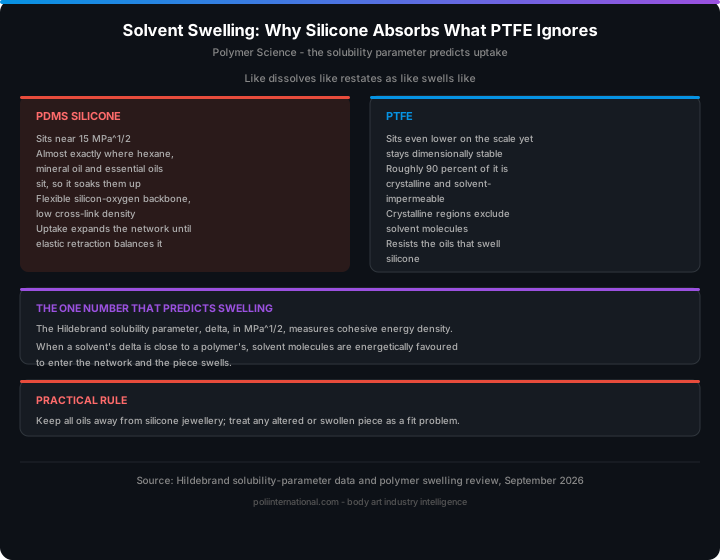
The Hildebrand solubility parameter, δ, expressed in MPa^1/2, measures cohesive energy density: how strongly a material's own molecules hold on to each other. The familiar rule like dissolves like restates as like swells like. When a solvent's δ is close to a polymer's, solvent molecules are energetically comfortable inside the matrix and migrate in.
A cross-linked elastomer cannot dissolve, so the network expands instead, until elastic retraction of the cross-links balances the osmotic pressure of the absorbed solvent. That is the Flory-Rehner balance, and it explains why cross-link density sets a ceiling on uptake. Published values make the pattern visible: water 47.8, ethanol 26.5, isopropanol 23.5, hexane 14.9, PDMS 14.9 to 15.5, PTFE 12.7. Treat anything within roughly 3 MPa^1/2 of a polymer's own value as a swelling agent.
Why silicone swells and PTFE mostly does not
PDMS has a flexible silicon-oxygen backbone, low cross-link density, and a large free volume fraction. Its δ of about 15 MPa^1/2 puts it in the same neighbourhood as aliphatic hydrocarbons, terpenes, silicone oils, and most plant-derived oils. Lee, Park and Whitesides characterised PDMS swelling across dozens of solvents and found the largest volume increases in alkanes, aromatics and chlorinated solvents, with minimal uptake in water, alcohols and dimethyl sulfoxide, exactly as the parameter match predicts [1].
PTFE breaks the naive reading of the same scale. Its δ of 12.7 should make it the worst offender on cohesion energy alone, yet it is the most solvent-resistant polymer in common use. Roughly 90% of it is crystalline, and crystallites are tightly packed, solvent-impermeable regions; only the amorphous fraction is accessible. The carbon-fluorine sheath also wraps the backbone in a tight helix that sterically shields the chain, which is why whole-Teflon microfluidic devices run organic chemistry in conditions that deform PDMS [2][3].
What uptake does to a piece of jewelry
Four consequences matter, in the order they appear.
Dimensional change. A swollen o-ring or tunnel is larger than the groove it was designed for. Retention drifts: threads bind or slip, balls seat differently, and a ring that fit a healed fistula on Monday can place new pressure on tissue by Friday.
Modulus drop. Absorbed solvent acts as a plasticiser, depressing glass transition temperature and lowering elastic modulus. Softening is not an improvement: a softer polymer creeps further under the same load.
Extractables. Once solvent opens the network, low-molecular-weight species diffuse out: cyclic siloxanes such as D4, D5 and D6, unreacted oligomers, catalyst residues and mobile additives. Flassbeck and colleagues measured siloxanes, silicon and platinum in tissue surrounding explanted silicone gel implants [4]. Extractables do not return when the solvent evaporates, so material after a soak is permanently different from material before it.
Loss of initial properties. Explanted silicone gel implant shells show measurable property loss and swelling-related failure pathways, a reminder that certified properties are initial properties [5].
Which exposures actually matter
| Exposure | δ (MPa^1/2) | Effect on silicone |
|---|---|---|
| Water, saline, dilute soap | Above 40 | Negligible |
| Isopropanol, ethanol | 26.5, 23.5 | Rapid but volatile uptake; wiping is fine, soaking is not |
| Acetone | 20.0 | Moderate uptake plus extraction |
| Tea tree, lavender, citrus oils | 14 to 17 | Severe swelling, softening, extraction |
| Mineral oil, silicone oil | 14 to 16 | Severe; storage contact is the usual route |
| Hexane, heptane | 14.9 | Maximum uptake of any common solvent |
Two rules follow. Solvent resistance is evaluated per polymer, not per product category: a PTFE retainer and a silicone tunnel in the same oil behave completely differently. And alcohol is a wipe agent, not a soak agent. Volatility limits damage in a rapid wipe; overnight submersion gives the network time to open and release its soluble fraction.
How to verify a compatibility claim
Ask for mass-uptake data rather than a marketing adjective. ISO 1817 and ASTM D471 define the test: weigh the dry specimen, immerse it in the relevant liquid for a defined time and temperature, blot, reweigh, and report percentage change alongside volume, hardness and tensile change. Medical device and packaging regulators apply the same logic, evaluating solution compatibility of polymers in contact with liquids and characterising extractables rather than assuming them away [6].
---
Frequently Asked Questions
Does alcohol damage silicone body jewelry?
It swells PDMS, because alcohols sit within about 9 MPa^1/2 of silicone on the scale, but they evaporate quickly, so a disinfection wipe causes temporary swelling that reverses. Prolonged soaking is different: the network opens and releases its soluble fraction, and repeated swelling and desorption cycles fatigue the material.
Can I use tea tree oil on silicone piercings?
No. Terpene-rich oils sit within 1 to 2 MPa^1/2 of PDMS, making them among the most aggressive swelling agents in a bathroom. They soften silicone, expand it, and accelerate siloxane extraction. Keep them away from silicone storage and use them, if at all, on titanium, niobium or steel.
Why does old silicone jewelry feel sticky or greasy?
Because it has absorbed something. Silicone takes up skin lipids, sebum, cosmetic oils and sunscreen over months of wear, and those species plasticise the surface and attract dust. Stickiness is the visible end of a swelling process that already changed the material's modulus. Mild soap removes surface residue; it does not reverse what has diffused into the network.
Is PTFE safe with essential oils and cleaning solvents?
PTFE resists nearly everything a household or studio will encounter, because crystallinity blocks solvent entry even though its δ is low. The limitation is mechanical rather than chemical: PTFE is soft and cold-flows under sustained load, which is how a chemically unbeaten PTFE retainer still deforms in a fistula.
References
1. Lee JN, Park C, Whitesides GM. Anal Chem, 2003; 75(23): 6544-6554. PMID 14640726. doi:10.1021/ac0346712
2. Puts GJ, Crouse P, Ameduri BM. Chem Rev, 2019; 119(3): 1763-1805. PMID 30689365. doi:10.1021/acs.chemrev.8b00458
3. Ren K, Dai W, Zhou J. Proc Natl Acad Sci USA, 2011; 108(20): 8162-8166. PMID 21536918. doi:10.1073/pnas.1100356108
4. Flassbeck D, Pfleiderer B, Klemens P. Anal Bioanal Chem, 2003; 375(3): 356-362. PMID 12589499. doi:10.1007/s00216-002-1694-z
5. Marotta JS, Goldberg EP, Habal MB. Ann Plast Surg, 2002; 49(3): 227-242. PMID 12351970. doi:10.1097/00000637-200209000-00001
6. Jenke D, Odufu A, Couch T. PDA J Pharm Sci Technol, 2012; 66(4): 286-306. PMID 22767879. doi:10.5731/pdajpst.2012.00869


