
Executive Summary. Ear stretching works because skin is a viscoelastic material, not an elastic band. When a larger plug is seated, the fistula wall does not simply stretch; it creeps under sustained load, sheds tension through stress relaxation, and remodels over days and weeks. The clinical physics explains why slow incremental stretching is safe, why sudden force tears tissue, and why the damage threshold is a measurable limit, not a feeling.
Skin Is a Viscoelastic Composite
Skin is a two-phase material. Collagen fibers give it tensile strength, elastin gives it recoil, and the hydrated ground substance between them behaves as a viscous fluid. Because of this structure, the mechanical response to load depends entirely on time and loading rate.
Stretch skin quickly and it responds like a stiff elastic solid: collagen fibers snap taut, stress rises fast, and failure comes at small deformation. Load the same tissue slowly and the viscous ground substance flows, fibers slide and reorient, and the tissue accommodates far more strain before breaking. Wilhelmi et al. (1998) reviewed this distinction in Annals of Plastic Surgery: creep and stretch are different mechanical phenomena with different clinical consequences. A taper shoved through in seconds recruits the elastic component and tears; a plug seated over days recruits the viscous component and grows the channel.
This is why the same earlobe can tolerate a 1 mm jump after eight weeks of healing and split at a 2 mm jump attempted on day three. The geometry of the jewelry is identical; the rate of loading is not.
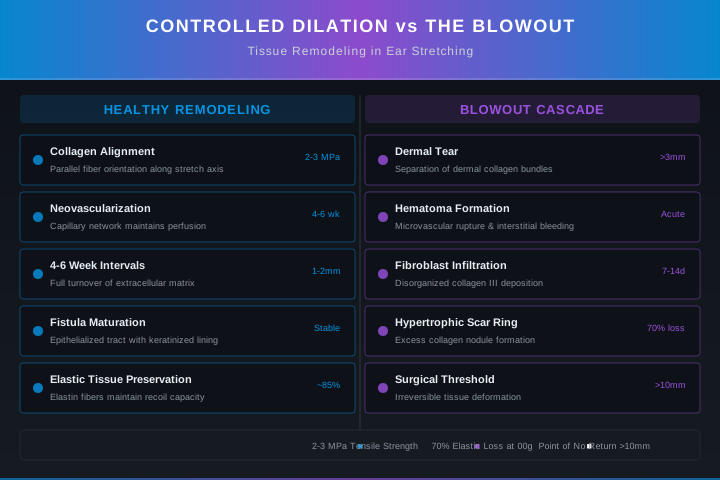
Creep: Deformation Under Constant Load
Creep is the progressive deformation of a material held under a constant load. In ear stretching, the plug is the load. Once seated, the plug exerts a steady radial force on the fistula wall, and the tissue slowly deforms around it.
Mechanical creep happens first, in minutes to hours: interstitial fluid shifts, collagen fibers straighten and align with the stress direction, and the wall becomes slightly thinner and larger in diameter. This is the initial "give" a fresh stretch feels. Biological creep follows over days and weeks: cells divide, fibroblasts lay down new collagen parallel to the stress lines, and the channel is actively rebuilt at the new diameter. Johnson et al. (1993) documented this histology in tissue expansion, showing that sustained tension triggers cellular proliferation and new collagen deposition, not just passive deformation.
The practical implication is direct: the waiting time between sizes is not a courtesy, it is the time constant of biological creep. Skip it and you are asking mechanical creep to do all the work, which is exactly when the wall thins and tears.
Stress Relaxation: Why Tension Fades
Stress relaxation is the mirror image of creep: the deformation is held constant and the force required to hold it decreases over time. A seated plug does not change size, yet the pressure it exerts on the fistula wall falls hour by hour. The viscous components flow, the collagen network reorients to a lower-energy configuration, and the wall stops fighting the jewelry.
Remache et al. (2018) measured cyclic tensile and stress-relaxation behavior in porcine skin and showed that repeated load-relaxation cycles progressively soften the tissue. Each stretch-and-hold cycle lowers the peak stress of the next cycle. This is the mechanical justification for the classic advice to massage a fresh stretch: gentle cyclic loading drives stress relaxation, which is why the ear feels less tight on day two than it did in the first hour, and why a new size always feels tighter than the same size did a week earlier.
The Damage Threshold: Yield, Ischemia, Blowout
Every tissue has a yield point, the stress beyond which deformation becomes permanent and structural. In skin, yield shows up as microtears in the collagen network, then as visible tearing of the fistula wall, then as the scar remodeling we call a blowout.
Two mechanisms do the damage. The first is mechanical: stress above the yield point breaks fibers outright. The second is ischemic: sustained high tension compresses the capillary bed, and the tissue runs out of oxygen. Marquardt et al. (2009) measured cutaneous tension against tissue oxygenation during acute external expansion and found that raising tension reliably lowered oxygen delivery. A wall that is stretched too hard or held too long is starved as well as strained, and hypoxic tissue heals as scar, not as healthy remodeled skin.
Scott et al. (2021) reviewed surgical repair of gauged earlobes and emphasized that the amount of intact tissue remaining after years of over-stretching determines whether repair is even possible. The damage is cumulative and partly irreversible; the surgeon can only work with the tissue that was not destroyed.
Comparative Table: Creep vs. Stretch vs. Damage
| Process | Load condition | Time scale | Tissue response | Stretching outcome |
|---|---|---|---|---|
| Elastic stretch | Rapid, high | Seconds | Collagen snaps taut, stress spikes | Tear, split, blowout |
| Mechanical creep | Constant load | Minutes to hours | Fluid shift, fiber alignment | Initial "give" after seating a size |
| Biological creep | Sustained load | Days to weeks | Cell division, new collagen, remodeling | Safe diameter increase |
| Stress relaxation | Constant strain | Hours to days | Viscous flow, force falls | Tension fades, ear stops aching |
| Yield and ischemia | Above threshold | Immediate to sustained | Fiber breakage, capillary compression | Thinning, scar, permanent damage |
Clinical Takeaways
1. Stretch by 0.5-1 mm at a time, never by a full gauge jump, because the elastic component fails at small strain when loaded fast.
2. Wait 4-8 weeks between sizes so biological creep can rebuild the wall at the new diameter; the wait time is a remodeling constant, not a preference.
3. Massage fresh stretches gently: cyclic loading accelerates stress relaxation and lowers the peak tension on the wall.
4. Treat persistent tightness, heat, or thinning as yield-point signals; they mean the load is above the remodeling capacity of the tissue.
5. Downsize if the wall thins or a blowout begins: hypoxic tissue heals as scar, and the damage is cumulative and partially irreversible.
6. Use implant-grade materials and proper surface finish, because a rough or reactive surface adds inflammation on top of mechanical stress.
The physics is unambiguous: slow load, sustained hold, and enough time for biological creep are the only safe way to enlarge a fistula. Every failed stretch, every blowout, and every thin wall is a case of exceeding the yield point and skipping the remodeling step.
You must wait a minimum of 8 weeks between sizes, because that is the time constant for biological creep—the period required for fibroblasts to lay down new collagen and for the channel to be actively rebuilt at the new diameter. Skipping this waiting period forces mechanical creep to handle the entire deformation, which is precisely when the fistula wall thins, microtears form, and a blowout occurs. A 1 mm jump is safe after eight weeks; the same 1 mm jump on day three recruits only the elastic collagen response and risks permanent structural damage. This sensation is the direct result of stress relaxation: when a plug is seated, the deformation is held constant, but the viscous ground substance in the skin flows and the collagen network reorients to a lower-energy configuration, so the force required to hold the plug decreases over hours. Remache et al. (2018) measured this in porcine skin, showing that repeated load-relaxation cycles progressively soften tissue and lower peak stress—which is why the ear feels less tight on day two than it did in the first hour after the stretch. Stretching engages the viscous component of the skin, allowing collagen fibers to slide and reorient while the hydrated ground substance flows, accommodating far more strain before failure; tearing recruits the elastic component, where collagen fibers snap taut and stress rises so fast that microtears occur at small deformation. Wilhelmi et al. (1998) in Annals of Plastic Surgery explicitly distinguished creep from stretch as mechanically different phenomena: a taper shoved through in seconds triggers elastic failure, while a plug seated over days drives viscous creep and cellular remodeling. Damage occurs when the stress in the fistula wall exceeds its yield point—the threshold beyond which deformation becomes permanent and structural—manifesting as microtears in the collagen matrix, ischemia from capillary compression, and eventual necrosis or blowout. The yield point is not a subjective feeling; it is a measurable limit tied to loading rate, where rapid force produces failure at small deformation, while slow loading allows the tissue to accommodate significantly more strain before reaching that same threshold. If the plug feels tight for more than 48 hours without progressive stress relaxation, the load has exceeded the tissue's remodeling capacity and is causing ischemic damage. Massaging applies gentle cyclic loading that drives stress relaxation: each load-release cycle lowers the peak stress of the next cycle, as documented by Remache et al. (2018) in cyclic tensile tests on porcine skin, which showed progressive tissue softening with repeated cycles. This cyclic compression also shifts interstitial fluid, straightens collagen fibers parallel to the stress direction, and promotes blood flow, preventing the ischemia that leads to blowout—which is why a massaged fresh stretch feels noticeably looser within a day compared to an unmassaged one.FAQ
How long should I wait between ear stretching sizes to avoid damaging my earlobe?
Why does a freshly stretched ear feel tight but then loosen up after a day?
What is the difference between stretching and tearing in ear tissue at the physics level?
At what point does an ear stretch cause ischemia or a blowout?
How does massaging a stretched ear actually work mechanically?


