Wired vs Wireless: What Building 50,000 FK Irons Cables Taught Me About Tattoo Power
Key Takeaways:
» I designed FK Irons' Ergo grips and engineered roughly 50,000 of their power cables, a two-material ABS core overmoulded in electronics-grade TPE, so this verdict comes from the manufacturing bench, not a marketing deck.
» A genuinely better cable still lost the market, because the industry chose wireless pens, and a platform shift beats a product improvement almost every time.
» Wireless won on convenience, ergonomics, and hygiene, no cord dragging across a fresh stencil, and for most artists that trade is the right one today.
» Cables are not dead. Artists who refuse to depend on a battery mid-session still have a legitimate reason to run wired, and reliability is on their side.
» When you buy power gear in 2026, buy for how you actually work, not for the trend. The right tool is the one that disappears while you tattoo.
1. Who Is Behind This Desk
This is the first entry in Gear Watch, our beat for the tools you actually hold: machines, power, grips, cartridges, inks, jewelry, and the sterilisation gear around them. Before I review anyone else's product, you should know why my verdicts are worth your time.
For several years I was an OEM supplier to FK Irons. I designed their Ergo grips, the contoured tubes that a lot of artists held for entire careers without ever wondering who shaped them. I also engineered and manufactured their power cables, and I made a great many of them, on the order of 50,000 units. That is not a number you reach by getting lucky once. It is a number you reach by building something that comes back order after order because it simply works.
So when I talk about tattoo power, cords, connectors, and the move to wireless, I am not theorising. I have run the tooling, signed off the materials, and watched a product I was proud of get quietly overtaken by a change in how the whole industry chose to work.
2. The Cable Nobody Noticed, Because It Just Worked
The cables I built for FK Irons were a two-material design. The core was rigid ABS, which gives you a stiff spine for strain relief and holds the connector geometry exactly where it needs to sit. Over that core I overmoulded an electronics-grade TPE jacket, the soft, slightly grippy outer layer that gives a cable its flex life and its feel in the hand.
That combination is the whole point. The ABS handles the structural job at the connector, where most cables die first. The TPE handles the thousands of bends, drapes, and twists of daily studio use without cracking or going stiff. We ran versions with a DC barrel connector around 4.0 by 1.7 mm and versions terminated in gold-plated RCA ends, where the plating buys you a clean, low-resistance contact that does not corrode and start introducing noise into the machine.
None of this was exotic. It was just done correctly, with the right materials in the right places. A cable you never think about, that never crackles, never drops power mid-line, and never frays at the plug, is a cable doing its job. That is the highest compliment a piece of gear can earn, and it is also the reason nobody talks about cables. Invisible reliability does not trend.
3. Wired vs Wireless: The Honest Comparison
Here is the trade-off laid out without spin.
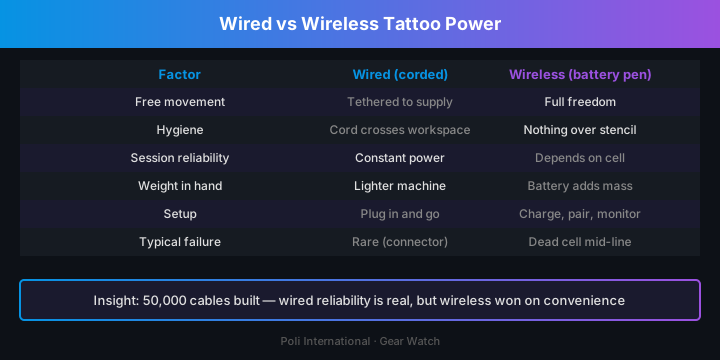
| Factor | Wired (corded machine) | Wireless (battery pen) |
|---|---|---|
| Free movement | Tethered to the supply | Full freedom around the client |
| Hygiene | Cord crosses the workspace | Nothing to drape over a fresh stencil |
| Session reliability | Constant power, no charge anxiety | Depends on the cell, needs a spare |
| Weight in hand | Lighter machine | Battery adds mass to the grip |
| Setup | Plug in and go | Charge, pair, monitor the level |
| Typical failure | Rare, usually the connector | A dead cell mid-line |
Read that table honestly and you can see why the market moved. For most artists, most of the time, the freedom and the clean workspace of a wireless pen outweigh the small risk of a battery running low. That is a real advantage, not a gimmick, and I will say so plainly even though it is the trend that ended my cable business.
4. Patrick's Deep Archive: A Better Product Can Still Lose
I dealt directly with FK Irons when it was still run by people, not by a portfolio. Gaston owned it, Zeke handled purchasing, and the relationship was a good one. Good time, good experience, until money talk. When the company was sold into the Body Art Alliance, the OEM relationships like mine were among the casualties, and that was that. I have written before about what that kind of consolidation does to the supply chain, and I lived the small version of it firsthand.
But the harder lesson is not about who bought whom. It is about the cables themselves. They honestly improved on what was on the market before. The build was better, the contacts were better, the flex life was better. And it did not matter, because the industry was going wireless, and that platform shift probably killed cable sales more than anything we ever could have done to the cable itself.
I suspect cables are still needed by some artists, the ones who do not want to depend on batteries, who want to plug in and know that the power is simply there for the whole session. For them, wired is still the correct call, and the reliability argument is entirely on their side. But on the long run, wireless won.
That is the real takeaway from running this desk: a better product can still lose to a trend. I have skin on both sides of this debate, I built the better wired cable and I watched wireless take the market anyway, so when I tell you to buy for how you actually work rather than for what is fashionable, understand that I learned it the expensive way.
5. FAQ: Technical Q&A
Q: Are wired tattoo machines obsolete in 2026?
No. They are a minority choice now, but a sound one for artists who want guaranteed, uninterrupted power and a lighter machine in the hand. Obsolete and out of fashion are not the same thing.
Q: Why were the FK Irons cables considered so good?
A two-material construction: a rigid ABS core for strain relief and connector seating, overmoulded with an electronics-grade TPE jacket for flex life and feel. The gold-plated RCA versions added a clean, corrosion-resistant, low-resistance contact. Right materials, right places.
Q: Should a new artist buy a wireless pen or a corded setup?
Buy for how you work. If you move around the client a lot and value a clear workspace, wireless is worth it. If long sessions and zero charge anxiety matter more to you, a corded machine and a quality cable will never let you down.
Q: What actually kills a power cable?
Almost always the connector and the strain-relief point, not the middle of the cable. That is exactly why a stiff ABS core at the plug and a flexible jacket along the run outlasts a single-material cable.
Conclusion: Buy for How You Work
Wireless won the tattoo market, and on the whole it deserved to. But it won as a platform, not because every wired cable was bad, some were the best gear in the room and still got left behind. That is the lens this desk will bring to every product we cover: not what is trending, but what genuinely serves the hand holding it. Follow Gear Watch in the Engineering Journal for honest buy, wait, or skip verdicts from someone who has actually built the gear. If your wired rig starts cutting out, our power-supply troubleshooter walks the fault tree from connector to contact, and our wiki on body-art ergonomics covers the grip and hand-fatigue trade-offs I learned designing the Ergo grips.