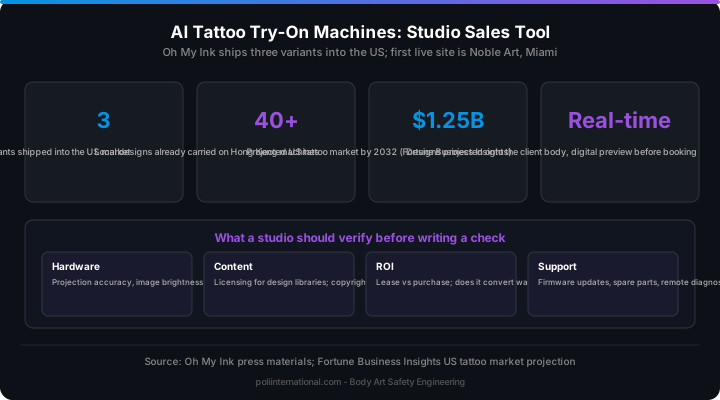
A tattoo studio in Miami just installed a machine that projects tattoo designs onto a client's body in real time, letting them walk away with a digital preview or printed snapshot before booking an artist. The hardware comes from Oh My Ink, a Hong Kong startup now shipping three variants of its AI Tattoo Try-On Machine into the US, with Noble Art in Miami as the first live site. Studios are being pitched a new category of floor equipment: an AR kiosk that sits between the front counter and the flash rack, promising to convert walk-in curiosity into deposits. The engineering and hygiene details matter more than the slide deck, so here is what a studio should verify before cutting a check.
1. The hardware, broken down
Oh My Ink sells three floor-standing units. The Try-On TV is the compact model: 130 cm tall, 57 cm wide, 10 cm deep, 18 kg. It outputs only digital photos, needs one meter of clearance, a stable connection (WiFi at 25 Mbps or better, or Ethernet), and draws 50 W. The company positions it as a "social-first" conversion tool: no prints, just a shareable image.
The Try-On Photobooth steps up the footprint: 211.5 cm tall, 59 cm wide, 65 cm deep, 95 kg, adding instant print output to the digital file. Power and network requirements stay the same.
The third variant is a Temporary Tattoos Vending machine, not a try-on terminal: 211 cm tall, 67 cm wide, 56 cm deep, 80 kg. It dispenses pre-packaged temporary tattoo sets tied to the studio's designs, with a claimed 240% return on investment.
All three machines load a studio's own artist designs rather than generic flash. The try-on units use an AR overlay that maps a selected design onto a live camera feed, showing a before/after visualization. The site calls it "AI Powered," but the tracking method—marker-based, skeletal tracking, or depth-sensing—is not disclosed in the public specs. That omission matters.
2. The market pitch and the numbers
Oh My Ink frames the US deployment as its third market, after Hong Kong and France. The press release cites a Fortune Business Insights projection pegging the US tattoo market at $1.25 billion by 2032. Hong Kong machines already carry designs from over 40 local artists, and the startup won Sun Hung Kai's SunEvision Startup Program 2026.
The machine is sold as a studio sales tool, not a consumer app. Studios pay for the hardware (pricing isn't public) and load their own content. The try-on step becomes a lead capture event—client sees a design on their arm, books time, and the design stays attributed to the artist who created it. The vending machine adds passive income from temporary tattoo sales.
I'm skeptical of the 240% ROI figure because the company doesn't publish unit cost, average transaction size, or the return timeline. Without a transparent cost basis, a percentage return is just a number on a brochure. The real test is whether a studio recoups the hardware investment through higher walk-in conversion, and how long that takes at typical foot traffic volumes.
3. How it changes the shop floor
A try-on kiosk shifts the consultation sequence. Instead of flipping a binder or scrolling an iPad, a walk-in client stands in front of a screen, picks a design, and sees it rendered on their own arm, leg, or torso. The theory is sound: closing the gap between a flat image and a body-applied piece should produce a more confident client and fewer placement regrets. Founder John Ip puts it directly: "A tattoo is one of the few purchases a person cannot return, so the decision carries real weight."
From a workflow standpoint, the machine absorbs exploratory browse time that would otherwise fall on counter staff or an artist. If the AR preview is accurate, the artist receives a client already committed to a design and placement, cutting stencil repositioning and rethink cycles.
Hygiene is the open question. No spec sheet mentions antimicrobial surfaces, cleanable touchscreens, or a disinfection protocol. Any reusable client-facing surface needs a documented cleaning step; a shared walk-in touchscreen is no exception, especially when clients may lean against the screen. Poli International's standards would flag high-touch equipment without a defined sanitization procedure and a smooth, non-porous surface spec.
Design ownership is handled cleanly: the machine carries only the host studio's artist portfolios. No external marketplace, no dilution of artist attribution, which keeps the economics aligned with the studio and the artist.
4. What a studio should verify before writing a check
A studio evaluating these machines needs to test four things on the floor.
First, try-on fidelity under real shop conditions. AR overlays on a 2D camera feed often struggle with body curvature, skin tone variation, and off-axis movement. Ask for a demo with designs that wrap, extend across joints, or sit on darker skin. If the preview distorts or floats, the tool creates more uncertainty than a paper tracing.
Second, network reliability. Both try-on units require 25 Mbps internet, which implies rendering depends on cloud processing, not local compute. If the WiFi drops mid-interaction, the experience stalls. A studio with spotty connectivity should budget for a dedicated Ethernet drop and confirm the device fails gracefully.
Third, attribution integrity. Verify the content management system locks designs to the artist who uploaded them and logs when a preview leads to a booking. The machine's value as a conversion tool hinges on tracking that lead.
Fourth, footprint and flow. The Photobooth weighs 95 kg and needs a meter of clearance. In a small studio, that space might displace seating or a consultation area. Measure actual foot traffic before committing to a unit that cannot be easily relocated.
5. FAQ: Technical Q&A
Q: Does the AI overlay accurately map designs to my body contours?
It depends on lighting, camera quality, and the tracking method Oh My Ink uses, which isn't disclosed. AR overlays have improved, but body tracking across skin tones and curved surfaces remains a hard problem. Test it in person with a design that crosses a joint before assuming the preview matches the stencil.
Q: Can a studio use only its own artists' designs, or does the machine pull from an external library?
The machine is designed to load the host studio's own artist portfolios exclusively. Oh My Ink does not operate a shared flash marketplace on these units, so attribution stays within the shop.
Q: What does the hygiene protocol look like for a shared try-on kiosk?
The public spec sheets do not list cleanable surface materials, IP ratings, or a disinfection procedure. Any studio installing a kiosk clients touch repeatedly needs a documented cleaning interval, an EPA-registered disinfectant compatible with the screen, and a surface finish that won't degrade. Until Oh My Ink publishes a sanitation guide, the studio takes on that liability.
6. References
1. USA Today (syndicated via ABNewswire). "Oh My Ink Expands AI Tattoo Try-On Machines to the US, Its Third Market." July 25, 2026. usatoday.com
2. Oh My Ink official site. ohmyink.com
3. Fortune Business Insights US tattoo market projection ($1.25 billion by 2032), as cited in Oh My Ink press materials.
4. The Standard (Hong Kong). "Twenty startups vie for top 10 HKTDC's Start-up Express 2026 spots." May 28, 2026.