Shop
Gear Watch

Critical Torque Wireless Tattoo Machine: Buy, Wait, or Skip for a Working Studio?

PP

Chief Engineer

Patrick Poli

Journal Date

2026-08-17

Last Reviewed

2026-10-10

A new wireless pen with real power—but not a magic wand

Key Takeaways:
» The Critical Torque is a high-output wireless pen built around a custom German brushless motor and Precision Strike Technology, targeting fast, smooth, low‑vibration tattooing.
» Its Critical Connect V3 battery claims up to ~15 hours runtime with a large colour LED display, Bluetooth 5.0, and integration with Critical’s wireless footswitch ecosystem.
» The machine ships in both 3.5 mm and 4.2 mm strokes, positioning it as a generalist tool that can cover lining, packing, and most shading workflows.
» Weight, forward balance and vibration damping make it competitive with other premium wireless pens, but it does not radically outperform FK Irons Flux or Bishop Power Wand in real-world terms.
» Verdict: Buy now for mid‑to‑large studios who are already invested in Critical wireless power; wait or skip if your current premium wireless pen is doing the job and your budget is tight.

---
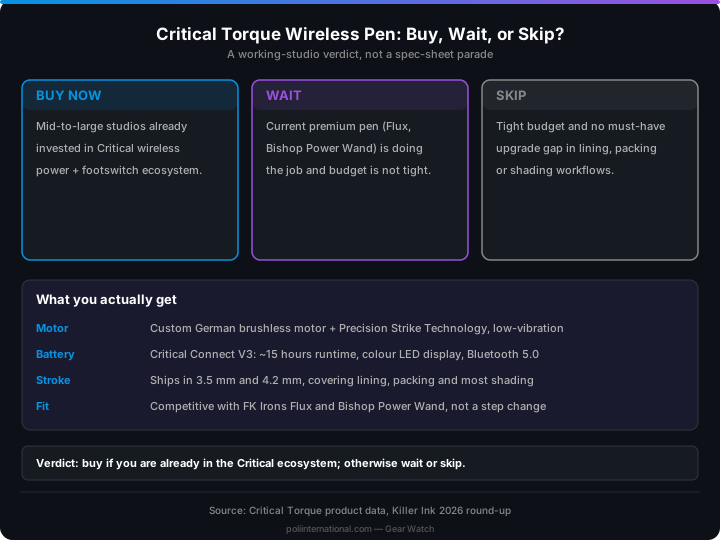
Critical Torque wireless tattoo pen buy wait or skip verdict
Infographic: Critical Torque wireless tattoo pen buy wait or skip verdict

1. Background: What the Torque is trying to be

Critical built its reputation on power supplies and wireless batteries, not machines. The Torque is their first serious attempt at a full wireless tattoo pen that stands next to FK Irons Flux/Flux Max and Bishop Power Wand rather than just powering them via battery packs. Killer Ink’s recent 2026 round‑up calls the Critical Torque “an all‑purpose tattoo pen with a battery that rivals any Critical has made before”, explicitly positioning it as a flagship, not a side project.

The core claim is simple: pair a custom German brushless motor with what Critical knows best—wireless power—and you get a machine that hits fast, smooth, and reliably, with fewer cables and less vibration. Marketing phrases like Precision Strike Technology and Vibration Dampening Solution hide a familiar reality: this is a mid‑to‑high‑torque brushless rotary tuned to keep speed under load and reduce hand fatigue over long sessions. The Torque’s appeal is less about novelty and more about consolidating Critical’s ecosystem into a single tool.

Design‑wise, the Torque follows the current “premium wireless pen” template:
- Integrated battery on the back.
- Swappable grip.
- Simple on‑device controls, plus Bluetooth for those who want to pair footswitches or manage settings wirelessly.

If you already use Critical Connect batteries on other pens, the Torque is clearly aimed at you—same ecosystem, same battery philosophy, now with a matching machine.

---

2. Specs, thresholds, and how it stacks up

On paper, the Critical Torque sits in the same lane as FK Irons Flux Max and Bishop Power Wand: wireless, premium, strong brushless motor, long battery life, ergonomic pen form. Here’s a simplified comparison of what matters at the bench.

FeatureCritical TorqueFK Irons Flux MaxBishop Power Wand (with Critical Shorty)
Weight (approx.)In the typical 6–7 oz wireless pen range; balanced with batterySimilar wireless pen weight, strongly forward‑weighted~4.4 oz with Shorty battery, one of the lightest
Stroke options3.5 mm or 4.2 mm3.2 / 4.0 / 4.5 mmMultiple variants (Packer, Liner, Shader) with tuned strokes
Motor typeCustom German brushless, “Precision Strike” tuningHigh‑end brushless, tuned for wireless useProprietary brushless, Bishop’s usual hit signature
Battery systemCritical Connect V3, 1.5" colour LED display, Bluetooth 5.0, ~15 h runtimePowerBolt battery, ~10+ h runtime, app accessCritical Shorty / standard batteries via Critical ecosystem
Wireless ecosystemNative compatibility with Critical Connect Footswitch + docksDarklab app, PowerBolt ecosystemHybrid: Bishop machine + Critical wireless power
Use caseAll‑rounder: lines, colour packing, most shadingAll‑rounder, more granular stroke choicesMore specialised per Wand variant; ultra‑lightweight ergonomics

Critical’s headline runtime—“a whopping 15 hours”—sounds impressive, but in practice runtime depends on voltage, needle configuration, and the artist’s hand. For studios already getting 8–10 solid hours from existing wireless pens, the extra margin is nice but not transformative; you are not suddenly tattooing a three‑day convention on a single charge.

The stroke choices (3.5 and 4.2 mm) place the Torque firmly in the generalist camp:
- 3.5 mm: good compromise for black and grey, softer colour, and controlled lining.
- 4.2 mm: clearly aimed at bold lines and strong colour packing, with enough throw to push big groupings consistently.

Compared with the Flux Max’s 4.5 mm option or Bishop’s more specialised Wand variants, Critical has chosen the middle ground rather than extremes—less custom tailoring, more “cover most jobs with one machine”.

---

3. Technical deep dive: what you actually feel on skin

Let’s translate the spec sheet into what matters in a working day.

Motor and hit. A brushless motor with “Precision Strike Technology” is essentially a motor control and drive profile designed to keep speed and torque stable when you load the machine with large groupings or thicker skin. In practice, that means:
- Less bogging down when you switch from a 9 round liner to a 15 mag.
- More consistent puncture depth at the same hand speed, especially in colour packing.
- Smoother response if you like to ride the machine at a slightly lower voltage and let torque do the work.

If you are coming from a mid‑tier rotary or an older wireless pen with a weaker motor, the Torque will feel noticeably more decisive in the hand—less hunting for the right voltage, fewer instances where you “lean” on the needle and the machine complains.

Vibration and fatigue. Critical’s talk of “Vibration Dampening Solution” is not magic, but they have clearly tried to:
- Align mass and balance so that the battery doesn’t turn the back end into a pendulum.
- Isolate motor vibration from the grip where your fingers sit.

For long colour sessions on larger pieces, that matters. The Torque will not turn a shaky hand into a surgeon, but it is less tiring than budget wireless pens that buzz through your knuckles all day. If your studio does all‑day sessions and cover‑ups, this is where the Torque earns part of its price.

Battery system details. The Critical Connect V3 battery is arguably the star of the show:
- Colour LED display makes voltage, battery status, and session info readable without squinting.
- Bluetooth 5.0 links into Critical’s wireless footswitch ecosystem and future updates.
- Claimed ~15 hours runtime gives you comfortable headroom for a full convention day or multiple back‑to‑back appointments.

The important point: you are buying into Critical’s wireless ecosystem, not just a machine. If you already own Critical Universal Batteries, docks, or footswitches, the Torque sits neatly on that rail. If you don’t, the real cost is machine + batteries + maybe a dock and footswitch, and that adds up quickly.

Stroke and technique boundaries. At 3.5 and 4.2 mm, there are a few practical thresholds:

- Fine single‑needle or ultra‑soft whip shading: The Torque can do it, but a shorter, ultra‑soft stroke machine will feel gentler and give more margin for error on thin or sensitive skin.
- Heavy blackwork and solid colour walls: The 4.2 mm Torque handles this well—enough travel to seat pigment robustly without cranking voltage into silly ranges.
- Delicate script and micro‑detail: The 3.5 mm stroke is sufficient, but this is where hand control and cartridge choice matter more than stroke number; the Torque won’t magically fix sloppy technique.

This is a versatile workhorse, not a hyper‑specialised shader or liner. For most studios, that’s a plus; for high‑specialisation artists, it may feel like the “middle” rather than a perfect fit.

---

4. Patrick’s Note: The counter‑intuitive wireless upgrade

The counter‑intuitive thing about wireless pens like the Torque is how little they change the tattoo itself and how much they change the day around it. You don’t buy this machine for a new kind of line; you buy it to stop tripping over cables, to spend less time wrapping power bricks, and to make your station genuinely easier to keep clean and organised.

My honest take: for studios already running FK Irons Flux, Flux Max, or Bishop Power Wand with Critical batteries, the Torque feels less like “the next big thing” and more like Critical finally offering a coherent machine to match the ecosystem they’ve been building around everyone else’s gear. That’s not a criticism; it’s reality. The motor is strong, the battery is excellent, the ergonomics are competitive—but if your existing premium wireless pen is behaving and your staff are comfortable, the jump to Torque is a quality‑of‑life tweak, not a revolution.

Where I do see a strong case is mid‑to‑large studios who have quietly standardised on Critical power supplies, docks, and batteries. For those shops, the Torque is the missing piece: one vendor, one wireless ecosystem, predictable runtime and behaviour across every station. That reduces “which battery goes with which pen” confusion, simplifies ordering, and keeps your tech drawer less chaotic. As always, though, don’t let ecosystem seduce you away from basic due diligence—test one or two units hard before you roll out a full fleet.

---

5. FAQ: Technical Q&A

Q: Is the Critical Torque strong enough to push large mags for heavy colour packing?
Yes. The custom German brushless motor and the 4.2 mm stroke option are tuned specifically so the machine keeps its speed and depth under load when you run larger magnum cartridges. You will still need sensible voltage and cartridge selection, but the Torque’s drive is in the same league as other premium wireless pens used for solid colour work.

Q: How real is the claimed 15‑hour battery life on a working day?
The headline figure assumes moderate voltage and a typical workload; if you run high voltage and big groupings continuously, expect closer to 8–12 solid hours. Even with that realistic range, the Connect V3 battery gives more headroom than many older wireless systems and removes the anxiety of swapping batteries mid‑session.

Q: Does it make sense for a small studio to buy Torque as their first wireless machine?
If you have the budget and plan to grow, starting with Torque is reasonable because you’re also adopting Critical’s broader wireless ecosystem. For a single‑artist shop with tight funds and no existing Critical gear, a slightly cheaper wireless pen from FK Irons or Bishop may deliver similar tattooing performance without locking you into a new ecosystem upfront.

---

Conclusion: Where the Torque actually belongs in a studio

The Critical Torque wireless tattoo machine is a solid, high‑end workhorse that finally lets Critical sell not just the power but the stroke. It delivers strong, stable performance with a serious brushless motor, ergonomic pen form, and a battery system that genuinely reduces cable clutter and setup friction. Day‑to‑day, what you feel is not a new kind of tattoo but an easier, cleaner station and fewer small annoyances around power management.

Verdict: Buy now if you’re a mid‑to‑large studio already leaning on Critical batteries and power supplies, or if you’re building a wireless ecosystem around a single, reliable vendor. Wait or skip if you already own a functioning premium wireless pen like Flux or Power Wand and your priority is raw tattoo performance rather than station ergonomics; in that case, Torque is an incremental upgrade, not a necessity. As with any machine, get one in hand, push it through a full convention‑style day, and let the bench—not the spec sheet—make the final call.

Mind map · Critical Torque Wireless Tattoo Machine: Buy, Wait, or Skip for a Working Studio?

  • Critical Torque Tattoo Machine
    • Machine Specifications

      The Critical Torque features a custom German brushless motor and offers stroke options of 3.5 mm and 4.2 mm.

      • Custom German Brushless Motor
      • Critical Connect V3 Battery
        • Fifteen Hours Max Runtime
      • Stroke Length Options
        • Three Point Five Millimeters
        • Four Point Two Millimeters
    • Market Competitors

      The Critical Torque competes directly with the FK Irons Flux Max and Bishop Power Wand in real-world performance.

      • FK Irons Flux Max
      • Bishop Power Wand
        • Magnetic Connecting Batteries
    • Ergonomic Performance

      The Critical Torque includes a vibration dampening solution designed to isolate motor vibrations from the grip to reduce hand fatigue.

      • Vibration Dampening Solution
      • Wireless Setup Operation
    • Studio Purchase Decisions

      Studios already invested in Critical wireless batteries should buy the Torque, while artists on tight budgets should wait or skip.

      • Critical Ecosystem Investment
      • Tight Budget Restrictions
        • Wait Or Skip Option
    • Machine Maintenance

      Tattoo artists report that the Critical Torque cannot be easily disassembled for cleaning and the batteries are prone to durability issues.

      • Closed Cam System Design
      • Battery Reliability Concerns
StructureProcessMaterialHazard

5 branches, 0 sources. Each branch cites the article it came from; the labels beneath it are names, not claims.

Tattoo Quiz

  1. 1. What engine design feature enables the Critical Torque to maintain consistent speed and torque under heavy loads?

    • ✓ Custom German brushless motor with Precision Strike tuning — A brushless motor paired with Precision Strike drive profiling stabilizes speed and depth when driving large needle groupings into skin.
    • • High-torque coreless motor with direct-drive mechanical give — Coreless motors are featured in many traditional rotaries, but the Torque specifically utilizes a custom German brushless motor.
    • • Swappable pneumatic motor with Vibration Dampening Solution — While the machine includes vibration dampening features, its drive system is purely electric brushless rather than pneumatic.
    • • Dual-bearing brush motor with digital voltage compensation — Brushed motors represent older technology, whereas the Torque relies on a modern brushless design tuned for wireless power.
  2. 2. How does the weight and balance profile of the Critical Torque compare to a Bishop Power Wand fitted with a Critical Shorty battery?

    • • The Torque is lighter overall and specifically designed for delicate script work. — The Torque sits in the standard 6–7 oz wireless pen weight class rather than an ultra-light niche.
    • ✓ The Torque sits in a typical 6–7 oz balanced pen range, whereas the Bishop setup is ultra-lightweight at approximately 4.4 oz. — The Torque maintains standard wireless pen mass with balanced weighting, while the Bishop setup with a Shorty battery achieves a notably lower mass of around 4.4 oz.
    • • Both machine setups weigh 4.4 oz, but the Torque concentrates its mass heavily at the grip. — The 4.4 oz figure applies specifically to the Bishop Power Wand paired with the Shorty battery, not the Torque.
    • • The Torque weighs over 10 oz due to its large display battery, making it the heaviest pen in its class. — Despite its battery size, the Torque remains within the standard 6–7 oz range typical of modern wireless pens.
  3. 3. While the Critical Connect V3 battery claims up to 15 hours of runtime, what is the realistic battery life under heavy operational load?

    • • 3 to 5 hours — Even under high workload, energy consumption does not deplete the pack in under 5 hours.
    • ✓ 8 to 12 hours — Continuous high voltage and large needle configurations increase power draw, bringing practical runtime to roughly 8 to 12 hours.
    • • 15 hours consistently — Headline battery ratings assume moderate voltage and average workloads rather than continuous heavy output.
    • • 18 to 20 hours — Heavy load conditions decrease battery runtime below the 15-hour baseline rather than extending it.
  4. 4. Which tattooing task is best suited for the 4.2 mm stroke variant of the Critical Torque?

    • • Ultra-soft whip shading on thin skin — Soft whip shading on delicate skin benefits from shorter, gentler stroke lengths to avoid unintended skin trauma.
    • • Micro-detail line work with single needles — Fine detail work relies heavily on hand control and subtle needle depth rather than a long, aggressive stroke.
    • ✓ Bold lining and strong colour packing — A 4.2 mm stroke provides longer travel and hit force, making it ideal for driving large groupings and packing dense pigment.
    • • Low-voltage black and grey wash layers — Smooth black and grey washes generally favor shorter strokes, such as 3.5 mm, for smoother gradient control.
  5. 5. Why might a tattoo artist prefer a shorter-stroke machine over the Critical Torque when executing delicate single-needle or soft whip shading work?

    • • The Torque cannot accept standard single-needle cartridge configurations. — The Torque accepts standard cartridge groupings, including single needles.
    • ✓ Shorter stroke machines hit more gently, offering a wider margin for error on delicate skin. — A shorter, gentler stroke reduces impact force, providing better control and safety when applying delicate shading on thin tissue.
    • • The Torque's Bluetooth connection creates operational lag during detailed shading. — Bluetooth connectivity handles device settings and switch links without affecting motor timing or hit response.
    • • Brushless motors stall when operated at low voltages required for light shading. — Modern brushless motors maintain stable torque even when tuned down to lower operating voltages.
  6. 6. According to the source material, under which studio scenario is purchasing the Critical Torque most strongly recommended?

    • • A solo artist working with limited funds who owns no Critical equipment — Solo artists without existing Critical hardware face high upfront costs to buy into the brand's proprietary battery and dock ecosystem.
    • • A specialized studio focused exclusively on soft whip shading micro-realism — Shops requiring hyper-specialized soft shaders may find generalist stroke options less tailored to their niche needs.
    • ✓ Mid-to-large studios already standardized on Critical wireless power supplies and batteries — Studios already utilizing Critical wireless infrastructure benefit from seamless battery, dock, and switch cross-compatibility across all stations.
    • • Studios currently operating fully functional FK Irons Flux units seeking a major performance revolution — Shops with working premium wireless pens will see incremental quality-of-life improvements rather than a dramatic performance overhaul.
  7. 7. Which combination of features is built directly into the Torque's Critical Connect V3 battery pack?

    • ✓ A 1.5-inch colour LED display, Bluetooth 5.0, and wireless footswitch integration — The Connect V3 battery incorporates a large digital color display alongside Bluetooth 5.0 connectivity for footswitch syncing.
    • • Darklab app integration, Wi-Fi 6 connectivity, and an analogue dial control — Darklab app integration belongs to competing ecosystems like FK Irons, not Critical.
    • • A monochrome LCD screen with hardwired pedal bypass ports — The V3 pack uses a color LED display and is designed around wireless footswitch integration.
    • • Internal cooling fans and dual-voltage power cord pass-through ports — Wireless tattoo battery packs use passive heat dissipation and standard wireless dock charging.
  8. 8. How do the stroke options offered by the Critical Torque compare to those available on the FK Irons Flux Max?

    • • The Torque provides 3.2 mm, 4.0 mm, and 4.5 mm options, whereas the Flux Max offers 3.5 mm and 4.2 mm. — This reverses the stroke specifications of the two machines.
    • ✓ The Torque offers 3.5 mm and 4.2 mm options, taking a generalist middle ground compared to the Flux Max's 3.2 mm, 4.0 mm, and 4.5 mm range. — Critical selected two standard stroke lengths to cover core workflows, while the Flux Max offers three options reaching broader stroke extremes.
    • • Both machines feature identical stroke options of 3.5 mm, 4.0 mm, and 4.5 mm. — The Torque does not offer a 4.5 mm stroke model.
    • • The Torque features an adjustable stroke dial, whereas the Flux Max relies on fixed stroke models. — The Torque is sold in distinct fixed stroke variants rather than featuring an adjustable stroke mechanism.
  9. 9. According to 'Patrick's Note,' what is the primary day-to-day benefit of adopting a wireless pen system like the Torque?

    • • It fundamentally alters line crispness and eliminates skin trauma. — Wireless power eliminates cables but does not fundamentally alter basic line mechanics or skin interaction.
    • ✓ It removes cable clutter, simplifies station wrapping, and streamlines station hygiene. — The real advantage lies in workflow ergonomics—reducing setup friction, eliminating cord snag, and making stations easier to sanitize.
    • • It automatically adjusts needle hang depth based on real-time skin resistance. — Needle hang depth is controlled manually via grip rotation, not automated electronic adjustment.
    • • It doubles tattooing speed, allowing artists to complete sessions in half the time. — Working speed remains constrained by artist technique and skin acceptance rather than wireless operation.
  10. 10. How does the weight distribution of the Critical Torque compare to that of the FK Irons Flux Max?

    • • The Torque is top-heavy at the battery end, whereas the Flux Max is perfectly centered. — The Torque is engineered specifically to prevent the battery from creating a top-heavy pendulum effect.
    • ✓ The Torque balances its mass across the body and battery, whereas the Flux Max is strongly forward-weighted. — Critical engineered the Torque for even weight distribution to reduce hand fatigue, while the Flux Max biases mass forward toward the grip.
    • • The Flux Max places mass in the back end, while the Torque biases all weight into the machine grip. — The Flux Max features a forward weight bias, whereas the Torque aims for centered balance.
    • • Both machines feature identical balance profiles produced by the same frame manufacturer. — The two machines exhibit distinct balance profiles in hand feel.

Extended Reference Table

8 of 8 rows

Extended reference table generated from the article and its verified research sources. Bracketed numbers jump to the matching entry in the Technical References below.

SafetyItem or Standard Name Category Critical Specifications Safety or Compliance Requirement Application and Use Case Source
✅ISO 5349-1Hand-Arm Vibration StandardExposure Action Value (EAV) of 2.5 m/s² A(8) ; Exposure Limit Value (ELV) of 5.0 m/s² A(8)Triggers risk management obligations (EAV) or engineering controls (ELV) to prevent HAVSMeasurement and evaluation of human exposure to hand-transmitted vibration from tools like tattoo machines
✅EU Directive 2002/44/ECOccupational Health RegulationEstablishes EAV and ELV for physical agents (vibration)Requires risk assessment and health surveillance for workers exposed above the EAVLegally binding for employed tattoo artists and piercers within EU studios
✅ISO/EU Occupational Health StandardsSafety Standard-Regulates vibration limits and ergonomic safety for hand-held toolsPreventing hand-arm vibration syndrome in professional settingsInferred
✅California Proposition 65Regulatory StandardChemical exposure notification thresholds (including DEHP)Warning requirement for chemicals known to cause cancer or reproductive toxinsConsumer safety disclosure for products sold in California
✅Cal/OSHA CCR 5110Regulatory Standard (USA)Repetitive Motion Injuries RegulationMandates identifying and correcting Musculoskeletal Disorder (MSD) hazardsEnforceable for California-based studios with employees to implement ergonomics programs
✅Critical TorqueWireless Tattoo MachineCustom German brushless motor with Hall sensors; 3.5mm, 4.2mm, or 5.0mm stroke options; Precision Strike TechnologyVibration Dampening Solution; California Proposition 65 (DEHP warning); Requires 60-100 hours break-in periodProfessional tattooing; single-pass power for efficient lining, color packing, and shading
✅Critical Connect V3 BatteryPower Supply2000mAh capacity; 1.5 inch color display; Bluetooth 5.0; Weight: 2.1 - 2.2 oz (60 - 63 g)Jumpstart mode; Must be fully charged before first use; Avoid sanitizing screen directlyWireless power for tattoo machines; features timer and hourly rate tracking[9]
✅Critical Torque LiteTattoo Machine3.8mm stroke; direct drive pen; brushed fall harbor motor; lighter/shorter than standard TorqueVibration dampening system designed to reduce hand fatigueVersatile machine for fine line work, color blending, and realism[9]

Free Body Art Wall Posters

Print-ready reference posters for your studio or your own wall. Free to download and display, embed on your own site with attribution. Click any poster to preview it full size before downloading.

Choose and download all 40 posters

Technical_References_Archive

About the Author

PP

Patrick Poli

Chief Engineer, Poli International · Creator of BioFlex® body jewelry

Patrick has spent 25+ years manufacturing body jewellery and studio equipment, and is the creator of BioFlex® body jewelry. He developed sterilised disposable grips and over-grips, including a dual-material version built around how a machine actually sits in the hand. He also built bi-material RCA and machine cables, overmoulded so the connector stops being the part that fails first.

More about Patrick →

Last reviewed: 2026-10-10 · Published: 2026-08-17

Related Tools & Reading

Continue Reading