Shop
Gear Watch

Asia's Wireless Tattoo Machine Race Is Rewriting the Price Ladder

PP

Chief Engineer

Patrick Poli

Journal Date

2026-09-21

Last Reviewed

2026-10-07

The wireless tattoo machine market is moving faster in Asia than anywhere else. While Western brands iterate on established direct-drive platforms, Korean and Chinese manufacturers are shipping smart motor controllers, adaptive power delivery, and ultra-fast charging systems that reset what artists expect from a cordless pen.

The Technology

Modern wireless pens are no longer battery-powered rotary motors with a switch. The Mast Racer PRO runs an evolved MCORE Pro motor rated at 40% more penetration force than the previous generation, and its dual smart modes split the problem in two: HZ Mode adapts stroke force to hand speed across a 3Hz to 140Hz range for controlled line work, while DCV Mode holds raw power at low voltage for dense packing [2]. The 1520mAh cell charges for five minutes to deliver an hour of runtime, fully recharges in forty minutes on its dock, and supports up to five hours of continuous work [2]. Mast also moved the battery into the grip to drop the center of gravity, which matters more than any spec sheet admits once you are four hours into a session.

Dragonhawk's range shows how wide the segment has become. The Mast Archer Ultra is a wireless smart pen with a 4.5mm stroke at $599, aimed at artists who want a heavier platform for large-scale work [3]. The Mast Fold 2 Pro covers the opposite end with two grips and an adjustable stroke spanning 2.4mm to 4.2mm, letting one machine handle fine line and packing at $169 [3]. Adjustable-frequency models such as the Mast Hertz sit at $145, and the entry tier starts around $69 [3]. In practice, Asian manufacturers are running an entire price ladder from disposable-adjacent to flagship, and each rung is technically credible.
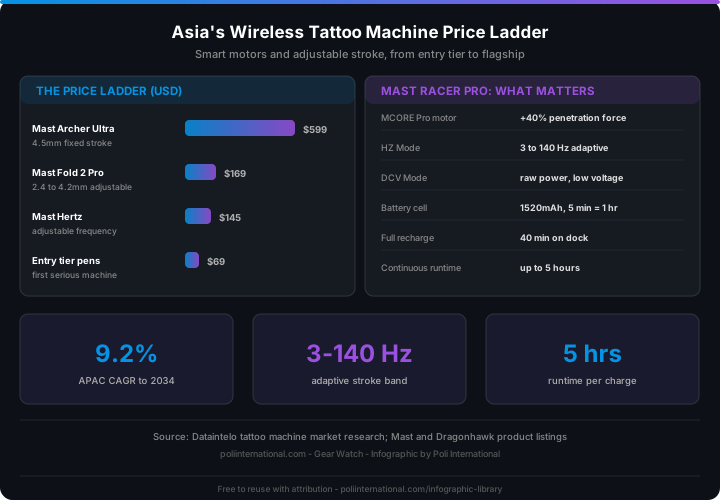
Asia wireless tattoo machine price ladder with Mast Racer PRO specs
Infographic: Asia wireless tattoo machine price ladder with Mast Racer PRO specs

Regional Breakdown

Asia. Korea, China, and Japan drive the pace. Chinese brands Mast and Dragonhawk now ship smart motor hardware and adjustable-stroke platforms that would have been flagship features two years ago, and they do it at every price point. Korea's permanent makeup and fine-line export market pushes demand for sub-3mm stroke precision, while Japanese rotary engineering keeps setting the benchmark for tolerances. The innovation is real, not marketing copy.

Europe. Regulation is the design driver. REACH restrictions on ink chemistry and tightening EU medical device rules push manufacturers toward documented material certification, sealed cartridge systems, and equipment that can prove batch traceability. German engineering from Cheyenne and MT.DERM still anchors the premium end with build quality rather than headline features [3].

USA. FK Irons, Bishop, and Cheyenne's US distribution hold the high-end artist market, with direct-drive systems and strong brand support. The weakness is price and iteration speed: a €600 to €700 premium machine competes against a $169 adjustable-stroke pen that does most of the same job [3].

Market/Economic Angle

Dataintelo's tattoo machine market research puts Asia Pacific as the fastest-growing region, projected to expand at roughly 9.2% compound annual growth through 2034, ahead of the other major regions [1]. That growth is not evenly distributed. It concentrates in markets where studio counts are climbing and where artists are buying their first serious machine, which is precisely the price band Asian manufacturers dominate.

The result is a squeeze on the mid-tier. A US artist comparing a $600 direct-drive flagship against a $169 adjustable-stroke pen with two grips has to justify the gap on drive engineering and long-term support, not on features. RightStuff's comparison makes the counterargument for premium machines directly: stroke consistency under load, mechanical feedback, and session endurance are what separate machines when you put a 25-magnum grouping against saturated skin [3]. That is a defensible case, but it is now the premium brands' whole case.

Studio/Practice Implications

From an infection-control standpoint, wireless is a genuine improvement, not a convenience. Removing the cord removes a snag point that crosses the sterile field, and eliminating the power supply from the tray simplifies surface decontamination between clients. Magnetic battery docks let an artist swap cells without touching the machine mid-session, which keeps the workflow clean.

Battery management is the part most artists underweight. Lithium-ion cells degrade, and fast charging trades cycle life for speed unless the charger is designed around it. Look for overcharge protection, temperature monitoring, and a dock that throttles current as the cell fills. Warranty terms are a useful proxy for how confident the manufacturer is: Mast covers the Racer PRO for one year, and Dragonhawk's coverage varies by model [2][3].

What to Look For

Five things decide whether a wireless pen will still be good in eighteen months.

1. Stroke consistency under load. Ask what happens with a 25-magnum grouping on saturated skin. Load-adaptive drive systems and smart motor controllers are the indicators to look for [3].
2. Battery architecture. Runtime per charge is the headline; cycle life is the real number. A fast-charging dock that manages current is worth more than a slightly larger cell [2].
3. Ergonomics. Battery position drives balance. Grips with the cell in the hand beat rear-weighted designs over a full day.
4. Adjustability. On-the-fly stroke length or frequency control lets one machine cover line work and packing without a second purchase [3].
5. Certification and warranty. CE marking, FCC compliance, and at least a one-year warranty are the minimum proof that the manufacturer stands behind the device's safety.

5. FAQ

Q: Are wireless tattoo machines suitable for all styles? Yes, provided the stroke is matched to the work. Adjustable-stroke machines such as the Mast Fold 2 Pro cover fine line through packing in one unit, while fixed-stroke pens are better suited to artists who specialize. Heavy magnum work still rewards a drive system with proven load consistency.

Q: How does battery life compare between wireless machines?
It varies widely. The Mast Racer PRO delivers up to five hours of runtime per charge with a forty-minute full recharge, while premium options such as the RightStuff REVO use dual 2,600mAh batteries for up to twelve hours. Compare both runtime and cycle life, not just the headline figure.

Q: What maintenance do wireless machines need?
Clean the grip and battery contacts regularly, keep the device out of extreme heat, and follow the manufacturer's charging guidance. Partial charge cycles are easier on lithium-ion cells than deep discharges, and storing the machine near 50% charge is the safer option during long idle periods.

6. References

1. Dataintelo. Tattoo Machine Market Research Report. Market analysis, 2026. 2. Justat Tattoo Supplies. Mast Racer PRO Wireless Tattoo Pen Machine with 4.2mm Stroke. Product listing, accessed September 2026. 3. DragonHawk Tattoo Supply. Tattoo Pen Machines product range, and RightStuff. Best Wireless Tattoo Machine 2026: Professional Artist Comparison. Accessed September 2026.

Mind map · Asia's Wireless Tattoo Machine Race Is Rewriting the Price Ladder

  • Asia's Wireless Tattoo Machine Market
    • Smart Motor Technology

      Mast Racer PRO pens use smart MCORE Pro motors with dual operating modes. [Asias Wireless Tattoo Machine Race Is Rewriting the Price Ladder]

      • Mast Racer PRO
        • Dual HZ and DCV Modes
      • Ergonomic Grip Balance
        • Low Center of Gravity
    • Diverse Price Ladder

      Asian manufacturers produce tattoo machines across a wide price ladder. [Asias Wireless Tattoo Machine Race Is Rewriting the Price Ladder]

      • Mast Archer Ultra
        • Flagship Large Work Pen
      • Mast Fold 2 Pro
        • Adjustable Stroke System
    • Regional Market Dynamics

      Asia Pacific leads market expansion while European makers adapt to regulations. [Asias Wireless Tattoo Machine Race Is Rewriting the Price Ladder]

      • Asia Pacific Growth
        • Fastest Regional Expansion Rate
      • European Regulation Drivers
        • REACH Material Certification
    • Studio Hygiene and Maintenance

      Wireless tattoo pens eliminate cords to streamline station decontamination. [Asias Wireless Tattoo Machine Race Is Rewriting the Price Ladder]

      • Sterile Field Protection
        • Cordless Surface Decontamination
      • Battery Cell Degradation
        • Overcharge Protection Need
StructureProcessMaterialHazard

4 branches, 0 sources. Each branch cites the article it came from; the labels beneath it are names, not claims.

Tattoo Machines Quiz

  1. 1. How does HZ Mode on the Mast Racer PRO differ from DCV Mode during operation?

    • ✓ HZ Mode adapts stroke force to hand speed for line work, whereas DCV Mode maintains raw power at low voltage for dense packing. — HZ Mode modulates stroke force across 3Hz to 140Hz in response to hand motion speed, while DCV Mode maintains steady power output at low voltage settings for solid color packing.
    • • HZ Mode locks voltage at maximum output for line work, while DCV Mode lowers stroke length based on movement speed. — DCV Mode does not dynamically alter stroke length, and HZ Mode does not lock voltage at maximum levels.
    • • HZ Mode reduces current to protect sensitive skin, while DCV Mode automatically swaps stroke length between 2.4mm and 4.2mm. — Neither mode automatically alters physical stroke length, which requires mechanical adjustment on applicable platforms.
    • • HZ Mode operates strictly under 3Hz for soft shading, whereas DCV Mode ranges up to 140Hz for heavy magnum work. — HZ Mode spans from 3Hz up to 140Hz rather than remaining below 3Hz, while DCV Mode focuses on power delivery at lower voltages.
  2. 2. What ergonomic design change was made in the Mast Racer PRO to improve balance during long tattoo sessions?

    • ✓ The battery cell was relocated into the grip to lower the center of gravity. — Placing the power cell inside the hand grip lowers the center of gravity, easing hand fatigue over multi-hour sessions.
    • • The motor housing was shortened and counterweighted at the top end. — The manufacturer achieved lower center-of-gravity balance by shifting battery position into the grip rather than counterweighting the motor top.
    • • Dual 2,600mAh batteries were positioned at opposite ends of the chassis. — Dual 2,600mAh cells belong to a different machine model described in the source material.
    • • The drive system was converted from rotary to direct-drive to lighten the pen tail. — The platform remains a rotary pen with a smart motor rather than converting to direct-drive.
  3. 3. What feature enables the Mast Fold 2 Pro to handle both fine-line tattooing and ink packing in a single unit?

    • ✓ An adjustable stroke ranging from 2.4mm to 4.2mm along with two interchangeable grips. — Providing an adjustable stroke span between 2.4mm and 4.2mm along with two grip sizes allows artists to configure the same pen for delicate lining or heavy packing.
    • • A dual smart motor controller that automatically senses needle resistance in the skin. — Smart load sensing refers to motor controller technology rather than the mechanical stroke adjustability of the Fold 2 Pro.
    • • A fixed 4.5mm stroke paired with variable frequency controls from 3Hz to 140Hz. — A fixed 4.5mm stroke is featured on the Mast Archer Ultra, not the Fold 2 Pro.
    • • Dual 2,600mAh battery cells that adjust voltage output based on needle grouping size. — Dual 2,600mAh cells are employed by the RightStuff REVO rather than the Mast Fold 2 Pro.
  4. 4. According to the source material, what is the main driver behind wireless tattoo machine design and engineering in Europe?

    • ✓ Strict REACH ink restrictions and EU medical device rules requiring material certification and batch traceability. — European manufacturers focus heavily on material certification, sealed cartridges, and batch traceability to comply with stringent EU medical device rules and REACH chemical limits.
    • • Rapid expansion of high-volume studios purchasing entry-level wireless equipment. — High studio expansion drives market volume in the Asia Pacific region rather than European engineering design choices.
    • • High market demand for fine-line permanent makeup requiring sub-3mm stroke precision. — Permanent makeup precision and sub-3mm stroke demands are primary drivers in the Korean export market.
    • • Direct competition with disposable-adjacent wireless pens from Asian manufacturers. — Competitively pricing platforms against budget entry-level pens reflects Asian market dynamics rather than European regulatory priorities.
  5. 5. According to Dataintelo research cited in the text, what is the projected compound annual growth rate for the Asia Pacific tattoo machine market through 2034?

    • ✓ Roughly 9.2% — Dataintelo market research projects the Asia Pacific tattoo machine market to grow at approximately 9.2% compound annual growth through 2034.
    • • Approximately 12.5% — This figure exceeds the 9.2% growth rate cited in the market analysis data.
    • • Exactly 5.0% — A 5.0% expansion rate understates the projected growth figure provided for the Asia Pacific region.
    • • Nearly 15.0% — This percentage is higher than the projected compound annual growth rate reported in the research.
  6. 6. What key technical argument do premium brands make to justify the higher cost of traditional flagship machines over budget smart pens?

    • ✓ Premium machines maintain stroke consistency under load, mechanical feedback, and session endurance when running large magnum groupings. — Mechanical feedback, stroke consistency under heavy load, and session endurance when pushing large needle groupings against saturated skin are highlighted as the primary defense for high-end platforms.
    • • Direct-drive flagships offer faster battery recharge times and larger internal milliamp-hour cell capacities. — Fast charging and specialized cell placement are primary selling points of Asian smart wireless pens rather than traditional direct-drive flagships.
    • • High-end models feature multi-mode digital displays that adjust motor frequency to match artist hand speed automatically. — Digital speed-adapting smart motor features characterize Asian wireless smart pens rather than traditional direct-drive flagships.
    • • Premium manufacturers provide lifetime cell replacements and open-source smart motor controllers. — Open-source motor controllers and lifetime cell replacements are not cited as advantages provided by high-end manufacturers.
  7. 7. From an infection-control perspective, how does switching to a wireless pen with a magnetic battery dock improve studio hygiene?

    • ✓ It eliminates a cord crossing the sterile field and allows cell swaps without touching the machine body mid-session. — Eliminating power cords prevents sterile field cross-contamination, while magnetic docking stations permit mid-session cell swaps without handling the main body of the pen.
    • • It permits the entire motor assembly and lithium-ion cell to undergo autoclave sterilization. — Lithium-ion cells and electronic motor components cannot survive the extreme heat and pressure of autoclave sterilization.
    • • It automatically sanitizes the grip surface using built-in UV-C LEDs during active tattooing. — Wireless tattoo pens rely on standard decontamination procedures rather than integrated UV-C sterilization lights.
    • • It replaces disposable plastic barrier sleeves by providing non-porous antimicrobial battery coatings. — Plastic barrier sleeves remain necessary, as magnetic docks simplify cell exchanges rather than providing self-sanitizing coatings.
  8. 8. According to the text's guidance on battery management, what is the recommended practice for storing wireless tattoo machine batteries during extended idle periods?

    • ✓ Storing the cell near a 50% charge state. — Storing lithium-ion cells near a 50% charge state minimizes chemical stress and capacity loss during prolonged periods of inactivity.
    • • Completely discharging the cell to 0% before storage. — Deep discharges to 0% accelerate stress and degradation on lithium-ion cell chemistry.
    • • Keeping the machine constantly docked at 100% trickle charge. — Leaving lithium batteries at full capacity on active chargers trades long-term cycle life for convenience.
    • • Storing the battery inside a freezer environment. — Freezing lithium-ion cells can cause structural and chemical damage to internal battery components.
  9. 9. Which specific regional market demand has pushed Korean tattoo equipment manufacturers toward developing sub-3mm stroke precision platforms?

    • ✓ The permanent makeup and fine-line export market. — Korea's strong permanent makeup and fine-line export segment creates specific demand for sub-3mm stroke precision.
    • • The demand for large-scale heavy magnum packing pens. — Heavy packing and large magnum work typically demand longer stroke lengths rather than sub-3mm stroke precision.
    • • EU medical device certification regulations. — European medical device regulations concentrate on material certification and batch tracking rather than sub-3mm stroke preferences.
    • • Direct sales of direct-drive machines to North American studios. — High-end direct-drive platforms in North America emphasize load endurance rather than short sub-3mm stroke fine-line work.
  10. 10. How does the RightStuff REVO achieve its extended session endurance of up to twelve hours of continuous runtime?

    • ✓ It utilizes dual 2,600mAh batteries. — The RightStuff REVO achieves up to twelve hours of continuous runtime by employing a dual 2,600mAh battery configuration.
    • • It incorporates a 1520mAh cell paired with an ultra-fast five-minute dock charge system. — A 1520mAh battery with five-minute quick charging specifies the Mast Racer PRO power system.
    • • It relies on an MCORE Pro motor that throttles current during low hand-speed intervals. — Smart motor throttling based on hand speed is a feature of the Mast Racer PRO rather than the REVO extended battery design.
    • • It draws wireless power from an inductive tray power supply. — The REVO achieves its extended runtime through dual high-capacity physical batteries rather than inductive tray power.

Extended Reference Table

8 of 8 rows

Extended reference table generated from the article and its verified research sources. Bracketed numbers jump to the matching entry in the Technical References below.

SafetyItem, Material, or Practice Classification or Specification Technical Standard or Regulation Key Properties or Requirements Clinical or Safety Application Source
✅Tattoo NeedlesCritical Item (Contact with blood/bodily fluids)OSHA Bloodborne Pathogens Standard (29 CFR 1910.1030)Single-use, pre-sterilized, or sterilized via autoclave; surgical-grade stainless steel; standardized industry gauges (e.g., #12 / 0.35mm diameter).Prevents transmission of pathogens like Hepatitis B, Hepatitis C, and HIV; configuration determines skin resistance and pigment delivery.
✅Safety MembraneFluid-tight barrier / Backflow preventerO. Reg 136/18: Personal Service SettingsSilicone or physical barrier capable of preventing ink and biological fluid backflow into the machine motor.Prevents cross-contamination between clients and protects machine longevity; verified via integrity tests (e.g., 50 plunger cycles).
✅Tattoo Cartridge PackagingIndividually sealed blister packsEO (Ethylene Oxide) Gas SterilizationMust feature a sterilization indicator and a valid expiry date; single-use only.Ensures the device is sterile and safe for clinical use on a client; supports batch traceability.
✅Autoclave SterilizersCritical Item SterilizationAS 4031; AS/NZS 4261Steam sterilization at 121°C ( 250°F ) at 15 psi for 30 minutes; requires ultrasonic pre-cleaning and biological indicator (spore) testing.Completely eliminates all microbial life including bacteria, viruses, and resistant spores from reusable tools.
✅Sharps ContainersMedical Waste Disposal UnitAS 4031; AS/NZS 4261; Biohazardous waste regulationsPuncture-resistant, biohazard labeled, secure lid; red or yellow identification; immediate disposal after use.Prevents accidental needle-stick injuries and biological hazards in the professional studio environment.
✅Wireless Tattoo MachinesRotary pen-style machine (e.g., Flux Max, Mast Racer PRO, Ambition MARS-U)OSHA Bloodborne Pathogens Standard; CE marking; FCC complianceLithium-ion battery powered; adjustable stroke (2.4mm - 4.5mm); aviation-grade CNC aluminum; voltage range 4V-12V.Eliminates cords to remove snag points and cross-contamination risks; enables freedom of movement during procedures.
✅Thermal Transfer Paper4-ply Spirit Master PaperISO 9706; ASTM D-4236Heat-sensitive violet carbon dye; non-toxic and skin-safe; includes master sheet, protective tissue, carbon layer, and backing.Transferring digital design blueprint to skin; must be cosmetic-grade to prevent dermal irritation.
✅Tattoo Stencil PrintersThermal stencil printer (e.g., INKSOUL T08FS, T106 Ultra-HD)ASTM International203 DPI or higher resolution; Bluetooth/USB connectivity; inkless direct thermal heating.Eliminates manual tracing to reduce human error; reduces cross-contamination risk via wireless operation and digital workflow.

Free Body Art Wall Posters

Print-ready reference posters for your studio or your own wall. Free to download and display, embed on your own site with attribution. Click any poster to preview it full size before downloading.

Choose and download all 40 posters

Technical_References_Archive

About the Author

PP

Patrick Poli

Chief Engineer, Poli International · Creator of BioFlex® body jewelry

Patrick has spent 25+ years manufacturing body jewellery and studio equipment, and is the creator of BioFlex® body jewelry. He built bi-material RCA and machine cables, overmoulded so the connector stops being the part that fails first. He also developed sterilised disposable grips and over-grips, including a dual-material version built around how a machine actually sits in the hand.

More about Patrick →

Last reviewed: 2026-10-07 · Published: 2026-09-21

Related Tools & Reading

Continue Reading